

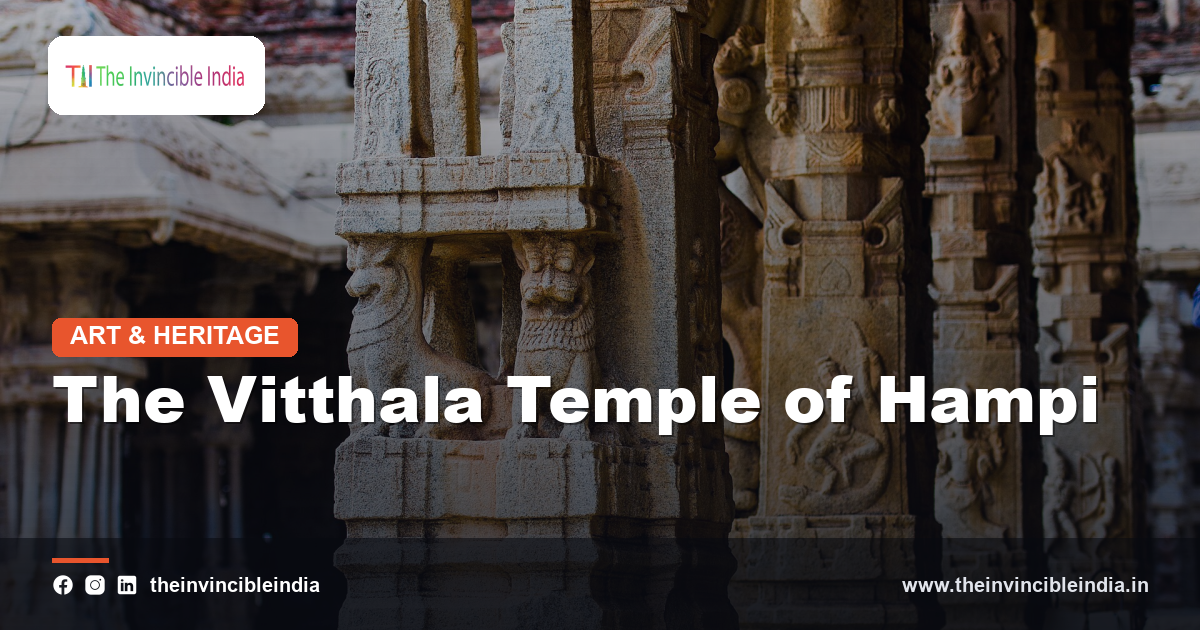
The Vitthala Temple stands among the most celebrated monuments within the ruined city of Hampi, once the thriving capital of the Vijayanagara Empire in present-day Karnataka. Dedicated to Vitthala, a form of Vishnu, the temple complex is renowned for its ornately carved stone chariot and its rows of slender pillars said to produce musical tones when struck. Built in the distinctive idiom that drew on and extended Dravidian temple architecture, the Vitthala Temple represents the artistic and engineering ambitions of one of medieval India’s most powerful southern kingdoms. Though no longer an active place of worship, it remains one of Hampi’s most visited and photographed monuments.
Quick Facts
| Detail | Information |
|---|---|
| Location | Hampi, Karnataka |
| Deity | Vitthala (a form of Vishnu) |
| Built during | Vijayanagara Empire |
| Notable feature | Stone chariot and musical pillars |
| Architectural style | Vijayanagara (Dravidian-influenced) |
| Recognition | Part of the Group of Monuments at Hampi, UNESCO World Heritage Site |
A Landmark Within Hampi's Sacred Precinct
The Vitthala Temple occupies a site near the banks of the Tungabhadra river, within the sprawling ruins of Hampi that once formed the heart of the Vijayanagara Empire’s capital. The temple lies at the eastern edge of the city’s sacred core, connected historically to a network of shrines, bazaars, and ceremonial pathways that defined the religious life of the capital.
Its riverside setting, framed by boulder-strewn hills characteristic of the region, gives the temple a striking visual context distinct from many other South Indian shrines. This dramatic natural backdrop, combined with the temple’s own architectural richness, has made it one of the defining images associated with Hampi’s ruined splendor.
The Vijayanagara Empire's Legacy
The Vijayanagara Empire rose to prominence as one of the major powers of the southern Indian peninsula, and its capital at Hampi grew into a vast, wealthy city known for its temples, markets, and fortifications. Rulers of the empire were prolific patrons of religious architecture, commissioning grand temple complexes as expressions of piety and political authority.
The Vitthala Temple is regarded as one of the most accomplished products of this patronage, reflecting the empire’s resources and artistic ambition at a mature stage of its architectural development. Its construction illustrates how deeply temple building was woven into the empire’s civic and religious identity.
Dedication to Vitthala
The temple is dedicated to Vitthala, a regional form of Vishnu whose worship is particularly associated with devotional traditions of the Deccan and western India. The deity is typically depicted standing with hands resting on the hips, an iconographic form distinct from many other representations of Vishnu found elsewhere in India.
The presence of a major Vitthala shrine at the Vijayanagara capital points to the empire’s broad religious patronage, which encompassed multiple Vaishnava traditions alongside Shaiva and other forms of worship. This inclusiveness in temple patronage is a notable feature of the empire’s religious landscape.
Origins and Construction
The temple’s construction is generally attributed to the patronage of Vijayanagara rulers and their court officials, with the complex expanded and embellished over successive phases rather than completed in a single building campaign. This incremental growth is typical of major South Indian temples, which often absorbed contributions from multiple generations of patrons.
The result is a complex of considerable scale, incorporating a main shrine, subsidiary shrines, pillared halls, and ceremonial structures, each reflecting slightly different moments in the temple’s ongoing development. This layered construction history contributes to the richness of the site as it survives today.
The Stone Chariot
The temple’s most iconic structure is its stone chariot, a shrine carved and constructed in the form of a ceremonial temple chariot, complete with representations of wheels and yoked animals. Rather than an actual functioning vehicle, the chariot is a stationary shrine designed to evoke the ratha, or festival chariot, used in temple processions.
Positioned within the temple’s outer courtyard, the stone chariot has become one of the most recognizable single monuments in India, its intricate detailing and unusual form drawing admiration from visitors and scholars alike. It stands as a striking example of architects translating a ritual object into permanent monumental stone form.
Engineering the Chariot's Wheels
The stone chariot’s carved wheels were originally designed to appear capable of rotation, a detail that reflects the sophistication of the sculptors who created them. Such attention to mechanical illusion within a static stone monument demonstrates the technical skill and playful ingenuity that Vijayanagara artisans brought to religious architecture.
Today the wheels are fixed in place as a conservation measure, but their design continues to convey the original intent of animating the monument with the appearance of motion. This feature remains a particular point of fascination for visitors studying the temple’s craftsmanship.
The Musical Pillars
Among the temple’s most celebrated features are its clusters of slender stone pillars, popularly known as musical pillars, which are said to produce distinct tonal sounds when tapped. These pillars are carved so finely that each is reported to resonate with a different note, a phenomenon attributed to the precise proportions and density of the stone used.
The musical pillars are concentrated in the temple’s main hall, where rows of these columns create an especially dense and elaborate architectural composition. This acoustic feature, combined with the pillars’ intricate carving, exemplifies the inventive spirit of Vijayanagara temple builders.
The Ranga Mandapa
The temple’s principal hall, known as the Ranga Mandapa, served as a space for ceremonial gatherings, musical performances, and religious rites associated with the temple’s festivals. Its ceiling and pillars are densely carved with figures and decorative motifs, reflecting the hall’s importance as a focal point of temple activity.
The mandapa’s open, pillared design allowed large numbers of worshippers to gather during festival occasions, underscoring the temple’s role not only as a shrine but as a venue for communal religious and cultural life within the Vijayanagara capital.
Vijayanagara Architectural Style
The Vitthala Temple exemplifies the mature Vijayanagara architectural style, which built upon earlier Dravidian traditions while introducing distinctive innovations in pillar design, hall composition, and sculptural ornamentation. This style is marked by heavily embellished pillared mandapas and a preference for dense, dramatic sculptural programs.
Vijayanagara architects drew on regional precedents while also developing their own visual vocabulary, producing structures that are recognizably part of the broader South Indian temple tradition yet distinct in their particular emphasis on complex pillar carving and monumental gateway towers.
Sculptural Ornamentation
The temple’s surfaces are extensively carved with depictions of deities, mythical creatures, dancers, and musicians, reflecting the wide-ranging sculptural ambitions of its builders. These carvings cover pillars, ceilings, and the outer walls of the various structures within the complex.
The density and variety of this ornamentation reflect the resources and skilled artisan communities available to Vijayanagara patrons, who invested heavily in decorative sculpture as an expression of devotion and prestige. The result is a temple whose every surface rewards close and repeated observation.
Gateways and Subsidiary Shrines
The temple complex is entered through gateway towers, or gopurams, that mark its outer boundary and lead visitors into a series of courtyards containing subsidiary shrines dedicated to associated deities. These smaller shrines, while less prominent than the main sanctum, contribute to the overall scale and completeness of the complex.
The arrangement of gateways and courtyards reflects the layered spatial planning typical of major South Indian temples, in which movement toward the sacred core is structured through a sequence of thresholds, each marked by its own architectural elaboration.
Decline After the Fall of Vijayanagara
The temple’s active religious life came to an end following the decline of the Vijayanagara Empire, when the capital at Hampi was sacked and largely abandoned after a major military defeat. The city’s temples, including the Vitthala Temple, ceased to function as centers of regular worship in the aftermath of this upheaval.
This abrupt decline left the temple and its surrounding structures largely intact as ruins rather than being repurposed or rebuilt, preserving much of their original form even as the surrounding city fell into disuse over the following centuries.
Rediscovery and Archaeological Study
Hampi and its monuments, including the Vitthala Temple, attracted renewed scholarly attention during the colonial period, when officials and researchers began systematically documenting the site’s ruins. This period saw efforts to record inscriptions, sketch monuments, and assess the historical significance of the abandoned capital.
Subsequent archaeological work has continued to deepen understanding of the temple’s construction phases and its place within the broader urban plan of Vijayanagara, contributing to Hampi’s recognition as one of India’s most significant historical sites.
UNESCO World Heritage Recognition
The Vitthala Temple forms part of the Group of Monuments at Hampi, which has been designated a UNESCO World Heritage Site in recognition of the exceptional historical and architectural value of the ruined capital. This designation covers the temple alongside numerous other structures across the wider archaeological zone.
World Heritage status has helped focus conservation resources and international attention on Hampi’s monuments, supporting continued efforts to protect the site from environmental degradation and the pressures of tourism while preserving its historical authenticity.
Conservation Challenges
Preserving the Vitthala Temple presents ongoing challenges, as its exposed stone structures remain subject to weathering, vegetation growth, and the wear caused by large numbers of visitors. Conservation authorities have implemented measures such as restricting direct contact with the stone chariot’s wheels to prevent further erosion.
Balancing public access with long-term preservation remains a central concern for those responsible for maintaining the site, given the temple’s importance both as a heritage monument and as one of Hampi’s most popular attractions for visitors from across the world.
Visiting the Temple Today
Visitors to the Vitthala Temple typically approach through the surrounding archaeological zone, passing bazaar ruins and smaller shrines before reaching the temple’s gateway. Once inside, the stone chariot and musical pillar halls form the primary focus of most visits, alongside the temple’s carved gateway towers.
The experience of exploring the complex, set against Hampi’s dramatic boulder-strewn landscape, offers a vivid sense of the scale and artistry once invested in the Vijayanagara capital, making the temple one of the most rewarding stops within the wider archaeological site.
The Temple's Place in Hampi's Bazaar Street
Leading up to the Vitthala Temple’s eastern gateway once ran a long ceremonial avenue lined with the ruined remains of a bazaar street, where merchants are understood to have traded goods brought from across the Vijayanagara Empire and beyond. This street formed part of the wider ceremonial approach that pilgrims and dignitaries would have followed toward the temple.
The scale of this avenue, flanked on either side by rows of stone pavilion structures, indicates that the temple’s precinct was conceived as more than a purely religious space, functioning also as a hub of commercial and civic activity tied directly to the rhythms of temple worship and festival life. Today the ruined pavilions of this avenue remain a striking complement to the temple itself, helping visitors visualize the vibrant public life that once surrounded the shrine during the height of Vijayanagara’s prosperity.
Vitthala Temple Today
The Vitthala Temple endures as one of the finest surviving expressions of Vijayanagara temple architecture, its stone chariot and musical pillars continuing to captivate visitors long after the empire that built it has passed into history. Though silent of the rituals it once hosted, the temple remains a vivid record of its builders’ artistry.
As part of the UNESCO-listed Group of Monuments at Hampi, the Vitthala Temple continues to be studied, conserved, and admired, standing as a lasting testament to the architectural ambition of one of medieval India’s greatest empires.
Sources & Further Reading
- Archaeological Survey of India (asi.nic.in).
- Ministry of Culture, Government of India (indiaculture.gov.in).
Frequently Asked Questions
Where is the Vitthala Temple located?
The Vitthala Temple is located within the ruins of Hampi in the southern Indian state of Karnataka.
Who is the temple dedicated to?
The temple is dedicated to Vitthala, a regional form of the Hindu god Vishnu.
What is the stone chariot at the temple?
It is a shrine carved in the form of a ceremonial temple chariot, complete with detailed representations of wheels, standing in the temple’s outer courtyard.
Why are the temple's pillars called musical pillars?
The pillars are said to produce distinct musical tones when tapped, a result of their fine carving and stone proportions.
Is the Vitthala Temple a UNESCO World Heritage Site?
Yes, it forms part of the Group of Monuments at Hampi, which is designated a UNESCO World Heritage Site.


