

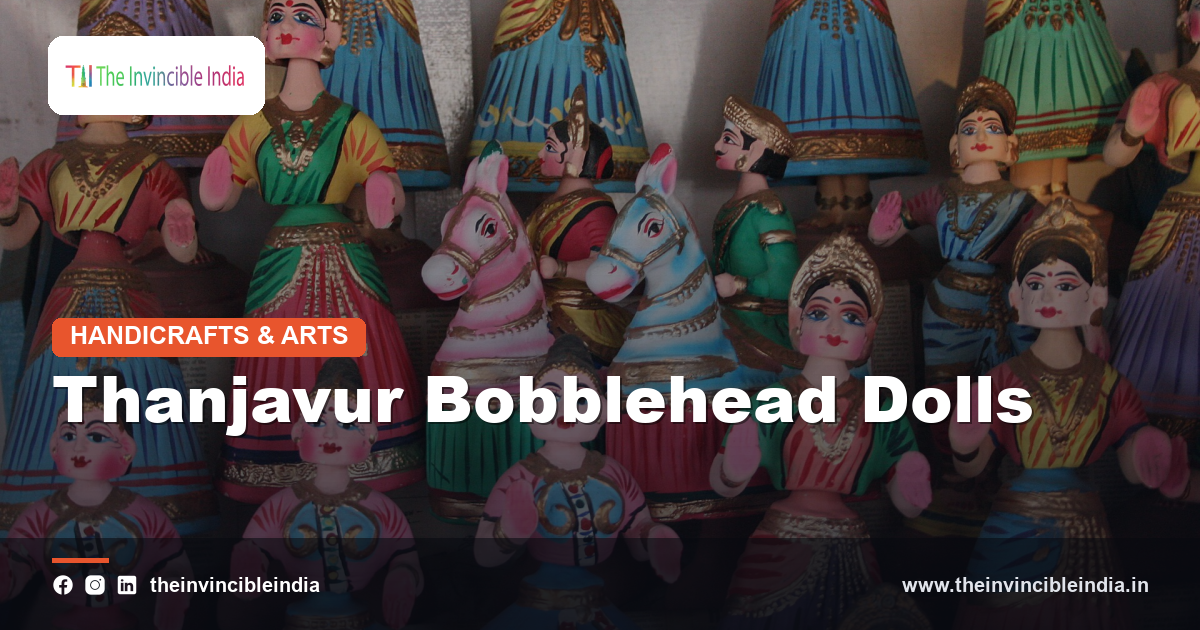
Thanjavur bobblehead dolls, known locally as Thalayatti Bommai, are among the most charming and instantly recognisable handicrafts of Tamil Nadu, celebrated for their gentle, self-balancing nodding motion and their bright, festive painting. Traditionally made in and around the city of Thanjavur, these dolls owe their playful movement to a carefully weighted rounded base that keeps the figure rocking softly long after it is touched, a piece of quiet engineering hidden within an otherwise decorative object, much like the inventive spirit seen in Channapatna toys from Karnataka. Long associated with courtly patronage and festive display, Thanjavur dolls remain a beloved emblem of Tamil craftsmanship. This guide explores their history, construction, symbolism and continuing popularity.
Quick Facts
| Detail | Information |
|---|---|
| Type | Weighted bobbing figurine |
| Local name | Thalayatti Bommai |
| Origin | Thanjavur, Tamil Nadu |
| Traditional material | Terracotta, later plaster of Paris and papier-mache |
| Distinctive feature | Rounded, weighted base enabling a nodding motion |
| Recognition | Holds a Geographical Indication tag |
What Are Thanjavur Dolls
Thanjavur bobblehead dolls are decorative figurines built around a clever balancing design that allows the figure to rock gently back and forth or nod when touched, before slowly settling back into stillness. Known locally as Thalayatti Bommai, meaning roughly a doll with a moving head, these figures are traditionally modelled as women in graceful dance poses, dressed in vividly painted traditional attire. The charm of the craft lies in the combination of decorative beauty and simple physical ingenuity, since the doll’s movement depends entirely on the careful placement of weight within its rounded base. This blend of artistry and mechanism has made Thanjavur dolls a distinctive and much-loved part of Tamil Nadu’s craft heritage.
Thanjavur and Its Craft Heritage
The city of Thanjavur in Tamil Nadu has long been recognised as a centre of refined artistic and craft traditions, home to accomplished painting, metalwork and temple architecture developed over many centuries under successive ruling dynasties. This broader environment of skilled artistry and courtly patronage provided fertile ground for the development of specialised decorative crafts, including the bobblehead dolls that now carry the city’s name. The dolls share something of the same attention to fine detail and vivid colour found in other Thanjavur art forms, reflecting a shared regional sensibility for careful, decorative craftsmanship. This deep local craft heritage helps explain why such a distinctive figurine tradition emerged specifically in this part of Tamil Nadu.
Historical Origins
The Thanjavur bobblehead doll is understood to have developed under the patronage enjoyed by artisans in the Thanjavur region, where skilled craftspeople were supported in producing refined decorative objects for courtly and domestic use. Over time, the dolls became closely associated with the wider decorative traditions of the region and were gradually adopted for both formal display and everyday gifting. Their development reflects a broader pattern seen across many Indian handicrafts, in which royal or local patronage helped elevate a craft from a purely functional or folk origin into a more refined and widely admired art form. This history has given the Thanjavur doll a lasting reputation as a symbol of regional artistic identity.
The Bobbling Balancing Principle
The defining feature of a Thanjavur doll is its ability to rock or nod gently after being touched, an effect achieved through a carefully weighted, rounded base that keeps the figure’s centre of gravity low and stable. When nudged, the doll tips slightly off balance before gradually rocking back to its resting position, producing the slow, soothing nodding motion for which it is best known. This principle, though simple in concept, requires careful calculation during construction to ensure the weight distribution produces a smooth, gradual motion rather than an abrupt tip or fall. This hidden mechanical thoughtfulness is what elevates the Thanjavur doll from a purely decorative object into a small, playful piece of applied craft engineering.
Traditional Materials
Thanjavur dolls were traditionally made using terracotta, with artisans shaping the figure and its rounded, weighted base from fired clay before painting and finishing the surface. Terracotta offered a readily available and workable material well suited to modelling the doll’s characteristic rounded form, though it also made the finished pieces relatively heavy and fragile compared with later alternatives. This early reliance on clay connected the craft to the wider tradition of terracotta modelling found across many parts of India, while its specific application to a balancing figurine gave the Thanjavur version its own unique identity. The choice of material has evolved over time as artisans sought lighter, more durable alternatives suited to wider distribution.
The Shift to Plaster of Paris
Over time, many Thanjavur doll makers moved from heavier terracotta to plaster of Paris and papier-mache as primary materials, valued for being considerably lighter, easier to mould in detail, and less prone to breakage during handling and transport. This shift allowed the dolls to be produced more efficiently and shipped more easily to markets beyond Tamil Nadu, supporting their growth as a popular souvenir and gift item. Despite this change in material, the essential design principle, a rounded, weighted base enabling the signature nodding motion, remained unchanged. This adaptation illustrates how traditional crafts often evolve their materials over time while preserving the core artistic and mechanical idea that defines them.
The Construction Process
Making a Thanjavur doll begins with preparing a mould for the body and the rounded base, into which the chosen material, whether plaster, papier-mache or terracotta, is shaped and left to set or dry thoroughly. The base is carefully weighted during this stage, often through the deliberate placement of denser material at its lowest point, to achieve the balance necessary for the doll’s characteristic motion. Once the basic form has set, the surface is smoothed and prepared for painting, with fine details such as facial features and costume patterns added by hand. This combination of moulding, precise weighting and detailed hand-finishing reflects the layered skill required to produce a doll that is both visually appealing and mechanically functional.
Weighted Base and Centre of Gravity
The success of a Thanjavur doll’s gentle rocking motion depends entirely on the precise engineering of its weighted base, which must be heavy and low enough to keep the figure stable yet light enough to allow smooth, extended movement rather than a rigid, unmoving stance. Artisans developed this balance through generations of practical experience rather than formal calculation, refining the proportion and placement of weight through repeated trial in the workshop. This careful attention to the physics of balance, embedded within what appears to be a purely decorative object, is one of the most distinctive aspects of the craft. It transforms a simple painted figurine into an object that visibly and satisfyingly responds to touch.
Painting and Ornamentation
Once the doll’s form has been finished and smoothed, artisans apply bright, richly detailed painting to depict traditional costume, jewellery and facial features, following established conventions of colour and pattern associated with the craft. Vivid reds, greens, yellows and golds are commonly used, often set against a lighter base colour to create striking visual contrast suited to festive display. Fine linework is used to render decorative borders on clothing and delicate facial details, giving each doll an expressive, lifelike character despite its stylised form. This stage of painting is where much of the doll’s individual charm and craftsmanship becomes visible, transforming a simple moulded shape into a vibrant decorative figure.
Traditional Costume and Colour
Thanjavur dolls are typically painted to depict women dressed in traditional South Indian attire, complete with detailed representations of draped garments, jewellery and hair ornamentation rendered in bright, festive colours. This costuming reflects regional dress conventions and cultural aesthetics, giving the dolls a recognisable connection to Tamil Nadu’s broader visual and textile heritage. The consistent use of certain colour combinations and decorative motifs across generations of doll-making has helped establish a recognisable visual identity for the craft, allowing genuine Thanjavur dolls to be distinguished from generic decorative figurines. This attention to authentic costume and colour remains an important marker of quality and tradition within the craft.
The Dancing Woman Figure
The most iconic and widely recognised form of the Thanjavur doll depicts a graceful female figure in a dance-like pose, her head gently nodding atop the weighted base in a manner reminiscent of rhythmic movement. This dancing woman figure has become closely associated with the craft as a whole, often serving as the default image that comes to mind when the Thanjavur doll is mentioned. The pose and styling draw on broader regional artistic conventions for depicting graceful female figures, adapted specifically to suit the doll’s balancing mechanism. This enduring figure has helped give the craft a strong, consistent visual identity recognised well beyond Tamil Nadu itself.
Couples and Family Sets
Alongside the classic solo dancing woman, artisans also produce paired figures, often depicted as a bobbing couple, as well as small family sets that extend the same balancing principle across multiple related figures displayed together. These grouped arrangements are popular as decorative sets for the home, offering a slightly more elaborate display than a single doll while retaining the same charming nodding motion in each figure. Such variations demonstrate the flexibility of the underlying craft, allowing artisans to expand a single core design into a range of related products suited to different display preferences and gifting occasions. This adaptability has helped sustain demand for the craft across changing consumer tastes.
Cultural Role in Golu Displays
Thanjavur dolls hold a special place in the Tamil tradition of Golu, an elaborate seasonal display of dolls and figurines arranged on tiered steps during certain festive periods, particularly around Navratri. Within these displays, the gently nodding Thanjavur doll often serves as a distinctive centrepiece or accent, its movement adding a touch of animation to an otherwise static arrangement of figures. This festive association embeds the craft directly within a significant cultural practice, rather than treating it purely as a decorative souvenir. The continued popularity of Golu displays in Tamil households helps sustain ongoing demand for genuine, well-made Thanjavur dolls each year.
Gifting Traditions
Beyond festive display, Thanjavur dolls are also commonly given as gifts to mark occasions such as weddings, housewarmings and the birth of a child, valued as tokens of good fortune, grace and cultural pride. Their bright, cheerful appearance and gentle motion make them popular presents suited to a wide range of celebratory contexts, appealing to both traditional and younger recipients. This gifting tradition has helped keep the craft economically relevant even as everyday domestic use of decorative figurines has evolved with changing tastes. The continued role of Thanjavur dolls in personal and family celebrations underscores their significance as more than simple ornaments.
Artisan Communities
The production of Thanjavur dolls is sustained by dedicated artisan families and small workshops in and around Thanjavur, who have passed down the specific skills of moulding, weighting and painting the figures across generations. For these artisans, doll-making represents both a creative pursuit and an important source of livelihood, closely tied to seasonal demand around festivals and wedding seasons. The relatively specialised nature of the craft, requiring both artistic skill and an intuitive understanding of balance, means that experienced makers remain valuable to the tradition’s continued authenticity. Supporting these artisan communities is essential to preserving both the technique and the cultural significance of the Thanjavur doll.
Geographical Indication and Recognition
In recognition of its distinctive regional character, the Thanjavur bobblehead doll, known formally by its local name, has received a Geographical Indication tag protecting the association between the craft and its home region. This formal recognition helps distinguish genuine, traditionally made Thanjavur dolls from generic imitation figurines produced elsewhere without the same careful balancing technique or regional painting style. Such recognition also supports the livelihoods of authentic artisan producers by reinforcing the value associated with the name and encouraging buyers to seek out genuine examples. This protective status marks an important step in securing the craft’s identity and economic future.
Thanjavur Dolls Today
Today Thanjavur bobblehead dolls remain a cherished and widely recognised handicraft, produced by artisan families for festive Golu displays, wedding gifts and the growing tourism and souvenir market across India. Their combination of vivid traditional painting and a simple, satisfying nodding motion continues to delight both local buyers and visitors encountering the craft for the first time. As younger artisans learn the technique alongside experienced elders, and as formal recognition helps protect its authenticity, the Thanjavur doll looks set to remain a beloved and enduring symbol of Tamil Nadu’s rich craft heritage for years to come.
Sources & Further Reading
- Ministry of Textiles, Government of India, on regional Indian handicraft traditions (texmin.nic.in).
- Ministry of Culture, Government of India, on the folk and craft heritage of Tamil Nadu (indiaculture.gov.in).
Frequently Asked Questions
What is a Thanjavur bobblehead doll?
A Thanjavur bobblehead doll, or Thalayatti Bommai, is a traditional Tamil Nadu figurine with a weighted, rounded base that makes it gently rock or nod when touched.
How does the doll manage to nod or rock?
The doll balances on a carefully weighted rounded base that keeps its centre of gravity low, allowing it to tip slightly when touched and then rock gently back to rest.
What materials are Thanjavur dolls made from?
Thanjavur dolls were traditionally made from terracotta, though many artisans today use lighter and more durable materials such as plaster of Paris or papier-mache.
When are Thanjavur dolls typically displayed?
Thanjavur dolls are especially popular during the festive Golu doll displays around Navratri and are also commonly given as gifts for weddings and other celebrations.
Does the Thanjavur doll have official recognition?
Yes, the Thanjavur bobblehead doll holds a Geographical Indication tag, which protects its regional identity and supports the artisans who make it using traditional methods.


