

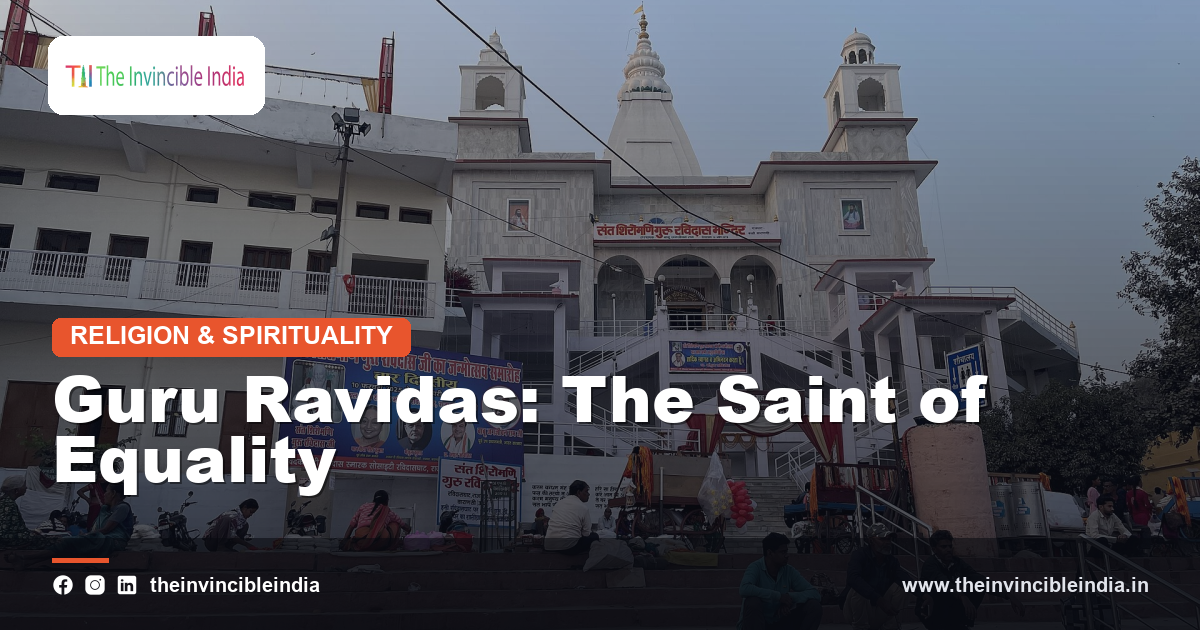
Among the saint-poets who shaped India’s devotional landscape, Guru Ravidas holds a distinctive place for uniting heartfelt spirituality with a firm call for social equality. Associated with the wider Bhakti movement, he composed hymns in the vernacular that spoke directly to ordinary people, bypassing the ritual complexity and social hierarchies that often stood between believers and the divine. Born into a family associated with leatherwork in Varanasi, a trade regarded in his time as socially marginalized, Ravidas transformed his lived experience of exclusion into a message of universal dignity. His compositions, later included in the Guru Granth Sahib, continue to be sung and studied today, and his life remains a touchstone for conversations about equality, devotion, and social justice within Indian religious thought.
Quick Facts
| Detail | Information |
|---|---|
| Tradition | Bhakti movement, Sant tradition |
| Birthplace | Varanasi |
| Known For | Devotional hymns and teachings on equality |
| Compositions Found In | Guru Granth Sahib |
| Core Message | Devotion to one formless God, social equality |
| Legacy | Ravidassia tradition and Guru Ravidas temples |
Guru Ravidas and the Bhakti Movement
Guru Ravidas is remembered as one of the notable saint-poets associated with the Bhakti movement, a broad devotional current that swept across many regions of India and emphasized a direct, personal relationship with the divine over formal ritual and priestly mediation. Within this wider current, he is counted among the Sants, poet-saints known for composing verse in regional languages accessible to common people.
His voice within this tradition is distinguished by its unusually direct engagement with questions of social status and dignity, alongside its devotional content. This combination of spiritual depth and social conscience is a central reason his memory endures so strongly across diverse communities today.
Early Life in Varanasi
Tradition places the early life of Guru Ravidas in and around Varanasi, one of India’s oldest and most spiritually significant cities on the banks of the Ganges. Growing up in this environment, steeped in devotional practice and pilgrimage activity, is often understood to have shaped his early inclination toward spiritual reflection.
Accounts of his upbringing emphasize a household engaged in traditional craftsmanship, a detail that later became central to how his life and teachings are popularly remembered. Rather than presenting a detailed biography with precise dates, devotional memory of Ravidas focuses on the themes of humility, labor, and spiritual insight that mark his story.
Family Background and Social Context
Guru Ravidas is traditionally described as belonging to a family associated with leatherwork, an occupation that in the social order of his time carried significant stigma and marginalization. This background placed him outside the circles typically granted access to formal religious learning or temple worship in that era.
Rather than treating this position as an obstacle to spiritual attainment, Ravidas’s life and teachings directly challenged the idea that social origin determined a person’s closeness to the divine. This lived experience of exclusion became a central wellspring for the egalitarian themes that run through his devotional poetry.
A Voice of Devotion and Equality
What sets Guru Ravidas apart among the saint-poets of his era is the way his devotional verse consistently intertwines love for the divine with an insistence on human equality. His hymns do not separate spiritual longing from social conscience, presenting them instead as two expressions of the same underlying truth.
This dual emphasis gave his message a broad resonance, appealing not only to those seeking personal devotion but also to communities who found in his words a validation of their own dignity and worth, regardless of birth or occupation.
Core Teachings: One Formless God
Central to the teachings attributed to Guru Ravidas is devotion to a single, formless divine reality, approached through sincere inward remembrance rather than elaborate external ritual. This emphasis aligns him with the broader Sant tradition, which favored direct, personal spirituality over ceremonial religion.
By locating access to the divine within the heart of the devotee rather than within any particular ritual apparatus, this teaching implicitly opened spiritual life to anyone willing to cultivate sincere devotion, regardless of social standing, wealth, or formal religious training.
Rejection of Caste Discrimination
A recurring theme in the verses attributed to Guru Ravidas is a clear rejection of discrimination based on birth or occupation. His poetry repeatedly affirms that spiritual worth cannot be measured by social category, challenging prevailing hierarchies of his era in language that remained accessible and direct.
This stance has given his legacy lasting relevance well beyond his own time, as later generations have continued to draw on his words when articulating aspirations for social equality and dignity. His teachings are frequently cited as an early and influential voice against caste-based exclusion within devotional literature.
Emphasis on Inner Devotion Over Ritual
Guru Ravidas’s teachings consistently favor sincere inner devotion over outward religious display. He is remembered for suggesting that a pure heart directed toward the divine matters far more than costly offerings, elaborate ceremonies, or claims to ritual purity based on social status.
This emphasis placed spiritual practice within reach of anyone, regardless of means or background, reinforcing the broader Bhakti ideal that devotion is a matter of the heart rather than a privilege reserved for those with access to temples, priests, or scriptural training.
Guru Ravidas's Poetry and Hymns
The devotional verses attributed to Guru Ravidas are composed in accessible vernacular language, employing vivid imagery and direct address that made them easy to remember, sing, and pass down orally. This accessibility was central to their wide circulation among ordinary devotees.
His hymns often combine personal expressions of longing for the divine with broader reflections on humility, equality, and righteous living, weaving social and spiritual themes into a single devotional voice that continues to be sung in gatherings and homes today.
Inclusion in the Guru Granth Sahib
A number of compositions attributed to Guru Ravidas were later included in the Guru Granth Sahib, the central scripture of Sikhism, which draws together devotional writings from various saints across different backgrounds and traditions. This inclusion reflects the broad respect his verses commanded beyond any single community.
The presence of his hymns within this shared scriptural collection illustrates the interconnected nature of devotional literature in medieval India, where verses by saints of differing social origins were valued for their spiritual insight rather than confined by sectarian boundaries.
Style and Themes of His Compositions
The compositions attributed to Guru Ravidas are marked by a simple, direct style that favors clarity of message over ornate literary technique. Recurring themes include the formless nature of the divine, the futility of pride in social rank, and the transformative power of sincere devotion.
This straightforward style contributed significantly to the lasting popularity of his verses, allowing them to be understood and embraced by audiences across different regions, languages, and generations, independent of formal education or scriptural training.
Relationship With Other Sant Poets
Guru Ravidas is often discussed alongside other prominent Sant poets of the era, such as Kabir, whose teachings likewise stressed direct devotion, social equality, and skepticism toward empty ritual. Together, these figures form a loosely connected devotional current sometimes described as the Nirguna strand of Bhakti, centered on a formless divine.
While each poet-saint retained a distinct voice and style, their shared emphasis on accessible devotion and social critique created a recognizable current within medieval Indian religious life, one that continues to be studied as a coherent, influential strand of Bhakti thought.
The Ravidassia Community and Legacy
Guru Ravidas is venerated as a central spiritual figure by the Ravidassia community, a devotional tradition that draws directly on his teachings and hymns. For adherents, his life exemplifies the possibility of spiritual attainment and social dignity regardless of birth.
This community maintains its own devotional practices, gatherings, and places of worship centered on his memory, and continues to actively transmit his teachings to new generations, ensuring that his message of equality and devotion remains a living tradition rather than a purely historical legacy.
Shrines and Places of Reverence
Temples and shrines dedicated to Guru Ravidas can be found in various parts of India, serving as focal points for devotional gatherings, communal singing, and reflection on his teachings. These sites function both as places of worship and as centers of community identity for his followers.
Such shrines typically feature spaces for congregational singing of his hymns, reflecting the participatory, communal character of devotion associated with his memory, in keeping with the broader Bhakti emphasis on shared, accessible spiritual practice rather than solitary or exclusive ritual.
Guru Ravidas Jayanti and Commemoration
The anniversary associated with Guru Ravidas is observed annually by devotees through gatherings that include recitation of his hymns, processions, and community meals, reflecting the values of devotion and equality central to his teachings. These observances draw participants from diverse backgrounds.
Such commemorations serve not only as acts of remembrance but as occasions for reaffirming his message of dignity and social equality, keeping his teachings actively present in contemporary devotional and social life rather than confined to historical memory alone.
Influence on Social Reform Thought
The teachings of Guru Ravidas have influenced later movements concerned with social equality and the dignity of marginalized communities in India. His articulation of spiritual worth independent of social origin provided an early devotional foundation for later reformist thought.
Many social and religious reformers in subsequent centuries have drawn on his verses to support arguments against caste-based discrimination, illustrating how his devotional legacy has extended well beyond purely religious contexts into broader conversations about social justice and human dignity.
Guru Ravidas's Message in Contemporary India
In contemporary India, the teachings of Guru Ravidas continue to be invoked in discussions of equality, social dignity, and inclusive devotion. His hymns are sung not only in dedicated shrines but also in wider public and cultural settings that celebrate his legacy.
This continued relevance reflects the enduring power of a message that unites spiritual devotion with social conscience, resonating with audiences who see in his life and words an early and articulate call for the equal worth of every human being.
Guru Ravidas Today
Today, Guru Ravidas is remembered as both a devotional poet and a moral voice whose teachings continue to inspire reflection on equality and inner spirituality. His hymns remain part of shared devotional heritage, sung across communities and included within revered scripture.
As interest in India’s diverse devotional traditions continues to grow, the life and message of Guru Ravidas serve as an enduring reminder that spiritual insight and social conscience can be deeply intertwined, offering a legacy that speaks as clearly to present concerns as it did in his own time.
Sources & Further Reading
- Ministry of Culture, Government of India (indiaculture.gov.in).
- Sahitya Akademi.
Frequently Asked Questions
Who was Guru Ravidas?
Guru Ravidas was a saint-poet of the Bhakti movement, remembered for his devotional hymns and his teachings on equality and social dignity regardless of birth or occupation.
Where was Guru Ravidas born?
Tradition places his early life in and around Varanasi, one of India’s oldest cities and a major center of devotional and pilgrimage activity.
What did Guru Ravidas teach?
He taught devotion to a single formless God through sincere inner remembrance, alongside a firm rejection of social discrimination based on caste or occupation.
Where can Guru Ravidas's hymns be found?
A number of his compositions were later included in the Guru Granth Sahib, the central scripture of Sikhism, alongside verses from other saints of his era.
How is Guru Ravidas remembered today?
He is remembered through dedicated temples, community gatherings, and an annual commemoration observed by devotees who continue to sing his hymns and honor his teachings.


