

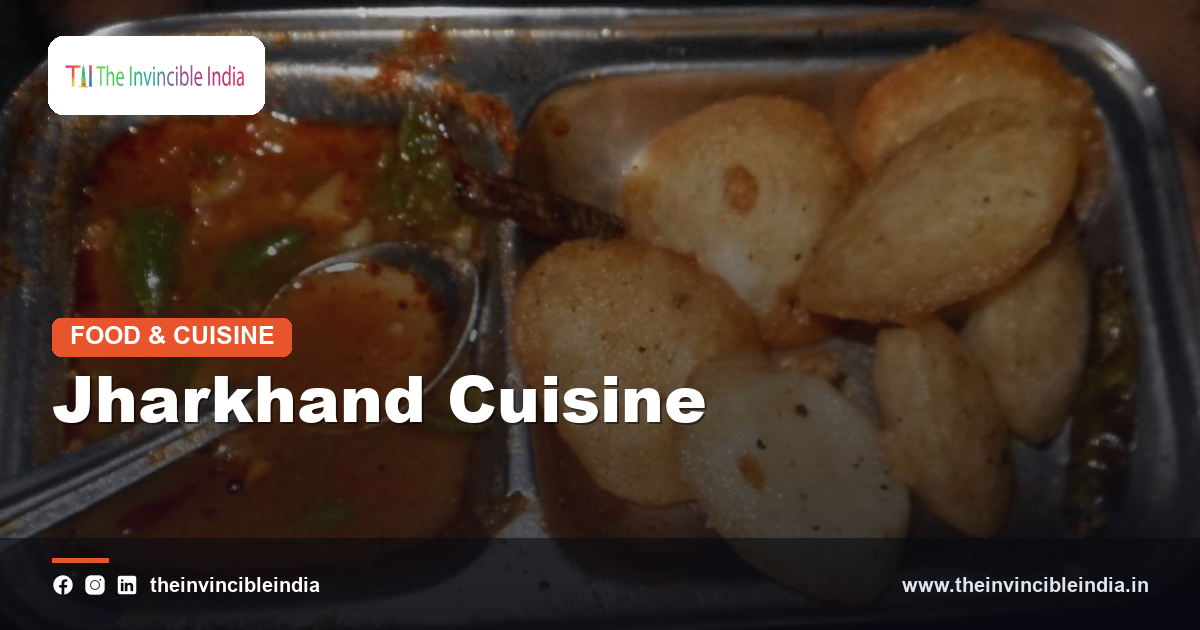
Jharkhand cuisine is the rustic, forest-linked food of a state carved from the Chota Nagpur plateau and home to a large and diverse tribal population whose cooking reflects generations of living close to the land. Rice, foraged greens, mahua and locally grown lentils form the backbone of everyday eating, while the deep-fried rice-and-lentil snack dhuska stands as its best-known dish. Much as the wider regional cuisines of India reveal how deeply geography shapes food, Jharkhand’s cuisine is inseparable from its plateau terrain and forest surroundings. This guide explores Jharkhand cuisine, its history, its famous dishes and its enduring place in India’s culinary heritage.
Quick Facts
| Detail | Information |
|---|---|
| Type | The rustic, tribal-influenced cuisine of Jharkhand |
| Rooted in | Chota Nagpur plateau agriculture and forest foraging |
| Famous for | Dhuska, thekua and rice-based dumplings |
| Key ingredients | Rice, mustard oil, forest greens and local lentils |
| Signature snack | Dhuska, a deep-fried rice-lentil patty |
| Character | Simple, earthy and closely tied to the seasons |
The Food of Jharkhand
Jharkhand cuisine is the food of a state formed from the mineral-rich Chota Nagpur plateau, home to a large tribal population including the Santhal, Munda and Oraon communities alongside many other groups who have farmed and foraged this land for generations. Its cooking is shaped less by royal courts than by village life, forest produce and the rhythms of a largely agrarian, monsoon-dependent calendar. Rice, mustard oil and locally available lentils and greens form the everyday foundation of the table. As the food of Jharkhand, rooted firmly in plateau farming and forest life, this cuisine occupies a distinctive and still under-recognised place among the regional cuisines of India.
Rice as the Everyday Staple
Rice underpins nearly every meal in Jharkhand, grown across the state’s plateau fields and prepared in numerous forms, from simple boiled rice served with lentils and vegetables to rice flour used in snacks, breads and festive sweets. Many households continue to favour traditional local varieties over polished commercial rice, valuing their flavour and their suitability to regional growing conditions. Rice water and leftover rice are also put to practical use rather than discarded. This central and versatile role of rice within Jharkhand cuisine, present at almost every meal and in many other forms besides, remains the single most defining feature of the region’s food.
Tribal Culinary Heritage
Jharkhand’s food culture owes much of its distinct character to its tribal communities, whose culinary knowledge, built up over generations of close observation of the forest and its seasons, has shaped dishes found nowhere else in India. Communities such as the Santhal, Munda, Oraon and Ho each maintain their own particular preparations and food customs, often tied closely to seasonal festivals and rites of passage. Elders continue to pass down this knowledge through everyday household cooking. This rich tribal culinary heritage, still very much alive across rural Jharkhand, gives the state’s cuisine a depth and originality that sets it apart from many neighbouring regions.
Dhuska – the Signature Snack
Dhuska, a deep-fried patty made from a batter of rice and lentils, ground together and left to rest before frying until crisp on the outside and soft within, is the single dish most closely associated with Jharkhand cuisine, sold at roadside stalls and prepared in homes alike. It is typically served with a spiced chickpea or potato curry, the pairing offering a satisfying contrast of crunch and gravy. Vendors often fry it fresh to order over open flames. This beloved dhuska, humble in its ingredients yet distinctive in taste and texture, has become the most recognisable culinary symbol of Jharkhand far beyond the state’s own borders.
Litti and Shared Wheat Traditions
Jharkhand shares with neighbouring Bihar a fondness for litti, a baked or roasted wheat ball stuffed with spiced roasted gram flour and traditionally served with a mash of vegetables and a generous helping of ghee. Though most closely associated with Bihari cuisine, litti is widely eaten across Jharkhand as well, reflecting the close cultural and culinary ties between the two neighbouring states. It remains a popular choice for outdoor gatherings and winter meals. This shared litti tradition, straddling both states with only minor variation, illustrates how Jharkhand’s food culture developed alongside, rather than entirely apart from, its wider regional neighbours.
Forest Produce and Foraged Ingredients
A defining feature of Jharkhand cuisine is its continued reliance on forest produce, with wild greens, tubers, mushrooms and flowers gathered seasonally and incorporated into the everyday diet in ways that reflect deep local ecological knowledge. Such foraging remains an active practice in many rural and tribal households, supplementing cultivated crops with ingredients unavailable through farming alone. This knowledge is transmitted largely through practice rather than written recipe. This continued use of forest produce and foraged ingredients within Jharkhand cuisine reflects a food culture still closely bound to its natural surroundings, distinguishing it from more purely agricultural regional cuisines.
Bamboo Shoot in Jharkhand Cooking
Bamboo shoot, harvested from the region’s forests and prepared through boiling, fermenting or drying to remove its natural bitterness, appears in a number of Jharkhand’s tribal dishes, lending a distinctive earthy flavour and texture found in few other Indian cuisines outside the northeast and central tribal belt. It is typically cooked with local greens or lentils into a simple, lightly spiced preparation. Its seasonal availability makes it a valued and anticipated ingredient. This use of bamboo shoot within Jharkhand cooking reflects the cuisine’s broader tribal character and its resourceful use of ingredients drawn directly from the surrounding forest.
Pittha and Rice Dumplings
Pittha, a steamed or boiled dumpling made from rice flour and filled with lentils, jaggery or sesame depending on the occasion, is a well-loved preparation across Jharkhand, particularly during festivals and the winter months. Its preparation, involving careful shaping and steaming, is often a shared household task, with several family members contributing to a single batch. Savoury and sweet versions exist side by side within the same tradition. This tradition of pittha and related rice dumplings, adaptable to both festive and everyday occasions, showcases the versatility of rice flour within Jharkhand’s wider culinary repertoire.
Thekua and Festive Sweets
Thekua, a dense, deep-fried sweet made from wheat flour, jaggery and ghee and pressed into decorative shapes before frying, is among Jharkhand’s most cherished festive foods, closely associated with the Chhath festival observed across the wider Bihar-Jharkhand region. Its long shelf life made it historically useful for travel and for prasad offerings distributed among family and neighbours. Each household often has its own preferred proportions of jaggery and ghee. This tradition of thekua and other festive sweets, prepared with particular devotion during Chhath, reflects the strong link between food and religious observance in Jharkhand.
Mahua and Its Culinary Uses
The mahua tree holds a special place in Jharkhand’s food and cultural life, its flowers collected and used to prepare a traditional fermented beverage long associated with tribal festivals and community gatherings, while its seeds yield an oil put to various household uses. Mahua flowers are also dried and stored, sometimes used in cooking or as a natural sweetener in certain preparations. The tree’s flowering season is marked by particular local anticipation. This significant role of mahua within Jharkhand’s food and cultural traditions reflects the close bond between tribal communities and the natural resources of their forested surroundings.
Lentils and Everyday Curries
Lentils form an essential part of the Jharkhand meal, cooked simply with turmeric, mustard oil and a modest amount of chilli into a thin, comforting dal eaten daily alongside rice. Local vegetables, often grown in kitchen gardens or gathered from nearby fields, are prepared into equally simple curries, with minimal use of elaborate spice blends compared with some other Indian regional cuisines. Mustard oil imparts a distinctive pungency valued in local cooking. This straightforward approach to lentils and everyday curries within Jharkhand cuisine reflects a food culture that favours simplicity and freshness over elaborate technique.
Non-Vegetarian Traditions
Jharkhand maintains a notable non-vegetarian tradition, particularly among its tribal communities, with chicken, mutton and freshwater fish prepared into simply spiced curries for family meals and festive occasions alike. Such dishes typically rely on onion, garlic, turmeric and mustard oil rather than elaborate spice pastes, allowing the meat or fish itself to remain the focus of the dish. Fish from local rivers and ponds is especially prized when in season. This non-vegetarian tradition within Jharkhand cuisine, straightforward yet flavourful in its approach, forms an important part of the state’s food culture across both tribal and non-tribal communities.
Vegetarian Traditions
Jharkhand also sustains a strong vegetarian tradition, particularly rooted in its farming households, where seasonal vegetables, lentils and foraged greens are transformed into nourishing, lightly spiced dishes suited to daily eating. Gourds, leafy greens and local tubers feature prominently, often cooked with little more than mustard oil, turmeric and a pinch of chilli. Such simplicity allows the natural flavour of fresh, locally grown produce to remain central. This resourceful vegetarian tradition within Jharkhand cuisine, built from humble and often self-grown ingredients, reflects the practical, land-connected character of the state’s wider food culture.
Street Food and Local Snacks
Beyond dhuska, Jharkhand’s towns offer a modest but distinctive street food culture, including fried snacks made from local lentils and vegetables, sold at stalls that often specialise in a single well-perfected item. Tea stalls serving these snacks act as informal gathering points in many towns, particularly in the cooler months. Such food is generally simple, inexpensive and prepared fresh to order. This local street food tradition, more understated than in some larger Indian cities, nonetheless offers its own comforting pleasures and reflects the everyday food culture of Jharkhand’s urban centres.
Dining Customs and the Jharkhand Thali
A traditional Jharkhand meal, comparable in structure to the wider Indian thali tradition, typically brings together rice with a thin dal, one or two vegetable preparations and, where available, a simple non-vegetarian curry, served without excessive ceremony but with genuine hospitality. Meals are usually eaten with the hand, and guests are traditionally offered a generous second helping as a mark of welcome. Seasonal and foraged ingredients often determine the day’s specific dishes. This Jharkhand thali and its accompanying customs, simple yet warm in character, reflect the practical, community-minded spirit of the state’s food culture.
Jharkhand Cuisine Today
Today Jharkhand cuisine is gaining slow but growing recognition beyond its home state, as food writers and travellers take greater interest in its tribal dishes, its forest-foraged ingredients and its signature dhuska. Urban eateries in the state’s cities increasingly showcase traditional preparations once confined largely to villages, while rural households continue to cook much as earlier generations did. Renewed interest in tribal food knowledge has supported this wider attention. As the rustic, forest-linked food of a plateau state, Jharkhand cuisine stands as a distinctive and still emerging part of India’s culinary heritage.
Sources & Further Reading
- Ministry of Tourism, Government of India, on the cuisines of India (tourism.gov.in).
- Culinary references on the food traditions of Jharkhand.
Frequently Asked Questions
What is Jharkhand cuisine known for?
Jharkhand cuisine is known for dhuska, a deep-fried rice-and-lentil snack, along with rice dumplings such as pittha, festive sweets such as thekua, and a strong tradition of tribal cooking that draws on forest-foraged ingredients.
What is dhuska?
Dhuska is a deep-fried patty made from a ground batter of rice and lentils, crisp on the outside and soft within, typically served with a spiced chickpea or potato curry. It is Jharkhand’s best-known dish.
How does tribal food shape Jharkhand cuisine?
Jharkhand’s large tribal population, including the Santhal, Munda and Oraon communities, has shaped much of the state’s cuisine through the use of forest produce, bamboo shoot and traditional preparations passed down through generations.
What role does mahua play in Jharkhand food culture?
The mahua tree is used in Jharkhand to prepare a traditional fermented beverage associated with tribal festivals, while its seeds yield oil for household use, making it an important part of the state’s food and cultural life.
Is Jharkhand cuisine spicy?
Jharkhand cuisine is generally simple and only lightly spiced, relying on mustard oil, turmeric and a modest amount of chilli rather than elaborate spice blends, allowing fresh, local ingredients to remain the focus of each dish.


