

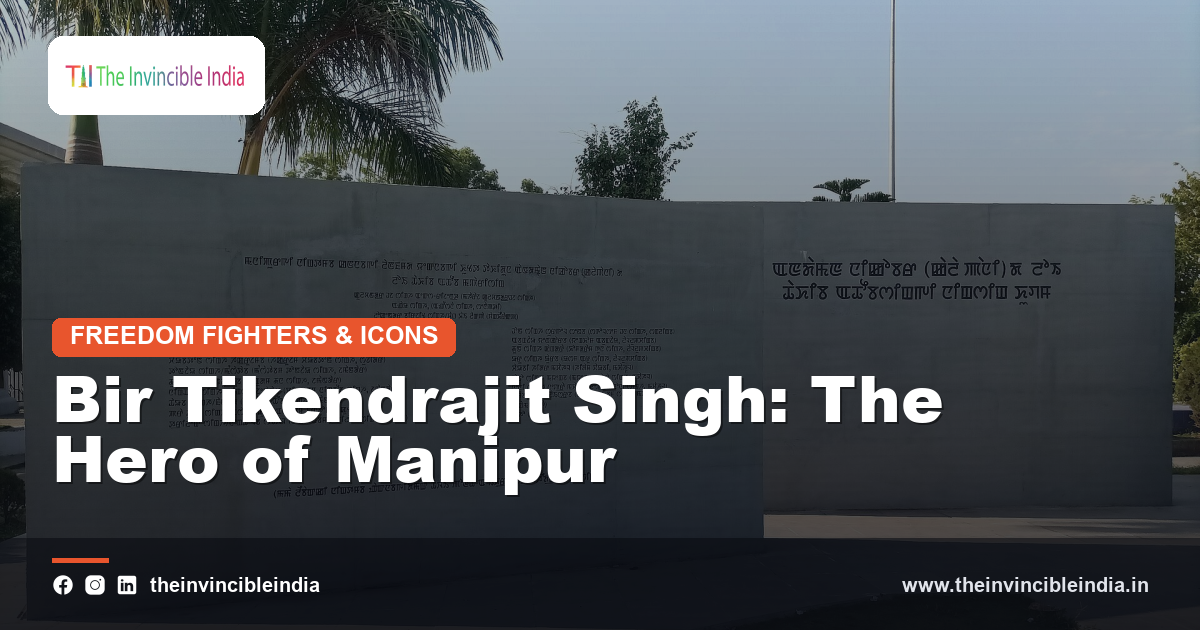
Bir Tikendrajit Singh is remembered in Manipur as a prince and military leader who resisted the expansion of British colonial authority into the kingdom’s internal affairs during the late nineteenth century. As tensions between the Manipur court and British officials escalated, he emerged as a central figure in the conflict that followed, known today as the Anglo-Manipur War, standing alongside other notable names discussed among the famous freedom fighters of India. His eventual capture and execution by British authorities transformed him into an enduring symbol of Manipuri resistance, and his story continues to inform the northeastern region’s distinct historical relationship with the broader movement against colonial rule.
Quick Facts
| Detail | Information |
|---|---|
| Title | Prince of the Manipur royal family |
| Region | Manipur, northeast India |
| Era | Nineteenth century |
| Known For | Leadership during the Anglo-Manipur War |
| Associated Conflict | Anglo-Manipur War |
| Legacy | Hero of Manipur’s resistance to colonial rule |
Early Life and Royal Background
Bir Tikendrajit Singh was born into the royal family of Manipur, a princely state in northeastern India with a long history of independent governance prior to increasing British involvement in the region during the nineteenth century. As a member of the ruling family, he was raised with an understanding of statecraft, military tradition, and the responsibilities associated with Manipur’s royal administration.
His upbringing within the palace exposed him early to the political complexities facing Manipur as British colonial influence expanded across the surrounding region. This environment shaped a strong sense of loyalty to Manipur’s sovereignty and traditions, qualities that would later define his role in the political and military crisis that engulfed the kingdom in the early 1890s.
Manipur in the Nineteenth Century
During the nineteenth century, Manipur functioned as a princely state with its own monarchy, administration, and military traditions, situated in a strategically significant location in northeastern India near the frontier with Burma. While maintaining internal autonomy for much of this period, Manipur increasingly found itself within the sphere of British colonial interest as the empire consolidated control over the wider region.
This period saw growing friction between the traditional structures of Manipuri governance and the expanding administrative and strategic ambitions of British authorities in India. Manipur’s rulers sought to preserve their kingdom’s autonomy while navigating a rapidly changing political landscape, a balancing act that became increasingly difficult as British expectations grew more assertive in the years leading up to open conflict.
Political Role in Manipur's Court
As a senior member of Manipur’s royal family, Bir Tikendrajit held significant influence within the kingdom’s political and military affairs, playing an active role in decisions concerning the state’s governance and defence. His position placed him at the centre of the palace’s response to the growing pressures being exerted by British colonial authorities during this period of heightened tension.
His involvement in court affairs meant that he was directly engaged in the deliberations that shaped Manipur’s response to British demands, including matters relating to succession and administrative authority within the kingdom, positioning him as one of the key figures whose decisions would shape the confrontation that followed.
Rising Tensions with British Authorities
Tensions between the Manipur court and British colonial authorities intensified over questions of internal governance and the extent of British influence over the kingdom’s affairs. British officials sought greater control over decisions within the Manipur court, an approach that clashed with the kingdom’s tradition of internal autonomy and its rulers’ determination to manage their own affairs according to established custom.
These disputes came to a head over specific administrative and succession issues within the palace, with British representatives attempting to intervene directly in matters the Manipur court considered its own sovereign prerogative, creating an atmosphere of mounting distrust that would soon escalate into open conflict.
The Outbreak of the Anglo-Manipur War
The escalating tensions between the Manipur court and British authorities eventually led to open conflict, remembered as the Anglo-Manipur War, one of the significant armed confrontations between a northeastern Indian kingdom and British colonial power in the late nineteenth century. The conflict arose from British attempts to assert direct control over internal Manipuri affairs, which the palace and its leadership resisted.
Bir Tikendrajit played a central role in Manipur’s military and political response during this confrontation, reflecting his standing within the royal family and his position in the kingdom’s defence establishment, drawing significant attention to Manipur’s determination to resist what it viewed as an infringement on its sovereign authority.
Manipuri Resistance and Military Leadership
During the Anglo-Manipur War, Bir Tikendrajit was closely associated with organising and leading Manipuri resistance against advancing British forces, drawing on the kingdom’s military traditions and the loyalty of its armed forces. His leadership during this period reflected both his personal courage and his commitment to defending Manipur’s independence against external control.
The resistance mounted by Manipuri forces demonstrated significant organisational capability and determination, even though the kingdom ultimately faced a much larger and better-resourced colonial military power, an imbalance that would eventually shape the outcome of the conflict, but which did not diminish the symbolic significance of the resistance itself.
The Course of the Conflict
The Anglo-Manipur War unfolded through a series of military engagements between Manipuri and British forces, fought across the kingdom’s difficult hill terrain, which posed significant logistical challenges for both sides. Manipuri forces, though outmatched in equipment and resources, mounted a determined resistance that reflected the depth of local commitment to preserving the kingdom’s traditional independence.
As the conflict progressed, the superior resources and organisation of the British military ultimately proved decisive, leading to the defeat of Manipuri forces and the assertion of direct British control over the kingdom’s affairs, marking a significant turning point in Manipur’s political history.
British Reprisal and Its Aftermath
Following the defeat of Manipuri forces, British authorities moved to reassert control over the kingdom and to hold accountable those they considered responsible for organising resistance against colonial rule. This process included formal proceedings against senior figures within the Manipur court who had played leading roles in the conflict, reflecting the severity with which British authorities responded to the challenge to their authority.
Bir Tikendrajit, given his prominent role in the kingdom’s resistance, faced serious consequences as part of this British response, and the aftermath of the war marked a difficult period for Manipur’s traditional leadership as the kingdom adjusted to a significantly altered political relationship with British India.
Trial and Execution
In the aftermath of the Anglo-Manipur War, Bir Tikendrajit was tried by British authorities in connection with his role in the conflict and its associated events. The proceedings reflected the colonial administration’s determination to demonstrate the consequences of armed resistance to its authority, and the outcome of the trial resulted in his execution, an event that had a profound impact on Manipuri society.
His execution was widely regarded within Manipur as an act of martyrdom rather than simple punishment, reinforcing his image as a leader who had given his life in defence of the kingdom’s sovereignty, remembered as one of the most solemn chapters in Manipur’s modern history.
Martyrdom and Symbolism
Bir Tikendrajit’s death came to symbolise the broader struggle of Manipur, and by extension the wider northeastern region, against the expansion of British colonial control in the late nineteenth century. His willingness to lead resistance against a far more powerful colonial military, despite the near certainty of defeat, has been remembered as an act of profound courage and commitment to Manipur’s sovereignty.
This symbolism has endured in Manipuri historical memory, where he is regarded not simply as a royal figure caught up in a political crisis, but as a deliberate and committed defender of his kingdom’s independence, placed alongside other regional accounts of resistance to colonial expansion.
Impact on Manipur's Political History
The Anglo-Manipur War and its aftermath, including Bir Tikendrajit’s execution, marked a decisive shift in Manipur’s political status, bringing the kingdom more directly under British colonial administration than had previously been the case. This transition altered the internal governance structures that had characterised Manipur for generations, reshaping the relationship between the traditional monarchy and the colonial state.
The events of this period left a lasting imprint on Manipuri political consciousness, contributing to a historical narrative in which the kingdom’s experience of colonial subjugation is closely tied to the memory of its resistance during the war.
Cultural Memory in Manipur
In Manipur, the memory of the Anglo-Manipur War and its leading figures, including Bir Tikendrajit, occupies an important place in regional historical consciousness, commemorated through public memorials, historical accounts, and educational references. The war is regarded as a significant chapter in the broader history of Manipur’s engagement with colonial power, distinct from but connected to the wider Indian independence movement.
This cultural memory reflects Manipur’s particular historical experience within the larger story of British colonialism in India, reinforcing the significance of this history for successive generations of Manipuris.
Connection to the Wider Freedom Struggle
While the Anglo-Manipur War took place decades before the more widely known phases of the Indian independence movement, it is increasingly recognised as part of the broader history of regional resistance to British colonial expansion across the subcontinent. Historians studying the northeastern frontier have highlighted how conflicts such as this one reflected the same underlying tensions between local sovereignty and colonial control seen elsewhere in India.
This wider recognition has helped situate Bir Tikendrajit’s story within the broader national narrative of resistance to colonial rule, informing a fuller, more regionally inclusive account of India’s long path to independence.
Commemoration in Modern Manipur
In present-day Manipur, Bir Tikendrajit is commemorated through public memorials, place names, and official observances that mark the significance of the Anglo-Manipur War in the state’s history. These acts of remembrance reflect the continuing importance attached to his role as a defender of Manipur’s sovereignty during a critical period of the kingdom’s history.
Public institutions and educational curricula within the state frequently reference the events of the war and the role of its leading figures, ensuring that younger generations remain aware of this chapter of regional history.
Legacy in Northeast India's History
Bir Tikendrajit’s legacy extends beyond Manipur to inform broader discussions of northeastern India’s historical relationship with British colonial expansion, illustrating how regional kingdoms across the frontier responded to increasing external pressure during the nineteenth century. His story contributes to a more complete understanding of the diverse forms resistance to colonial rule took across different parts of India.
This broader legacy has gained increasing attention in recent decades as historians and educators have sought to give fuller recognition to the northeastern region’s distinct historical experiences within the national narrative of India’s path to independence.
Bir Tikendrajit Singh Today
Today, Bir Tikendrajit Singh is remembered in Manipur and in broader accounts of northeastern Indian history as a figure who led resistance against British colonial expansion at significant personal cost. His story is commemorated through regional memorials and continues to be studied as part of the wider history of the Anglo-Manipur War and its consequences for the kingdom.
His legacy remains an important part of Manipur’s historical identity, contributing to ongoing efforts to ensure that the region’s experience of resistance to colonial rule receives due recognition within the broader story of India’s path to independence.
Sources & Further Reading
- Ministry of Culture, Government of India (indiaculture.gov.in).
- National Archives of India (nationalarchives.gov.in).
Frequently Asked Questions
Who was Bir Tikendrajit Singh?
Bir Tikendrajit Singh was a prince of the royal family of Manipur who played a leading role in resisting British colonial expansion into the kingdom’s internal affairs. He is best remembered for his role in the Anglo-Manipur War of the early 1890s.
What was the Anglo-Manipur War?
The Anglo-Manipur War was an armed conflict between the kingdom of Manipur and British colonial forces, arising from disputes over British attempts to control Manipur’s internal governance. Manipuri forces, though ultimately defeated, mounted significant resistance during the conflict.
What role did he play in Manipur's royal court?
As a senior member of Manipur’s ruling family, Bir Tikendrajit held considerable influence over the kingdom’s political and military affairs. This position placed him at the centre of Manipur’s response to escalating British pressure in the years before the war.
Why is he considered a freedom fighter?
He is regarded as a freedom fighter because he led armed resistance against the expansion of British colonial control over Manipur, ultimately losing his life for this cause. His actions are seen as part of the broader history of Indian resistance to colonial rule.
How is he remembered in Manipur today?
In Manipur, he is remembered through public memorials, place names, and official commemorations that mark his role in the Anglo-Manipur War. He continues to be regarded as a symbol of the kingdom’s historical resistance to colonial expansion.


