

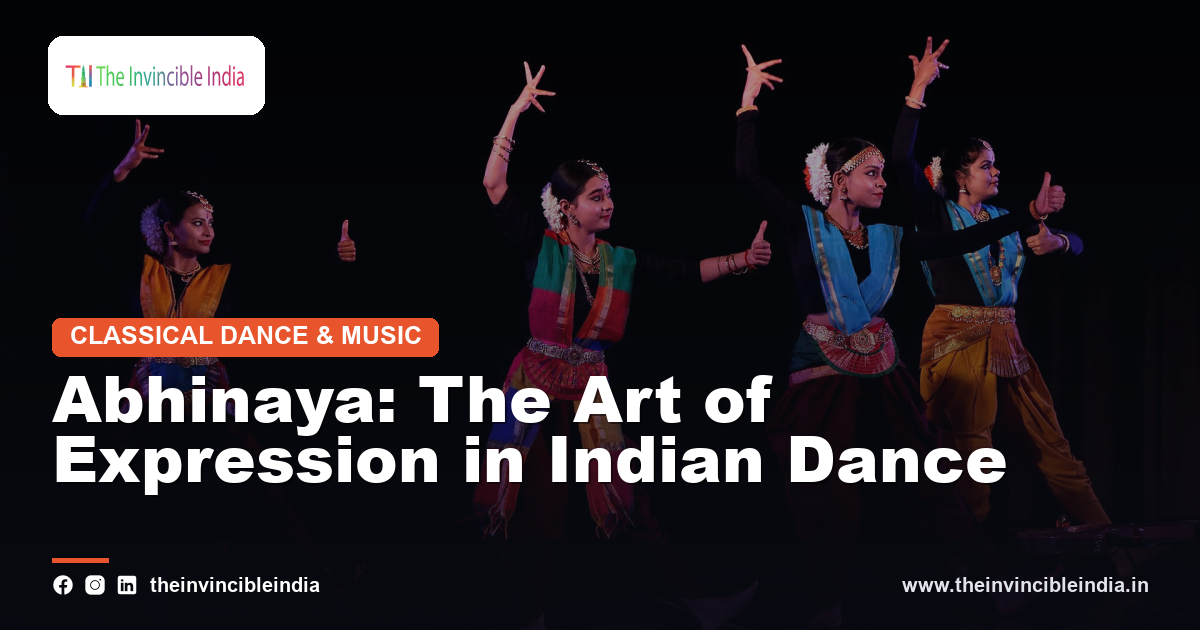
In Indian classical dance, rhythm and movement are only half the story. The other half is abhinaya, the art of expression, through which a dancer turns gesture, glance and posture into narrative, emotion and meaning. The word comes from Sanskrit and is usually understood as carrying the meaning of a performance toward the audience. It is the discipline that allows a single performer to become a god, a heroine, a king or a devotee within moments. Whether in Bharatanatyam or other classical forms, abhinaya lies at the centre of the art. This guide explores its types, tools, philosophy and place in Indian dance.
Quick Facts
| Detail | Information |
|---|---|
| Meaning | The art of expression in dance and drama |
| Source text | The Natya Shastra, the classic treatise on performance |
| Four types | Angika, vachika, aharya and sattvika |
| Key tools | Hand gestures, face, eyes, body, costume and voice |
| Aim | To evoke rasa, the aesthetic experience of emotion |
| Found in | All the major Indian classical dance forms |
What Is Abhinaya
Abhinaya is the art of expression in Indian dance and theatre, covering every means by which a performer communicates meaning and emotion to an audience. It includes gesture, facial expression, movement of the body, speech or song, and the visual language of costume and ornament. While pure dance, called nritta, is concerned with rhythm and form, abhinaya is concerned with story and feeling, bringing poetry and narrative to life. The two are interwoven in most performances, but it is often through abhinaya that a dancer’s depth and maturity are judged. A technically perfect dancer without expressive power may impress the eye, whereas one with fine abhinaya can move the heart, which is the true aim of the art.
Meaning of the Word
The term abhinaya is traditionally explained as coming from roots meaning to carry or lead toward, suggesting that the performer carries the meaning of the text toward the spectator. In this sense the dancer is a kind of messenger, taking the poet’s words, the story’s events and the emotion of a character and delivering them to a receptive audience. The idea highlights the communicative nature of dance in the Indian tradition: performance is not self-display but a means of sharing experience. This understanding places a heavy responsibility on the artist, who must understand the text deeply, feel its mood and project it with clarity. The word itself thus captures the essence of the whole expressive discipline.
The Natya Shastra Foundation
The theoretical basis of abhinaya lies in the Natya Shastra, the ancient Sanskrit treatise on drama, dance and music traditionally attributed to the sage Bharata. This foundational text discusses at length the principles of performance, the means of expression, the emotions to be portrayed and the aesthetic experience to be created. Later writers and traditions built upon its framework, developing detailed manuals and regional practices, but the core concepts remain recognisable across the classical forms. The Natya Shastra treats performance as a complete art that engages body, mind and spirit, and abhinaya as the heart of that art. Its influence on later dance and drama is profound and continues to guide teachers and performers today.
The Four Types of Abhinaya
The Natya Shastra classifies abhinaya into four types, each employing a different means of expression. Angika abhinaya uses the limbs and body, vachika abhinaya uses speech and song, aharya abhinaya uses costume, makeup and ornament, and sattvika abhinaya conveys inner emotional states through involuntary physical signs. Together they form a complete system, covering everything a performer does to communicate. In practice they work in combination: a dancer’s gesture may be supported by the lyrics sung, the colour of the costume and the glow of genuine feeling. This fourfold scheme remains a standard tool for understanding how Indian dance builds meaning and is still taught as part of the formal study of the art.
Angika: Expression Through the Body
Angika abhinaya is expression through the movements of the body, including the hands, face, head, neck, torso and feet. It is the most visible form of abhinaya and encompasses the codified gestures that give Indian dance its distinctive language. Hand gestures, called mudras or hastas, express objects, actions and ideas; head and neck movements convey attitude and response; eye movements guide attention and show emotion. The torso and legs provide posture and rhythm, anchoring the gestural narrative. Because the body is the dancer’s instrument, years of training are needed to make these movements precise yet fluid. Angika abhinaya gives the dancer a rich physical vocabulary with which to depict anything from a blossoming flower to a charging warrior.
Vachika: Expression Through Words
Vachika abhinaya is expression through speech, song and verbal text. In many dance forms the dancer does not speak but dances to a song whose words carry the narrative, and the singer and musicians provide the vachika element while the dancer interprets it through the body. In dance-dramas such as Yakshagana and Kathakali, spoken or sung dialogue forms part of the performance directly. The text may be devotional poetry, a love song or an epic episode, and the dancer’s task is to give visible shape to its meaning. The quality of the poetry and its musical setting thus influences the performance greatly, and a close relationship between dancer, singer and text is essential for effective abhinaya.
Aharya: Costume and Makeup
Aharya abhinaya refers to the external adornment of the performer, including costume, makeup, ornaments, hairstyle and stage setting. These visual elements help to establish character, social position and mood before any movement begins. In Kathakali, elaborate face painting and towering headdresses distinguish gods, heroes and demons at a glance, while in other forms the colour and style of a dancer’s attire convey region, tradition and tone. Costume also shapes movement, as its drape and weight influence how the dancer moves. Aharya thus supports and amplifies the other types of abhinaya, creating a visual world within which the narrative unfolds. Its careful design is an art in itself, and a hallmark of the aesthetic seriousness of Indian dance.
Sattvika: Inner Emotion Made Visible
Sattvika abhinaya is the expression of genuine inner emotional states through involuntary or semi-involuntary physical signs. Classical theory describes a set of such responses, including trembling, perspiration, change of colour, tears and a quivering of the voice, which show that a feeling is deeply experienced rather than merely shown. This is regarded as the most subtle and demanding form of abhinaya, since it depends on the performer’s capacity to truly enter the emotion of the character. When sattvika is successful, the audience senses sincerity beyond technique. It is the quality that elevates a performance from skilled imitation to genuine artistic communication, and it is widely valued as the mark of a great dancer.
Hand Gestures: Hasta Mudras
The hand gestures of Indian dance, known as hasta mudras, are among the most distinctive elements of abhinaya. Traditional texts describe a set of single-hand gestures and a set of double-hand gestures, each with a defined form and a range of meanings depending on context. A single gesture may stand for an object such as a lotus, an animal such as a deer, or an action such as drinking, and combinations of gestures can build entire sentences. The gestures are not arbitrary; they form a codified language that trained viewers can read. Dancers practise them until they are crisp and fluid, using them with the face and eyes to give each moment its precise meaning.
The Face, Eyes and Head
Facial expression is at the core of abhinaya, and the eyes in particular are said to be the most powerful means of communication. Classical treatises describe distinct glances, eyebrow movements and eyelid actions that convey feelings such as longing, anger, wonder and disdain, along with movements of the head and neck that signal affirmation, hesitation or surprise. The dancer learns to isolate each element, building a vocabulary of nuance that can express complex emotion with minimal movement. The face must remain mobile and controlled, showing the character’s feeling without exaggeration. Strong command of facial expression allows even a small gesture to carry great weight and is among the hardest skills to perfect.
Rasa and Bhava
Abhinaya is guided by the twin concepts of bhava and rasa. Bhava refers to the emotional state portrayed by the performer, while rasa is the aesthetic flavour or relish that the audience experiences in response. The Natya Shastra identifies a set of principal emotions and their corresponding rasas, and the performer’s task is to depict the bhava so skilfully that the audience tastes the rasa. This theory frames dance as a transaction of feeling between artist and viewer, with the goal of aesthetic delight rather than mere information. The doctrine has shaped Indian arts of all kinds and remains a central principle in the training of dancers, who learn to cultivate and project emotion with clarity and depth.
The Navarasa
The nine rasas, known as the Navarasa, are the traditional set of aesthetic moods in Indian performance. They are commonly listed as love, humour, compassion, fury, heroism, fear, disgust, wonder and peace. A dancer is trained to portray each of these moods through the face and body, and to move between them within a single piece. A single performance may begin in devotion and move through love, anger and wonder, demanding emotional range and control. Practising the Navarasa is a standard part of a dancer’s education, building the expressive flexibility required for storytelling. Their presence in performance gives Indian dance its emotional richness and its ability to move audiences across cultural boundaries.
Abhinaya in Different Dance Forms
Each classical dance form applies abhinaya in its own manner. In Bharatanatyam, expression often centres on devotional and lyrical poetry, with detailed gesture and facial acting. In Kathak, storytelling and subtle expression mingle with rhythmic virtuosity, while Odissi emphasises graceful, sculptural poses with lyrical expression. In Kathakali, abhinaya reaches theatrical grandeur through highly stylised gesture and face. Mohiniyattam and Kuchipudi have their own emphases, with Kuchipudi retaining strong dramatic elements. Despite these differences, all rest on the same foundation of mudra, facial expression and emotional depth. The variety shows how a shared theory can produce a rich diversity of living practice.
Padam, Javali and the Art of Interpretation
Forms such as the padam and the javali are lyrical compositions that give dancers the greatest scope for abhinaya. These songs, often on themes of love and longing, are performed slowly, allowing the dancer to elaborate the meaning of each line through many variations of expression. The same line may be interpreted in several ways, with the dancer exploring different shades of feeling and imagery. This improvisational interpretation, sometimes called sanchari, demands imagination, poetic understanding and emotional maturity. Such items are often reserved for experienced dancers, since they test the capacity to hold an audience through expression alone. They reveal how abhinaya can turn a few lines of poetry into a vivid and moving drama.
Training in Abhinaya
Training in abhinaya begins with the basic vocabulary of gestures, glances and head movements, which students practise until they become automatic. Later, they learn to apply this vocabulary to songs, interpreting the words and building character. Teachers stress observation of life, study of poetry and mythology, and emotional sensitivity, since abhinaya depends as much on understanding as on technique. Students often learn to perform a single line in many ways, developing creativity and range. The process is gradual and may take many years, with maturity of expression generally deepening with age and experience. A strong guru guides the student not only in method but in the inner discipline needed for authentic expression.
Abhinaya Today
Today abhinaya remains the soul of Indian classical dance. Dancers continue to train in its codified vocabulary while also exploring new subjects, from contemporary themes to adaptations of world literature. Festivals, academies and teachers keep the traditional repertoire alive, and audiences continue to value the emotional power of expressive performance. In an age of speed and spectacle, abhinaya reminds viewers of the beauty of subtlety, of what a glance or a gesture can say. Its principles of clarity, sincerity and emotional depth apply to all performing arts. As the language through which Indian dance tells its stories, abhinaya remains a living tradition and one of the great contributions of Indian culture to world performance.
Sources & Further Reading
- Sangeet Natak Akademi, Government of India (sangeetnatak.gov.in).
- Ministry of Culture, Government of India (indiaculture.gov.in).
Frequently Asked Questions
What does abhinaya mean?
Abhinaya is the art of expression in Indian dance and theatre, covering gesture, facial expression, speech or song, and costume. The word is traditionally understood as carrying meaning toward the audience.
What are the four types of abhinaya?
The Natya Shastra describes angika, expression through the body; vachika, expression through speech and song; aharya, expression through costume and makeup; and sattvika, expression of inner emotion through involuntary signs. Together they form a complete system of expression.
What is the difference between nritta and abhinaya?
Nritta is pure dance, concerned with rhythm and movement for their own beauty, while abhinaya is expressive dance that conveys story, emotion and meaning. Most performances combine the two.
What are the Navarasa?
The Navarasa are the nine traditional aesthetic moods of Indian performance: love, humour, compassion, fury, heroism, fear, disgust, wonder and peace. Dancers train to portray each of them through the face and body.
Why are the eyes so important in abhinaya?
The eyes are regarded as the most powerful means of communicating emotion, and classical texts describe many distinct glances and eye movements. Skilled use of the eyes allows a dancer to convey complex feeling with great subtlety.


