

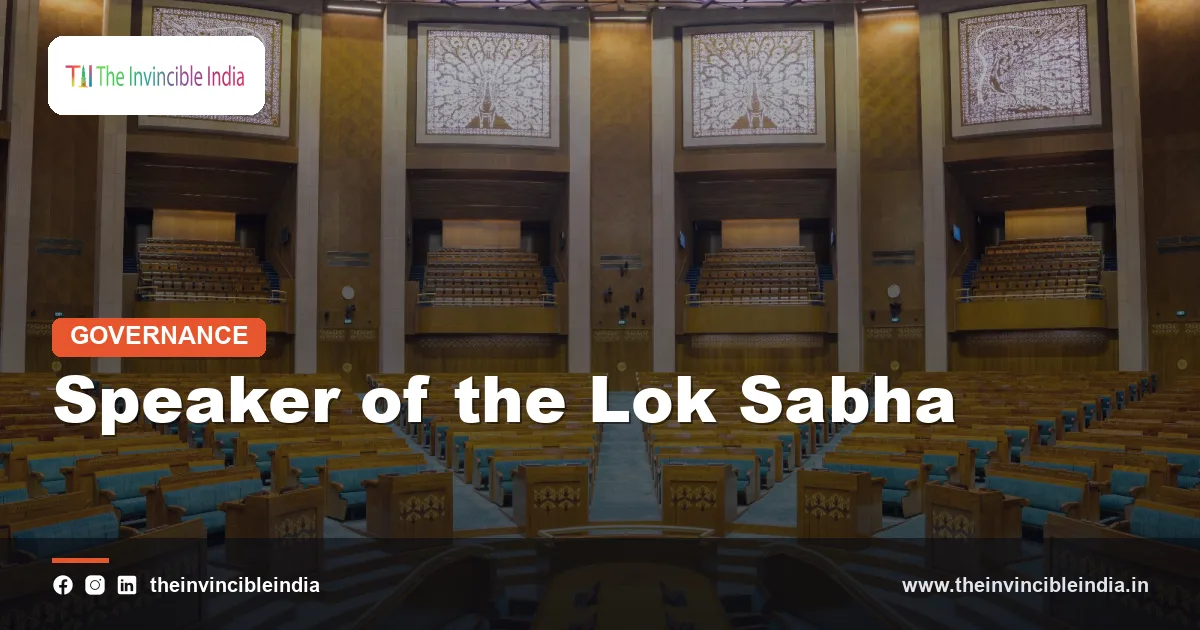
The Speaker of the Lok Sabha is the presiding officer of the lower House of India’s Parliament and the final authority on how its proceedings are run. Elected by the members of the House from among themselves, the Speaker controls debate, maintains order, decides which motions are admitted, certifies Money Bills and represents the House to the outside world. The office is expected to combine the power of a referee with the restraint of a judge.
The role is rooted in the Westminster tradition but has been shaped by India’s own constitutional text, conventions and court decisions. This article explains how the Speaker is chosen, what the Constitution says about the office, the powers over proceedings, the casting vote under Article 100, the controversial role under the anti-defection law, and the work of the Deputy Speaker.
Quick Facts
| Feature | Details |
|---|---|
| Constitutional provisions | Articles 93 to 97 and Article 100, among others |
| Elected by | Members of the Lok Sabha, by a simple majority of those present and voting |
| Term | Duration of the Lok Sabha, but continues until the new House meets after dissolution |
| Removal | Resolution passed by a majority of all the then members, with 14 days’ notice |
| First Speaker of the Lok Sabha | G.V. Mavalankar (1952 to 1956) |
| First woman Speaker | Meira Kumar (2009) |
| Casting vote | Exercised only in case of a tie (Article 100) |
| Money Bill | Speaker’s certificate is final (Article 110) |
| Salary | Charged on the Consolidated Fund of India |
Origins of the Office
The office of presiding officer in India’s legislature has a colonial lineage. Under the Government of India Act, 1919, the Central Legislative Assembly was created with a President, and the first holder, Sir Frederick Whyte, was appointed in 1921. In 1925, Vithalbhai J. Patel was elected by the members as the first Indian to preside over the Assembly, and he is remembered for asserting the independence of the Chair from the executive.
The title of Speaker was adopted after Independence. G.V. Mavalankar had presided over the central legislature from 1946, and he became the first Speaker of the Lok Sabha after the first general election of 1951-52. He is often called the Father of the Lok Sabha because he laid down many of the rules, practices and traditions that still guide the House. Mavalankar also established that the Speaker’s office must be seen to be above party loyalties, a principle that later Speakers have cited repeatedly.
How the Speaker Is Elected
Article 93 of the Constitution says that the House of the People shall, as soon as may be, choose two of its members to be Speaker and Deputy Speaker. The Constitution does not set any special qualification, so any member of the House can be elected to the office. In practice, the candidate is usually proposed by the ruling party or coalition after informal consultations with other parties.
Steps in the election
- After a general election, the President appoints a pro tem Speaker, usually a senior member, who administers the oath to new members and conducts the election of the Speaker.
- The date of the election is fixed by the President for the first such election, and by the Speaker for subsequent vacancies.
- Members move notices proposing names, and if more than one candidate stands, a vote is taken, and a simple majority of members present and voting decides the result.
- The new Speaker is conducted to the Chair by the Prime Minister and the Leader of the Opposition, and the House offers congratulations from all sides.
Convention in many cases, though not in all, has seen the Speaker chosen unopposed or with the support of a broad consensus. A contest, when it occurs, is decided by the strength of the ruling coalition.
Tenure, Resignation and Removal
The Speaker holds office until the end of the Lok Sabha’s term. Article 94 provides that the Speaker vacates the post if he or she ceases to be a member of the House, may resign by writing to the Deputy Speaker, and may be removed by a resolution of the House. A proviso adds that, whenever the House is dissolved, the Speaker continues in office until immediately before the first meeting of the newly elected House. This ensures that the institution has a continuing head even when there are no sitting members, and that the Speaker can attend to the necessary work of the Secretariat during the interval.
The removal procedure
- A resolution for removal can be moved only after at least 14 days’ notice.
- It must be passed by a majority of all the then members of the House, which is higher than a simple majority of those present.
- Under Article 96, the Speaker cannot preside while the resolution is under consideration, though he or she may be present, speak and vote in the first instance, but has no casting vote.
Notices of removal have been moved on a few occasions in the history of the House, including against G.V. Mavalankar, Hukam Singh and Balram Jakhar, but no Speaker has been removed through this process. The strict procedure, combined with the fact that the Speaker usually belongs to the party in power, makes removal difficult in practice.
Powers and Functions Over Proceedings
The Speaker is the guardian of the rights and privileges of the House, its committees and its members. The powers come from the Constitution, the Rules of Procedure and Conduct of Business in Lok Sabha and the directions issued by the Speaker over time.
Conduct of business
- Decides the admissibility of questions, motions, resolutions and notices, including adjournment motions.
- Permits members to speak, determines the order of speakers and the time allotted, and can ask a member to stop or resume their seat.
- Rules on points of order and interprets the rules, and the decisions are generally final.
- Orders the expunging of unparliamentary words from the record.
- Adjourns the House or suspends a sitting in case of grave disorder.
Maintaining order
Under Rules 373 and 374 of the Lok Sabha rules, the Speaker may direct a member to withdraw from the House for disorderly conduct, or name the member, after which the House may suspend him or her. Rule 374A, added in 2001, provides for automatic suspension for five consecutive sittings or the remainder of the session, whichever is less, when a member who has been named persists in grave disorder such as coming into the well of the House and shouting slogans.
The Speaker also decides whether a motion of no-confidence in the government can be admitted. Under Rule 198, leave is granted if at least 50 members rise in support of it, after which the Speaker fixes a day for discussion.
Chairing Committees and Administrative Role
Beyond the chamber, the Speaker is the head of the Lok Sabha Secretariat, which functions under the Speaker’s control under Article 98. The Secretariat is staffed by permanent officials and is led by the Secretary-General, and it ensures that the House can function without depending on the executive.
The Speaker chairs several important bodies:
- Business Advisory Committee, which recommends the time to be allotted for different items of legislative and other business.
- Rules Committee, which considers matters of procedure and suggests amendments to the rules.
- General Purposes Committee, which considers matters affecting the House that do not fall within the purview of other committees.
The Speaker also nominates the chairpersons of parliamentary committees, and is the ex officio President of the Indian Parliamentary Group, which represents India in the Inter-Parliamentary Union. In addition, the Speaker leads parliamentary delegations abroad, presides over conferences of presiding officers of legislative bodies and acts as the symbolic face of the House. When a joint sitting of the two Houses is summoned to resolve a deadlock over a Bill, the Speaker presides under Article 108.
The Casting Vote Under Article 100
Article 100(1) provides that all questions in either House are determined by a majority of votes of the members present and voting, other than the presiding officer. It adds that the Chairman, Speaker or person acting as such shall not vote in the first instance, but shall have and exercise a casting vote in the case of an equality of votes.
This means the Speaker is not an ordinary voting member in the House. Being the neutral arbiter, the Speaker does not vote on a motion or Bill unless the numbers are exactly tied. Only then does the Speaker use the casting vote to break the tie.
Guiding principles
- The principle drawn from British practice, known as Speaker Denison’s rule, suggests the casting vote should preferably be used to allow further discussion, or to keep the existing position unchanged where no further discussion is possible.
- The vote is not meant to reflect the Speaker’s own party preference but to preserve the House’s ability to reconsider the matter.
- Article 100(3) fixes the quorum at one-tenth of the total number of members, which the Speaker must ensure is present before proceeding with business.
Because the ruling coalition usually commands a clear majority, the casting vote is seldom needed, but it remains an important safeguard in a House that could, in a closely divided Parliament, become evenly split.
Certifying Money Bills
One of the Speaker’s most consequential powers relates to Money Bills. Article 110 defines a Money Bill as one that contains only provisions dealing with matters such as taxation, borrowing by the government, the custody of the Consolidated Fund and expenditure charged on it. Under Article 110(3), if any question arises whether a Bill is a Money Bill, the decision of the Speaker of the House of the People is final.
Why it matters
- A Money Bill can be introduced only in the Lok Sabha, and on the recommendation of the President.
- The Rajya Sabha can only make recommendations on it, which the Lok Sabha may accept or reject, and it must return the Bill within 14 days.
- The Speaker must endorse a certificate on every Money Bill transmitted to the Rajya Sabha and presented to the President for assent.
The certification power has led to debate about whether the Speaker may, on occasion, classify a Bill with wider provisions as a Money Bill and so limit the role of the Upper House. In the context of the Aadhaar Act, 2016, the Supreme Court considered the issue, and the question of how far courts can review a Speaker’s certificate has been referred for a more detailed examination. Article 122 protects parliamentary proceedings from being questioned in court on grounds of procedural irregularity, but the extent of this protection in respect of Money Bill certification remains a subject of legal discussion.
Role Under the Anti-Defection Law
The Tenth Schedule, added by the 52nd Constitutional Amendment in 1985, provides for the disqualification of legislators who defect from their party. Under Paragraph 6, the question whether a member of the Lok Sabha has become subject to disqualification is decided by the Speaker, and in the Rajya Sabha by the Chairman. This makes the Speaker an adjudicator in matters that directly affect party strength.
Judicial oversight
In Kihoto Hollohan v. Zachillhu (1992), the Supreme Court upheld the Tenth Schedule but struck down Paragraph 7, which sought to bar judicial review of the Speaker’s decisions. The Court held that the Speaker acts as a tribunal in these matters, so the decisions are subject to judicial review on limited grounds such as mala fides, violation of constitutional mandates and perversity.
The 91st Constitutional Amendment of 2003 removed the exception for splits in a party and retained merger of two-thirds of the legislature party as the only protection. In 2020, in Keisham Meghachandra Singh v. Speaker, Manipur Legislative Assembly, the Supreme Court observed that disqualification petitions should ordinarily be decided within three months, and suggested that Parliament consider vesting such decisions in an independent tribunal, given that the Speaker belongs to a political party. This continues to be a major point of discussion on the office’s neutrality.
Neutrality and Conventions
The Speaker’s authority depends on the confidence of the House as a whole. Although the Constitution does not require the Speaker to quit the party, there are conventions that seek to build impartiality.
- Neelam Sanjiva Reddy resigned from his party on being elected Speaker in 1967 to signal his independence, and has often been cited as an example.
- Speakers generally avoid party activity and do not take part in debates, except in unusual circumstances.
- In 2008, Speaker Somnath Chatterjee remained in the Chair even when his party withdrew support from the government, citing the duty of the office.
- The House expects the Speaker to give opposition members adequate opportunity to speak, and the Speaker is addressed with respect by all members.
In the United Kingdom, the Speaker traditionally gives up party affiliation and is usually not opposed in the constituency at a general election. India has not adopted that practice in full, and a number of expert committees have recommended the Speaker’s disengagement from party politics.
The Deputy Speaker and the Panel of Chairpersons
The Deputy Speaker is also elected by the House under Article 93, after the election of the Speaker, on a date fixed by the Speaker. Under Article 95, the Deputy Speaker performs the duties of the Speaker when the office is vacant, or when the Speaker is absent from a sitting. When presiding, the Deputy Speaker has the same powers as the Speaker, including the casting vote.
Key points about the Deputy Speaker
- The Deputy Speaker is not subordinate to the Speaker but is directly responsible to the House.
- The first Deputy Speaker was M. Ananthasayanam Ayyangar, who later became Speaker.
- By convention, in many Lok Sabhas the post has been offered to a member of an opposition party, though this has not always been followed, and in some terms the post has remained vacant for long periods.
- The Deputy Speaker may resign by writing to the Speaker and can be removed in the same way as the Speaker.
In addition, the Speaker nominates a Panel of Chairpersons, made up of up to ten members, any of whom may preside over the House in the absence of the Speaker and Deputy Speaker. This ensures the proceedings continue smoothly through long sittings.
Conclusion
The Speaker of the Lok Sabha occupies an office whose strength lies as much in convention as in constitutional text. From the casting vote to the certification of Money Bills and decisions under the anti-defection law, the Speaker’s powers are significant, and the credibility of the House depends on how impartially they are exercised. As courts and committees continue to examine the role, the central expectation remains unchanged: that the occupant of the Chair will serve the whole House, and not any single party within it.
Frequently Asked Questions
How is the Speaker of the Lok Sabha elected?
The Speaker is elected by the members of the Lok Sabha from among themselves, by a simple majority of those present and voting, under Article 93. The election is held soon after a new House meets, and is conducted by a pro tem Speaker appointed by the President.
Can the Speaker vote in the Lok Sabha?
The Speaker does not vote in the first instance. Under Article 100, the Speaker exercises a casting vote only when the votes are equally divided, in order to break the tie.
How can the Speaker be removed?
The Speaker can be removed by a resolution passed by a majority of all the then members of the Lok Sabha, after at least 14 days’ notice, under Article 94. The Speaker may also resign by writing to the Deputy Speaker, or vacates the office on ceasing to be a member.
What is the Speaker’s role in a Money Bill?
Under Article 110(3), the Speaker decides whether a Bill is a Money Bill, and the decision is final. The Speaker’s certificate is endorsed on the Bill when it is sent to the Rajya Sabha, which can only make recommendations on it.
What is the Speaker’s role under the anti-defection law?
Under Paragraph 6 of the Tenth Schedule, the Speaker decides whether a member of the Lok Sabha should be disqualified for defection. The Supreme Court has held that this decision is subject to judicial review, and has suggested that Parliament consider an independent tribunal for the purpose.
Who presides when the Speaker is absent?
The Deputy Speaker presides when the Speaker is absent or the post is vacant, as provided in Article 95. If both are absent, a member from the Panel of Chairpersons nominated by the Speaker presides over the sitting.


