

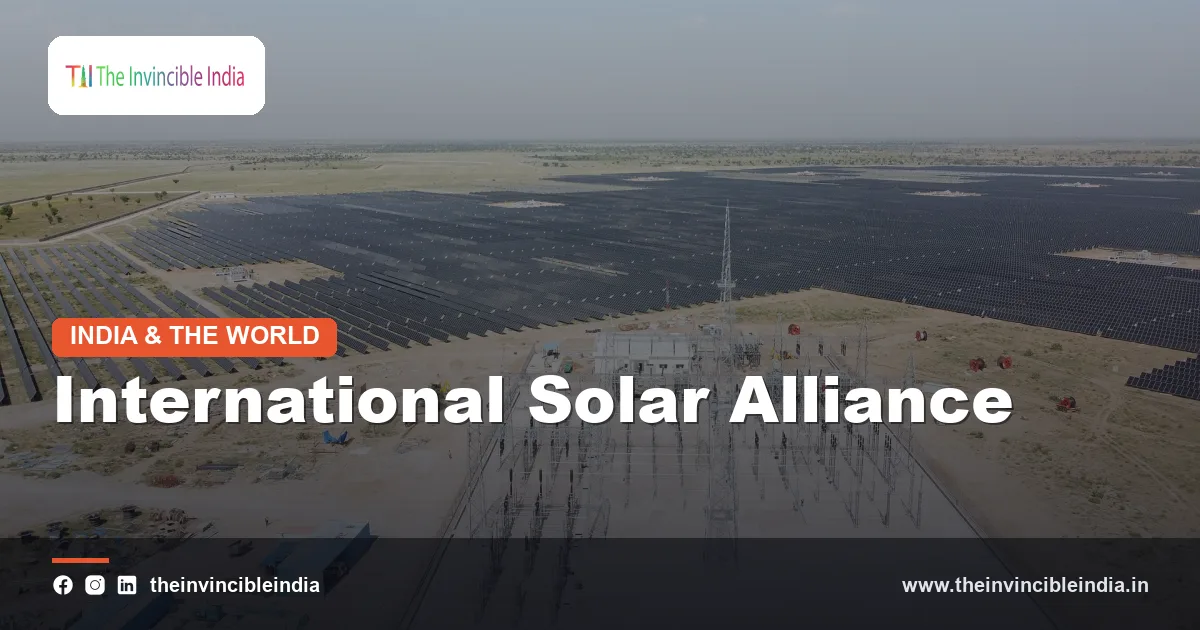
The International Solar Alliance (ISA) is a treaty-based international organisation, jointly conceived by India and France, that brings together countries with abundant sunshine to speed up the deployment of solar energy. It was launched on 30 November 2015 on the sidelines of the Paris climate conference (COP21), and its secretariat is located in Gurugram, Haryana, which makes it the first international intergovernmental organisation to have its headquarters in India.
The International Solar Alliance was built around a simple observation. Many countries that lie between the Tropic of Cancer and the Tropic of Capricorn receive plentiful sunlight throughout the year, yet face high financing costs, limited technology and weak grids, which hold back solar power. By pooling demand, sharing knowledge and mobilising finance, the alliance aims to make solar energy cheaper and more accessible. This explainer looks at its origins, structure, goals, flagship programmes and its place in climate diplomacy.
Quick Facts
| Item | Details |
|---|---|
| Full name | International Solar Alliance (ISA) |
| Launched | 30 November 2015, at COP21 in Paris |
| Founding leaders | Indian Prime Minister Narendra Modi and French President Francois Hollande |
| Legal status | Treaty-based intergovernmental organisation; Framework Agreement entered into force on 6 December 2017 |
| Headquarters | Gurugram, Haryana, India |
| Original target group | Sunshine-rich countries between the Tropics of Cancer and Capricorn |
| Membership today | Open to all United Nations member states since the amendment to the Framework Agreement |
| Guiding slogan | One Sun, One World, One Grid |
Why a Solar Alliance? The Idea Behind the Initiative
Solar energy is, in principle, available almost everywhere, but it is especially abundant in the belt of countries around the equator. Many of these are developing economies in Africa, South Asia, Southeast Asia, Latin America and the Pacific. They have a large energy need, and often a large population with no or unreliable access to electricity, yet solar projects in these regions typically face a higher cost of capital than similar projects in rich countries.
The alliance was intended to tackle that imbalance. India’s leadership drew on its own domestic push for solar power through the National Solar Mission, launched in 2010, which had shown that costs could fall quickly when a large and predictable market was created. France, host of the 2015 climate summit, saw the initiative as a way to give the Paris negotiations a practical, action-oriented outcome.
The “Suryaputra” framing
At the launch, Prime Minister Narendra Modi described the countries of the solar belt as “Suryaputras”, or sons of the Sun, who should collectively use their natural advantage. This framing captured the idea that sunshine, like other natural resources, could become a basis for cooperation rather than competition.
Origins: From Paris 2015 to a Treaty Organisation
The idea was first announced by Prime Minister Modi in 2015, and it took formal shape at COP21, where leaders from India, France and many other countries endorsed a declaration establishing the alliance. The Paris Agreement, adopted at the same conference, provided the wider climate framework in which the ISA would operate.
Key milestones
- November 2015: The alliance is launched in Paris at COP21 as a coalition of solar-rich countries.
- January 2016: The foundation stone of the ISA headquarters is laid in Gurugram by Prime Minister Modi and President Hollande.
- November 2016: The Framework Agreement is opened for signature at the climate conference in Marrakech.
- December 2017: The Framework Agreement enters into force after the required number of countries ratify it, and the ISA becomes a full legal entity.
- October 2018: The first Assembly of the ISA meets in New Delhi.
- 2020 to 2021: The Framework Agreement is amended so that all members of the United Nations, not just countries in the tropics, can join.
Structure and Governance of the ISA
As a treaty-based body, the International Solar Alliance has a formal institutional structure laid out in its Framework Agreement. It works through three main organs.
The Assembly
The Assembly is the supreme decision-making body, with every member country represented. It meets periodically, usually once a year, to approve the programme of work, the budget and important policy decisions. India holds the presidency of the Assembly and France holds the co-presidency, a reflection of their joint role as founders.
The Council and committees
The Council is the executive body that prepares the ground for the Assembly and oversees the implementation of its decisions. It is composed of members elected by the Assembly from different regions, along with the Assembly’s president and co-president. Specialised committees handle matters such as programmes, finance and procedures.
The Secretariat
The Secretariat, led by a Director-General, runs the daily work of the alliance from Gurugram. It coordinates programmes, supports member countries with technical assistance and builds partnerships with development banks, private companies, research institutions and international organisations. The ISA has also been granted observer status at the United Nations General Assembly, which allows it to take part in the UN’s work on energy and climate.
Aims and Targets: The “Towards 1000” Strategy
The alliance’s central mission is to help its members expand the use of solar energy so that it meets a growing share of energy needs. Its strategic framework, often summarised as “Towards 1000”, sets out ambitious goals to be reached by 2030.
- Deploy about 1,000 gigawatts of solar generation capacity across member countries.
- Mobilise investment of about 1,000 billion US dollars in solar energy.
- Provide energy access to about 1,000 million people through solar solutions.
The alliance also aims to lower the cost of solar finance, standardise technical norms, promote research and development, and build skills among engineers and technicians. These targets are aspirational and serve as markers for the direction of progress rather than legally binding commitments.
One Sun, One World, One Grid
The slogan “One Sun, One World, One Grid” (OSOWOG) expresses a long-term vision of interconnected power grids that can carry solar electricity across regions. The logic is simple. The Sun is always shining somewhere on Earth, so a grid that stretches across time zones could carry solar power from places where it is daytime to places where it is night.
How the concept works
The proposal envisages stages of interconnection, first linking national grids within regions in South Asia, the Middle East and Southeast Asia, and later connecting these to Africa and other parts of the world. A related effort, the Green Grids Initiative, was announced by India and the United Kingdom at the Glasgow climate summit in 2021 and works alongside the ISA to promote cross-border transmission.
Practical challenges
- Building long-distance transmission lines is expensive and technically demanding.
- Countries must agree on rules for power trading, pricing and grid security.
- Energy storage and grid management technology need to advance in parallel.
- Political trust between neighbouring countries is essential for shared infrastructure.
Flagship Programmes of the Alliance
To move from vision to action, the ISA has launched a set of programmes that focus on specific uses of solar power. They are designed to help countries with the most urgent needs and to demonstrate models that can be copied.
| Programme area | Purpose |
|---|---|
| Scaling solar applications for agricultural use | Solar water pumps and cold storage to cut diesel use and improve farm incomes |
| Affordable finance at scale | Reduce the cost of capital for solar projects in developing countries through guarantees and innovative financial instruments |
| Scaling solar mini-grids | Bring electricity to remote communities not connected to the main grid |
| Scaling rooftop solar | Support rooftop solar adoption in homes, offices and public buildings |
| Solar e-mobility and storage | Link solar power with electric vehicles and batteries |
| Solar parks and large-scale projects | Share India’s experience with large solar parks and common infrastructure |
Capacity building and technical support
The alliance supports training and the creation of solar technology application resource centres in member countries so that local professionals can design, install and maintain solar systems. It also encourages the sharing of data, research and standards so that countries do not need to start from scratch.
Financing and Partnerships
Money is the biggest hurdle for solar projects in many developing countries. Although solar panels have become much cheaper over the past decade, the up-front investment is large, and risks such as currency fluctuations, off-taker credit and political uncertainty can raise borrowing costs.
Tools to reduce risk
The ISA works with multilateral development banks, climate funds and private investors to develop instruments that reduce risk and attract capital. Examples include partial guarantees, standardised project documentation and pooled procurement of equipment, where several countries combine their orders to obtain better prices. Such mechanisms aim to bring down the cost of capital, which is a major driver of the final price of solar power.
Partnerships
- Development banks and climate funds, which provide loans and grants.
- United Nations agencies and other international organisations, which provide expertise.
- Private sector companies, which supply technology and invest in projects.
- Research institutions and think tanks, which develop standards and policy ideas.
Membership: From Tropical Belt to Global Coalition
The initial design of the alliance reserved full membership for countries that lie wholly or partly between the Tropics of Cancer and Capricorn, which were estimated to number about 120. Other states could take part as partners or supporters. Many countries in Africa, South Asia, Southeast Asia, Latin America and the Pacific signed the Framework Agreement early on.
The amendment that opened membership
In 2020, the Framework Agreement was amended to open membership to all United Nations member states. The change recognised that countries outside the tropics, including major economies in Europe, North America and East Asia, have technology, finance and expertise to contribute, and that solar energy is a global priority. As more countries ratified the amendment, the alliance became a truly global body, though its main focus on solar-rich and developing countries remains.
The ISA in Climate Diplomacy
The alliance is closely tied to the broader global effort to limit climate change. Under the Paris Agreement, each country submits a Nationally Determined Contribution, setting out its own climate targets. Many of these plans rely on a large expansion of renewable energy, and the ISA helps countries convert such pledges into projects.
India’s role
For India, the alliance is an instrument of both climate action and diplomacy. It supports India’s aim of expanding non-fossil capacity, builds ties with developing countries in Africa and Asia, and gives India a leadership role in an international institution. It also reflects the principle of climate justice, the idea that developing countries should have access to the finance and technology they need to grow without relying on fossil fuels.
France and the wider partnership
France brought its diplomatic weight, its development agency and its experience in the energy sector. Together, the two countries have used the alliance to bring developed and developing countries onto a common platform, an approach consistent with their shared interest in multilateral solutions.
Challenges and Criticisms
Like many international initiatives, the International Solar Alliance faces practical difficulties. The most common concerns include the following.
- Finance gap: The funds needed to meet the ambitious targets are far greater than what the alliance can mobilise directly, so success depends on private and multilateral investors.
- Grid and storage limits: Solar power is available only in daylight, so high shares of solar require grids that can balance supply and demand and storage that can hold energy for the evening.
- Local capacity: Many countries need trained workers, regulators and strong utilities to manage solar projects effectively.
- Manufacturing dependence: A large share of solar equipment is produced in a few countries, which raises questions about supply chains and costs.
- Overlap with other bodies: Several agencies work on renewable energy, so coordination is important to avoid duplication.
Supporters respond that the ISA is a catalyst, not a funder, and that its value lies in bringing together buyers, financiers and technology providers, and in giving smaller countries a stronger voice.
Looking ahead
The International Solar Alliance shows how a shared natural resource can become the basis of international cooperation. From its launch in Paris in 2015 to its treaty status in 2017 and its opening to all UN members, the alliance has grown from a bold idea into an institution with a headquarters in Gurugram, flagship programmes and a global membership. Its success will be judged by how many homes, farms and businesses receive affordable solar power, and by how effectively it can turn the vision of One Sun, One World, One Grid into reality.
Frequently Asked Questions
When was the International Solar Alliance launched?
The International Solar Alliance was launched on 30 November 2015 at the Paris climate conference (COP21) by India and France. Its Framework Agreement entered into force on 6 December 2017, which gave it the status of a treaty-based international organisation.
Where is the headquarters of the ISA?
The headquarters is in Gurugram, Haryana, India. It is the first international intergovernmental organisation to be headquartered in India, and its foundation stone was laid in January 2016.
Which countries can join the International Solar Alliance?
Initially, only sunshine-rich countries between the Tropic of Cancer and the Tropic of Capricorn could be full members. After an amendment to the Framework Agreement, membership has been opened to all member states of the United Nations.
What does One Sun, One World, One Grid mean?
It is a vision of interconnected power grids that can carry solar electricity across regions and time zones, so that power generated where the Sun is shining can be used where it is night. The idea is to improve the reliability of solar power and reduce its cost through shared infrastructure.
What are the main targets of the ISA?
Its Towards 1000 strategy aims for about 1,000 gigawatts of solar capacity, about 1,000 billion US dollars of investment and energy access for about 1,000 million people by 2030. These are aspirational goals that guide the alliance’s programmes.
Who leads the International Solar Alliance?
India holds the presidency and France holds the co-presidency of the ISA Assembly, which is the main decision-making body. Day-to-day work is carried out by the Secretariat in Gurugram under a Director-General.


