

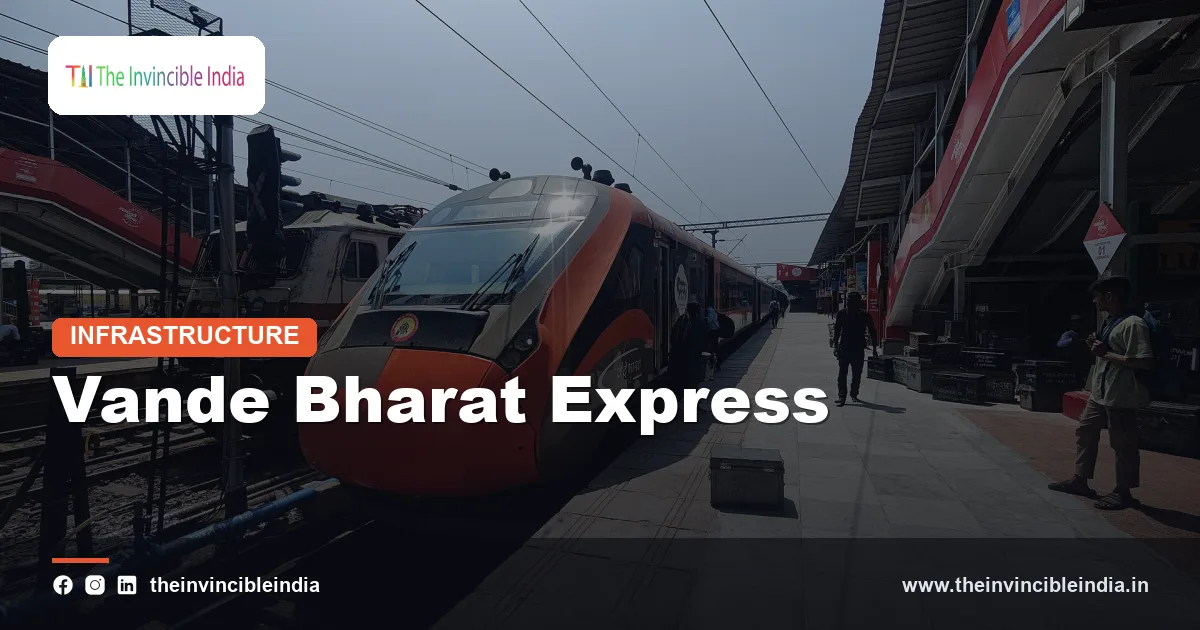
The Vande Bharat Express is India’s first indigenously designed and manufactured semi-high-speed, self-propelled electric trainset. Originally developed under the project name Train 18, it was conceived as a modern, faster and more comfortable replacement for ageing locomotive-hauled intercity services such as the Shatabdi Express. Unlike a conventional train, it has no separate engine at the front: the power equipment is distributed under the coaches themselves, which allows quick acceleration, rapid braking and shorter journey times.
Since its first commercial run in February 2019 between New Delhi and Varanasi, the Vande Bharat Express has become one of the most visible symbols of Indian Railways’ modernisation drive. The brand now covers many routes across the country, and the design has grown into a family of trainsets, including chair-car, sleeper and short-distance variants. This article explains how the train was developed, how it works, what it offers passengers, and where the programme is heading.
Quick Facts
| Item | Details |
|---|---|
| Official brand name | Vande Bharat Express (project name: Train 18) |
| Type | Semi-high-speed electric multiple unit (EMU) trainset |
| Designed and built at | Integrated Coach Factory (ICF), Perambur, Chennai |
| Operator | Indian Railways, under the Ministry of Railways |
| First commercial service | 15 February 2019, New Delhi to Varanasi |
| Traction system | Distributed traction (powered axles under multiple coaches), 25 kV AC overhead supply |
| Design speed | Up to 180 km/h; typical operating speeds are lower, depending on track |
| Variants | Chair car, sleeper version and the shorter-distance Vande Metro concept |
Origins: From Train 18 to Vande Bharat
The story begins in the middle of the 2010s, when Indian Railways recognised that its premier day-time intercity services were being held back by their technology. The Shatabdi Express, introduced in 1988, relied on locomotive-hauled rakes built around older coach designs. Imported high-speed trains were expensive, and earlier attempts to buy foreign trainsets had stalled over cost and technology-transfer questions. Engineers at the Integrated Coach Factory (ICF) in Chennai therefore proposed building a modern trainset in-house, within a short timeframe and at a fraction of the cost of an imported equivalent.
The project was nicknamed Train 18 because it was targeted for completion in 2018. The first rake rolled out of ICF in October 2018 and went through a long series of oscillation, braking and speed trials on test sections. During trials it demonstrated a speed well above the 160 km/h mark, which established it as the fastest train in the country at the time. The name Vande Bharat Express, which can be loosely translated as “salute to India”, was given when the train entered service.
Why it mattered
- It showed that India could design a trainset domestically rather than depending entirely on imports.
- It was developed in a comparatively short period, which was unusual for a rolling-stock project of this scale.
- It created a platform design that could be adapted into different variants over time.
Design and Manufacture at ICF Chennai
The Integrated Coach Factory at Perambur, Chennai, is one of the oldest and largest coach production units of Indian Railways. It was established in the 1950s with technical collaboration from Switzerland and is best known for producing the Integral Coach, the standard passenger coach of Indian Railways for decades. It later became the lead agency for the Vande Bharat project, with the engineering team working on the train’s shell, interiors, bogies and integration of electrical equipment.
Several Indian and foreign component suppliers contributed to the first rakes, supplying items such as traction motors, converters, control systems and interior fittings. Over time, the Ministry of Railways has pushed for greater indigenisation, and the later rakes carry a higher share of domestically sourced parts. Production has also expanded beyond Chennai, with other railway coach factories and private-sector partners taking part in building trainsets, in line with the “Make in India” approach.
Body and materials
The coach shell is made of stainless steel, which is corrosion resistant and suited to Indian climatic conditions. The front is designed with an aerodynamic profile and a streamlined nose cone, which reduces air drag and, in later versions, also helps meet crashworthiness requirements. Coaches are fully sealed and use gangways with no gaps between them, which cuts noise and improves passenger comfort at speed.
How Distributed Traction Works
The key technical idea behind the Vande Bharat Express is distributed traction. In a traditional train, one heavy locomotive pulls or pushes a string of unpowered coaches. All the traction force is concentrated at a single point, and the locomotive’s weight is borne by only a few axles. In an electric multiple unit (EMU), by contrast, several coaches carry their own traction motors on powered axles, so the pulling force is shared along the length of the train.
This has several practical advantages. Acceleration is much faster because more axles are driven and adhesion is spread across the train. Braking is also more effective, and regenerative braking can return part of the energy to the overhead line. In addition, the train can be reversed at a terminus without shunting a locomotive from one end to the other, since each end has a driving cab. This shortens turnaround times at stations and allows a single rake to be used for more trips in a day.
Power supply
- The train draws 25 kV AC single-phase power from overhead catenary, the standard on Indian electrified routes.
- Transformers and converters under the coaches step the voltage down and feed the traction motors.
- Auxiliary systems such as air conditioning, lighting and passenger information run from separate converters.
Features Passengers Experience
For travellers, the most noticeable difference is the interior environment. The coaches are air-conditioned, quiet and smoother than older stock. Seats are cushioned and reclining, and the executive chair car class has seats that can rotate to face the direction of travel. Large windows, ambient lighting and automatic sliding doors give the train a look closer to an international metro or high-speed service than a traditional mail or express.
Onboard systems and amenities
- Passenger information: display screens and announcements that show stations and journey details.
- Connectivity: an onboard infotainment and Wi-Fi arrangement was provided in early rakes.
- Safety monitoring: CCTV cameras inside the coaches and fire detection and suppression systems.
- Toilets: bio-vacuum toilets that use less water and help keep the coach clean.
- Accessibility: spaces and fittings meant for passengers with reduced mobility.
- Catering: pantry facilities with food served to the seat, as is usual on premium services.
The vestibules between coaches are sealed and the doors operate automatically, which improves safety and cuts down on drafts and dust. The suspension and bogie design are tuned for smoother running on Indian track, which has been progressively upgraded on key corridors.
Speed: Design, Operating and Real-World Performance
It is important to distinguish between three different speed figures when discussing the Vande Bharat Express. The first is the design speed, which is the maximum the trainset is engineered to reach, commonly stated as 180 km/h. The second is the trial speed, which the first rake exceeded during testing on a Rajasthan section, creating a record for an Indian train at the time. The third and most relevant for passengers is the operating speed, the speed at which the train is actually allowed to run in service.
Operating speed depends on track quality, signalling, curves, level crossings, and the presence of other traffic. Much of the Indian network is shared by freight, suburban and slower passenger trains, so the Vande Bharat typically runs well below its design limit for most of the journey. On selected sections that have been upgraded, with fencing, improved track geometry and modern signalling, higher speeds up to 160 km/h are permitted. The train’s real advantage is therefore less about its top speed and more about its rapid acceleration and deceleration, which lets it save time at every stop and recover from speed restrictions quickly.
Why the average speed stays lower
- Mixed traffic on the same tracks limits freedom to run at the maximum.
- Older sections have curves and speed restrictions that cap safe speeds.
- Unmanned or poorly protected crossings and stray animals have historically forced caution.
The First Service and Network Expansion
The first Vande Bharat Express was flagged off on 15 February 2019 on the New Delhi to Varanasi route, a corridor that links the national capital with one of the oldest living cities in the world. It cut the travel time of the earlier fastest option by a significant margin and drew heavy public interest. A second service followed in October 2019 on the New Delhi to Katra route, serving pilgrims heading to the Vaishno Devi shrine in Jammu and Kashmir.
After a pause caused by the COVID-19 pandemic and the need to refine the design, expansion picked up from 2022. New services were gradually added across many regions, including routes in Gujarat, Maharashtra, Himachal Pradesh, the south, the east and the north-east. The network has grown to connect state capitals, major commercial centres and pilgrimage and tourist destinations.
| Milestone | Detail |
|---|---|
| October 2018 | First Train 18 rake rolled out of ICF, Chennai |
| 15 February 2019 | First commercial run, New Delhi to Varanasi |
| October 2019 | Second route, New Delhi to Katra |
| 2022 onwards | Rapid expansion with improved, lighter second-generation rakes |
| Later years | Introduction of saffron-and-grey livery, new variants and sleeper development |
Versions: Chair Car, Sleeper and Vande Metro
The brand is no longer a single design. The original chair-car rake is meant for day journeys, typically up to around eight hours, and operates in configurations of different lengths, such as 8, 16 and 20 coaches depending on demand. The newer versions are lighter and have a higher level of safety and comfort features, with improved suspension, better air conditioning and redesigned seating.
Vande Bharat Sleeper
A sleeper version has been developed to replace premium overnight trains such as the Rajdhani Express on long routes. It provides berths instead of seats, while retaining the distributed-traction design, faster acceleration and the modern interiors. The idea is to cut overnight journey times so that passengers could travel between distant cities within a single night.
Vande Metro
The Vande Metro, also known in its development phase as a short-distance or regional variant, is envisaged for routes of a few hundred kilometres between nearby cities. It would feature more standing space and frequent stops, serving daily commuters and travellers who make regular inter-city trips. It is distinct from the urban metro rail systems of cities such as Delhi or Kolkata, and also from the regional rapid transit (RRTS) that runs under a different brand.
Safety Systems
Safety is built into the design on several levels. The coaches are constructed to meet modern crashworthiness norms, with energy-absorbing zones and anti-climbing features. Fire-retardant materials are used for interiors, and the trains have smoke and fire detection systems. Emergency brakes, emergency talk-back units and CCTV help in quick response.
Many routes are also being equipped with Kavach, the indigenous automatic train protection system developed by Indian Railways with domestic industry partners. Kavach is designed to help prevent collisions by automatically applying brakes if a driver fails to respond to a signal or exceeds a speed limit. On high-speed corridors, other safety measures such as fencing along the track, removal of level crossings and better signalling are considered essential before higher speeds can be allowed.
Operational challenges
Early in the programme, the trains were involved in incidents with cattle straying on to the track, which damaged the front nose cone. The design of the nose assembly was subsequently modified to be more easily replaceable, and fencing projects were taken up on several busy corridors.
Economic and Strategic Significance
The Vande Bharat programme matters for reasons beyond the individual trains. It is a flagship of the effort to make Indian Railways a manufacturer and exporter of modern rolling stock rather than merely an importer. Building trainsets domestically supports a wide ecosystem of suppliers in electrical equipment, steel, interiors and electronics, and it builds engineering capability that can serve future projects such as high-speed rail and metro systems.
For passengers, the trains narrow the gap between rail and air travel on medium-distance routes, offering a time-competitive and comparatively affordable alternative. For tourism and pilgrimage circuits, faster connections can encourage greater travel to places that were previously difficult to reach in a single day. The programme also has an energy dimension, since electric traction lowers dependence on diesel and supports the national plan to fully electrify the broad-gauge network.
Criticisms and Challenges
Like any ambitious public project, the Vande Bharat Express has faced scrutiny. Fares are higher than those on ordinary mail and express trains, and the premium positioning means the service is not accessible to every segment of travellers. Observers have also pointed out that, as the trains share tracks with other services, the benefit of higher design speed cannot be fully realised until the underlying infrastructure is upgraded.
Other concerns include the need for sustained investment in track strengthening, signalling and fencing; the importance of maintenance depots that can support modern trainsets; and the necessity of keeping a balance between flagship services and the needs of the vast majority of passengers who use ordinary trains. Indian Railways has responded by pairing the rollout with infrastructure upgrades and by working on a wider range of train categories.
The Road Ahead
The future of the Vande Bharat family is tied to the broader modernisation of Indian Railways. Plans include more sleeper rakes for long-distance overnight routes, lighter and more energy-efficient designs, greater indigenous content, and gradual export potential. Developments such as improved bogies, advanced onboard diagnostics and wider deployment of Kavach are expected to feature in later generations.
The brand will also coexist with other modern initiatives, including the Mumbai-Ahmedabad high-speed rail project, dedicated freight corridors and the continued electrification of the network. Together, these efforts aim to improve speed, capacity and safety across the railway system.
Conclusion
The Vande Bharat Express began as a bold in-house experiment at ICF Chennai and has grown into a national brand for modern rail travel. Its distributed traction, passenger comforts and rapid acceleration set it apart from conventional services, and its expanding family of variants reflects a long-term shift in how Indian Railways designs and builds trains. While the full potential of its design speed depends on continued track and signalling upgrades, the programme has already changed expectations of what a domestic passenger train can be.
Frequently Asked Questions
What is the Vande Bharat Express?
The Vande Bharat Express is an indigenously built, semi-high-speed electric trainset operated by Indian Railways. It was developed as Train 18 and works on the distributed-traction principle, so it needs no separate locomotive. It offers air-conditioned chair-car travel on medium-distance intercity routes.
Where was the Vande Bharat Express built?
The first trainset was designed and built at the Integrated Coach Factory (ICF) in Perambur, Chennai, and rolled out in October 2018. Production of later rakes has expanded to other coach factories and industry partners under the Make in India approach.
When did the first Vande Bharat Express start running?
The first commercial service began on 15 February 2019 between New Delhi and Varanasi. A second service connecting New Delhi and Katra followed in October 2019, and the network has been steadily expanded since 2022.
How fast is the Vande Bharat Express?
The trainset is designed for speeds of up to 180 km/h, and the first rake exceeded 160 km/h in trials. In regular service, the permitted speed depends on the track section, and most routes see lower average speeds because of shared tracks and speed restrictions.
What is the difference between the chair-car and sleeper versions?
The chair-car version has seats and is intended for day journeys of up to several hours. The sleeper version has berths and is meant to replace overnight premium trains on long routes, using the same basic distributed-traction technology with interiors designed for night travel.
What is the Vande Metro?
The Vande Metro is a planned short-distance variant of the Vande Bharat design intended for travel between nearby cities. It is expected to have more standing capacity and frequent stops, and it is different from the urban metro systems operating within cities.


