

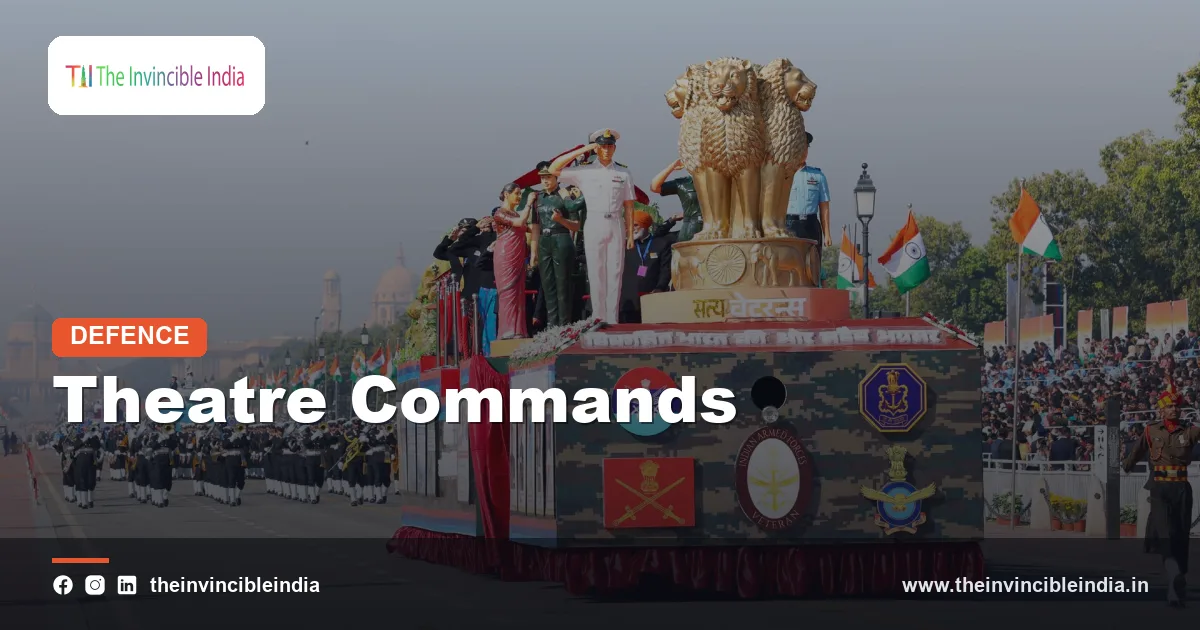
Integrated theatre commands are one of the most significant organisational reforms under discussion in the Indian military since independence. The idea is to replace a system in which the Army, Navy and Air Force each plan and fight their own separate campaigns with one in which a single commander controls land, sea and air assets in a particular geographic area, or theatre, of operations. Such a commander would answer for the outcome of the whole joint battle rather than for one service’s part in it.
India’s armed forces have so far operated mostly through single-service commands, with only a few tri-service commands, such as the Andaman and Nicobar Command and the Strategic Forces Command, in place. The creation of the post of Chief of Defence Staff and the Department of Military Affairs in 2019-20 was meant to lay the groundwork for deeper “jointness”. This explainer describes the background, the existing structures, the models under discussion, the expected benefits and the genuine challenges involved.
Quick Facts
| Item | Details |
|---|---|
| Concept | Joint command of Army, Navy and Air Force units under one commander for a defined geographic theatre |
| Post of CDS announced | 15 August 2019, from the Red Fort |
| CDS approved by Cabinet | 24 December 2019; General Bipin Rawat took charge as the first CDS on 31 December 2019 |
| Department of Military Affairs | Created in the Ministry of Defence in January 2020, with the CDS as its Secretary |
| First tri-service command | Andaman and Nicobar Command, Port Blair, 2001 |
| Strategic Forces Command | Set up in 2003 to manage the nuclear forces under the Nuclear Command Authority |
| Key earlier recommendations | Kargil Review Committee (1999), Group of Ministers (2001), Naresh Chandra Task Force (2012), Shekatkar Committee (2016) |
| Related law | Inter-Services Organisations (Command, Control and Discipline) Act, 2023 |
What Is a Theatre Command?
A theatre command is a permanent military formation that brings together the forces of all services needed to fight in a given region, and places them under a single operational commander. The commander plans, trains and fights with the land, air and naval units assigned to the theatre, and reports upwards to the national military leadership. The units remain part of their parent services for recruitment, training doctrine and administration, but their operational control passes to the theatre commander.
Joint, combined and integrated
Terms are often used loosely, so it helps to distinguish them. “Joint” means the cooperation of two or more services of the same country. “Combined” refers to operations with allied foreign forces. “Integrated” suggests a deeper fusion, with common planning staffs, command structures and, ideally, a single chain of command, rather than occasional coordination.
Why geography matters
Modern warfare is rarely fought in a single domain. A land battle may need air support, naval control of sea lanes, cyber and space inputs, and unified logistics. A theatre command gives one officer responsibility for synchronising all these in one region, instead of leaving three service chiefs to coordinate in the face of an emergency.
The Present Command Structure
At present, India’s armed forces are largely organised along service lines. The Indian Army has seven commands in all: six operational commands, namely Northern, Western, Eastern, Southern, South Western and Central, along with the training-oriented Army Training Command, known as ARTRAC. The Indian Navy has three commands: Western Naval Command at Mumbai, Eastern Naval Command at Visakhapatnam and Southern Naval Command at Kochi, the last of which focuses chiefly on training. The Indian Air Force has seven commands, five operational and two functional, covering training and maintenance.
Because the boundaries of these commands do not coincide and their headquarters are located in different cities, a single contingency along a border can involve several commanders from three services, each with different reporting lines. This fragmentation is exactly what the proposed theatre structure aims to resolve.
The Chiefs of Staff Committee
The Chiefs of Staff Committee, comprising the heads of the three services, has historically been the highest forum for inter-service coordination. Its chairmanship used to rotate according to seniority, which limited continuity. The post of Chief of Defence Staff changed this by giving the committee a permanent chairman.
Existing Tri-Service Commands and Organisations
India has already experimented with joint structures, and the results provide a template for what a wider reform might look like.
- Andaman and Nicobar Command (ANC): Established in 2001 at Port Blair, it was the country’s first and remains the only geographic tri-service theatre-style command. It oversees the strategically located island chain at the mouth of the Malacca Strait and is headed by a Commander-in-Chief rotated among the three services.
- Strategic Forces Command (SFC): Created in 2003 after the Nuclear Command Authority was established, it manages and administers the country’s strategic nuclear forces. It is a functional rather than a geographic command and is controlled by the political leadership through the Nuclear Command Authority.
- Integrated Defence Staff (IDS): Established in 2001 as a joint planning and coordination body in the Ministry of Defence, it now works under the CDS.
- Defence Intelligence Agency (DIA): Created in 2002 to coordinate military intelligence among the services.
- Defence Cyber Agency and Defence Space Agency: Joint organisations created in the wake of the national security reforms to handle emerging domains.
- Armed Forces Special Operations Division: A joint special-forces body formed to coordinate the special units of the three services.
The Andaman and Nicobar Command is often cited as proof of concept for jointness, but it also shows the limits of the model. Since the services retain much of their own authority and the commander-in-chief has limited power to direct assets from the home commands, the ANC has had difficulty exercising full operational control.
Why Reform Was Considered Necessary
The case for jointness rests on lessons from past conflicts and on the international trend. The Kargil conflict of 1999 revealed gaps in intelligence sharing, coordination and higher defence management. The Kargil Review Committee, headed by K. Subrahmanyam, recommended a comprehensive review of national security, including the appointment of a Chief of Defence Staff. A Group of Ministers examined the recommendations in 2000-01 and endorsed the idea, leading to the creation of the Integrated Defence Staff and the Andaman and Nicobar Command, though the CDS post itself had to wait nearly two decades.
Reports that shaped the debate
- Kargil Review Committee (1999): Called for a reform of the higher defence organisation and the appointment of a CDS.
- Group of Ministers (2001): Accepted the need for a CDS and a unified approach, and recommended single-point military advice for the government.
- Naresh Chandra Task Force (2012): Suggested a permanent Chairman of the Chiefs of Staff Committee as an intermediate step.
- Shekatkar Committee (2016): Proposed measures to improve combat capability and rebalance expenditure within the armed forces.
The international trend also mattered. The United States adopted its modern combatant command structure after the Goldwater-Nichols Act of 1986, and China reorganised its military into joint theatre commands in 2016. Many other countries have moved the same way.
The Role of the CDS and the Department of Military Affairs
On 15 August 2019, the Prime Minister announced from the ramparts of the Red Fort that India would have a Chief of Defence Staff. The Union Cabinet approved the post on 24 December 2019, and General Bipin Rawat, the former Army Chief, assumed office as the first CDS on 31 December 2019. In January 2020, the Department of Military Affairs (DMA) was created as a fifth department within the Ministry of Defence, with the CDS as its Secretary.
Functions of the CDS
- Serves as the principal military adviser to the Defence Minister on tri-service matters, while the three service chiefs continue to advise on matters concerning their own services.
- Acts as the Permanent Chairman of the Chiefs of Staff Committee.
- Heads the Department of Military Affairs and functions as a four-star officer.
- Administers tri-service organisations, including the Andaman and Nicobar Command, the Defence Cyber Agency and the Defence Space Agency.
- Is a member of the Defence Acquisition Council and the Defence Planning Committee, and is the Military Adviser to the Nuclear Command Authority.
- Does not exercise operational command over the services, and does not command troops, a point that distinguishes the post from a full-fledged theatre commander.
Mandate of the DMA
The DMA’s mandate includes promoting jointness in procurement, training and staffing, facilitating the restructuring of military commands for optimal use of resources, and promoting the use of indigenous equipment. Notably, the CDS was specifically tasked with restructuring military commands to establish joint and theatre commands, often within a fixed period.
Proposed Models and Theatres
The government has not published a final blueprint, and details discussed in public have varied. Several broad models have been discussed by defence analysts and in official statements over the years, and a short comparison is useful.
| Model | Basic idea | Typical commentary |
|---|---|---|
| Geographic theatre commands | Separate commands for each major front, such as a northern command facing the northern borders and a western command facing the western front | Closest to the Chinese and American models; ensures dedicated forces for each threat |
| Maritime theatre command | A command covering the Indian Ocean region and the coasts, with naval leadership and air and land components | Reflects the country’s long coastline and island territories |
| Functional commands | Commands organised by function, such as air defence, logistics, training or space | Useful for shared resources that cannot be divided by geography |
| Hybrid model | A combination of a small number of geographic theatres and functional commands | Considered the most likely compromise for India’s circumstances |
Among the structures discussed in public are three geographic theatres, northern, western and maritime, together with an Air Defence Command. These should be treated as proposals rather than settled decisions.
Goals and Expected Benefits
Advocates argue that theatre commands would make India’s military more cost-efficient and effective. The main expected advantages are as follows.
- Unity of command: A single commander is responsible for all operations in a theatre, reducing delays and confusion in a crisis.
- Optimal use of resources: Assets such as aircraft, ships and logistics can be shared and allocated according to operational need rather than service ownership.
- Integrated planning: Joint staff and common doctrine allow operations in all domains to be planned together from the beginning.
- Reduced duplication: Common logistics, communications, medical and training infrastructure can cut costs.
- Faster decision-making: Shorter chains of command allow quicker responses on the ground.
- Better preparation for modern warfare: Cyber, space and information operations demand cross-service integration.
These goals are supported by joint doctrines and by initiatives such as joint logistics nodes and joint training, which gradually build habits of cooperation among the services.
Challenges and Concerns
Theatre commands are conceptually appealing but practically difficult. Their introduction in a large and complex organisation involves careful negotiation, and several issues have shaped the pace of the reform.
Allocation of air power
The most sensitive question concerns the Air Force. Air assets are scarce and highly flexible, and can shift rapidly between fronts. There are concerns that splitting them among several theatres could dilute the concentration of force, and that important assets such as strategic airlift, air defence and strike aircraft might need centralised control. How many aircraft to allot to each theatre, and what to retain under the Air Chief, is a key design issue.
Command, seniority and legal provisions
There are questions about the rank of theatre commanders, how seniority would be handled among officers from different services, and what role would remain for the service chiefs. The Army Act, 1950, the Air Force Act, 1950 and the Navy Act, 1957 govern discipline and command in each service separately. The Inter-Services Organisations (Command, Control and Discipline) Act, 2023 was passed to allow the commander of a joint organisation to exercise disciplinary and administrative control over personnel of all services posted to it, removing one of the legal barriers.
Other concerns
- Different service cultures: Each service has its own traditions, training methods and operating concepts.
- Resource and budget control: Deciding who funds and equips the theatre forces is a complex matter.
- Threat perception: A two-front situation, plus maritime responsibilities, complicates how many theatres are enough.
- Political oversight: The role of civilian leadership and the Ministry of Defence in the new structure needs to be defined clearly.
- Transition risk: Restructuring while operational commitments continue requires careful sequencing.
Lessons from Other Countries
India’s reform is often compared with foreign examples, though none can be copied directly. The American system divides the world into geographic and functional combatant commands led by four-star officers who report to the Secretary of Defense and the President. The 1986 reform was the product of lessons from failures in joint operations, and it took years to take effect.
China’s People’s Liberation Army reorganised in 2015-16 into five theatre commands, shifting the old system of regional military commands and strengthening the central military leadership. Other countries, including the United Kingdom and France, rely on joint operational headquarters that command forces drawn from the services for each operation. These variations show that jointness can be achieved in different ways, from permanent geographic commands to flexible joint task forces assembled when needed.
The common thread is that deeper integration usually follows political decisions, sustained legal reform and long periods of adjustment, rather than quick structural changes alone.
The Road Ahead
The foundations of jointness are being laid step by step. Joint doctrines, joint training institutions, shared logistics hubs, common procurement planning and cross-posting of officers are all intended to build trust among the services before theatre commands are formally created. The CDS and the Department of Military Affairs continue to coordinate the effort in consultation with the service chiefs and the political leadership.
Whatever the final design, the aim remains the same: to ensure that India’s land, sea and air forces fight as one force, backed by modern capabilities in the cyber, space and information domains. Any final model will need to balance operational effectiveness with the distinctive strengths of each service.
Conclusion
Integrated theatre commands represent a shift from service-centred to mission-centred military organisation. The creation of the CDS, the Department of Military Affairs and the legal framework for inter-services organisations has moved India closer to that objective, while the Andaman and Nicobar Command and the Strategic Forces Command offer working experience of joint structures. The design details, especially for air power, remain matters for careful deliberation, and the success of the reform will depend on consensus among the services and strong political direction.
Frequently Asked Questions
What is an integrated theatre command?
It is a joint military command in which units of the Army, Navy and Air Force operating in a specific geographic region or function are placed under a single commander. The commander is responsible for planning and conducting all operations in that theatre, instead of each service acting separately.
Which is India’s first tri-service command?
The Andaman and Nicobar Command, headquartered at Port Blair, was established in 2001 as India’s first integrated tri-service command. The Strategic Forces Command, created in 2003, is another joint command, but it is functional and manages the nuclear forces rather than a geographic area.
What is the role of the Chief of Defence Staff?
The CDS is the principal military adviser to the Defence Minister on tri-service matters, the permanent chairman of the Chiefs of Staff Committee and the Secretary of the Department of Military Affairs. The CDS promotes jointness and oversees tri-service organisations, but does not exercise operational command over the three services.
When was the Department of Military Affairs created?
The Department of Military Affairs was created in January 2020 within the Ministry of Defence, after the Cabinet approved the post of Chief of Defence Staff in December 2019. It became the fifth department of the ministry, headed by the CDS as its Secretary.
Why are theatre commands considered difficult to implement?
Challenges include deciding how to distribute scarce air assets among theatres, defining command and seniority arrangements, aligning separate service laws and cultures, and managing the transition without affecting operational readiness. The Inter-Services Organisations Act of 2023 addressed some legal issues, but design questions remain.
How many commands do the Indian armed forces have at present?
The Army, Navy and Air Force each have their own commands, with the Army having seven, the Navy three and the Air Force seven. In addition, there are two tri-service commands, the Andaman and Nicobar Command and the Strategic Forces Command, which operate under the CDS and the Nuclear Command Authority respectively.


