

The BrahMos missile is one of the most recognisable weapons in India’s arsenal and a rare example of a successful long-running defence partnership between India and Russia. It is a supersonic cruise missile, meaning that it flies at a sustained speed greater than that of sound, at low altitude, along a guided path to strike a chosen target. It can be launched from land, ships, submarines and aircraft, and is widely regarded as one of the fastest operational cruise missiles in the world.
Unlike many Indian defence programmes, which are developed entirely by a single agency, BrahMos is the product of a joint venture company created for the purpose. It combines Indian systems integration, guidance and electronics expertise with Russian propulsion and missile design heritage. This explainer covers the origin of the name, the technology, the evolution of its range, its variants, its integration with the Su-30MKI and its first major export order.
Quick Facts
| Item | Details |
|---|---|
| Type | Supersonic cruise missile, anti-ship and land-attack |
| Developer | BrahMos Aerospace, a joint venture of India’s DRDO and Russia’s NPO Mashinostroyeniya (NPOM) |
| Joint venture formed | 12 February 1998, by an inter-governmental agreement signed in Moscow |
| Name | Derived from the Brahmaputra river of India and the Moskva river of Russia |
| First test launch | 12 June 2001, from the Integrated Test Range at Chandipur, Odisha |
| Speed | Roughly Mach 2.8 to 3, nearly three times the speed of sound |
| Propulsion | Two stages: solid-fuel booster, then a liquid-fuelled ramjet |
| Launch platforms | Land, ship, submarine (tested) and air |
| First export customer | The Philippines, with a contract signed in January 2022 |
Origin and Meaning of the Name
The name BrahMos is a portmanteau of two rivers, the Brahmaputra in India and the Moskva in Russia. It was chosen to symbolise the friendship and cooperation between the two countries, and its spelling deliberately echoes the Sanskrit word “Brahma”, the creator in Hindu tradition. The company which builds the missile took the same name.
Why a joint venture
By the 1990s, India wanted a modern, fast cruise missile that could be used against ships and land targets, while Russia possessed proven technology developed for its own anti-ship missiles. The Defence Research and Development Organisation, then led by Dr A.P.J. Abdul Kalam as Scientific Adviser to the Defence Minister, signed an agreement with the Russian Federation in 1998 to create a joint company. The venture was capitalised in a roughly 50.5 to 49.5 per cent split between the Indian and Russian sides, with India holding the slightly larger share. Dr A. Sivathanu Pillai was the first chief executive of BrahMos Aerospace.
The Russian parent design
The BrahMos design draws on the Russian P-800 Oniks, also known by its export name Yakhont, an anti-ship missile developed by NPO Mashinostroyeniya of Reutov near Moscow. Indian engineers have contributed significantly to the guidance system, software, airframe elements, testing and integration, and the missile has been continually upgraded.
How the Missile Works
BrahMos is a two-stage missile. The first stage is a solid-propellant booster, which accelerates the missile from the launcher to supersonic speed and then separates. The second stage is a liquid-fuelled ramjet, in which the high-speed airflow itself is used to compress the air before combustion, without needing a conventional turbine. The ramjet then sustains supersonic flight for the rest of the journey. This design is the reason the missile can maintain speeds in the region of Mach 2.8 to 3 over its flight path.
Flight profile and guidance
The missile can fly at different altitudes and trajectories. For an anti-ship mission, it can cruise at a very low altitude, often described as sea-skimming, to avoid detection by ship radars until the last moments. For land targets, it can follow a high-altitude cruise followed by a steep terminal dive. It works on the “fire and forget” principle: once launched, it homes in on the target on its own using inertial navigation and an active radar seeker, without the operator needing to guide it.
Why speed matters
Because it travels at nearly three times the speed of sound, the missile gives the target very little time to react. Its kinetic energy at impact adds to the destructive effect of the conventional warhead, which weighs about 200 to 300 kg depending on the version. Compared with subsonic cruise missiles that travel at about 0.8 Mach, BrahMos reaches targets far more quickly and is harder to intercept.
Development and Testing History
The first test firing took place on 12 June 2001 from a land-based launcher at the Integrated Test Range, Chandipur in Odisha. Further trials in the following years refined the missile, and it was inducted into the Indian Navy, with the first ship-launched firing from INS Rajput in 2005, the year of its formal induction. The Indian Army began receiving land-attack versions soon afterwards.
Over the years, the missile has undergone repeated upgrades in its software, seeker and range, and each new variant has been put through a series of successful trial firings.
Milestones
- 1998: BrahMos Aerospace is formed in a government-to-government agreement.
- 2001: First test launch from Chandipur.
- 2005: Induction into the Indian Navy begins, starting with the destroyer INS Rajput.
- 2007: The Indian Army inducts the first regiment of land-based BrahMos missiles.
- 2013: A submarine-launched version is tested from a submerged platform.
- 2016: India joins the Missile Technology Control Regime, opening the way to longer ranges.
- 2017: The air-launched version is test-fired from a Su-30MKI.
- 2022: The first export contract is signed with the Philippines.
Range Evolution
The original BrahMos was limited to a range of about 290 km. This was not a purely technical limit. India was not yet a member of the Missile Technology Control Regime (MTCR), a voluntary group that restricts the transfer of missiles with a range above 300 km and a payload above 500 kg, and BrahMos was kept within those thresholds. India’s entry into the MTCR in June 2016 removed this constraint for the cooperation with Russia.
Following this, the extended-range versions were developed with ranges of roughly 400 km and above, and subsequent trials of extended-range versions have been announced. The missile’s range depends on the version, the launch platform and the flight profile, and figures published by the manufacturer and the government have increased over time. A longer range allows launchers to remain farther from their targets and out of reach of enemy defences.
| Stage | Approximate range | Note |
|---|---|---|
| Initial version | About 290 km | Kept within MTCR limits |
| Post-MTCR extended-range version | Roughly 450 km and beyond | Tested following India’s MTCR membership |
| Later extended-range ambitions | Longer ranges have been publicly discussed | Subject to ongoing testing and official announcements |
Variants: Land, Sea, Air and Sub-Surface
One of the main strengths of BrahMos is its modular, multi-platform design. The same basic missile has been adapted to four types of launch platform, giving all three services a common weapon.
Ship-launched
The ship-launched version was the first to be inducted. It is fitted on a number of Indian Navy warships, including the Talwar-class and Shivalik-class frigates, the Delhi-class and Kolkata-class destroyers and newer classes built in India. The missile is carried in vertical or inclined launchers on deck and gives surface ships powerful anti-ship and land-attack capability.
Land-based
The Indian Army operates BrahMos in mobile autonomous launcher systems mounted on heavy trucks, each carrying several missiles. These units are organised into regiments and deployed to strike enemy targets such as command centres, bunkers, bridges and radar sites. A block upgrade allows the missile to hit targets in mountainous terrain by performing a steep dive and manoeuvring.
Submarine-launched
A submarine-launched variant was tested in 2013 from a submerged pontoon, and further trials followed. It is designed to be fired from the torpedo tube, or a vertical launcher, of a submarine while it is underwater. This would give the Navy a stealthy first-strike capability, since submarines are difficult to detect.
Air-launched
The air-launched BrahMos-A is lighter than the surface versions and is designed to be carried by aircraft. It is described in detail in the next section.
The Air-Launched BrahMos on the Su-30MKI
The Sukhoi Su-30MKI, built under licence by Hindustan Aeronautics Limited, is the main platform for the air-launched BrahMos. Making it work meant modifying both the missile and the aircraft. The missile was made lighter by about 500 kg compared with the surface versions, its booster and fins were adapted for air launch, and the Su-30MKI’s structure, electronics and software were modified to carry the weapon under the fuselage.
The Su-30MKI fitted with BrahMos made its first successful launch on 22 November 2017, when it fired the missile at a sea target in the Bay of Bengal. Subsequent firings tested its ability to hit both sea and land targets with accuracy. The Indian Air Force has modified a number of its Su-30MKIs for the role.
Strategic value
- The aircraft can launch from a long distance from the target, within safe airspace.
- The aircraft’s own range extends the reach of the missile far beyond its basic range.
- It gives the air force a quick-reaction, stand-off strike capability against ships and key land targets.
- The weapon is highly mobile, since it can be launched from any part of the country’s airspace.
The Indian Navy has also been exploring the use of BrahMos on carrier-based and other naval aircraft in the longer term, though that remains a matter of ongoing development.
Next-Generation Developments: BrahMos-NG and BrahMos-II
BrahMos Aerospace has been working on a smaller and lighter version known as BrahMos-NG, or New Generation. It aims to keep supersonic speed while cutting weight and length considerably, with the aim of fitting it to more platforms, including smaller fighter aircraft and submarine torpedo tubes, and being fired in larger numbers from ships. The new design is also expected to have reduced radar signature and improved electronics.
A hypersonic cruise missile concept, known as BrahMos-II, which would travel at about Mach 7, was also discussed as a long-term project. It has been regarded as a technologically challenging effort which would need a scramjet engine, and public information on its progress has been limited.
The wider missile family
BrahMos sits alongside other Indian missile systems developed by the DRDO, such as the Prithvi, Agni and Akash missiles. It fills the niche of a high-speed conventional precision-strike weapon, as distinct from ballistic missiles used for longer ranges or nuclear roles.
Exports and the Philippines Deal
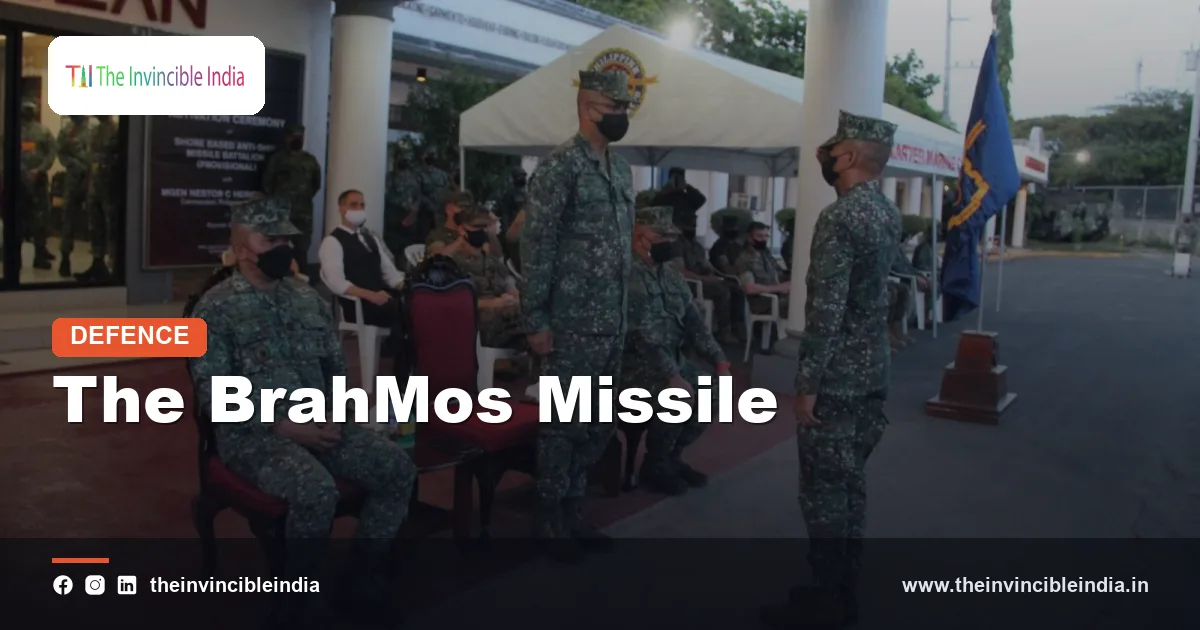
BrahMos is a key element of India’s drive to export defence equipment. In January 2022, the Philippines signed a contract of roughly 375 million US dollars with BrahMos Aerospace for a shore-based anti-ship missile system, making it the first foreign customer. The system, intended to strengthen the Philippines’ coastal defence, includes missiles, launchers, a command and control unit and training and support. Deliveries began with the first batteries arriving in 2024.
Other export interest
Several other countries, especially in South-East Asia and the Middle East and Latin America, have been reported to have shown interest in the system, and negotiations with some have been described in the media from time to time. Since the missile is a joint venture product, any sale needs the approval of both the Indian and Russian governments, and the market is shaped by diplomatic relations and the regional security environment.
Exports also bring economic benefits, including higher production volumes and job creation, and support India’s emergence as a defence exporter alongside the broader Make in India and self-reliance initiatives.
Production, Industry and Indigenisation
The missile is made through an extensive network of Indian public and private firms and research laboratories, with BrahMos Aerospace acting as the integrator. Over time, the share of Indian components has risen, with many subsystems that were initially imported from Russia, such as the seeker, the airframe and the software, now produced in India. The headquarters of BrahMos Aerospace is in New Delhi, and the production and integration are done at several facilities across the country, including a facility at Thiruvananthapuram in Kerala.
Why the model is considered a success
- It moved quickly from agreement to a tested missile within about three years.
- It combined partners’ strengths rather than replicating existing work.
- It delivered a common weapon system for all three services.
- It created a platform that could be exported and upgraded.
Strategic Significance
For India, BrahMos offers a credible conventional deterrent. Its speed and low altitude make it hard to intercept, and its availability on multiple platforms provides flexibility. On the sea, it improves the ability of the Navy to threaten enemy ships at a distance, while on land, it allows precision strikes on high-value targets. It is a significant symbol of what Indo-Russian technological cooperation can produce, and an example of how joint ventures can transfer technology and skills.
At the same time, the missile is only one part of a larger system. Effectiveness also depends on surveillance, targeting data, command and control, and defences against enemy countermeasures. These factors are part of the overall modernisation of the armed forces.
Conclusion
Since the first test in 2001, the BrahMos missile has grown from a joint Indo-Russian concept into a flexible family of weapons deployed by the Army, Navy and Air Force, and a missile that has now won an export customer. Its supersonic speed, multi-platform adaptability and continuous upgrades have made it a cornerstone of India’s conventional strike capability, and the next generation of the missile is set to extend its reach and versatility.
Frequently Asked Questions
Why is the missile called BrahMos?
The name is formed from the Brahmaputra river in India and the Moskva river in Russia. It reflects the partnership between the two countries that developed the missile through the joint venture BrahMos Aerospace.
How fast is the BrahMos missile?
BrahMos travels at about Mach 2.8 to 3, which is nearly three times the speed of sound. This is made possible by its two-stage design, in which a solid-fuel booster is followed by a liquid-fuelled ramjet engine.
What is the range of the BrahMos missile?
The original version had a range of around 290 km, in line with Missile Technology Control Regime limits. After India joined the MTCR in 2016, extended-range versions of 400 km and beyond have been developed and tested.
Which platforms can launch BrahMos?
BrahMos can be launched from land-based mobile launchers, from warships and, in a tested variant, from submarines. An air-launched version, carried by the Su-30MKI fighter, was first successfully test-fired on 22 November 2017.
Has India exported the BrahMos missile?
Yes. The Philippines became the first export customer by signing a contract worth about 375 million US dollars in January 2022 for a shore-based anti-ship missile system. Other countries have reportedly shown interest, and any sale requires approval from both India and Russia.
Who owns BrahMos Aerospace?
BrahMos Aerospace is a joint venture between India’s Defence Research and Development Organisation and Russia’s NPO Mashinostroyeniya. India holds a slightly larger stake of about 50.5 per cent, while the Russian side holds about 49.5 per cent.


