

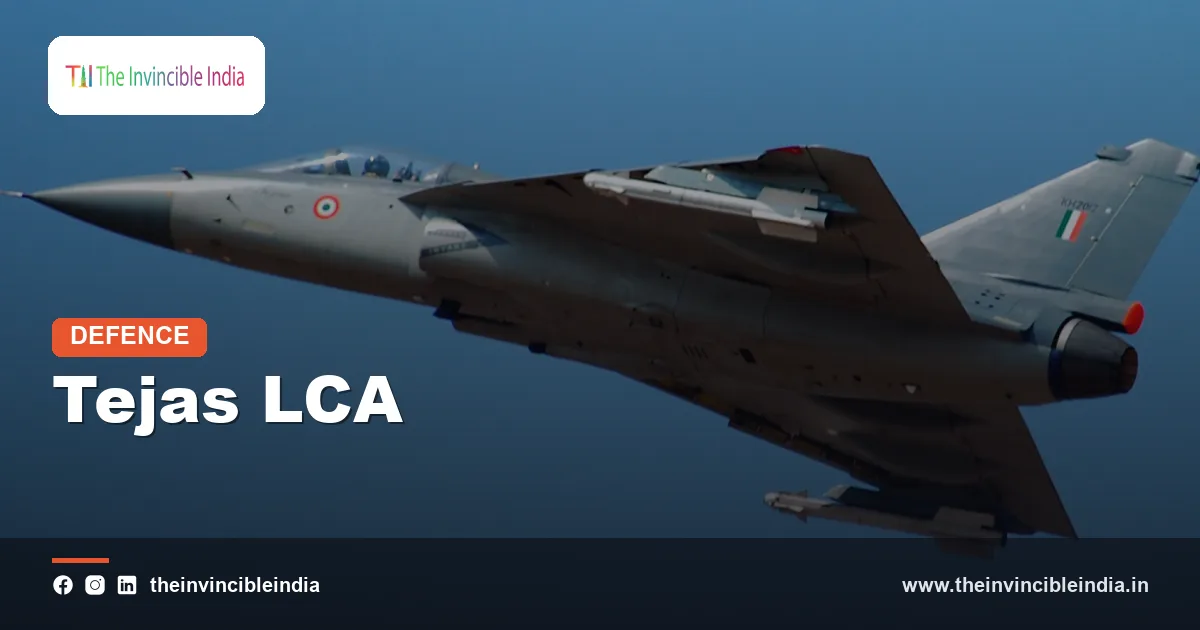
The Tejas Light Combat Aircraft is India’s first modern, fully indigenous fighter jet designed and built in the country, and the centrepiece of the nation’s long effort to build its own combat aircraft. A single-engine, single-seat, multirole fighter, it was developed by the Aeronautical Development Agency (ADA) and manufactured by Hindustan Aeronautics Limited (HAL). The name “Tejas” is Sanskrit for “radiance” or “brilliance”.
The Light Combat Aircraft, or LCA, programme began in the early 1980s with the goal of replacing the ageing MiG-21 fleet of the Indian Air Force and reducing dependence on imported fighters. The road to induction was long and technically demanding, and the programme became a test of India’s aerospace industry, from materials and avionics to flight control software and engines. This explainer covers its history, design, variants, strengths and challenges, and its wider significance for Make in India.
Quick Facts
| Item | Details |
|---|---|
| Type | Single-engine, single-seat, light multirole fighter (two-seat trainer variant also built) |
| Designer | Aeronautical Development Agency (ADA), with DRDO laboratories and HAL |
| Manufacturer | Hindustan Aeronautics Limited (HAL), Bengaluru and Nashik |
| Programme sanctioned | 1983, with ADA formed in 1984 |
| First flight | 4 January 2001, of the Technology Demonstrator |
| Named “Tejas” | 2003, by then Prime Minister Atal Bihari Vajpayee |
| First squadron | No. 45 Squadron, “Flying Daggers”, formed on the Tejas in July 2016 |
| Final Operational Clearance | February 2019, for the Mk1 version |
| Major versions | Mk1, Mk1A, naval prototypes, and the planned Mk2 |
Origins of the LCA Programme
India’s air force in the 1970s and 1980s relied largely on Soviet-origin fighters such as the MiG-21, which were to reach the end of their service lives in the following decades. At the same time, the country’s own experience in building fighters, such as the HF-24 Marut of the 1960s, had not led to a sustained industry. The government therefore decided to launch a large indigenous programme which would use modern technology and build capabilities that could support later designs.
The programme was sanctioned in 1983, and in 1984 the Aeronautical Development Agency was set up under the Department of Defence Research and Development to manage it. ADA became the nodal agency, bringing together HAL, the Defence Research and Development Organisation’s laboratories, the Council of Scientific and Industrial Research, academic institutions, and private firms.
The aim of the programme
- Replace the MiG-21 variants in the Indian Air Force with a modern, light and agile aircraft.
- Develop a technology base in advanced materials, avionics, flight control and propulsion.
- Build up an industrial ecosystem for future combat aircraft.
- Reduce dependency on foreign suppliers in a strategic area.
Development Timeline
The Tejas programme faced significant delays and obstacles. Imposed technology sanctions after India’s 1998 nuclear tests affected access to some imported systems and materials, and indigenous development of several subsystems took longer than expected. Despite this, India persisted, and the programme has produced a series of important milestones.
| Year | Milestone |
|---|---|
| 1983 | LCA programme sanctioned by the Government of India |
| 1984 | Aeronautical Development Agency established |
| 2001 | First flight of the Technology Demonstrator on 4 January |
| 2003 | The aircraft is officially named Tejas |
| 2011 | Initial Operational Clearance (IOC) granted |
| 2013 | Second stage of Initial Operational Clearance achieved |
| 2016 | First squadron inducted into the Indian Air Force |
| 2019 | Final Operational Clearance granted for the Mk1 |
| 2021 | Government approves a major order for Mk1A aircraft |
The Technology Demonstrator made its maiden flight from Bengaluru on 4 January 2001, an event regarded as a landmark in Indian aviation history. Several prototype and limited series production aircraft followed, with progressive testing of the aircraft’s performance, weapons and flight envelope.
Design Features
The Tejas has a compact, tailless, compound delta-wing configuration which is well suited to agile manoeuvres at both low and high speeds. It is among the smallest and lightest supersonic multirole fighters in its class, and this small size gives it a low visual and radar signature, besides simplifying maintenance and reducing costs.
Fly-by-wire flight control
One of the most notable features is its digital fly-by-wire flight control system. Because a tailless delta design is inherently unstable, a quadruplex digital flight control computer constantly adjusts the control surfaces, making the aircraft highly manoeuvrable while allowing the pilot to fly it as if it were stable. The flight control software and the control law were developed in India, which was a major technological achievement, as only a few countries have mastered the design of fly-by-wire fighters.
Composite materials
The airframe uses a high proportion of carbon-fibre composites, along with aluminium-lithium alloys and titanium. Composites make up a significant share of the structure by weight, including parts of the wings, fin and fuselage. This cuts weight, increases strength and improves fatigue life, and the composite manufacturing capability developed for the project has been valuable for other aerospace programmes as well.
Avionics and cockpit
- A glass cockpit with multi-function displays and a head-up display.
- Hands-on-throttle-and-stick controls to reduce pilot workload.
- A multi-mode radar, navigation and electronic warfare systems.
- Data links and secure communications for networked operations.
Engine and Weapons
Propulsion has been one of the toughest areas of the programme. India’s own Kaveri engine, developed by the Gas Turbine Research Establishment (GTRE), did not achieve the thrust and reliability needed for the Tejas, and the production Mk1 aircraft are powered by the General Electric F404 engine from the United States. The Kaveri technology has since been used in other contexts, such as unmanned vehicles, and the engine remains a long-term project.
Armament
The Tejas can carry a wide range of weapons on multiple hardpoints. These include short-range and beyond-visual-range air-to-air missiles, air-to-surface missiles, precision-guided bombs, rockets and an internal 23 mm twin-barrel cannon. Indigenous weapons such as the Astra beyond-visual-range air-to-air missile have been integrated, in keeping with the programme’s emphasis on self-reliance. The aircraft can also carry external fuel tanks and electronic countermeasure pods.
As a multirole aircraft, it can be used for air defence, ground attack, maritime strike and reconnaissance, which makes it a flexible platform for a modern air force.
Induction into the Indian Air Force
After the first stage of Initial Operational Clearance in 2011 and the second in 2013, the Indian Air Force began to receive the aircraft in numbers. No. 45 Squadron, known as the “Flying Daggers”, was re-formed on 1 July 2016 as the first operational squadron to fly the Tejas. It was followed by No. 18 Squadron, the “Flying Bullets”, which was raised on the Tejas in 2020. The squadrons were first based in southern India, and the type has since been operated from other air bases as well.
Final Operational Clearance, the last major certification step for the Mk1 standard, was granted in February 2019. It cleared the aircraft with improved weapons, in-flight refuelling and other capabilities. During the process, the aircraft was subjected to a wide range of trials, including hot weather, high altitude and cold weather tests, and weapons firings.
Safety and reputation
The Tejas has built a good safety reputation among its operators in its early years of operation, though like every combat aircraft, it has been involved in occasional accidents. Pilots have described it as agile, easy to fly and responsive, and its performance in demonstrations has attracted international attention.
The Tejas Mk1A
The Mk1A is an upgraded version of the Mk1 designed to address the air force’s requirements for improved combat capability and ease of maintenance. In January 2021, the Union government cleared a large order for Mk1A aircraft to be built by HAL, which was the biggest indigenous defence procurement of its kind at the time. Further orders have followed.
Key improvements
- An Active Electronically Scanned Array (AESA) radar, which provides better detection range, tracking and multi-target capability than a conventional mechanically scanned radar.
- An improved electronic warfare suite, including a self-protection jammer and radar warning receiver.
- Upgraded avionics, mission computers and data handling.
- Capability to use more advanced beyond-visual-range missiles.
- Easier maintenance through line-replaceable units and a larger share of components that are accessible without extensive disassembly.
HAL has expanded its production line at Bengaluru and added a new line at Nashik to increase output. Deliveries have been affected by supply chain factors, especially engines, and by the time needed to qualify new systems, but the Mk1A is the version intended to form the bulk of the Tejas fleet.
The Tejas Mk2 and the Naval Variants
The Tejas Mk2, sometimes called the Medium Weight Fighter, is a larger and more powerful development of the design. It is intended to fill the gap between the Tejas Mk1A and the planned fifth-generation Advanced Medium Combat Aircraft (AMCA). It is planned to be powered by the more powerful General Electric F414 engine, with a larger airframe, more fuel and a higher weapons load, and with advanced avionics and a longer range.
The programme for the Mk2 is led by ADA, and its timelines may change with design and testing. It is an important step, since many of the technologies developed for it will be used in the AMCA.
Naval Tejas
The Indian Navy has also been involved in a naval version of the LCA, designed to operate from aircraft carriers. A prototype carried out its first arrested landing aboard the carrier INS Vikramaditya on 11 January 2020, an important demonstration of the aircraft’s capability. Carrier operation requires a stronger undercarriage, an arrester hook and aerodynamic modifications for slow-speed approaches. Later naval designs are intended to be developed from the Mk2 platform.
Trainer variant
A two-seat trainer version has been developed to train new pilots on the type, and it can also fly operational missions.
Make in India and Industrial Significance
The Tejas is often presented as one of the most important examples of Make in India in the defence sector. More than a single aircraft, it is a platform that has built up a supply chain across public and private industry. Hundreds of firms, including major private companies and small and medium enterprises, supply components, structures and subsystems, while academic and research institutions contribute to design and testing.
- Indigenous design: The airframe, flight control laws and many mission systems are designed in India.
- Industrial ecosystem: A network of private-sector partners builds parts of the airframe, such as wings and fuselage sections.
- Skills and jobs: The programme has created skilled employment in aerospace engineering and manufacturing.
- Savings in foreign exchange: Domestic production reduces the need to import fighters.
- Technology spillover: Advances in composites, software and testing support other programmes.
The indigenous content of the aircraft has increased across versions, although some critical components, such as the engine and certain sensors and weapons, are still imported or built under licence. Reducing this reliance is a continuing objective.
Export Interest and Global Position
The Tejas has attracted interest from several countries seeking an affordable and modern light fighter, and it has been showcased at international air shows such as Aero India, Dubai and Bahrain. Malaysia evaluated the Tejas in a competition for a light combat aircraft, and other countries in Asia, Africa, the Middle East and Latin America have been reported to have shown interest at different times. In the global market, it competes with light fighters from other manufacturers, and its prospects depend on factors such as price, delivery schedule, support and diplomatic ties.
India’s own exports of defence equipment have been growing, and a successful export sale of the Tejas would be a symbolic and commercial milestone for the sector. At the same time, the priority is to meet the Indian Air Force’s own requirements before large-scale exports can follow.
Challenges and Criticisms
The programme has been described as a long and difficult effort, and it has been criticised for delays and for cost overruns compared with initial expectations. Among the main issues have been the following.
- Long development time: More than three decades passed between sanction and the maturity of the Mk1A.
- Engine dependence: The failure of the Kaveri engine to meet requirements meant reliance on imported engines.
- Production rate: Capacity constraints and supply chain delays have affected delivery schedules.
- Performance requirements: The Air Force has sought improvements in range, payload and weapons, as its needs have changed.
- Dependence on imported subsystems: Radar, electronic warfare and some weapons come from foreign partners.
Supporters note that building a modern fighter from scratch is among the most demanding industrial tasks, that every major aircraft programme in the world has faced delays, and that the Tejas has given India the capability to design, test, certify and produce a fighter at home.
Conclusion
The Tejas Light Combat Aircraft has travelled from a 1983 sanction to a front-line fighter flown by Indian Air Force squadrons, with a more capable Mk1A entering service and the more powerful Mk2 on the drawing board. Its fly-by-wire controls, composite airframe and growing indigenous content represent a real transformation of India’s aerospace industry. Whatever the remaining delays, the programme has created lasting capabilities which will shape the next generation of Indian combat aircraft.
Frequently Asked Questions
What does “Tejas” mean, and who named the aircraft?
Tejas is a Sanskrit word meaning radiance or brilliance. The Light Combat Aircraft was formally given this name in 2003 by the then Prime Minister, Atal Bihari Vajpayee.
Who builds the Tejas?
The aircraft is designed by the Aeronautical Development Agency, with the support of DRDO laboratories, and it is manufactured by Hindustan Aeronautics Limited. Many private and public sector firms supply structures and subsystems.
When did the Tejas first fly and enter service?
The Technology Demonstrator made its first flight on 4 January 2001. The Indian Air Force formed its first Tejas squadron, No. 45 Squadron, on 1 July 2016, and the Mk1 version received Final Operational Clearance in February 2019.
What is the difference between the Tejas Mk1, Mk1A and Mk2?
The Mk1 is the original production version. The Mk1A adds an AESA radar, an improved electronic warfare suite and easier maintenance. The Mk2 is a larger, more powerful aircraft planned around the General Electric F414 engine, with longer range and a heavier weapons load.
Is the Tejas completely indigenous?
The airframe, flight control system and many mission systems are designed and built in India, but some important items, notably the engine and certain sensors and weapons, are imported or produced under licence. The share of indigenous content has been rising with each version.
Has India exported the Tejas?
As of now, the Tejas has attracted interest from several countries and was evaluated by Malaysia in a competition, but major export orders have not been finalised. India continues to promote the aircraft at international air shows while meeting the needs of the Indian Air Force.


