

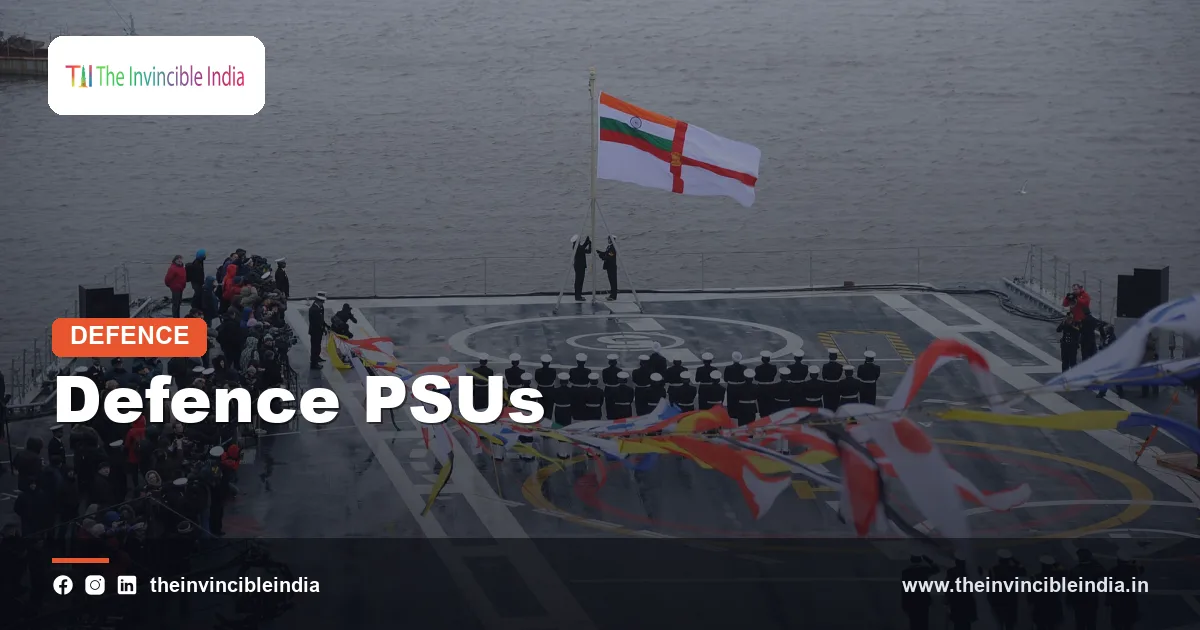
The defence public sector undertakings, commonly abbreviated as DPSUs, are government-owned companies that design, manufacture, overhaul and sustain much of the equipment used by the Indian Army, Navy and Air Force. From fighter aircraft and helicopters to radars, missiles, warships, special alloys and armoured vehicles, these enterprises form the industrial backbone of the country’s armed forces and are administered by the Department of Defence Production in the Ministry of Defence.
Since independence, India has relied on state-owned manufacturing to build a defence base that would not be hostage to foreign suppliers. That idea has acquired fresh momentum under the Atmanirbhar Bharat (self-reliant India) programme, and the 2021 corporatisation of the Ordnance Factory Board into seven new companies was its most visible structural reform. This article explains who the DPSUs are, what each one makes, how they evolved and why they matter.
| Fact | Detail |
|---|---|
| Administrative ministry | Ministry of Defence, through the Department of Defence Production |
| DPSUs before 2021 | Nine: HAL, BEL, BEML, BDL, MIDHANI, Mazagon Dock, GRSE, Goa Shipyard and Hindustan Shipyard |
| Ordnance Factory Board corporatised | 1 October 2021, into seven new DPSUs |
| Oldest ordnance roots | Gun Carriage Factory, Cossipore (Kolkata), 1801 |
| Hindustan Aeronautics Limited | Origins in 1940 at Bengaluru; present form since 1964 |
| Bharat Electronics Limited | Established 1954 at Bengaluru |
| Ship built by Cochin Shipyard | INS Vikrant, India’s first indigenous aircraft carrier, commissioned September 2022 |
| Policy anchor | Atmanirbhar Bharat and Make in India in defence |
What Are Defence Public Sector Undertakings?
A public sector undertaking is a company in which the central government holds a majority stake. The defence public sector undertakings are those that operate under the administrative control of the Ministry of Defence. Their shared purpose is to supply, repair and upgrade military hardware so that the armed forces are not wholly dependent on imports, especially in wartime or during sanctions.
Why the state took the lead
In the decades after 1947, private industry in India lacked the capital, technology and long gestation tolerance that defence manufacturing demands. The Industrial Policy Resolution of 1956 reserved arms, ammunition and military aircraft for the public sector, and the state therefore built the early base. Over time, a few of the companies were partly listed on stock exchanges, though the government continues to hold the controlling share.
How they differ from the ordnance system
The DPSUs grew alongside, but separately from, the old ordnance factories. Ordnance factories were departmental units, functioning as part of the government itself. The DPSUs were incorporated as companies with their own boards, balance sheets and, in several cases, ownership of design capability. The 2021 reform effectively converted the departmental ordnance system into the company format as well.
Hindustan Aeronautics Limited: Aircraft and Helicopters
Hindustan Aeronautics Limited (HAL), headquartered in Bengaluru, is the country’s principal aerospace manufacturer. Its story begins in December 1940, when industrialist Walchand Hirachand founded Hindustan Aircraft Limited with support from the Mysore government. The Government of India became a major shareholder in 1942, and the company later merged with Aeronautics India Limited and Aircraft Manufacturing Depot, Kanpur, to form HAL in 1964.
Products and programmes
- Fighter aircraft: HAL built the HF-24 Marut, India’s first indigenously designed jet fighter, and produces the Tejas light combat aircraft. It has also manufactured Sukhoi Su-30MKI fighters under licence.
- Helicopters: The Advanced Light Helicopter Dhruv, the Light Combat Helicopter Prachand and the Light Utility Helicopter form the core of its rotary-wing portfolio.
- Trainers and transports: The HTT-40 basic trainer and the Hawk advanced jet trainer, built under licence, support pilot training.
- Overhaul: HAL maintains, repairs and overhauls a large fleet of aircraft, engines and avionics, a role as important as new production.
Design and development
HAL maintains its own design centres and works closely with the Defence Research and Development Organisation and the Aeronautical Development Agency on programmes such as the Tejas. Its engine division in Bengaluru and Koraput also works on aero engines and their components, an area where India still seeks greater indigenous capability.
Bharat Electronics Limited: The Electronic Backbone
Bharat Electronics Limited (BEL) was established in 1954 in Bengaluru to meet the electronic needs of the defence services, initially with assistance from a foreign technology partner. It is today among the larger electronics manufacturers in the country and is classified as a Navratna public sector enterprise, a designation that gives greater financial and operational autonomy.
Core capabilities
- Radars for air surveillance, weapon location and naval use
- Electronic warfare and communication systems
- Fire-control systems and sonars
- Electro-optics, night-vision devices and avionics
- Electronic voting machines, a civilian product used in Indian elections
BEL also produces components for missile systems and has diversified into civil areas such as telecommunications, homeland security and railway signalling. Its network of manufacturing units across several states, along with a central research and development set-up, allows it to integrate sensors, software and hardware into complete systems for the three services.
Bharat Dynamics Limited and Missile Manufacturing
Bharat Dynamics Limited (BDL), headquartered in Hyderabad, was set up in 1970 to produce guided missiles under licence, initially an anti-tank missile of foreign design. It has since moved from licensed production to manufacturing missiles developed by the Defence Research and Development Organisation.
Missiles and weapons associated with BDL
- Akash: a medium-range surface-to-air missile system
- Astra: a beyond-visual-range air-to-air missile
- Anti-tank missiles: including the Konkurs-M and the Milan variants
- Naval weapons: the Varunastra heavyweight torpedo and other underwater weapons
- Strategic support: BDL has been involved in the integration of missiles in the Agni and Prithvi families, working with DRDO laboratories
The company’s location at Kanchanbagh in Hyderabad, with additional units at Bhanur and Visakhapatnam, places it close to the DRDO missile ecosystem in the same city. This proximity has helped technology transfer between laboratory and production floor, which is one of the central challenges in turning prototypes into reliable, repeatable products.
BEML and Mishra Dhatu Nigam: Vehicles and Special Metals
Two DPSUs work on the less glamorous but essential layers of the defence industry: heavy mobility and specialised materials.
BEML Limited
Bharat Earth Movers Limited, now styled BEML, began in 1964 in Bengaluru as a producer of earth-moving machinery. It supplies the armed forces with high-mobility trucks, recovery vehicles and specialised engineering platforms, along with engineering equipment for border infrastructure. It also manufactures metro coaches and mining equipment, which shows how defence PSUs often balance military and civil lines of business.
Mishra Dhatu Nigam Limited (MIDHANI)
Mishra Dhatu Nigam Limited, popularly called MIDHANI, was established in 1973 in Hyderabad. It produces superalloys, titanium alloys, special steels and other advanced metals needed for aircraft engines, missiles, naval vessels and space launch vehicles. These materials must survive extreme temperature and stress, and few countries can make them reliably.
- Titanium alloys for airframes and engine parts
- Nickel- and cobalt-based superalloys for turbines
- Armour steels and special-purpose forgings
- Materials supplied to the space and nuclear sectors
Without such metallurgical independence, even an indigenous aircraft or missile would remain dependent on imported inputs.
The Shipyards: From Mazagon Dock to Cochin Shipyard
Warship building in India stretches back long before independence, and the country’s yards remain central to the Navy’s expansion. Several of them are defence public sector undertakings, while others serve the Navy from outside the Ministry of Defence.
Mazagon Dock Shipbuilders Limited
Based in Mumbai, Mazagon Dock traces its origins to the 18th century. It builds destroyers and frigates, including the Kolkata class and the Visakhapatnam class destroyers, and it assembled the Kalvari class (Scorpene) conventional submarines under a technology-transfer arrangement with a French firm.
Garden Reach Shipbuilders and Engineers
Garden Reach Shipbuilders and Engineers (GRSE) in Kolkata has roots in 1884. It has built frigates, corvettes, landing ships, survey vessels and patrol craft for the Navy and the Coast Guard, and has a record of delivering warships through largely indigenous designs.
Goa Shipyard and Hindustan Shipyard
Goa Shipyard Limited, at Vasco da Gama, specialises in patrol vessels, fast attack craft and offshore patrol ships. Hindustan Shipyard Limited at Visakhapatnam, long a civil shipbuilder, was transferred to the Ministry of Defence and now supports naval fleet-support and repair work.
Cochin Shipyard and INS Vikrant
Cochin Shipyard Limited in Kochi functions under the Ministry of Ports, Shipping and Waterways, not the Ministry of Defence, so it is not formally a DPSU. It nevertheless built INS Vikrant, India’s first indigenous aircraft carrier, which was commissioned on 2 September 2022 and entered the fleet as a symbol of naval self-reliance.
The Ordnance Factory Board and Its 2021 Corporatisation
The ordnance factories were India’s oldest defence manufacturing units. Their lineage runs back to the Gun Carriage Factory at Cossipore in Kolkata, established in 1801 under the East India Company. At independence, India inherited a modest chain of factories, which later expanded into a network of 41 units supervised by the Ordnance Factory Board (OFB), formed in 1979.
Why the structure was reformed
The OFB, a departmental organisation, made weapons, ammunition, vehicles, clothing and equipment largely for the Indian armed forces. Over the years, successive committees questioned its efficiency, cost structures and slow pace of modernisation. The government decided that corporate management, with its own boards and commercial accountability, would be a better fit.
The decision and its timeline
- 16 May 2021: corporatisation announced as part of the Atmanirbhar Bharat economic package
- 16 June 2021: Union Cabinet approval for the restructuring
- 1 October 2021: seven new defence public sector undertakings began functioning
- 15 October 2021: the new companies were formally dedicated to the nation by the Prime Minister
Employees were allowed to continue as government servants on deemed deputation for a defined period, a measure intended to ease the transition.
The Seven New DPSUs Created from the OFB
The 41 factories were grouped by product category into seven companies, each with a focused mandate. The table below summarises them.
| Company | Abbreviation | Focus area |
|---|---|---|
| Munitions India Limited | MIL | Ammunition, explosives and related munitions |
| Armoured Vehicles Nigam Limited | AVNL | Tanks, infantry combat vehicles and armoured platforms |
| Advanced Weapons and Equipment India Limited | AWEIL | Artillery guns, small arms and advanced weapons |
| Troop Comforts Limited | TCL | Uniforms, tents, parachutes and soldiers’ equipment |
| Yantra India Limited | YIL | Metals, machinery and engineering components |
| India Optel Limited | IOL | Optical and electro-optical devices |
| Gliders India Limited | GIL | Parachutes, gliders and related aerial-delivery products |
The Armoured Vehicles Nigam, for example, inherited the Heavy Vehicles Factory at Avadi in Tamil Nadu, associated with the Arjun and T-90 programmes, while Munitions India inherited the large ammunition factories. By the grouping, the government hoped to build economies of scale and specialisation within each sub-sector.
Role in Self-Reliance and Atmanirbhar Bharat
Self-reliance in defence is a long-standing goal, because the country has historically been among the world’s larger importers of military equipment. The defence public sector undertakings are its principal institutional instruments, and several policy measures have strengthened them since 2014.
Policy tools
- Positive indigenisation lists: the Ministry of Defence has notified lists of items that the services will procure only from domestic sources, creating assured demand.
- Defence Acquisition Procedure: it gives preference to categories such as Buy (Indian-IDDM), meaning indigenously designed, developed and manufactured.
- Foreign investment: the automatic route for foreign direct investment in defence was raised to 74 per cent in 2020.
- Defence corridors: industrial corridors were announced in Uttar Pradesh and Tamil Nadu to attract suppliers.
- iDEX: Innovations for Defence Excellence, launched in 2018, engages start-ups and small firms.
The DPSUs are expected to act as anchor integrators, with a wide base of small and medium enterprises supplying components. Export promotion forms another part of the plan, and these companies have signed several export arrangements for a range of platforms.
Strengths, Challenges and the Private Sector
The undertakings bring strengths that are hard to replicate quickly: decades of accumulated expertise, large capital assets, trained workforces, specialised test facilities and strong links with DRDO. They can take on long-gestation programmes where returns are slow.
Persistent challenges
- Delays in delivery and cost overruns on major programmes
- Dependence on imported engines, sensors and sub-systems for some platforms
- The need to modernise ageing production infrastructure
- Slow technology absorption from licensed production to genuine design capability
A growing partnership with private firms
Private Indian companies now participate in defence manufacturing in areas such as shipbuilding, aerostructures, electronics and ammunition. Rather than replacing the DPSUs, they increasingly work as partners, suppliers and, in some cases, competitors in tenders. The overall industrial model is therefore a mixed one, in which the public sector remains the largest component, but not the only one.
Conclusion
The defence public sector undertakings carry the country’s long-term effort to produce what its forces need at home. From HAL’s aircraft and BEL’s radars to BDL’s missiles, MIDHANI’s alloys and the shipyards that built INS Vikrant, they cover almost every layer of military capability. The 2021 creation of seven companies from the Ordnance Factory Board marked the biggest structural change in decades, and its success will depend on delivery, innovation and the steady growth of a wider industrial base around these anchor enterprises.
Frequently Asked Questions
What are defence public sector undertakings in India?
Defence public sector undertakings (DPSUs) are government-owned companies under the Ministry of Defence that manufacture and maintain military equipment. Examples include HAL, BEL, BDL, BEML, MIDHANI, Mazagon Dock and GRSE, along with the seven companies formed from the Ordnance Factory Board in 2021.
When was the Ordnance Factory Board corporatised?
The corporatisation was announced in May 2021 and approved by the Union Cabinet in June 2021. The seven new companies began functioning on 1 October 2021 and were dedicated to the nation later that month.
What are the seven new DPSUs created from the OFB?
They are Munitions India Limited, Armoured Vehicles Nigam Limited, Advanced Weapons and Equipment India Limited, Troop Comforts Limited, Yantra India Limited, India Optel Limited and Gliders India Limited. Each took over a group of the earlier ordnance factories according to product type.
Is Cochin Shipyard a defence public sector undertaking?
Not formally. Cochin Shipyard Limited comes under the Ministry of Ports, Shipping and Waterways, although it builds vessels for the Navy. It built INS Vikrant, which was commissioned in September 2022 as India’s first indigenous aircraft carrier.
What does HAL manufacture?
Hindustan Aeronautics Limited builds and overhauls fixed-wing aircraft, helicopters, engines and avionics. Its products include the Tejas light combat aircraft, the Dhruv helicopter and the Prachand light combat helicopter, as well as licence-built Su-30MKI fighters.
How do DPSUs support Atmanirbhar Bharat?
They act as anchor manufacturers that convert indigenous designs into equipment for the armed forces and reduce dependence on imports. Policies such as positive indigenisation lists and preference for indigenously designed products give them and their supplier networks assured demand.


