

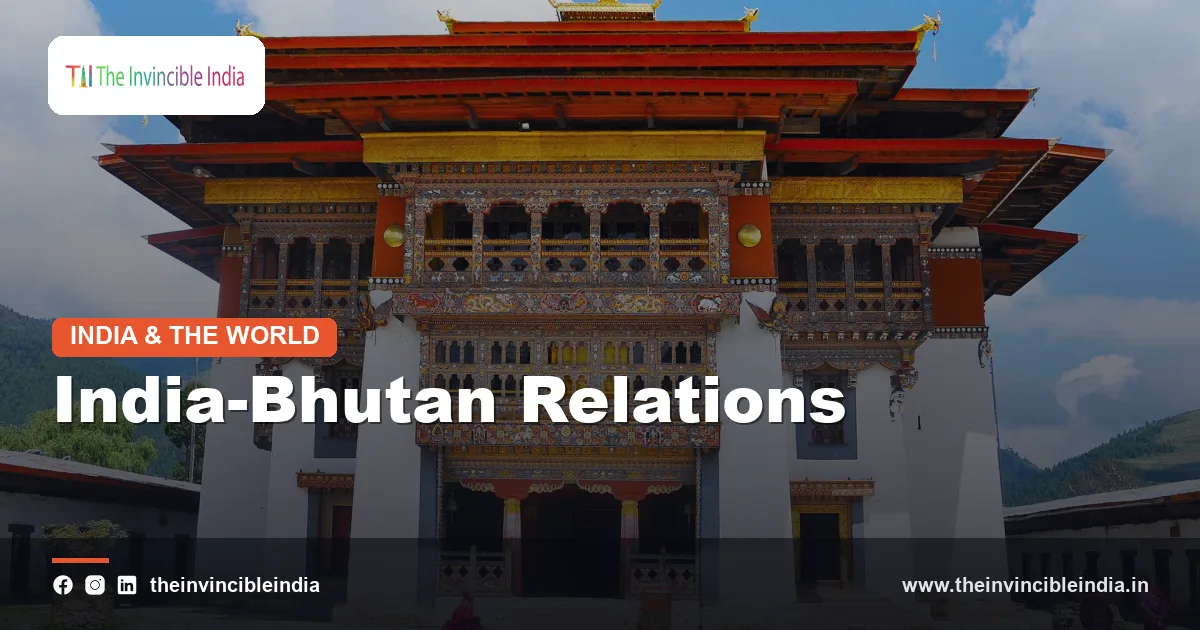
India-Bhutan relations are widely described as one of the closest and most trusting partnerships in South Asia. The Himalayan kingdom of Bhutan, sandwiched between India and China, has maintained an unusually deep friendship with its southern neighbour since the middle of the twentieth century, built on a treaty of friendship, a shared border that is open to the citizens of both countries, a long-running development partnership and a hydropower arrangement from which both sides benefit.
Unlike many bilateral relationships in the region, the India-Bhutan bond has been remarkably free of public disputes. It is anchored in a high degree of political trust between the two governments and, at the personal level, between the Indian leadership and the Bhutanese monarchy. This explainer traces the history, institutions and sectors of cooperation, and also notes the questions and adjustments that have accompanied the relationship.
| Fact | Detail |
|---|---|
| Foundational treaty | Treaty of Friendship, signed in Darjeeling on 8 August 1949 |
| Revised treaty | India-Bhutan Friendship Treaty of February 2007 |
| Diplomatic representation | Indian mission established in Thimphu in 1968 |
| Bhutan’s UN membership | 1971, supported by India |
| Currency link | Bhutanese ngultrum is pegged to the Indian rupee at par |
| Border | Open border; citizens of both countries travel without a visa |
| Flagship projects | Chukha, Tala, Kurichhu and Mangdechhu hydropower stations |
| Trade regime | Free trade arrangement; India is Bhutan’s largest trading partner by a wide margin |
Historical Background of India-Bhutan Relations
Bhutan was never colonised, but it has had long contact with the Indian subcontinent. Buddhism, trade routes and religious networks linked Bhutan with Tibet and with the plains of Bengal and Assam for centuries. In the nineteenth century, conflict over the Duars, the strip of land along the southern foothills, led to the Anglo-Bhutanese War of 1864-65 and the Treaty of Sinchula, under which Bhutan ceded the Duars to British India in exchange for an annual subsidy. A later treaty in 1910, the Treaty of Punakha, gave British India a say over Bhutan’s external relations while leaving internal matters to Bhutan.
The post-independence reset
After India’s independence in 1947, the Government of India recognised Bhutan’s sovereign status and signed a new agreement with it in 1949. Prime Minister Jawaharlal Nehru’s visit to Bhutan in 1958, which involved a difficult journey over high mountain trails, is remembered in both countries as a landmark of trust. Nehru assured the Bhutanese leadership that India respected Bhutan’s independence, and this became the basis for the modern partnership. The third Druk Gyalpo, Jigme Dorji Wangchuck, set Bhutan on a path of planned development, and India stood alongside as its principal supporter.
The 1949 Treaty and Its 2007 Revision
The Treaty of Perpetual Peace and Friendship, signed at Darjeeling on 8 August 1949, was the legal cornerstone of the relationship for nearly six decades. India agreed not to interfere in Bhutan’s internal administration, and Bhutan agreed to be guided by India’s advice in its external relations. India also restored a small area of territory, Dewangiri, to Bhutan and provided an annual grant.
Revising the treaty
Over time, Bhutan’s own constitutional development and growing international profile raised the question of whether the old language still reflected the relationship. In February 2007, the two governments signed a revised Treaty of Friendship during the visit of Bhutan’s monarch, King Jigme Khesar Namgyel Wangchuck, to India. The new text removed the clause under which Bhutan agreed to be guided by India on foreign policy. Instead, the revised treaty states that the two countries will cooperate closely on issues relating to their national interests, and that neither will allow its territory to be used for activities harmful to the national security and interest of the other.
The revision was widely seen as a step that recognised Bhutan’s full sovereignty while preserving close security coordination. It came shortly before Bhutan’s move to parliamentary democracy and the adoption of a written constitution, and it signalled India’s confidence in Bhutan’s institutions.
Development Assistance and Five-Year Plans
India has been Bhutan’s principal development partner since the start of planned development in 1961. The first Five-Year Plan of Bhutan was fully funded by India, and India has supported subsequent plans in areas ranging from roads and bridges to schools, hospitals, power transmission and administrative institutions. Border Roads Organisation projects in Bhutan, carried out under the names Project Dantak and Project Vartak, built a large part of the country’s early road network.
- Infrastructure: Roads, airports, telecommunications, digital connectivity and urban development have received Indian support.
- Health and education: Indian assistance has supported hospitals, medical personnel and the training of Bhutanese students in Indian institutions, along with scholarships for higher education.
- Institution building: Indian experts and institutions have helped train civil servants, judges, engineers and other professionals.
- Project-tied assistance: India funds a range of projects chosen in consultation with the Bhutanese government and tied to its priorities, including programmes in rural development and small community projects.
The two countries also coordinate through a high-level mechanism that reviews progress on assistance and projects regularly, reflecting the way development is treated as a shared undertaking.
The Hydropower Partnership
Hydropower is the centrepiece of the economic relationship. Bhutan’s fast-flowing Himalayan rivers offer enormous potential, and India’s growing electricity demand offers a ready market. India has helped finance, design and build major plants, and Bhutan sells surplus electricity to India under long-term agreements. Revenue from these sales has formed a large share of Bhutan’s government income and has played an important role in funding its social and development spending.
Major projects
| Project | Approximate capacity | Notes |
|---|---|---|
| Chukha | 336 MW | Commissioned in the 1980s; the first major joint project |
| Kurichhu | 60 MW | Commissioned in 2001 |
| Tala | 1,020 MW | Commissioned in the mid-2000s; Bhutan’s largest plant |
| Dagachhu | 126 MW | A joint venture with an Indian power company |
| Mangdechhu | 720 MW | Inaugurated in 2019 |
| Punatsangchhu I and II | Larger projects | Long under construction, with delays and cost increases |
In 2006, the two governments signed an umbrella agreement on cooperation in hydropower, and in 2009 a protocol set a target of developing 10,000 MW of capacity by 2020. That target was not met, partly because of geological challenges, financing and construction delays at some sites. The Punatsangchhu projects in particular have faced technical difficulties and cost overruns, and the two governments have worked to resolve them.
Trade, Currency and the Open Border
India and Bhutan operate under a free trade regime. The first Trade and Transit Agreement was signed in 1972 and has been renewed periodically, allowing duty-free movement of goods and giving Bhutan transit rights through Indian territory and ports for trade with third countries. India is by far Bhutan’s largest trading partner, both for imports and for exports, with hydroelectricity, minerals, ferro-alloys, cement and agricultural produce among the main exports.
Currency and people
The Bhutanese ngultrum is pegged to the Indian rupee at parity, and the Indian rupee is accepted as legal tender in Bhutan. The open border allows Indians and Bhutanese to move freely between the two countries without visas, though third-country visitors have different rules. This arrangement has encouraged tourism, employment, education and family links across border towns such as Phuentsholing, Gelephu and Samdrup Jongkhar.
Many Indians work in Bhutan, particularly in construction and hydropower projects, and Bhutanese students and patients come to India for education and medical care. Digital payment links, including the use of India’s RuPay card and the UPI platform in Bhutan, have been added in recent years.
Security and Defence Cooperation
Security cooperation between the two countries is long-standing and close. The Indian Military Training Team, based in Bhutan, has trained the Royal Bhutan Army and the Royal Bhutan Police since the 1960s. The two countries coordinate on border security and intelligence, and the Indian armed forces maintain a presence for training and capacity-building.
Operation All Clear
One of the most significant episodes was Operation All Clear in December 2003, in which the Royal Bhutan Army, with Indian logistic support and cooperation along the border, removed camps of Indian militant groups, including the United Liberation Front of Asom and the National Democratic Front of Bodoland, from southern Bhutan. Bhutan’s king personally led the effort, and the operation is cited as an example of how the revised understanding on not allowing territory to be used against the other works in practice.
The Doklam standoff
In June 2017, India and China became involved in a standoff of about 73 days near the Doklam plateau, close to the tri-junction of the borders of India, Bhutan and China. Bhutan stated that the area was disputed between itself and China, and India, citing its security interests in the Siliguri corridor, supported Bhutan’s position. The episode ended with a mutual disengagement and underlined the strategic importance of the relationship.
Connectivity, Culture and Soft Power
India and Bhutan have invested in physical connectivity, including road links and, in recent years, proposed rail links between Indian railheads and Bhutan’s southern towns. Kokrajhar-Gelephu and Banarhat-Samtse rail connections have been discussed under agreements reached from 2018 onward. The proposed Gelephu Mindfulness City, announced by the King of Bhutan, is a planned special administrative region in the south, and India has expressed support for its connectivity and investment links.
Cultural affinity strengthens ties. Buddhism links Bhutan with Indian pilgrimage sites such as Bodh Gaya, Sarnath and Nalanda, and Indian films and music are popular in Bhutan. Bhutanese students study in Indian schools and universities, and Indian teachers once formed a large share of Bhutan’s school staff. The government of India also supports the preservation of Bhutan’s monastic heritage and Himalayan Buddhist traditions.
Bhutan’s Foreign Policy and Boundary Talks
Bhutan follows an independent foreign policy and has diplomatic relations with a number of countries, though not with any of the five permanent members of the UN Security Council. Its boundary talks with China have continued for decades, with the two sides holding periodic rounds and expert group meetings on the unresolved boundary. India has said that it respects Bhutan’s sovereign decisions, while Bhutan has repeatedly stated that it will not enter into arrangements that harm India’s security interests.
Bhutan’s concept of Gross National Happiness, introduced under the fourth king, has attracted international interest and shapes domestic policy, including limits on tourist numbers through a sustainable development fee. India, for its part, has supported Bhutan’s pursuit of balanced development.
Challenges and Points of Adjustment
Even a close relationship has points of adjustment. Observers have noted a few recurring themes.
- Hydropower costs: Delays and cost overruns in projects, and the question of tariffs for exported power, have required periodic negotiation.
- Debt and dependency: Hydropower-related borrowing makes up a significant part of Bhutan’s external debt, which both governments monitor.
- Economic diversification: Bhutan seeks to broaden its economy beyond hydropower and tourism and to create jobs for its young population, some of whom have migrated abroad.
- Subsidy debates: In 2013, a temporary withdrawal of Indian subsidies on fuel and cooking gas just before Bhutan’s elections prompted public discussion in Bhutan, though supplies were later restored.
- Regional balance: Bhutan’s boundary negotiations with China are followed closely in India, and both sides emphasise consultation.
The two governments generally address such issues through quiet diplomacy, regular high-level visits and established dialogue mechanisms rather than public disagreement.
Conclusion
India-Bhutan relations are often cited as a model of friendly cooperation between a larger and a smaller neighbour. The 1949 treaty and its 2007 revision, the shared hydropower success, the open border, the monetary link and the security cooperation form a web of interdependence that serves both countries. As Bhutan diversifies its economy and engages the wider world, and as India pursues its Neighbourhood First policy, the partnership is likely to continue to evolve while remaining centred on mutual trust.
Frequently Asked Questions
What is the basis of India-Bhutan relations?
The relationship rests on the Treaty of Friendship signed in 1949 and revised in 2007. It commits both countries to close cooperation on matters of national interest and to ensuring that neither’s territory is used against the other’s security.
How did the 2007 treaty change the relationship?
The 2007 revision removed the earlier provision that Bhutan would be guided by India on foreign policy. It replaced this with a commitment to cooperate closely on national interest and security issues, which recognised Bhutan’s full sovereignty.
Why is hydropower so important to India and Bhutan?
Bhutan has plentiful hydropower potential and a small domestic market, while India needs electricity. Bhutan exports surplus power to India, earning a major share of its government revenue, and India gets a clean, renewable source of electricity.
Can Indians and Bhutanese travel freely between the two countries?
Yes. The border is open, and citizens of the two countries can travel without a visa. The Indian rupee is also accepted in Bhutan, and the ngultrum is pegged to it at par.
What security arrangements exist between the two countries?
India trains the Royal Bhutan Army through the Indian Military Training Team and the two countries coordinate on border security. Operation All Clear in 2003 and the Doklam standoff in 2017 are well-known episodes illustrating their security cooperation.
Does Bhutan have diplomatic relations with China?
Bhutan does not have formal diplomatic relations with China, but the two countries hold regular talks on their boundary. Bhutan says it conducts an independent foreign policy while remaining sensitive to India’s security concerns.
{“@context”:”https://schema.org”,”@graph”:[{“@type”:”FAQPage”,”mainEntity”:[{“@type”:”Question”,”name”:”What is the basis of India-Bhutan relations?”,”acceptedAnswer”:{“@type”:”Answer”,”text”:”The relationship rests on the Treaty of Friendship signed in 1949 and revised in 2007. It commits both countries to close cooperation on matters of national interest and to ensuring that neither’s territory is used against the other’s security.”}},{“@type”:”Question”,”name”:”How did the 2007 treaty change the relationship?”,”acceptedAnswer”:{“@type”:”Answer”,”text”:”The 2007 revision removed the earlier provision that Bhutan would be guided by India on foreign policy. It replaced this with a commitment to cooperate closely on national interest and security issues, which recognised Bhutan’s full sovereignty.”}},{“@type”:”Question”,”name”:”Why is hydropower so important to India and Bhutan?”,”acceptedAnswer”:{“@type”:”Answer”,”text”:”Bhutan has plentiful hydropower potential and a small domestic market, while India needs electricity. Bhutan exports surplus power to India, earning a major share of its government revenue, and India gets a clean, renewable source of electricity.”}},{“@type”:”Question”,”name”:”Can Indians and Bhutanese travel freely between the two countries?”,”acceptedAnswer”:{“@type”:”Answer”,”text”:”Yes. The border is open, and citizens of the two countries can travel without a visa. The Indian rupee is also accepted in Bhutan, and the ngultrum is pegged to it at par.”}},{“@type”:”Question”,”name”:”What security arrangements exist between the two countries?”,”acceptedAnswer”:{“@type”:”Answer”,”text”:”India trains the Royal Bhutan Army through the Indian Military Training Team and the two countries coordinate on border security. Operation All Clear in 2003 and the Doklam standoff in 2017 are well-known episodes illustrating their security cooperation.”}},{“@type”:”Question”,”name”:”Does Bhutan have diplomatic relations with China?”,”acceptedAnswer”:{“@type”:”Answer”,”text”:”Bhutan does not have formal diplomatic relations with China, but the two countries hold regular talks on their boundary. Bhutan says it conducts an independent foreign policy while remaining sensitive to India’s security concerns.”}}]}]}


