

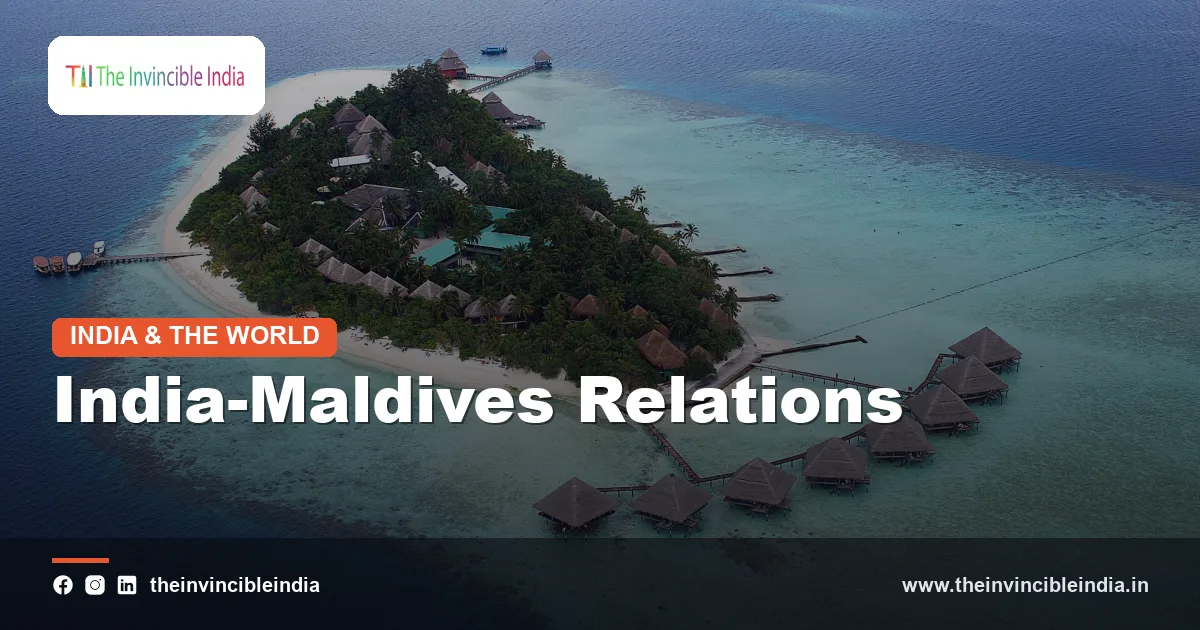
India-Maldives relations connect the Indian subcontinent with one of the smallest and most geographically dispersed countries in the world, an archipelago of coral atolls strung across the central Indian Ocean. Only a short sea distance separates the northernmost Maldivian atolls from India’s Lakshadweep islands, and the Maldives sits astride some of the busiest east-west shipping lanes on earth. For India, this makes the neighbour strategically significant far beyond its small size.
The two countries share centuries of trade, cultural contact and religious exchange, and in modern times they have built a partnership spanning security, development, health, education and disaster relief. The relationship has also been shaped by the shifting domestic politics of the Maldives, which has produced periods of closeness and periods of recalibration. This explainer sets out the main milestones and themes in an even-handed way.
| Fact | Detail |
|---|---|
| Maldivian independence | 26 July 1965, from Britain |
| Diplomatic ties | Established in 1965; India was among the first to recognise the new state |
| Security milestone | Operation Cactus, 3 November 1988 |
| Geography | The Eight Degree and Nine Degree Channels separate the Maldives from India’s Lakshadweep |
| Regional groupings | Both are members of SAARC; Maldives is a founding member (1985) |
| Maritime security forum | Colombo Security Conclave, involving India, the Maldives, Sri Lanka and other partners |
| Flagship project | Greater Male Connectivity Project, linking Male with neighbouring islands |
| Policy framing | India’s Neighbourhood First policy and the SAGAR vision |
Historical and Cultural Ties
The Maldives and India have been in contact since ancient times. Maldivian islanders traded cowrie shells, a form of currency across much of Asia and Africa, with Indian ports on the Malabar and Coromandel coasts, and coconut-fibre rope, dried tuna and other goods moved along the same routes. Sailors from the Kerala coast, the Lakshadweep islands and beyond crossed regularly. Languages show this connection as well, since Dhivehi, the Maldivian national language, belongs to the Indo-Aryan family and has clear links with Sinhala and other languages of the subcontinent.
The Maldives was a Buddhist-influenced society before the conversion to Islam in the twelfth century. In later centuries it was a sultanate, became a British protectorate in 1887 and gained independence on 26 July 1965. The contemporary relationship reflects this layered history, with Indian trade, education and healthcare networks continuing to touch everyday Maldivian life.
Independence and Early Diplomatic Relations
India recognised the independent Maldives in 1965 and established diplomatic relations soon afterwards. India’s High Commission in Male was opened in 1972, and the Maldives later opened a mission in New Delhi. The two sides signed an agreement on the maritime boundary in 1976, defining their respective zones in the Eight Degree Channel and the Nine Degree Channel, which has been a rare example of a clear, settled boundary between neighbours.
The Maldives joined the South Asian Association for Regional Cooperation as a founding member in 1985, and the two countries have often consulted each other in regional and international forums. Both have also been members of the Commonwealth, although the Maldives left the grouping in 2016 and rejoined in 2020. India has supported the Maldives’ interests as a small island developing state, including in climate negotiations, where the Maldives has been a prominent voice about sea-level rise.
Operation Cactus of 1988
The most famous chapter in the relationship came on 3 November 1988, when a group of armed mercenaries, linked to a Sri Lankan Tamil militant organisation and hired by a Maldivian businessman, landed in Male in an attempt to overthrow the government of President Maumoon Abdul Gayoom. The president took shelter and sent urgent appeals for help to several countries, including India.
What India did
Within hours, India launched Operation Cactus. Paratroopers of the Indian Army’s 50th Independent Parachute Brigade were airlifted from Agra in Indian Air Force aircraft, flying over a long distance to land at Hulhule airport, the airport of Male. They secured the airport and moved swiftly into the capital, restoring the elected government to control. Indian naval ships, including frigates, were also deployed and helped intercept a vessel carrying some of the mercenaries as they tried to escape.
The operation was carried out at the invitation of the Maldivian government and was completed within a short time. It was widely seen internationally as a rapid and disciplined response. It also became a powerful point of reference in Maldivian public memory and in Indian strategic thinking about its role as a security provider in the Indian Ocean region.
Neighbourhood First and the SAGAR Vision
India’s policy towards the Maldives is guided by two broad frameworks. The first, Neighbourhood First, was articulated in 2014 and emphasises connectivity, trade, people-to-people links and assistance to immediate neighbours. The second, SAGAR, an acronym for Security and Growth for All in the Region, was announced by Prime Minister Narendra Modi in 2015, and sets out an approach to the Indian Ocean based on cooperation, capacity-building, disaster response and respect for sovereignty. In later years, the broader MAHASAGAR formulation has also been used to describe India’s maritime outlook.
- Capacity-building: Training of Maldivian defence personnel, police, civil servants and judicial staff in Indian institutions.
- Maritime domain awareness: Joint surveillance, coastal radar cooperation and information sharing.
- Humanitarian response: India acts as a first responder in natural disasters and health emergencies.
- Economic partnership: Lines of credit, grants, budget support and development projects.
The Maldives, for its part, has described its foreign policy as seeking friendly relations with all countries, and successive Maldivian governments have emphasised both that India is a close neighbour and that the Maldives retains full independence in its decisions.
Defence and Maritime Security Cooperation
Defence cooperation has long been central. India and the Maldives conduct joint exercises, including Ekuverin, a military exercise held in alternate countries since 2009, and Ekatha, an exercise involving diving and marine operations. The Dosti coast guard exercise has also involved Sri Lanka. India has gifted patrol vessels, interceptor craft, radar systems and other equipment to Maldivian security forces, and has helped build facilities for the coast guard, including a harbour at Uthuru Thila Falhu.
The Colombo Security Conclave
Maritime cooperation has also been organised through a trilateral process which began among India, the Maldives and Sri Lanka, and later became the Colombo Security Conclave, with other Indian Ocean states joining as members or observers. It covers piracy, trafficking, terrorism, cyber security and marine pollution. The Maldives, whose territorial waters and exclusive economic zone are very large relative to its land area, has an obvious interest in maritime security.
India has also provided helicopters and a Dornier aircraft for use in search, rescue and medical evacuation. The presence of Indian military personnel operating this equipment became a political subject in the Maldives in 2023, and in 2024 an arrangement was reached under which Indian military personnel were replaced by civilian technical staff.
Development and Infrastructure Projects
India has supported a wide range of infrastructure and social projects across the Maldives. These have been implemented through grants, lines of credit and technical assistance.
The Greater Male Connectivity Project
The flagship project is the Greater Male Connectivity Project, which seeks to connect Male with the neighbouring islands of Villingili, Gulhifalhu and Thilafushi by a combination of bridges, causeways and a link road, for a total length of around seven kilometres. The project, financed through an Indian grant and a substantial line of credit, was launched in 2021 and aims to ease congestion, expand housing and support economic growth in a capital region where most of the country’s economic activity takes place. It is the largest infrastructure project in the country.
Other projects
- Airport development at Hanimaadhoo and other facilities in the northern atolls.
- Water, sanitation and housing projects, including social housing units on a number of islands.
- Hospitals and health-care facilities, including the Indira Gandhi Memorial Hospital in Male, which dates from the 1990s.
- Institutional and training facilities, such as the National College for Policing and Law Enforcement and defence training infrastructure, alongside community, sports and cultural projects.
- Support for the Maldives’ fisheries, tourism and digital sectors, including payment systems.
Disaster Assistance and Humanitarian Support
India has repeatedly acted as the Maldives’ first responder. After the Indian Ocean tsunami of December 2004, Indian ships and aircraft brought relief to the islands within hours. In December 2014, when a fire at the main water treatment plant in Male left the capital without drinking water, India sent water by air and sea in a rapid operation known as Operation Neer, with Indian Air Force transport aircraft and naval ships delivering supplies and desalination assistance.
During the COVID-19 pandemic, India sent medical teams, essential medicines and equipment, and the Maldives was among the first countries to receive doses of Indian-made vaccines in January 2021. India also helped to keep supply lines open for essential commodities, including food items, and provided economic assistance, such as currency swap support and the rollover of Maldivian treasury bills, at points when the Maldivian economy came under pressure.
Trade, Tourism and Economic Links
The Maldives economy depends heavily on tourism and fisheries, and India has been a major source market for tourists and a supplier of goods. The Maldives imports a significant share of its construction materials, food items, pharmaceuticals and other goods from India, and exports fish products and scrap metal. Both sides have discussed expanding trade, including a possible free trade arrangement and local currency settlement, though progress has depended on political circumstances. Direct air and sea connections, including a cargo and passenger ferry service proposed between Indian and Maldivian ports, support these links.
Thousands of Indians live and work in the Maldives, particularly as teachers, doctors, nurses and technical workers, and many Maldivians travel to India for medical care, higher education and shopping. Indian cuisine, cinema and cricket are popular across the islands.
Political Shifts and Periodic Recalibration
The Maldives has seen sharp political changes since the introduction of multiparty democracy in 2008. These changes have often influenced relations with India, though Maldivian officials from different parties have each stressed the importance of the relationship.
- 2013-2018: The government of President Abdulla Yameen strengthened economic ties with China, including through large infrastructure projects, and relations with India became cooler. Concerns about debt and about a political emergency in 2018 drew regional attention.
- 2018-2023: President Ibrahim Mohamed Solih’s administration followed an openly India-friendly approach, and Indian assistance and project work expanded considerably.
- 2023 onwards: President Mohamed Muizzu was elected on a platform that included the removal of Indian military personnel from the country. In early 2024, remarks about India by some Maldivian officials on social media led to a diplomatic row, and tourism and public sentiment became topics of discussion in both countries.
Over the following months, the two governments resumed high-level contacts. The Maldivian president visited India in 2024, and India’s prime minister travelled to the Maldives in 2025 as guest of honour for the 60th anniversary of independence. India extended financial support, including currency swap arrangements and treasury bill rollovers, while the Maldives reiterated that it would not allow its territory to be used against India’s security.
Challenges and Outlook
The Maldives faces significant economic and environmental challenges, including public debt, dependence on tourism and vulnerability to sea-level rise. India has an interest in the stability of its neighbour, while the Maldives has a clear interest in diversifying its partnerships and protecting its autonomy. Other major powers, including China, the Gulf states and Japan, are also active in the archipelago.
Analysts commonly note that the relationship is likely to remain strong because of geography, trade and dependence on Indian goods, health care and training. Pursuing practical cooperation in areas such as disaster response, climate resilience, digital payments, health and fisheries, and being sensitive to Maldivian domestic opinion, appear to be the most productive path for both sides.
Conclusion
India-Maldives relations have survived changes in governments and in the strategic environment, and the essential logic of proximity remains. From Operation Cactus in 1988 and tsunami relief in 2004 to the Greater Male Connectivity Project, India has been a close and visible partner. The Maldives, as a sovereign island nation, balances this closeness with a wish to engage the wider world, and the periodic recalibrations in the relationship reflect that balance rather than a break in the underlying friendship.
Frequently Asked Questions
What was Operation Cactus?
Operation Cactus was the Indian military operation of 3 November 1988 to help the Maldivian government when mercenaries tried to stage a coup in Male. Indian paratroopers were flown from Agra, secured the airport and restored the government within hours, at the request of the Maldivian president.
What is the Greater Male Connectivity Project?
It is an Indian-funded infrastructure project to link Male with the nearby islands of Villingili, Gulhifalhu and Thilafushi through bridges, causeways and roads. It is intended to reduce congestion and support housing and economic growth in the capital region.
What are Neighbourhood First and SAGAR?
Neighbourhood First is India’s policy of giving priority to relations with its immediate neighbours through connectivity, trade and assistance. SAGAR, or Security and Growth for All in the Region, is India’s Indian Ocean vision of cooperation on maritime security, capacity-building and disaster response.
How has India helped the Maldives in emergencies?
India has provided relief after the 2004 tsunami, supplied drinking water during the 2014 Male water crisis under Operation Neer, and sent medical aid and vaccines during the COVID-19 pandemic. It has also supported the Maldives with financial assistance at times of economic stress.
Why has the relationship seen ups and downs?
Changes in government in the Maldives have brought different foreign-policy emphases, including on the presence of Indian military personnel and on ties with other powers such as China. Despite this, both countries have kept dialogue open and continued cooperation in key areas.
Why is the Maldives strategically important to India?
The Maldives lies close to India’s southwest coast and along major sea lanes carrying energy and trade. Its location makes its stability, and its maritime security cooperation with India, important to both countries.
{“@context”:”https://schema.org”,”@graph”:[{“@type”:”FAQPage”,”mainEntity”:[{“@type”:”Question”,”name”:”What was Operation Cactus?”,”acceptedAnswer”:{“@type”:”Answer”,”text”:”Operation Cactus was the Indian military operation of 3 November 1988 to help the Maldivian government when mercenaries tried to stage a coup in Male. Indian paratroopers were flown from Agra, secured the airport and restored the government within hours, at the request of the Maldivian president.”}},{“@type”:”Question”,”name”:”What is the Greater Male Connectivity Project?”,”acceptedAnswer”:{“@type”:”Answer”,”text”:”It is an Indian-funded infrastructure project to link Male with the nearby islands of Villingili, Gulhifalhu and Thilafushi through bridges, causeways and roads. It is intended to reduce congestion and support housing and economic growth in the capital region.”}},{“@type”:”Question”,”name”:”What are Neighbourhood First and SAGAR?”,”acceptedAnswer”:{“@type”:”Answer”,”text”:”Neighbourhood First is India’s policy of giving priority to relations with its immediate neighbours through connectivity, trade and assistance. SAGAR, or Security and Growth for All in the Region, is India’s Indian Ocean vision of cooperation on maritime security, capacity-building and disaster response.”}},{“@type”:”Question”,”name”:”How has India helped the Maldives in emergencies?”,”acceptedAnswer”:{“@type”:”Answer”,”text”:”India has provided relief after the 2004 tsunami, supplied drinking water during the 2014 Male water crisis under Operation Neer, and sent medical aid and vaccines during the COVID-19 pandemic. It has also supported the Maldives with financial assistance at times of economic stress.”}},{“@type”:”Question”,”name”:”Why has the relationship seen ups and downs?”,”acceptedAnswer”:{“@type”:”Answer”,”text”:”Changes in government in the Maldives have brought different foreign-policy emphases, including on the presence of Indian military personnel and on ties with other powers such as China. Despite this, both countries have kept dialogue open and continued cooperation in key areas.”}},{“@type”:”Question”,”name”:”Why is the Maldives strategically important to India?”,”acceptedAnswer”:{“@type”:”Answer”,”text”:”The Maldives lies close to India’s southwest coast and along major sea lanes carrying energy and trade. Its location makes its stability, and its maritime security cooperation with India, important to both countries.”}}]}]}


