

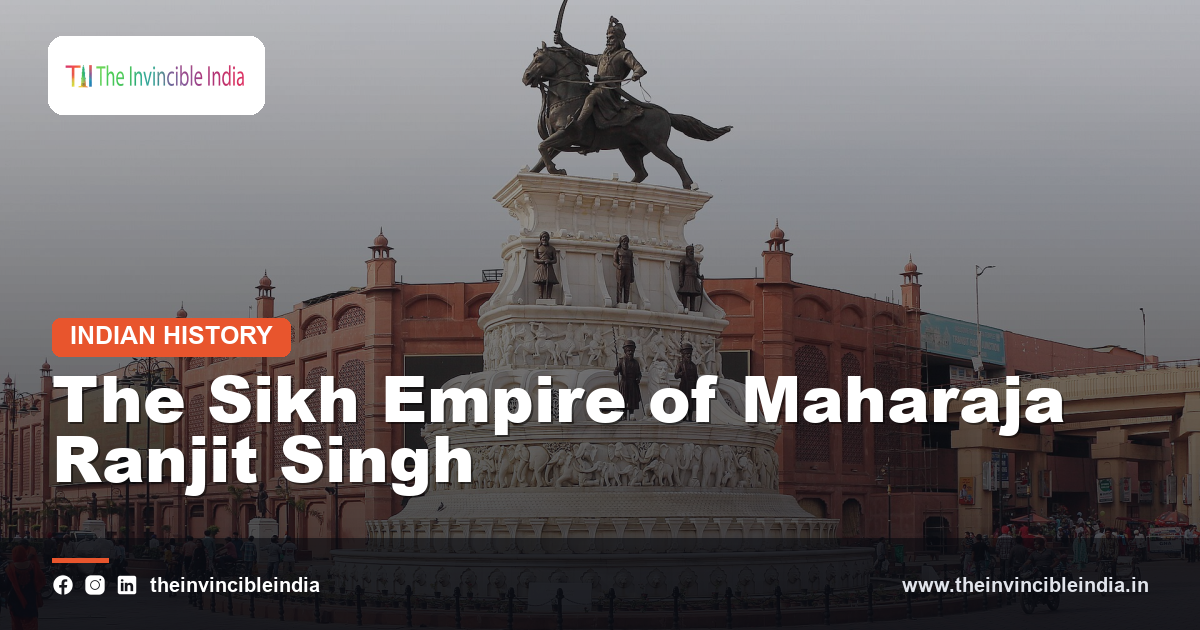
In the early nineteenth century, while the older Indian powers were giving way before an expanding British presence, a new state took shape in the northwest under the leadership of Maharaja Ranjit Singh. Known as the Sikh empire or Sarkar-i-Khalsa, it united the Punjab, extended into Kashmir, Multan and Peshawar, and was governed from Lahore through a court remarkable for its diversity. Its roots lay in the Sikh tradition of the Khalsa and in the confederacies that arose as Mughal power weakened across the region. Though short-lived, the empire left a deep imprint on the culture, architecture and memory of Punjab. This guide explains its origins, institutions and legacy in clear, general terms.
Quick Facts
| Detail | Information |
|---|---|
| Founder | Maharaja Ranjit Singh |
| Also Known As | Sarkar-i-Khalsa or the Lahore Darbar |
| Capital | Lahore, with Amritsar as the sacred centre |
| Territory | Punjab, Multan, Peshawar and Kashmir at its height |
| Famous Army | The disciplined Khalsa force with European-trained units |
| Fate | Annexed by the British after the Anglo-Sikh wars |
The Sikh Tradition and the Khalsa
The Sikh empire emerged from a religious and social tradition that began with Guru Nanak and developed under his successors in the Punjab. Over generations, the community formed a distinct identity centred on devotion, equality, service and the sacred scripture. The creation of the Khalsa under Guru Gobind Singh gave the community a disciplined brotherhood committed to justice and self-defence. This tradition of collective identity and military readiness later shaped the political organisation of the Sikhs. The idea that sovereignty belonged to the Panth, the community as a whole, remained influential even after a single ruler took power. Understanding the empire therefore begins with understanding the faith and community from which it grew. The values of the Khalsa continued to provide the moral language of Sikh rule.
Punjab in the Eighteenth Century
During the eighteenth century, the Punjab became a contested borderland where the declining Mughal administration, Afghan invaders and local powers struggled for control. Repeated invasions from the northwest disrupted order, and the old imperial structure could no longer keep the peace. In this turbulent setting, Sikh bands gained strength, defending villages, raiding rivals and gradually carving out areas of influence. Banda Singh Bahadur had earlier led a major Sikh uprising, and the memory of his campaigns inspired later generations. The fertile plains of the five rivers offered rich resources for any force able to hold them. Political fragmentation thus created the conditions in which Sikh chiefs could build lasting territorial authority. The stage was set for the emergence of a unifying leader.
The Misls and the Dal Khalsa
Sikh power in this period was organised into a group of confederacies known as misls, each led by a chief and made up of mounted fighters bound by loyalty and shared purpose. The misls cooperated in the larger body called the Dal Khalsa and met in general assemblies to decide matters of common concern. This arrangement was effective in resisting invaders but prone to rivalry, since each chief guarded his own territory and independence. Over time, some misls grew stronger and absorbed others, shifting the balance of power. The system reflected the egalitarian and communal spirit of Sikh tradition, but it also lacked the central authority needed for a stable state. The eventual consolidation of the misls under a single ruler would transform the political map of the region. Their rivalries and achievements form the essential background to the empire.
Early Life of Ranjit Singh
Ranjit Singh was born into the Sukerchakia misl, one of the rising Sikh confederacies of the Punjab, and he inherited leadership at a young age. His early years were shaped by the responsibilities of command and by the political rivalries of the time. Despite limited formal education, he developed a sharp understanding of people, strategy and diplomacy. Tradition also records the personal hardships he faced in youth, which hardened his determination. He rose quickly in reputation, combining courage in the field with a talent for choosing capable advisers. The foundations of his future authority lay in the strength of his own misl and in his ability to win the trust of others. His early life thus prepared him for the great task of uniting the Sikh territories.
The Capture of Lahore
A decisive step in Ranjit Singh’s rise was his acquisition of Lahore, the historic capital of the Punjab and a city rich in prestige. Lahore had long been a centre of power under earlier dynasties, and its possession gave the young leader a commanding political and symbolic base. Accounts describe how the city’s residents and local notables supported his entry, which helped secure the transition. After consolidating his hold, he was formally recognised as ruler and soon assumed the title Maharaja. The city became the seat of the Lahore Darbar, the court from which the Sikh empire would be governed. Lahore’s position at the heart of the Punjab made it ideal for administering the expanding territory. The capture of the city marked the true beginning of Sikh imperial rule.
Uniting the Punjab
Over the following years, Ranjit Singh brought the remaining misls and many independent chiefs under his authority, using a mixture of military pressure, diplomacy and marriage alliances. Amritsar, the sacred city of the Sikhs, came under his control and was integrated into the new state. He generally preferred to retain capable local rulers as vassals and to reward loyalty with positions and estates. This pragmatic approach reduced resistance and widened the base of his support. The result was a unified Sikh state in the central Punjab, replacing the earlier patchwork of rival confederacies. The achievement represented a profound change from the decentralised misl system to a more centralised monarchy. The unification of the Punjab was the cornerstone on which all later expansion rested.
Relations with the British
As Ranjit Singh’s power grew, the British East India Company was expanding its own authority across northern India and approaching the Sutlej river. The two powers negotiated a settlement, known as the Treaty of Amritsar, which recognised the Sutlej as the boundary between their spheres of influence. The arrangement secured the Maharaja’s territories north of the river and freed him to expand elsewhere. It also reflected a cautious realism, since open conflict with a well-equipped rival carried great risks. For the remainder of his reign, the relationship stayed generally peaceful, although both sides watched each other warily. The agreement helped preserve Sikh independence for a generation while the rest of northern India fell under British control. Diplomatic skill thus proved as important as military strength in the life of the empire.
Expansion to Multan, Kashmir and Peshawar
With the Punjab secure, Ranjit Singh directed his armies outward, bringing Multan in the south, Kashmir in the north and Peshawar in the northwest under Sikh authority. These regions were strategically and economically important, controlling trade routes and fertile valleys. The acquisition of Peshawar and the frontier lands pushed the empire to the edge of the Afghan highlands, historically the source of invasions into India. Kashmir added a prosperous province known for its shawls and craftsmanship. Campaigns in these areas required skilled commanders and well-supplied forces, and they demonstrated the growing power of the Sikh army. The expanded territory made the Sikh empire one of the most significant states in the northwest of the subcontinent. Its frontier now reached regions that earlier Punjab powers had rarely held.
The Khalsa Army
The army of the Sikh empire is among the most celebrated features of the state. Ranjit Singh recognised that traditional cavalry alone would not suffice against modern forces, and he set about training infantry and artillery on disciplined lines. European officers, drawn from several countries, were employed to help drill the troops and organise the artillery. The result was a force that combined the courage of the Sikh tradition with modern organisation, supported by foundries and arsenals at Lahore. The cavalry remained prominent, and Sikh commanders such as Hari Singh Nalwa won lasting renown for their conduct on the frontier. The army served both as a military instrument and as a source of pride and identity for the empire. Its discipline and strength made the Sikh state a respected power.
The Lahore Darbar and Administration
The Lahore Darbar functioned as the political and ceremonial heart of the Sikh empire. Government was highly personal, with the Maharaja himself making important decisions and relying on a circle of trusted ministers and officials. Revenue was collected through a system that drew on existing local practices, and provinces were placed under governors responsible for order and taxation. Justice was administered through a mixture of local custom and royal authority. The state also issued its own coinage and maintained a treasury to support the army and court. While the system lacked the elaborate bureaucracy of some larger empires, it was effective under a strong ruler. The administration reflected the personal authority of the Maharaja, which later proved a source of vulnerability after his death.
A Diverse and Inclusive Court
One of the most admired features of the Sikh empire was the breadth of its court. Ranjit Singh employed ministers, administrators, generals and advisers from different religious and regional backgrounds, including Sikhs, Hindus and Muslims. Prominent figures included members of the Dogra family, as well as Muslim advisers such as the Fakir brothers who served in diplomacy and administration. This inclusiveness helped secure the loyalty of a diverse population in a land of many faiths. It also reflected the Maharaja’s practical judgement that ability should be rewarded wherever it was found. Religious festivals of different communities were respected, and patronage extended to several traditions. The court at Lahore thus presented a model of cooperation across communities. This tradition of plural governance remains an enduring part of the empire’s reputation.
Harmandir Sahib and Sikh Patronage
Ranjit Singh was a generous patron of Sikh shrines, and his support transformed the appearance of the sacred centre at Amritsar. The Harmandir Sahib, popularly known as the Golden Temple, was renovated and embellished with gold-covered upper levels, giving it the radiant appearance admired by visitors today. Marble and decorative work were added, and other gurdwaras across the Punjab also received donations and endowments. These acts expressed the ruler’s devotion and strengthened the bond between the state and the Sikh community. The shrine continued to function as the spiritual heart of the faith, welcoming people of all backgrounds. The patronage of the Maharaja helped ensure that the architectural heritage of Sikhism flourished. The gilded sanctum remains the most visible legacy of this devotion.
Lahore Fort and Court Architecture
Lahore offered a magnificent architectural setting for the Sikh court. The Lahore Fort, already a grand structure inherited from the Mughal age, was used and adapted by the Sikh rulers, who added pavilions and residential spaces. Elegant buildings, gardens and audience areas reflected the dignity of the Darbar and blended Mughal, Rajput and local Punjabi influences. Decorative work in mirror, painted plaster and inlaid stone became associated with the era. The Hazuri Bagh and its pavilion stand as examples of the refined architecture of the period. Such buildings were intended not only for use but also to express royal authority and cultural confidence. The architectural legacy of the Lahore Darbar remains an important chapter in the story of regional Indian art.
Arts, Painting and Craft
The Sikh court supported painters, poets, musicians and craftsmen, creating a vibrant artistic environment. Portraits of the Maharaja and his court, executed in the tradition of Punjab painting, show a distinctive style that borrowed from Mughal and Pahari schools. Craftsmen in metal, jewellery and textiles produced work of high quality, and Kashmiri shawls became prized across regions. Poetry and music in Punjabi, Persian and other languages found audiences at court and in religious settings. The Kohinoor diamond, which came into the Maharaja’s possession, became a famous symbol of the treasury and the wealth of the state. This patronage enriched the regional culture and gave Punjab a lasting artistic identity. The empire therefore contributed to heritage far beyond the battlefield.
Death of Ranjit Singh and Political Crisis
The death of Ranjit Singh removed the central force that held the empire together, and the state quickly faced a crisis of succession. His heirs lacked his authority and experience, and rival factions at court competed for power through intrigue and sometimes violence. Several rulers came and went in rapid succession, while influential ministers and army leaders struggled for control. The army itself, strong and proud, increasingly acted as a political force through its regimental committees. The administrative system, built around a single powerful ruler, struggled to function without him. This period of instability weakened the state internally just as the neighbouring British power was growing stronger. The speed of the decline illustrates how closely the empire’s success had depended on its founder.
The Anglo-Sikh Wars and Annexation
Tensions between the Sikh state and the British eventually led to open conflict in the Anglo-Sikh wars. The Sikh army fought with notable courage in several hard-fought engagements, but divisions among its leadership and the strength of its opponent proved decisive. After the first war, the Sikh state lost territory and came under growing British influence in its affairs. A second war followed, ending with the annexation of the Punjab into British India. The young ruler Duleep Singh was removed from power and later taken to Britain. The Kohinoor passed into British hands, a fact still remembered and debated today. The end of the Sikh empire marked the last major independent state in the subcontinent to fall under British control.
The Sikh Empire Today
The Sikh empire is remembered with deep respect in Punjab and among Sikh communities around the world. Maharaja Ranjit Singh is regarded as a ruler who united a fractured land, built a powerful army and governed a diverse population with a degree of tolerance. Monuments such as the Golden Temple, the Lahore Fort and the museums and memorials of the region preserve the memory of the era. Historians continue to study its institutions, its diplomacy with the British and its cultural patronage. The empire also stands as a reminder of the unity of Punjab’s shared heritage across modern borders. Its story, while brief, remains one of the most vivid chapters in Indian history. The Sikh empire thus endures as a symbol of courage, plurality and cultural achievement.
Sources & Further Reading
- Ministry of Culture, Government of India (indiaculture.gov.in).
- Archaeological Survey of India (asi.nic.in).
Frequently Asked Questions
Who founded the Sikh empire?
The Sikh empire was founded by Maharaja Ranjit Singh, who rose from the Sukerchakia misl, took Lahore and united the Sikh confederacies of the Punjab into a single state. He ruled as Maharaja from the Lahore Darbar.
What was the Khalsa army?
The Khalsa army was the military force of the Sikh empire, combining traditional Sikh cavalry with modern infantry and artillery trained on disciplined lines. European officers helped drill and organise the new units.
How far did the Sikh empire extend?
At its height the empire covered the Punjab and extended to Multan, Peshawar and Kashmir. Its frontier reached the foothills of the Afghan highlands and the Himalayan valleys of the north.
What was the Treaty of Amritsar?
It was an agreement between Ranjit Singh and the British East India Company that recognised the Sutlej river as the boundary between their spheres of influence. It allowed the Maharaja to expand elsewhere while keeping peace with the British.
How did the Sikh empire end?
After the death of Ranjit Singh, political instability weakened the state, and conflict with the British led to the Anglo-Sikh wars. The Punjab was eventually annexed into British India.


