

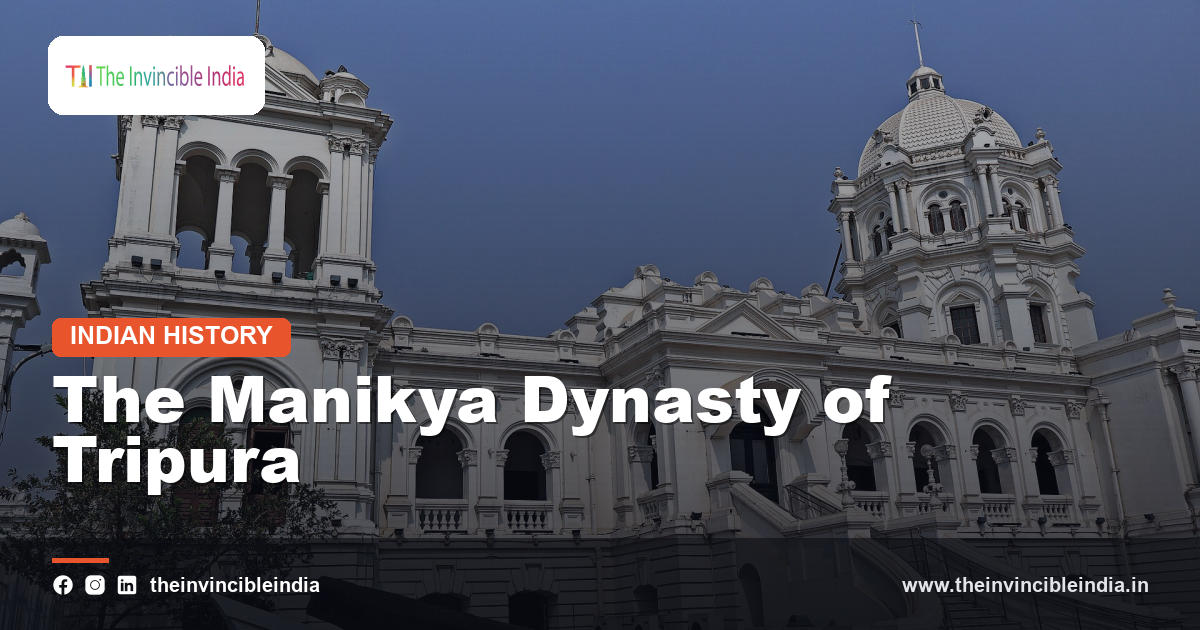
The Manikya dynasty of Tripura, also called the Manikya kings of Tripura or the Tripura royal house, was the ruling line of the Tripuri kingdom in the hills and plains of present-day Tripura and nearby parts of Bangladesh. Their court chronicle, the Rajmala, records a long line of rulers who used the title Manikya, while the kingdom itself survived through the medieval age and into the colonial period as a princely state. Unlike the imperial houses described in our guide to the Mughal Empire, the Manikyas ruled a small frontier realm that balanced Bengal, Burma and Assam. Early chronology is traditional and debated, so this guide keeps to general terms.
Quick answer: The Manikya dynasty was the ruling family of the kingdom of Tripura in north-eastern India, whose rulers took the title Manikya and are recorded in the court chronicle Rajmala. They held a succession of capitals, including Udaipur and later Agartala, and built landmarks such as the Tripura Sundari temple and Ujjayanta Palace. The kingdom became a princely state under the British and joined the Indian Union in the middle of the twentieth century.
Key Takeaways
- The Manikya dynasty was the royal house of Tripura, a hill-and-plains kingdom in north-eastern India.
- The Rajmala is the traditional royal chronicle that preserves the genealogy and stories of the Tripura kings.
- Capitals shifted over time, with Udaipur and Agartala being the best known.
- The Tripura Sundari temple at Udaipur is a major Shakti shrine linked with the dynasty.
- Ujjayanta Palace in Agartala, built in the late nineteenth and early twentieth century, now serves as a state museum.
- Tripura joined the Indian Union in 1949 and later became a full state.
Read on for the history, culture, and legacy in detail.
Quick Facts
| Detail | Information |
|---|---|
| Dynasty | Manikya dynasty of Tripura (Tripura royal house) |
| Region | Tripura, with historic reach into parts of present-day Bangladesh |
| Royal Chronicle | Rajmala |
| Known Capitals | Udaipur, Old Agartala, Agartala |
| Famous Monuments | Tripura Sundari temple, Ujjayanta Palace, Neermahal |
| End of Princely Rule | Merger with the Indian Union in 1949 |
Who Were the Manikya Kings of Tripura?
The Manikya kings were the hereditary rulers of the Tripuri kingdom, a state of the Borok-speaking Tripuri people and allied communities in the hills east of Bengal. Their title Manikya, meaning a ruby or precious jewel, became the shared name of the royal line, and each king added it to his personal name. The dynasty ruled for many centuries, according to its own chronicle, through changing fortunes against the Sultans of Bengal, the Mughals, the Burmese and the British. Because early reign lists rest on tradition, historians treat the earliest names with caution while accepting the broad continuity of the line. The Manikyas thus stand as one of the longest-surviving royal houses of the Northeast.
Where Was the Kingdom of Tripura Located?
The kingdom of Tripura lay in the hills, valleys and river plains east and south of Bengal, in what is now the Indian state of Tripura and adjoining parts of Bangladesh. At different times its influence reached toward Comilla, Noakhali, Sylhet and the Chittagong coast, while its heartland remained the forested Tripura hills. Rivers such as the Gomati, Haora and Manu shaped its settlements and routes of movement. This position between the Bengal delta and the hills of Burma made Tripura a frontier kingdom, valued for its timber, cotton and strategic passes. The geography explains both its long survival and its repeated border conflicts.
What Is the Rajmala Chronicle?
The Rajmala is the royal chronicle of Tripura, a record of the kings that was compiled by court scholars and rewritten over time. It combines genealogy, legend and court history, tracing the royal line to ancient lunar-dynasty ancestors in the manner of many Indian royal chronicles. The text was composed in a Bengali idiom with Sanskritic influence, reflecting the court’s ties with Bengal. Scholars value the Rajmala as a source for the kingdom’s self-image, but they caution that its early chapters mix myth with history and that dates cannot be taken at face value. For later centuries, the chronicle becomes more reliable and offers rich detail on wars, alliances and religious patronage.
How Did the Title Manikya Begin?
Tradition holds that the title Manikya was adopted when a Tripura king received a jewel or an honorific from a Bengal ruler, after which the name remained in the royal family. The Rajmala links this episode to a king of the fifteenth century, and later rulers all bore the title. Historians regard the story as a tradition rather than a settled fact, and the exact circumstances are debated. What is clear is that the name became an emblem of royal identity and appeared on coins and inscriptions of the dynasty. The Manikya name therefore points both to the kingdom’s relations with Bengal and to its own distinctive sense of kingship.
Early Kings and the Limits of Chronology
The earliest Tripura kings appear in the Rajmala with long genealogies that reach back to legendary ages, and no modern historian accepts these lists as precise records. A more secure picture begins in the medieval period, when contacts with the Bengal Sultanate and the use of coins and inscriptions provide external checks. Rulers of this phase expanded into the plains, built settlements, and established a Hindu court culture with Shaiva and Shakta leanings. Tribal councils and clan leaders continued to matter, and the kings balanced hill traditions with courtly practice. The early story of the dynasty is therefore best read as a blend of oral memory and later literary shaping.
Udaipur and the Tripura Sundari Temple
Udaipur, in the Gomati district of Tripura, served as a capital of the dynasty and remains the site of its most famous temple. The Tripura Sundari temple at Matabari is traditionally counted among the major Shakti shrines of the subcontinent, and it is said to have been established by a Manikya king in the sixteenth century. Its sanctum has a shape often compared to a tortoise, which gives the hillock its local name, and a large lake lies beside it. Pilgrims visit throughout the year, especially at the festival of Diwali. The temple shows how the Manikyas used religion to tie their kingdom to wider Hindu traditions.
Why Is Unakoti Important to Tripura's Heritage?
Unakoti is important because it preserves one of the largest rock-cut sculpture sites in the Northeast, set in a forested hill valley of north Tripura. Its giant Shaiva reliefs, including a great carved head often called Unakoti Bhairava, draw pilgrims and scholars alike. The origins of the site are debated, and different traditions attribute it to different patrons and periods, so it cannot be tied firmly to a single Manikya king. It is nonetheless part of the cultural landscape in which the dynasty ruled and belongs to the same world of Shaiva devotion. Unakoti reminds visitors that Tripura’s religious heritage runs deeper than any one dynasty.
Wars with Bengal, Arakan and the Mughals
The Manikyas fought a long series of border wars with the Sultans of Bengal, the rulers of Arakan, and later the Mughals. Control of the plains around Comilla and Noakhali shifted back and forth, and the Rajmala preserves vivid accounts of campaigns, river fleets and elephant forces. The Mughals pressed hard on the plains and sometimes installed their own claimants, yet they never fully absorbed the hill heartland. The kings paid tribute at times and recovered independence at others, using the forests as a natural defence. This pattern of pressure and resilience defines the political history of the kingdom between the medieval and early modern periods.
The Move to Agartala
The Manikya capital moved to Agartala in the nineteenth century, when the royal court settled on the plains of the Haora river. An earlier settlement known as Old Agartala, a few miles away, had already been a seat, and its Chaturdasha Devata temple remains an important site. The shift to the new city reflected both strategic needs and the wish for a more accessible administrative centre. Agartala grew into a planned princely capital with palaces, public buildings and gardens, and it is today the capital of the state of Tripura. The move marks the beginning of the modern urban history of the region.
Ujjayanta Palace: The Royal Residence
Ujjayanta Palace is the grand royal residence built by the Manikya rulers in Agartala toward the end of the nineteenth century and completed in the early twentieth. Set amid gardens and ornamental ponds, it combines elements of European, Mughal and Indian architectural taste, with domes, arches and wide staircases. After the merger with India, the palace served for a time as the seat of the state legislature and was later converted into the State Museum. The galleries now display tribal arts, sculpture and historical material, giving visitors a view of Tripura’s culture. The building remains the most recognised symbol of the dynasty.
Neermahal and the Water Palace Tradition
Neermahal is a water palace in the middle of Rudrasagar lake at Melaghar, built by a late Manikya ruler in the twentieth century as a summer retreat. It blends Hindu and Mughal styles, with pavilions, domes and terraces set on the lake and approached by boat. The palace expresses the princely taste for leisure architecture seen elsewhere in India, yet it is distinctive for its setting in a lake of north-eastern hill country. Its restoration and lighting have made it a popular tourist site. Neermahal stands as a reminder that the Manikyas were patrons of both devotional and pleasure architecture.
Rabindranath Tagore and the Manikya Court
The Manikya court enjoyed a notable friendship with the poet Rabindranath Tagore, who visited the kingdom more than once and drew inspiration from its history. The Tripura kings admired Bengali literature and extended generous support to Tagore and his institutions, and the poet used Tripura legends in works such as the plays Visarjan and Raja o Rani. This relationship shows the court’s strong Bengali cultural orientation and its interest in literature and music. It also enriched the wider cultural record of the region, since Tagore’s writings and letters mention the kingdom’s landscapes and people. The connection remains one of the best-known literary links in the dynasty’s story.
Tripuri Society, Language and Festivals
Tripuri society, the foundation of the kingdom, was shaped by Borok-speaking clans with their own language, Kokborok, and a rich calendar of festivals. The Kharchi festival honours the fourteen deities of the royal and tribal tradition at Old Agartala, while Garia puja celebrates the harvest with song and dance. The kings acted as patrons of these rites even as they practised Hindu worship at court. Communities of Bengali, Manipuri and other origins also settled in the kingdom and added to its mixed culture. This blend of tribal and Hindu traditions is one of the defining features of Tripura’s heritage.
The Princely State under British Paramountcy
Under the British, Tripura was a princely state that kept its own ruler while accepting the paramountcy of the Crown. The Manikya kings also held estates in British Bengal, a double position that gave them wealth and influence beyond their hill territory. The court introduced administrative reforms, schools, a legal system and urban planning, especially in the late nineteenth and early twentieth centuries. The rulers kept patronising arts and literature, and some maintained close ties with Bengal’s intellectual circles. The princely era thus brought modernisation alongside continued royal tradition, and it shaped the institutions inherited by the later state.
Merger with India and the Making of Modern Tripura
Tripura joined the Indian Union in 1949, when the regent queen signed the merger agreement on behalf of the young heir after the death of the previous king. Tripura was first administered as a centrally governed territory, then became a Union Territory and finally a full state in the early 1970s. The merger ended princely rule but did not erase the dynasty’s cultural presence, since palaces, temples and festivals remained as public heritage. The decades after independence also brought deep demographic and political changes, which scholars discuss at length. The merger is therefore a key turning point in the story of the state.
The Manikya Legacy in Tripura Today
The legacy of the Manikya dynasty lives on in the monuments, festivals and memory of Tripura today. Ujjayanta Palace, Neermahal, the Tripura Sundari temple and the Chaturdasha Devata temple draw pilgrims, students and visitors from across India. The chronicle Rajmala continues to inform historians of the Northeast, and the figure of the Manikya king remains a cultural reference in Tripuri folklore. Debates about chronology and about tribal and royal narratives continue, and they enrich rather than diminish the story. The dynasty remains a defining chapter in the history of one of the most distinctive states of the region.
Sources & Further Reading
- Archaeological Survey of India (asi.nic.in).
- Ministry of Culture, Government of India (indiaculture.gov.in).
Frequently Asked Questions
Who were the Manikya kings of Tripura?
The Manikya kings were the hereditary rulers of the kingdom of Tripura in north-eastern India. They took the title Manikya, meaning ruby or jewel, and ruled until the princely state merged with India in the middle of the twentieth century.
What is the Rajmala?
The Rajmala is the royal chronicle of the Tripura kings. It combines genealogy, legend and court history, and its early portions are regarded by scholars as traditional rather than precisely dated.
Where is Ujjayanta Palace?
Ujjayanta Palace is in Agartala, the capital of Tripura. It was the royal residence of the Manikya rulers and now houses the State Museum.
Why is the Tripura Sundari temple important?
The Tripura Sundari temple at Udaipur in Tripura is a major Shakti shrine traditionally counted among the sacred seats of the goddess. It is linked with the Manikya rulers and attracts large numbers of pilgrims, especially during Diwali.
When did Tripura join India?
Tripura joined the Indian Union in 1949 through a merger agreement signed by the regent queen. It later became a Union Territory and then a full state in the early 1970s.
Was Rabindranath Tagore connected to the Tripura royal family?
Yes, Rabindranath Tagore enjoyed a close friendship with the Manikya court and visited Tripura more than once. He used Tripura legends in works such as Visarjan and Raja o Rani.


