

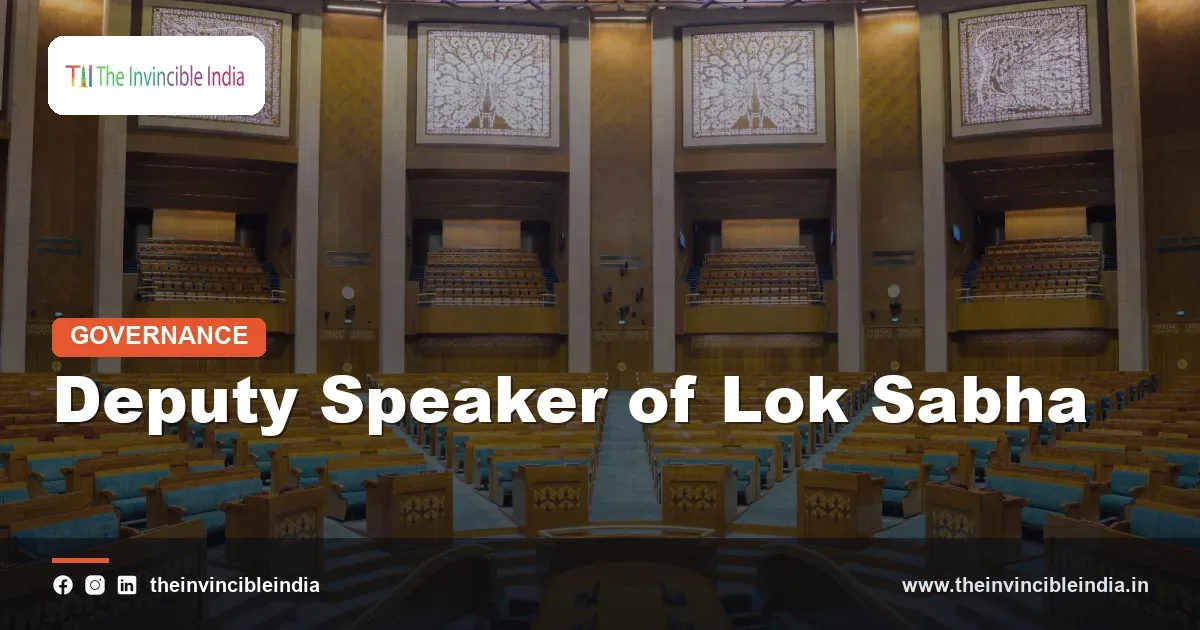
The Deputy Speaker of the Lok Sabha is the second-ranking presiding officer of India’s House of the People, elected by its members under Article 93 of the Constitution to preside over sittings and exercise the Speaker’s powers whenever the Speaker is absent or the office is vacant. The post exists so that the Lok Sabha never has to function without someone in the chair who can maintain order, interpret the rules and conduct the business of the House.
The office is short on ceremony but heavy on constitutional importance. The Deputy Speaker is not an assistant who answers to the Speaker; the holder is a member chosen by the House itself and is answerable only to the House. This explainer sets out how the office is created, what it can do, how it ends, and why its long vacancies have become a topic of debate. It was last reviewed on 8 October 2026.
| Attribute | Detail |
|---|---|
| Office | Deputy Speaker of the Lok Sabha |
| Constitutional basis | Articles 93, 94, 95, 96 and 97 of the Constitution of India |
| Elected by | Members of the Lok Sabha, by a simple majority of those present and voting |
| Elected from | Among the members of the Lok Sabha itself |
| Presides when | The Speaker is absent from a sitting or the Speaker’s office is vacant |
| Resigns to | The Speaker, in writing |
| Removal | Resolution passed by a majority of all the then members of the House, after 14 days’ notice |
| Parallel office | Deputy Chairman of the Rajya Sabha; Deputy Speaker of a State Legislative Assembly (Article 178) |
Key Takeaways
- The Deputy Speaker of the Lok Sabha is elected by the members of the House from among themselves, as required by Article 93 of the Constitution.
- Under Article 95, the Deputy Speaker performs the Speaker’s duties when the Speaker’s office is vacant and presides over any sitting from which the Speaker is absent.
- The Deputy Speaker of the Lok Sabha is not subordinate to the Speaker and is accountable to the House, not to the Speaker.
- The Deputy Speaker resigns by writing to the Speaker and can be removed only by a resolution passed by a majority of all the then members of the Lok Sabha.
- A parliamentary convention, followed from the early 1990s, offers the post of Deputy Speaker to a member of an opposition party, although the Constitution does not require it.
- Article 93 says the posts must be filled “as soon as may be” but sets no deadline, which is why long vacancies in the office of Deputy Speaker have been debated.
What is the Deputy Speaker of the Lok Sabha?
The Deputy Speaker of the Lok Sabha is a member of the House elected to fill the second-highest presiding office, ranking below the Speaker and acting in the Speaker’s place when required. The Constitution treats the two offices as a pair: the House of the People chooses both its Speaker and its Deputy Speaker, and each is a full member of the Lok Sabha with the right to speak and vote on the floor in the ordinary way when not presiding.
The office has a colonial-era ancestor. The Government of India Act 1919 created a Central Legislative Assembly with a President and a Deputy President. After the Constitution came into force in 1950, these titles were replaced by Speaker and Deputy Speaker, and the first Lok Sabha constituted after the 1951-52 general election chose G. V. Mavalankar as Speaker and M. Ananthasayanam Ayyangar as Deputy Speaker. Ayyangar later became Speaker, and the pattern of a Deputy Speaker graduating to the chair has repeated in the House’s history.
The Deputy Speaker is distinct from the Deputy Chairman of the Rajya Sabha. The Rajya Sabha’s presiding officer is the Chairman, who is the Vice-President of India, and its Deputy Chairman is elected by that House. The Lok Sabha’s Deputy Speaker is the equivalent figure in the lower House.
What does Article 93 say about the Deputy Speaker?
Article 93 of the Constitution says that the House of the People shall, as soon as may be, choose two of its members to be the Speaker and Deputy Speaker, and that a new member shall be chosen whenever either office falls vacant. The wording makes three points clear: the choice belongs to the House, the persons chosen must already be members, and the House must fill a vacancy when it occurs.
The phrase “as soon as may be” is deliberately flexible. It tells the House to act without undue delay but does not fix a date, a number of days or a consequence for delay. This flexibility is central to the later debate about prolonged vacancies, because the text gives no one the power to compel an election.
The related articles complete the framework:
- Article 94 covers vacation of office, resignation and removal of the Speaker and Deputy Speaker.
- Article 95 deals with the powers of the Deputy Speaker or another person to perform the duties of the Speaker’s office.
- Article 96 prevents the Speaker or Deputy Speaker from presiding while a resolution for their own removal is being considered.
- Article 97 provides for their salaries and allowances, which Parliament fixes by law and which are charged on the Consolidated Fund of India.
How is the Deputy Speaker of the Lok Sabha elected?
The Deputy Speaker of the Lok Sabha is elected by a motion moved by one member and seconded by another, and the House decides the matter by a simple majority of members present and voting. The Rules of Procedure and Conduct of Business in the Lok Sabha lay down the process: the Speaker fixes the date for the election of the Deputy Speaker, and notice of candidates is given in advance.
The election usually takes place in the first session or soon after the Speaker has been chosen. Once the House elects the Speaker, the Speaker normally presides when the Deputy Speaker is chosen. Where several names are proposed, the House votes; where only one is proposed, the Speaker declares that member elected after the House agrees.
The key features of the process are:
- Only a sitting member of the Lok Sabha can be elected.
- The election is by the House and not by any outside electorate or by the President of India.
- The Speaker, not the government, fixes the date, which gives the process a measure of independence from the executive.
- The oath is not a separate constitutional requirement for this office, since the person is already a sworn member of the House.
The Constitution does not set a minimum experience or qualification other than being a Lok Sabha member. In practice the House has chosen experienced parliamentarians who command respect across party lines.
What powers does the Deputy Speaker have under Article 95?
Under Article 95, the Deputy Speaker has all the powers of the Speaker while presiding over the House, including the power to maintain order, rule on points of order and interpret the rules of procedure. The Deputy Speaker acts in two situations. When the Speaker’s office is vacant, the Deputy Speaker performs the duties of the Speaker. When the Speaker is only absent from a particular sitting, the Deputy Speaker presides at that sitting.
When the Deputy Speaker presides, the same rules apply as when the Speaker does. The chair does not vote in the first instance but may exercise a casting vote in the case of a tie. The Deputy Speaker can permit or refuse adjournment motions, call members to speak, admit or reject notices within the rules, and name or suspend members for disorderly conduct. Rulings given from the chair by the Deputy Speaker are treated as rulings of the House’s chair.
Article 95 also provides a fallback. If both the Speaker and the Deputy Speaker are absent, the House’s own rules of procedure decide who presides, and if no such person is present, the House itself determines who shall act. Where the Speaker’s office is vacant and there is no Deputy Speaker either, the President of India appoints a member to perform the Speaker’s duties until a Speaker is chosen.
Other functions of the Deputy Speaker
- The Deputy Speaker becomes the chairperson of any parliamentary committee of which the Deputy Speaker is appointed a member.
- The Deputy Speaker is often named on the panel of chairpersons from which presiding members are drawn during a session.
- The Deputy Speaker may take part in debate and vote like any other member when not occupying the chair.
Is the Deputy Speaker subordinate to the Speaker?
The Deputy Speaker is not subordinate to the Speaker; both are independent constitutional offices, each elected by the House and each answerable to the House. This is a point that is often misunderstood because of the title “Deputy”, which suggests an assistant working under instructions.
The Speaker cannot direct the Deputy Speaker on how to rule, cannot dismiss the Deputy Speaker and cannot assign the Deputy Speaker’s powers. The Deputy Speaker holds power in their own right under Article 95 and, when in the chair, acts on their own authority and judgment. Only the House, acting under Article 94, can end the Deputy Speaker’s term through a removal resolution.
Several features reinforce this independence:
- The Deputy Speaker’s salary and allowances are charged on the Consolidated Fund of India and are not voted annually by Parliament.
- The Deputy Speaker’s removal needs a majority of all the then members of the House, which is a higher threshold than a simple majority of those present.
- The Deputy Speaker does not lose the post when a Speaker changes; the term depends on membership of the House, not on the Speaker.
The Speaker does remain the senior office. The Speaker is the principal presiding officer, decides on many administrative matters of the House and its Secretariat, and ranks higher in the order of precedence. The relationship is one of seniority and rank, not of command.
How does the Deputy Speaker resign or get removed?
The Deputy Speaker resigns by writing a letter addressed to the Speaker, as provided in Article 94 of the Constitution. A mirror-image provision applies to the Speaker, who resigns by writing to the Deputy Speaker, so each of the two presiding officers is the natural recipient of the other’s resignation.
Article 94 lists three ways in which the Deputy Speaker’s term ends:
- The Deputy Speaker ceases to be a member of the Lok Sabha, for example on disqualification, resignation of the seat or dissolution of the House.
- The Deputy Speaker resigns in writing to the Speaker.
- The Deputy Speaker is removed by a resolution of the House passed by a majority of all the then members, after at least 14 days’ notice of the intention to move the resolution.
A special rule applies on dissolution. Article 94 allows the Speaker to continue in office until immediately before the first meeting of the new House, but that protection is written for the Speaker alone. The Deputy Speaker’s office therefore ends when the Lok Sabha is dissolved, because the Deputy Speaker stops being a member, and a new Deputy Speaker must be elected in each new House.
Article 96 protects the process. While a resolution to remove the Deputy Speaker is under consideration, the Deputy Speaker may not preside, though the Deputy Speaker may speak and take part in the proceedings and may vote in the first instance, but not on an equality of votes. This prevents a presiding officer from controlling the debate on their own removal.
What is the convention of giving the post to the opposition?
The convention of giving the Deputy Speaker’s post to the opposition is a parliamentary practice, not a constitutional or statutory rule, under which the ruling side takes the Speaker’s chair and an opposition member becomes the Deputy Speaker. The aim is to reassure the minority that the House’s presiding team is not entirely drawn from the government’s own ranks.
Historically, the early Lok Sabhas generally chose Deputy Speakers from the ruling party, and from the early 1990s the practice of offering the post to the opposition took hold. Since then, Deputy Speakers have come from parties such as the Bharatiya Janata Party, the Indian National Congress, the Shiromani Akali Dal and the All India Anna Dravida Munnetra Kazhagam, depending on the composition of the House and the alliances then in office. The details of each term depend on the political arrangement of that Lok Sabha and are best checked against the Lok Sabha’s own records.
Two features of the convention are worth noting:
- The convention is not enforceable. No court or rule can compel a government to offer the post to a particular party.
- It has sometimes been applied to a member of a party that is not in government, rather than to the principal opposition party, which has led to differing views about how closely it has been followed.
Supporters of the convention argue that it strengthens the legitimacy of the chair. Others point out that the Deputy Speaker, once elected, is expected to act impartially regardless of party label, and that the convention should not be mistaken for a rule of constitutional law.
Why have vacancies in the Deputy Speaker’s office been debated?
Vacancies in the Deputy Speaker’s office have been debated because Article 93 requires the House to choose a Deputy Speaker “as soon as may be” but does not fix a deadline or provide any mechanism to enforce the choice. As a result, a Lok Sabha can in principle run for years without a Deputy Speaker, as happened in the 17th Lok Sabha (2019-2024), which completed its term without electing one.
Critics of long vacancies raise several concerns:
- The Constitution describes the election as something the House “shall” do, so leaving the post empty for a full term sits uneasily with the text.
- If the Speaker is unavailable or the office falls vacant, there is no Deputy Speaker to take over, and the President would have to appoint a member to act under Article 95.
- The convention of offering the post to the opposition is weakened when the post is not filled at all.
- Presiding duties then fall on the panel of chairpersons, which the Speaker nominates, so the House relies more on appointed than elected presiding officers.
Those who defend flexibility argue that the House has full control over its own proceedings under Article 118 and the Speaker can manage with the panel of chairpersons. The question has also been raised in public interest litigation and in debates in Parliament, but the Constitution leaves the final decision with the House, and the courts have traditionally been cautious about directing the legislature on how it manages its internal affairs.
How does the Deputy Speaker compare with the Speaker?
The Deputy Speaker has the same powers as the Speaker when presiding, but the Speaker holds the senior office with wider administrative and institutional responsibilities. The table below sets out the main differences between the two offices.
| Feature | Speaker | Deputy Speaker |
|---|---|---|
| Article for election | Article 93 | Article 93 |
| Elected by | The Lok Sabha | The Lok Sabha |
| Resigns to | The Deputy Speaker | The Speaker |
| Continues after dissolution | Yes, until just before the first meeting of the new House | No, since membership of the dissolved House ends |
| Presides over joint sittings | Yes, under Article 108 | Only in the Speaker’s absence |
| Certifies Money Bills | Yes, under Article 110 | Only when acting as the Speaker |
| Decides disqualification petitions under the Tenth Schedule | Yes | Only when acting as the Speaker |
| Controls Lok Sabha Secretariat | Yes | No |
What is the history of the Deputy Speaker’s office?
The history of the Deputy Speaker’s office begins with the Central Legislative Assembly of 1921, where the equivalent post was called Deputy President, and continues through independent India’s Lok Sabha from 1952. Over the decades, the office has evolved from a ruling-party post into one frequently offered to the opposition.
- 1921: The Government of India Act 1919 leads to the creation of a President and Deputy President of the Central Legislative Assembly.
- 1950: The Constitution of India comes into force, and Articles 93 to 97 set out the offices of Speaker and Deputy Speaker.
- 1952: The first Lok Sabha elects M. Ananthasayanam Ayyangar as its first Deputy Speaker.
- 1956: Ayyangar becomes Speaker and Hukam Singh is elected Deputy Speaker; Hukam Singh later also becomes Speaker.
- Early 1990s onwards: The convention of offering the Deputy Speaker’s post to the opposition takes hold.
- 2019-2024: The 17th Lok Sabha completes its term without electing a Deputy Speaker.
The way in which the office has been used offers a window into the working of Indian parliamentary democracy. It shows how a constitutional text that sets a minimal framework is filled out by conventions that change with the political climate.
How is the Deputy Speaker different from the Deputy Chairman of the Rajya Sabha?
The Deputy Speaker of the Lok Sabha is a presiding officer of the lower House, while the Deputy Chairman of the Rajya Sabha is a presiding officer of the upper House, and the two serve under different parent offices. The Rajya Sabha’s ex officio Chairman is the Vice-President of India, who is not a member of the House, whereas the Lok Sabha’s Speaker is an elected member of the House.
Both Deputies are elected by their respective Houses, and both preside in the absence of the senior officer. A significant difference lies in the standing of the senior offices. The Rajya Sabha is a permanent House that is not subject to dissolution, so its Deputy Chairman’s term follows the member’s term in the Rajya Sabha, which is six years for a member. The Lok Sabha’s Deputy Speaker, by contrast, is tied to a House that can be dissolved and starts afresh after each general election.
State legislatures follow the same model. Article 178 provides for a Speaker and Deputy Speaker of each State Legislative Assembly, and Article 182 provides for a Chairman and Deputy Chairman of a Legislative Council. The rules on election, resignation and removal closely mirror the provisions that apply at the Union level.
Bottom Line
The Deputy Speaker of the Lok Sabha is an independent, elected presiding officer who keeps the House functioning when the Speaker is absent and can exercise the Speaker’s full powers in the chair. The office’s strength comes from the House’s own choice and not from any appointment by the executive, and its weakness is that Article 93 gives no deadline for filling it. Whether the convention of offering the post to the opposition and the expectation of timely elections remain strong will depend on the practice of future Lok Sabhas.
Frequently Asked Questions
Who elects the Deputy Speaker of the Lok Sabha?
The members of the Lok Sabha elect the Deputy Speaker from among themselves. Article 93 of the Constitution requires the House to choose both the Speaker and the Deputy Speaker, and the decision is taken by a simple majority of members present and voting. The Speaker fixes the date for the election.
What is the role of the Deputy Speaker when the Speaker is absent?
The Deputy Speaker presides over the sitting and exercises all the powers of the Speaker. Article 95 provides for this arrangement both when the Speaker is absent from a sitting and when the Speaker’s office is vacant. The Deputy Speaker can maintain order, give rulings and use a casting vote in the event of a tie.
Is the Deputy Speaker subordinate to the Speaker?
No, the Deputy Speaker is not subordinate to the Speaker. Both are independent offices elected by the House, and the Deputy Speaker is answerable to the House itself. Only a resolution of the House under Article 94 can remove the Deputy Speaker.
How can the Deputy Speaker resign or be removed?
The Deputy Speaker resigns by writing to the Speaker, and removal needs a resolution passed by a majority of all the then members of the Lok Sabha. At least 14 days’ notice must be given of the intention to move such a resolution. The Deputy Speaker also ceases to hold office on ceasing to be a member of the House, including on its dissolution.
Does the Deputy Speaker have to come from the opposition?
No, there is no constitutional or legal rule that requires it. The practice of offering the post to a member of an opposition party is a parliamentary convention that took hold from the early 1990s. The House remains free to elect any of its members.
Can the Lok Sabha function without a Deputy Speaker?
Yes, the Lok Sabha can function without one, though this is not the arrangement the Constitution envisages. Article 93 says the House must fill the post as soon as may be, but sets no deadline. In the absence of both a Speaker and a Deputy Speaker, Article 95 requires the President to appoint a member to perform the Speaker’s duties, and the panel of chairpersons presides over sittings in the meantime.
{“@context”:”https://schema.org”,”@graph”:[{“@type”:”FAQPage”,”mainEntity”:[{“@type”:”Question”,”name”:”Who elects the Deputy Speaker of the Lok Sabha?”,”acceptedAnswer”:{“@type”:”Answer”,”text”:”The members of the Lok Sabha elect the Deputy Speaker from among themselves. Article 93 of the Constitution requires the House to choose both the Speaker and the Deputy Speaker, and the decision is taken by a simple majority of members present and voting. The Speaker fixes the date for the election.”}},{“@type”:”Question”,”name”:”What is the role of the Deputy Speaker when the Speaker is absent?”,”acceptedAnswer”:{“@type”:”Answer”,”text”:”The Deputy Speaker presides over the sitting and exercises all the powers of the Speaker. Article 95 provides for this arrangement both when the Speaker is absent from a sitting and when the Speaker’s office is vacant. The Deputy Speaker can maintain order, give rulings and use a casting vote in the event of a tie.”}},{“@type”:”Question”,”name”:”Is the Deputy Speaker subordinate to the Speaker?”,”acceptedAnswer”:{“@type”:”Answer”,”text”:”No, the Deputy Speaker is not subordinate to the Speaker. Both are independent offices elected by the House, and the Deputy Speaker is answerable to the House itself. Only a resolution of the House under Article 94 can remove the Deputy Speaker.”}},{“@type”:”Question”,”name”:”How can the Deputy Speaker resign or be removed?”,”acceptedAnswer”:{“@type”:”Answer”,”text”:”The Deputy Speaker resigns by writing to the Speaker, and removal needs a resolution passed by a majority of all the then members of the Lok Sabha. At least 14 days’ notice must be given of the intention to move such a resolution. The Deputy Speaker also ceases to hold office on ceasing to be a member of the House, including on its dissolution.”}},{“@type”:”Question”,”name”:”Does the Deputy Speaker have to come from the opposition?”,”acceptedAnswer”:{“@type”:”Answer”,”text”:”No, there is no constitutional or legal rule that requires it. The practice of offering the post to a member of an opposition party is a parliamentary convention that took hold from the early 1990s. The House remains free to elect any of its members.”}},{“@type”:”Question”,”name”:”Can the Lok Sabha function without a Deputy Speaker?”,”acceptedAnswer”:{“@type”:”Answer”,”text”:”Yes, the Lok Sabha can function without one, though this is not the arrangement the Constitution envisages. Article 93 says the House must fill the post as soon as may be, but sets no deadline. In the absence of both a Speaker and a Deputy Speaker, Article 95 requires the President to appoint a member to perform the Speaker’s duties, and the panel of chairpersons presides over sittings in the meantime.”}}]}]}


