

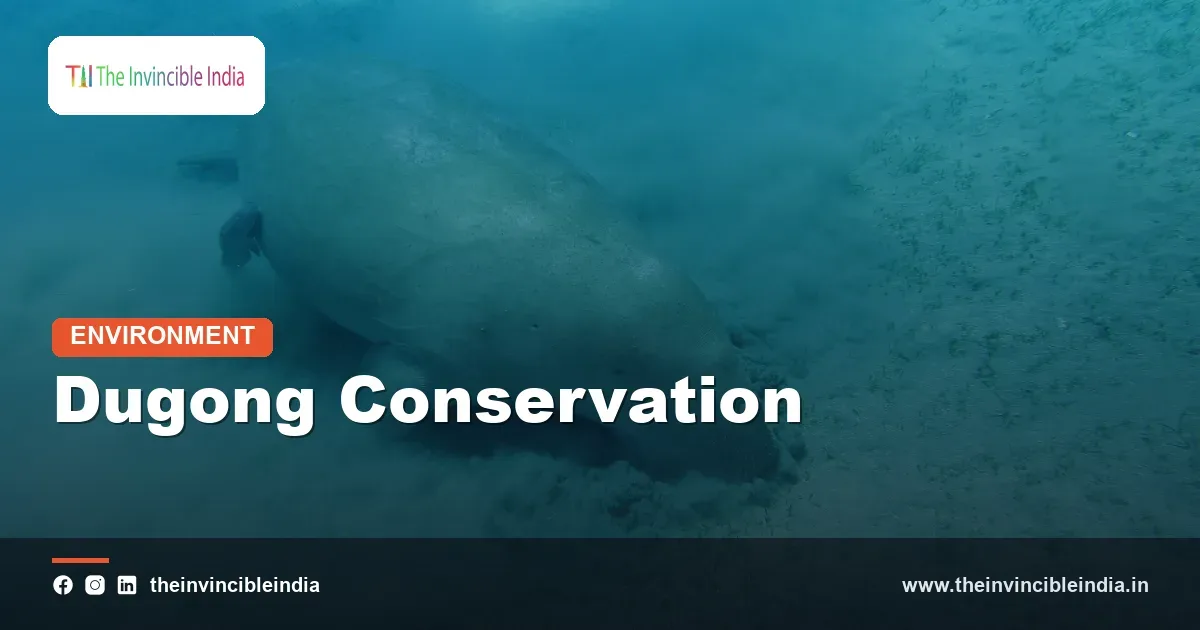
The dugong (Dugong dugon), popularly called the sea cow, is a large marine mammal that grazes on seagrass meadows and is the only strictly herbivorous marine mammal found in Indian waters. In India, dugong populations survive in small numbers in the Gulf of Mannar, Palk Bay and the Andaman and Nicobar Islands, and the species is protected under Schedule I of the Wildlife (Protection) Act, 1972.
Dugong conservation in India depends mainly on protecting seagrass habitat and reducing accidental deaths in fishing nets. In 2022, Tamil Nadu announced the Dugong Conservation Reserve in Palk Bay, the first reserve in the country dedicated to this species. Last updated: 8 October 2026.
| Attribute | Detail |
|---|---|
| Common names | Dugong, sea cow |
| Scientific name | Dugong dugon |
| Order and family | Sirenia; family Dugongidae |
| Diet | Seagrass (herbivore) |
| Indian habitats | Gulf of Mannar, Palk Bay, Andaman and Nicobar Islands, and historically the Gulf of Kachchh |
| Legal protection in India | Schedule I, Wildlife (Protection) Act, 1972 |
| Global status | Vulnerable on the IUCN Red List |
| Notable first | Dugong Conservation Reserve, Palk Bay, Tamil Nadu (announced 2022), India’s first |
Key Takeaways
- The dugong is the only herbivorous marine mammal in India, and it feeds almost entirely on seagrass.
- Dugong populations in India are small and found mainly in the Gulf of Mannar, Palk Bay and the Andaman and Nicobar Islands.
- The dugong is listed as Vulnerable globally by the IUCN and is placed in Schedule I of India’s Wildlife (Protection) Act, 1972, the highest level of legal protection.
- Seagrass loss, entanglement in fishing nets and boat strikes are the principal threats to dugongs in Indian waters.
- The Dugong Conservation Reserve in Palk Bay, Tamil Nadu, is India’s first protected area created specifically for the dugong.
- Dugongs reproduce slowly, with long gestation and widely spaced births, so even small numbers of deaths can threaten a local population.
What is a dugong?
A dugong is a large, gentle, fully aquatic mammal belonging to the order Sirenia, which also includes the manatees, and it is the only living member of its family, Dugongidae. It spends its entire life in the sea and, unlike whales and dolphins, eats plants rather than animals.
An adult dugong typically grows to about three metres in length and weighs a few hundred kilograms. It has a smooth, grey-brown body, a broad snout that points downward for feeding on the sea bed, and a tail fluke shaped somewhat like that of a whale. Manatees, by comparison, have a rounded, paddle-shaped tail. Male dugongs develop short tusks, which are small incisors that erupt as the animal matures.
The dugong is thought to have inspired sailors’ tales of mermaids, and the name sea cow reflects its habit of grazing slowly on the sea floor much as cattle graze on land.
Why is the dugong called the sea cow?
The dugong is called the sea cow because it grazes on underwater grasses in shallow coastal waters in much the same way that cattle graze on pasture. It cruises slowly, uses its muscular upper lip to root up seagrass, and often leaves visible feeding trails across the sea bed.
The feeding style has a strong ecological effect. By cropping and uprooting seagrass, dugongs influence the structure and nutrient cycling of seagrass meadows. A healthy meadow supports juvenile fish, crabs, sea cucumbers and other marine life, which is one reason that protecting the dugong also protects the wider coastal ecosystem on which local fisheries depend.
Where are dugongs found in India?
Dugongs in India are found mainly in the shallow, seagrass-rich waters of the Gulf of Mannar, Palk Bay and the Andaman and Nicobar Islands. Historical records also mention the Gulf of Kachchh in Gujarat, though sightings there have become very rare.
- Gulf of Mannar and Palk Bay (Tamil Nadu): the stretch of sea between southeastern India and Sri Lanka holds some of the largest seagrass beds in the country and is the most important dugong area in India. The Gulf of Mannar Marine National Park and the surrounding Gulf of Mannar Biosphere Reserve, set up in 1989, protect part of this habitat.
- Andaman and Nicobar Islands: the island chain has clear waters and coastal seagrass areas, and dugongs are occasionally reported in several bays, though accurate population counts are difficult.
- Gulf of Kachchh (Gujarat): the species was reported here in the past, but its presence today is uncertain.
Dugongs elsewhere in the world occur across the warm coastal waters of the Indian and western Pacific oceans, from East Africa to Australia, with Australia holding the largest populations.
How many dugongs are left in India?
Only a small number of dugongs remain in India, and credible estimates place the national population in the low hundreds at most, with some local groups numbering only a few individuals. Precise counts are difficult because the animals are shy, spend long periods under water and live in turbid coastal seas.
Biologists describe the Indian population as small and fragmented. Because dugongs breed slowly, a decline can take decades to reverse. For this reason, conservationists treat every recorded death or injury, including those caused by accidental netting, as significant for the population as a whole.
What do dugongs eat and why do seagrass meadows matter?
Dugongs eat seagrass, particularly soft, low-fibre species such as Halophila and Halodule, and they depend on healthy meadows for survival. An adult dugong may eat tens of kilograms of seagrass in a day.
Seagrass meadows matter well beyond the dugong itself. They:
- Act as nurseries for many commercially important fish and invertebrates.
- Stabilise the sea bed and reduce coastal erosion.
- Store carbon in the sediment, which makes them an important part of what scientists call blue carbon ecosystems.
- Improve water quality by trapping sediment and absorbing nutrients.
Since the dugong cannot switch to another food source easily, any decline in seagrass quickly affects the animals, which may then become weak, travel farther to feed or fail to breed.
What are the main threats to dugongs in India?
The main threats to dugongs in India are loss and degradation of seagrass habitat, accidental entanglement in fishing nets, and collisions with boats. Each threat is linked to human activity in the same coastal waters where the animals feed.
| Threat | How it harms dugongs |
|---|---|
| Seagrass loss | Dredging, trawling, coastal construction, pollution and sediment run-off smother or uproot the meadows that dugongs depend on |
| Fishing-net entanglement | Dugongs are air-breathing and drown if trapped in gill nets, trawl nets or other fishing gear, often as accidental bycatch |
| Boat strikes | Slow-moving animals that surface to breathe can be hit by fast vessels in busy coastal channels |
| Illegal hunting | Historic hunting for meat, oil and tusks has declined but remains a risk in some areas |
| Climate and pollution | Warming seas, storms, plastic and chemical pollution degrade seagrass and coastal water quality |
Because most dugong deaths in India are accidental, successful conservation depends on working with fishing communities rather than treating them only as a risk factor.
How is the dugong legally protected in India?
The dugong is legally protected in India under Schedule I of the Wildlife (Protection) Act, 1972, which gives it the same highest level of protection as the tiger and the elephant. Hunting, harming or trading in a Schedule I species is a serious offence punishable with imprisonment and fines.
Several other legal and policy instruments support this protection:
- International listings: the dugong is listed as Vulnerable by the International Union for Conservation of Nature (IUCN), and its international trade is regulated through the Convention on International Trade in Endangered Species (CITES).
- Marine protected areas: the Gulf of Mannar Marine National Park and the surrounding biosphere reserve provide habitat protection, and parts of the Andaman and Nicobar waters are covered by marine parks.
- Species recovery programmes: the dugong has been included among the species targeted for habitat and recovery support under government wildlife schemes, with research input from bodies such as the Wildlife Institute of India.
- Coastal regulation: coastal zone rules limit certain construction and industrial activity near sensitive marine habitats.
What is the Dugong Conservation Reserve in Palk Bay?
The Dugong Conservation Reserve is a protected marine area in Palk Bay off the coast of Tamil Nadu, announced by the state government in 2022 as India’s first reserve created specifically to protect the dugong and its seagrass habitat. It covers a stretch of sea in the Palk Bay region adjoining the Thanjavur and Pudukkottai districts.
The reserve was designed to safeguard the seagrass meadows that dugongs use for feeding. Conservation measures associated with the reserve include:
- Regulating activities that damage the sea bed, such as destructive fishing methods.
- Promoting fishing gear and practices that reduce accidental netting.
- Monitoring dugong sightings and seagrass condition through scientific surveys.
- Involving local fishing communities in protection, rescue and awareness efforts.
The reserve is notable because it recognises that protecting a marine mammal requires protecting an entire habitat rather than only the animal. It also tries to balance conservation with the livelihoods of coastal families who fish in the same waters.
How can fishing communities help protect dugongs?
Fishing communities can help protect dugongs by releasing animals found entangled in nets, reporting sightings and strandings to forest authorities, and using gear that reduces accidental capture. Many dugong rescues in coastal India have depended on fishers who free the animal or alert officials.
Practical measures often discussed by conservation agencies include:
- Training fishers in safe release methods for trapped marine mammals and turtles.
- Avoiding trawling and other bottom-disturbing methods over seagrass beds.
- Establishing reporting channels so that sightings and incidents are recorded.
- Providing alternative livelihoods or support where fishing restrictions reduce income.
Community participation matters because enforcement alone cannot monitor a long coastline. Local knowledge also helps scientists locate seagrass beds and identify areas where dugongs feed.
Why do dugongs recover slowly?
Dugongs recover slowly because they mature late, carry a single calf after a gestation of roughly a year, and give birth only once every few years. The calf stays close to its mother and nurses for an extended period.
These life-history traits are typical of long-lived marine mammals, and dugongs can live for several decades. The slow breeding rate means that a population cannot quickly replace animals lost to accidents. A small, isolated group, such as those found in parts of India, is particularly vulnerable, because the loss of a few breeding females can eliminate local reproduction for years.
Bottom Line
The dugong is India’s only herbivorous marine mammal, and its small populations in the Gulf of Mannar, Palk Bay and the Andaman and Nicobar Islands depend entirely on healthy seagrass meadows. Legal protection under Schedule I and the creation of the Dugong Conservation Reserve in Palk Bay are important steps, but long-term survival will depend on reducing bycatch, safeguarding seagrass and working closely with coastal fishing communities.
Frequently Asked Questions
What is a dugong?
A dugong is a large marine mammal, also called the sea cow, that lives in shallow coastal waters and feeds on seagrass. It belongs to the order Sirenia, along with manatees. It is the only strictly marine herbivorous mammal in Indian waters.
Where are dugongs found in India?
Dugongs in India are found mainly in the Gulf of Mannar, Palk Bay and the Andaman and Nicobar Islands. The Gulf of Kachchh in Gujarat held them in the past, but sightings there are now very rare. The Gulf of Mannar and Palk Bay region has the most important seagrass habitat.
Is the dugong protected in India?
Yes, the dugong is protected under Schedule I of the Wildlife (Protection) Act, 1972, which is the highest category of protection. Hunting or trading in it is a serious offence. The species is also listed as Vulnerable on the IUCN Red List.
What is India’s first Dugong Conservation Reserve?
India’s first Dugong Conservation Reserve is in Palk Bay off the Tamil Nadu coast and was announced in 2022. It aims to protect seagrass meadows that dugongs feed on. The reserve also seeks to reduce harmful fishing practices while involving local fishing communities.
What are the biggest threats to dugongs in India?
The biggest threats are loss of seagrass habitat, accidental entanglement in fishing nets and collisions with boats. Pollution, coastal development and climate change also degrade the meadows that dugongs need. Because dugongs breed slowly, even a few deaths can harm a local population.
Why are dugongs important for the marine ecosystem?
Dugongs are important because their grazing helps maintain healthy seagrass meadows, which shelter young fish and other marine life. Seagrass beds also protect coasts and store carbon. Protecting the dugong therefore helps protect the wider coastal ecosystem and the fisheries that rely on it.
{“@context”:”https://schema.org”,”@graph”:[{“@type”:”FAQPage”,”mainEntity”:[{“@type”:”Question”,”name”:”What is a dugong?”,”acceptedAnswer”:{“@type”:”Answer”,”text”:”A dugong is a large marine mammal, also called the sea cow, that lives in shallow coastal waters and feeds on seagrass. It belongs to the order Sirenia, along with manatees. It is the only strictly marine herbivorous mammal in Indian waters.”}},{“@type”:”Question”,”name”:”Where are dugongs found in India?”,”acceptedAnswer”:{“@type”:”Answer”,”text”:”Dugongs in India are found mainly in the Gulf of Mannar, Palk Bay and the Andaman and Nicobar Islands. The Gulf of Kachchh in Gujarat held them in the past, but sightings there are now very rare. The Gulf of Mannar and Palk Bay region has the most important seagrass habitat.”}},{“@type”:”Question”,”name”:”Is the dugong protected in India?”,”acceptedAnswer”:{“@type”:”Answer”,”text”:”Yes, the dugong is protected under Schedule I of the Wildlife (Protection) Act, 1972, which is the highest category of protection. Hunting or trading in it is a serious offence. The species is also listed as Vulnerable on the IUCN Red List.”}},{“@type”:”Question”,”name”:”What is India’s first Dugong Conservation Reserve?”,”acceptedAnswer”:{“@type”:”Answer”,”text”:”India’s first Dugong Conservation Reserve is in Palk Bay off the Tamil Nadu coast and was announced in 2022. It aims to protect seagrass meadows that dugongs feed on. The reserve also seeks to reduce harmful fishing practices while involving local fishing communities.”}},{“@type”:”Question”,”name”:”What are the biggest threats to dugongs in India?”,”acceptedAnswer”:{“@type”:”Answer”,”text”:”The biggest threats are loss of seagrass habitat, accidental entanglement in fishing nets and collisions with boats. Pollution, coastal development and climate change also degrade the meadows that dugongs need. Because dugongs breed slowly, even a few deaths can harm a local population.”}},{“@type”:”Question”,”name”:”Why are dugongs important for the marine ecosystem?”,”acceptedAnswer”:{“@type”:”Answer”,”text”:”Dugongs are important because their grazing helps maintain healthy seagrass meadows, which shelter young fish and other marine life. Seagrass beds also protect coasts and store carbon. Protecting the dugong therefore helps protect the wider coastal ecosystem and the fisheries that rely on it.”}}]}]}


