

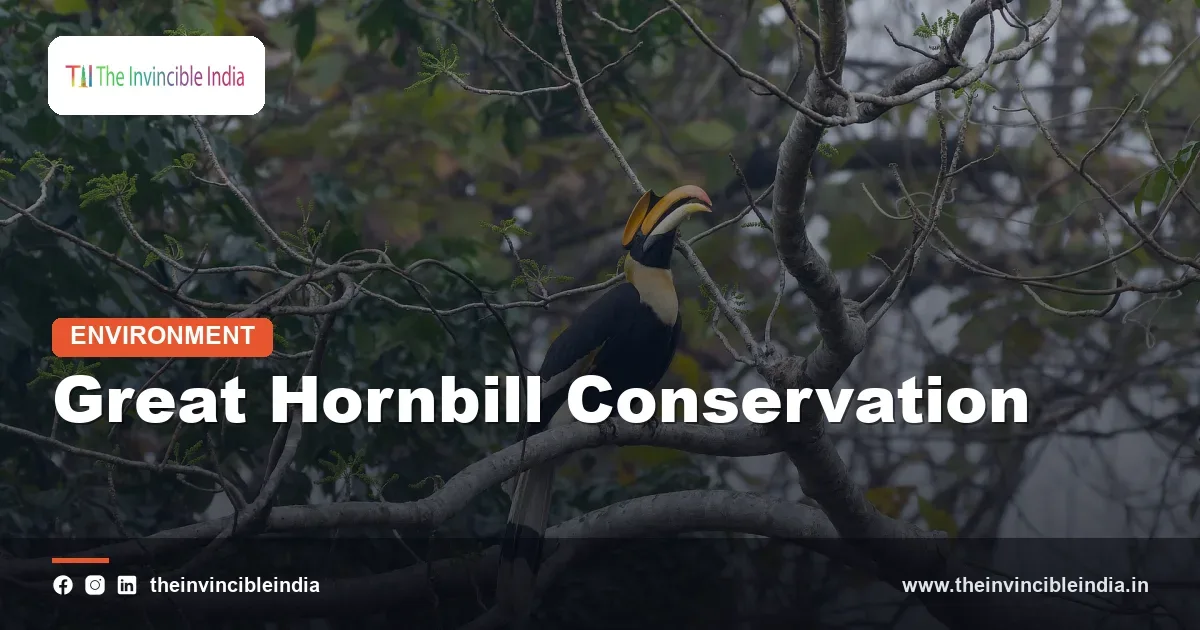
The great Indian hornbill (Buceros bicornis), also called the great hornbill, is a large forest bird recognised by its huge yellow-orange bill and casque, and it serves as the state bird of both Kerala and Arunachal Pradesh. Found in the Western Ghats, the Himalayan foothills and the Northeast, the species is listed as Vulnerable by the IUCN and is given the highest protection in India under Schedule I of the Wildlife (Protection) Act, 1972.
The great Indian hornbill is often called the farmer or gardener of the forest because it disperses the seeds of many large-fruited trees. Its conservation relies on protecting old nesting trees and on community programmes, such as nest adoption schemes, that give local people a stake in its survival. Last updated: 8 October 2026.
| Attribute | Detail |
|---|---|
| Common names | Great hornbill, great Indian hornbill, concave-casqued hornbill |
| Scientific name | Buceros bicornis |
| Family | Bucerotidae (hornbills) |
| State bird of | Kerala and Arunachal Pradesh |
| Indian range | Western Ghats, Himalayan foothills, Northeast India |
| Diet | Mainly fruit, especially figs; also small animals |
| Legal protection in India | Schedule I, Wildlife (Protection) Act, 1972 |
| Global status | Vulnerable (IUCN); listed in CITES Appendix I |
Key Takeaways
- The great Indian hornbill is the state bird of Kerala and Arunachal Pradesh and is one of the most recognisable forest birds in India.
- The great Indian hornbill is called the farmer or gardener of the forest because it eats fruit and disperses the seeds of many large rainforest trees.
- During nesting, the female great hornbill seals herself inside a tree cavity with a mud-like mixture, leaving a narrow slit through which the male passes food.
- The great hornbill is classified as Vulnerable by the IUCN and is protected under Schedule I of India’s Wildlife (Protection) Act, 1972.
- Habitat loss from logging and forest clearance, and hunting for its casque, feathers and meat, are the main threats to the great Indian hornbill.
- Community nest adoption programmes in Arunachal Pradesh have helped turn former hunters into protectors of hornbill nests.
What is the great Indian hornbill?
The great Indian hornbill is the largest of the hornbill species found in India, a bird that can reach roughly a metre or more in length and is distinguished by a massive curved bill topped by a hollow casque. The bird has black and white plumage, a yellow-tinged neck and a bright yellow-orange bill and casque.
The casque is a helmet-like structure on top of the bill. Its exact function is still studied by ornithologists, but it appears to play a role in display, in recognising other birds and possibly in amplifying calls. The casque is mostly hollow and light, so the bill is not as heavy as it looks. The male has a slightly larger casque and a red-tinged eye, while the female has a bluish-white eye.
The bird flies with heavy, noisy wingbeats that are audible from a distance, and it often calls loudly in the forest canopy.
Where is the great Indian hornbill found?
The great Indian hornbill is found in the evergreen and moist deciduous forests of the Western Ghats, along the Himalayan foothills and across the forests of Northeast India. Outside India, its range extends to Nepal, Bhutan and parts of Southeast Asia.
- Western Ghats: populations occur in the forests of Kerala, Karnataka and Tamil Nadu, including protected areas such as those in the Anamalai and Parambikulam landscapes.
- Himalayan foothills: the species lives in the lower forests of the Himalayan belt, including parts of the Terai and sub-Himalayan region.
- Northeast India: the forests of Arunachal Pradesh, Assam, Nagaland and neighbouring states hold important populations. Pakke Tiger Reserve in Arunachal Pradesh is among the best-known sites for observing hornbills.
The bird prefers large tracts of mature forest with tall trees, because it needs both fruiting trees to feed on and old trees with large cavities for nesting.
Why is the great Indian hornbill called the farmer of the forest?
The great Indian hornbill is called the farmer or gardener of the forest because it swallows large fruits whole and later drops the seeds far from the parent tree, helping new trees to grow. Many tropical trees have seeds that are too big for smaller birds to carry, so the hornbill plays a special role in their survival.
The birds feed heavily on figs and other fruits, and they can travel long distances in a day. This movement spreads seeds across wide areas and keeps the forest genetically varied. Scientists describe the great hornbill as a keystone seed disperser, meaning that its loss could alter the composition of the forest over time. A forest that loses its hornbills may gradually lose some of its large-seeded tree species.
The bird also eats small mammals, reptiles, insects and nestlings of other birds when available, so its diet is not entirely fruit.
How does the great hornbill nest?
The great hornbill nests in a natural hollow high in a large old tree, where the female seals herself inside with a plaster of mud, droppings and fruit pulp, leaving only a narrow slit. This unusual behaviour protects the female, the eggs and the chicks from predators such as snakes, monkeys and large cats.
The nesting cycle follows a clear sequence:
- The pair selects a large cavity in a tall tree, often returning to the same nest year after year.
- The female enters the cavity and the entrance is sealed, leaving a small opening.
- The female lays one or two eggs and incubates them. During this period she moults her flight feathers and cannot fly.
- The male brings fruit and other food to the slit, sometimes making many trips in a day to feed the female and, later, the chicks.
- When the chick is partly grown, the female breaks out of the cavity and the chick often reseals the wall until it is ready to leave.
The nesting period lasts for several months. The male is entirely responsible for food during this time, so his survival is critical to the breeding success of the pair. Hornbills form long-term pairs and may live for several decades.
Why is the great Indian hornbill a symbol of Kerala and Arunachal Pradesh?
The great Indian hornbill is the state bird of Kerala and Arunachal Pradesh because of its striking appearance and its cultural importance in forested regions of the south and Northeast. In Kerala it is associated with the forests of the Western Ghats, while in Arunachal Pradesh it is closely tied to tribal culture.
Hornbill feathers and beaks have traditionally been used in the ceremonial headgear of several communities in the Northeast. In Nagaland, the annual Hornbill Festival, held in December near Kohima and named after the bird, showcases the heritage of the Naga tribes. The festival’s name reflects the hornbill’s place in local folklore and identity, although the event itself is a cultural festival rather than a conservation programme.
What are the hornbill species found in India?
India is home to nine species of hornbill, with the great hornbill being the largest and the most widely recognised. Several are confined to specific regions, and the Narcondam hornbill occurs only on one island.
| Species | Typical region in India |
|---|---|
| Great hornbill | Western Ghats, Himalayan foothills, Northeast |
| Malabar pied hornbill | Western Ghats and parts of the Konkan coast |
| Malabar grey hornbill | Western Ghats |
| Indian grey hornbill | Widespread across much of peninsular and northern India |
| Oriental pied hornbill | Northeast India and parts of eastern India |
| Rufous-necked hornbill | Eastern Himalayas and Northeast |
| Wreathed hornbill | Eastern Himalayas and Northeast |
| Brown hornbill (Austen’s brown hornbill) | Northeast hill forests |
| Narcondam hornbill | Narcondam Island, Andaman Sea (endemic) |
What are the threats to the great Indian hornbill?
The main threats to the great Indian hornbill are loss of forest habitat, particularly the felling of large old trees used for nesting, and hunting for the casque, beak, feathers, fat and meat. Because the bird depends on mature forest, even partial logging can sharply reduce suitable nest sites.
- Habitat loss: logging, conversion of forest to plantations or farmland, roads and infrastructure remove the tall trees that hornbills need.
- Hunting: the casque and feathers have been used in traditional attire, and the bird has been hunted for meat and for supposed medicinal uses. Illegal trade is also a concern.
- Fragmentation: small isolated forest patches cannot support breeding pairs, and birds may be unable to move between them.
- Slow breeding: hornbills raise only one or two chicks per nesting season, so populations take time to recover.
The nesting behaviour also adds risk, since a female sealed inside a cavity cannot escape if the tree is cut down or the nest is raided.
How is the great Indian hornbill protected in India?
The great Indian hornbill is protected in India under Schedule I of the Wildlife (Protection) Act, 1972, which prohibits hunting, capture and trade. It is also listed in Appendix I of the Convention on International Trade in Endangered Species (CITES), which restricts international trade, and classified as Vulnerable by the IUCN.
In addition to the law, protection happens through:
- National parks, wildlife sanctuaries and tiger reserves that safeguard large forest blocks.
- Forest department monitoring of nests and anti-poaching patrols.
- Research and surveys by organisations such as the Nature Conservation Foundation and university groups.
- Awareness programmes in schools and villages near hornbill habitat.
What is the Hornbill Nest Adoption Programme?
The Hornbill Nest Adoption Programme is a community conservation initiative in Arunachal Pradesh in which local people and supporters help protect hornbill nests, with the Nature Conservation Foundation working alongside the forest department and local communities. It began in the 2010s in the forests around Pakke Tiger Reserve.
The programme is widely cited as an example of conservation with community participation. Its key features include:
- Members of the Nyishi community, some of whom previously hunted hornbills, are engaged as nest protectors who monitor nests through the breeding season.
- Nest protectors receive a stipend or support, and sponsors can adopt a nest to fund this work.
- Fibreglass replicas of hornbill beaks have been provided to reduce the demand for real beaks in traditional headgear.
- Monitoring of nests provides scientific data on breeding success and the condition of nesting trees.
The approach has shown that offering livelihoods and recognition to forest communities can protect a species more effectively than enforcement alone. Local organisations, such as community societies, have also helped to coordinate protection and awareness.
How can people help hornbill conservation?
People can help hornbill conservation by protecting forests and large old trees, supporting community-led programmes, avoiding products made from wild bird parts and reporting illegal hunting. Responsible tourism that respects distance from nests also helps.
Because the great Indian hornbill needs large mature trees, forest protection is its single most important need. Maintaining forest corridors between protected areas lets birds move between fruiting trees through the year. Citizen science also contributes: birdwatchers who record sightings and nests give researchers valuable information on the bird’s range and numbers.
Bottom Line
The great Indian hornbill is both a symbol of Kerala and Arunachal Pradesh and a vital seed disperser that keeps tropical forests healthy. Its dependence on large old trees makes it vulnerable to logging and hunting, but programmes such as the Hornbill Nest Adoption Programme show that community involvement can protect it. Safeguarding the species means safeguarding the mature forests it shares with countless other plants and animals.
Frequently Asked Questions
What is the great Indian hornbill?
The great Indian hornbill is a large forest bird with a bright yellow-orange bill and a hollow casque on top. It is found in the Western Ghats, the Himalayan foothills and Northeast India. It is the state bird of Kerala and Arunachal Pradesh.
Why is the hornbill called the farmer of the forest?
The hornbill is called the farmer of the forest because it eats fruit and spreads the seeds of many large-seeded trees through its droppings. Many such seeds are too big for smaller birds to carry. By moving seeds over long distances, hornbills help forests regenerate.
Why does the female hornbill seal herself inside a tree?
The female hornbill seals herself inside a tree cavity to protect herself, her eggs and her chicks from predators. She uses mud, droppings and fruit pulp to close the entrance, leaving a narrow slit. The male feeds her through this opening for the duration of nesting.
Is the great Indian hornbill endangered?
The great Indian hornbill is classified as Vulnerable by the IUCN, which means it faces a high risk of decline if threats continue. In India it is protected under Schedule I of the Wildlife (Protection) Act, 1972. Its main threats are habitat loss and hunting.
Which states have the hornbill as their state bird?
The great Indian hornbill is the state bird of Kerala and Arunachal Pradesh. It is closely linked with the forests of the Western Ghats and with the tribal cultures of the Northeast. Its image also appears in the cultural identity of states such as Nagaland through the Hornbill Festival.
What is the Hornbill Nest Adoption Programme?
The Hornbill Nest Adoption Programme is a community conservation scheme in Arunachal Pradesh in which local people are paid to protect hornbill nests, with support from the Nature Conservation Foundation and the forest department. Sponsors can adopt a nest to fund the effort. The programme has helped reduce hunting by involving former hunters in protection.
{“@context”:”https://schema.org”,”@graph”:[{“@type”:”FAQPage”,”mainEntity”:[{“@type”:”Question”,”name”:”What is the great Indian hornbill?”,”acceptedAnswer”:{“@type”:”Answer”,”text”:”The great Indian hornbill is a large forest bird with a bright yellow-orange bill and a hollow casque on top. It is found in the Western Ghats, the Himalayan foothills and Northeast India. It is the state bird of Kerala and Arunachal Pradesh.”}},{“@type”:”Question”,”name”:”Why is the hornbill called the farmer of the forest?”,”acceptedAnswer”:{“@type”:”Answer”,”text”:”The hornbill is called the farmer of the forest because it eats fruit and spreads the seeds of many large-seeded trees through its droppings. Many such seeds are too big for smaller birds to carry. By moving seeds over long distances, hornbills help forests regenerate.”}},{“@type”:”Question”,”name”:”Why does the female hornbill seal herself inside a tree?”,”acceptedAnswer”:{“@type”:”Answer”,”text”:”The female hornbill seals herself inside a tree cavity to protect herself, her eggs and her chicks from predators. She uses mud, droppings and fruit pulp to close the entrance, leaving a narrow slit. The male feeds her through this opening for the duration of nesting.”}},{“@type”:”Question”,”name”:”Is the great Indian hornbill endangered?”,”acceptedAnswer”:{“@type”:”Answer”,”text”:”The great Indian hornbill is classified as Vulnerable by the IUCN, which means it faces a high risk of decline if threats continue. In India it is protected under Schedule I of the Wildlife (Protection) Act, 1972. Its main threats are habitat loss and hunting.”}},{“@type”:”Question”,”name”:”Which states have the hornbill as their state bird?”,”acceptedAnswer”:{“@type”:”Answer”,”text”:”The great Indian hornbill is the state bird of Kerala and Arunachal Pradesh. It is closely linked with the forests of the Western Ghats and with the tribal cultures of the Northeast. Its image also appears in the cultural identity of states such as Nagaland through the Hornbill Festival.”}},{“@type”:”Question”,”name”:”What is the Hornbill Nest Adoption Programme?”,”acceptedAnswer”:{“@type”:”Answer”,”text”:”The Hornbill Nest Adoption Programme is a community conservation scheme in Arunachal Pradesh in which local people are paid to protect hornbill nests, with support from the Nature Conservation Foundation and the forest department. Sponsors can adopt a nest to fund the effort. The programme has helped reduce hunting by involving former hunters in protection.”}}]}]}


