

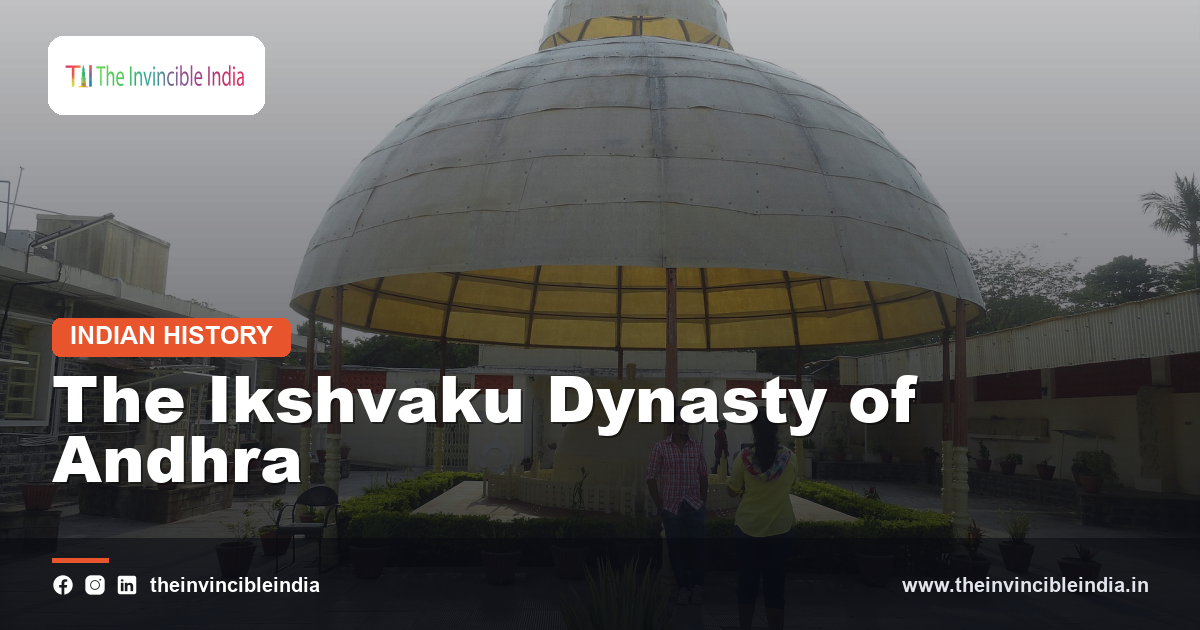
The Ikshvaku dynasty of Andhra, also called the Andhra Ikshvakus, the Ikshvakus of Vijayapuri or the Ikshvakus of Nagarjunakonda, was a ruling line of the Krishna river valley in what is now Andhra Pradesh. They rose after the decline of the Satavahanas and are best known for their capital Vijayapuri and for the Buddhist monuments built under the patronage of the royal family, especially its women. Their story continues the narrative of the Satavahana dynasty, whose cultural and religious traditions they inherited. The chronology of the dynasty is debated, with scholars generally placing it in roughly the third and fourth centuries CE, and this guide uses general terms.
Quick answer: The Ikshvaku dynasty of Andhra was a ruling family of the Krishna valley in southern India that rose after the Satavahanas and governed from Vijayapuri, the site now called Nagarjunakonda. The kings performed Vedic sacrifices, while royal women, notably queens and princesses, endowed major Buddhist monasteries and stupas. Their rule is usually dated to roughly the third and fourth centuries CE, though exact chronology is debated.
Key Takeaways
- The Andhra Ikshvakus were successors to the Satavahanas in the Krishna valley.
- Their capital Vijayapuri lay at the site now known as Nagarjunakonda.
- Their kings followed Vedic religion, while their queens and princesses were generous patrons of Buddhism.
- Inscriptions at Nagarjunakonda record royal gifts to monasteries, stupas and shrines.
- Marriage alliances linked the family with other ruling houses of India, including a Shaka royal house.
- The Nagarjunakonda valley was flooded by a dam, and many monuments were moved to an island museum.
Read on for the history, culture, and legacy in detail.
Quick Facts
| Detail | Information |
|---|---|
| Dynasty | Ikshvaku dynasty of Andhra (Andhra Ikshvakus, Ikshvakus of Vijayapuri) |
| Region | Krishna river valley, present-day Andhra Pradesh |
| Capital | Vijayapuri (Nagarjunakonda) |
| Approximate Era | Roughly third to fourth centuries CE (debated) |
| Predecessors | The Satavahanas |
| Key Heritage | Nagarjunakonda Buddhist monuments and inscriptions |
Who Were the Andhra Ikshvakus?
The Andhra Ikshvakus were the rulers of a kingdom in the lower Krishna valley who emerged as the Satavahana power faded. They are called the Ikshvakus because they claimed descent from the legendary solar dynasty of Ikshvaku, the line associated in tradition with Rama and Ayodhya. This claim was a common way for ancient dynasties to gain prestige, and historians do not treat it as proof of a literal link with the northern kings. Puranic texts mention a group of Andhra rulers who may correspond to this family, while inscriptions provide firmer evidence. The Andhra Ikshvakus therefore appear in both literary and epigraphic sources as the main power of the Krishna valley in their age.
Where Was the Ikshvaku Kingdom Located?
The Ikshvaku kingdom was located along the lower Krishna River, in the area of present-day Andhra Pradesh and nearby parts of the Deccan. Its heart was the Nagarjunakonda valley, surrounded by hills and flanked by the river, a position that offered both defence and access to trade routes. The Krishna valley had long been a zone of prosperous towns, Buddhist monasteries and maritime links with the east coast, an inheritance from Satavahana times. Control of this corridor connected inland farming regions with the Bay of Bengal. The geography of the kingdom thus explains its wealth and its role as a meeting place for religion, commerce and art.
How Did the Ikshvakus Rise After the Satavahanas?
The Ikshvakus rose after the Satavahanas by taking over territories and administrative traditions that the earlier empire had left behind. As Satavahana central power weakened, regional officials and feudatories built local states, and the Ikshvakus emerged as the leading one in the Krishna valley. They continued many practices of their predecessors, including the use of Prakrit in early records, patronage of monasteries and the issuing of land gifts. Historians describe this as a transition rather than a sudden break, because culture, language and religion carried over with little disruption. The rise of the Ikshvakus thus shows how a great empire’s institutions could survive its fall and shape the next dynasty.
Who Founded the Dynasty and Who Were Its Main Kings?
The founder of the dynasty is usually identified as Vasishthiputra Chantamula, also written Santamula, whose name appears in the inscriptions of Nagarjunakonda. He is remembered for performing Vedic sacrifices, a sign that he wished to present himself as a legitimate and powerful king. His successors included Virapurushadatta and later rulers, whose reigns are recorded in the inscriptions that survive. The order and exact reign lengths of some kings are debated, since the evidence is mainly epigraphic and fragmentary. The founding king and his successors nonetheless provide the backbone of the dynasty’s history, and their names are widely cited in studies of the Krishna valley.
What Role Did Royal Women Play?
Royal women played an exceptionally prominent role in the Ikshvaku court, especially as patrons of religion and builders of monuments. Inscriptions at Nagarjunakonda record that queens and princesses, including the sister and wives of the early kings, endowed monasteries, stupas and halls for monks. Their gifts are among the most striking examples of female patronage in early Indian history. These women often had their own names, titles and records, which suggests that they held independent wealth and standing. The Ikshvaku court therefore stands out for the visibility of its women, and their donations explain why so much Buddhist architecture survives from this dynasty.
What Was Vijayapuri and Why Was It Important?
Vijayapuri was the capital city of the Ikshvakus and is the ancient settlement whose remains lie at Nagarjunakonda. The city included royal buildings, residential areas, temples, Buddhist monasteries and public spaces, spread along the river valley. Archaeological work has revealed brick structures, stone sculptures and inscriptions that point to a busy urban centre. The city served as the administrative capital and as a religious and cultural hub, drawing monks, merchants and artisans. Its layout reflects the rich urban tradition of the Deccan in the early centuries CE. Vijayapuri was therefore both the political seat of the Ikshvakus and one of the most important religious centres of ancient Andhra.
Why Is Nagarjunakonda So Famous?
Nagarjunakonda is famous because it preserves one of the largest and best-documented collections of ancient Buddhist remains in southern India. The site includes the foundations of stupas, monastic complexes, shrine halls, Hindu temples and an amphitheatre-like structure, along with carved limestone panels and inscriptions. Its name means the hill of Nagarjuna, a link to the great Buddhist philosopher Nagarjuna, whom tradition associates with this region, though the exact connection is debated. Excavations before the construction of a large dam revealed the extent of the ancient city. Nagarjunakonda therefore stands as a key site for studying early Buddhism, Deccan art and the life of an ancient Indian capital.
How Did the Ikshvakus Support Buddhism?
The Ikshvakus supported Buddhism chiefly through the generosity of royal women, ministers and wealthy merchants who funded monasteries, stupas and rest houses. Inscriptions mention donations to monastic communities belonging to several Buddhist schools, which shows that the valley hosted a diverse monastic life. Monks from different regions, including distant lands, are said to have stayed in the monasteries of Vijayapuri. The kingdom also appears connected with the spread of Buddhism along the sea routes to other parts of Asia. The Ikshvaku patrons therefore built a lasting foundation for Buddhist learning in the Krishna valley, one that outlived the dynasty.
What Religions Did the Ikshvaku Kings Follow?
The Ikshvaku kings themselves followed Vedic and Brahmanical religion, while the wider society and the royal women supported Buddhism, creating a mixed religious environment. Inscriptions record Vedic sacrifices such as the Ashvamedha and other rites performed by the early kings. At the same time, temples for deities such as Kartikeya and Vishnu appear at Nagarjunakonda, showing the growth of temple worship in the region. This coexistence of traditions reflected a broader pattern in early India, where different faiths often shared patrons, cities and sacred landscapes. The religious life of the Ikshvaku realm was therefore plural, with Vedic rites, Buddhist monasticism and early temple cults existing side by side.
What Do Inscriptions Tell Us About the Ikshvakus?
Inscriptions are the most important source for the history of the Ikshvakus, giving names, relationships and records of gifts. Many of them are engraved on pillars and slabs at Nagarjunakonda and nearby sites, and they are written in Prakrit, with later records showing the growing use of Sanskrit. They list kings, queens, officials and donors, and they describe the dedication of monuments. Such records provide a rare family-level view of an ancient dynasty. Because they focus on gifts and genealogy rather than wars, they reveal more about religion and society than about political events. The inscriptions thus form the documentary core of Ikshvaku history, though they leave some questions of chronology open.
What Was Ikshvaku Art and Sculpture Like?
Ikshvaku art is known for graceful carved panels in pale limestone that show scenes from the life of the Buddha and from Buddhist stories. The sculptures at Nagarjunakonda belong to the same stylistic family as those from nearby Amaravati, with slim, flowing figures and detailed narrative scenes. Stupa surfaces were decorated with relief panels, railings and decorative motifs such as lotus and garland patterns. Artists represented the Buddha in human form in many scenes, reflecting the artistic developments of the early centuries CE. The art of the Ikshvaku period therefore offers a vivid visual record of Buddhist devotion in the Deccan and ranks among the finest achievements of ancient Andhra.
How Did Marriage Alliances Shape the Dynasty?
Marriage alliances shaped the dynasty by linking the Ikshvakus with other ruling houses, which helped secure their position among neighbouring powers. Inscriptions indicate that members of the family married into the royal lines of regions such as the Deccan and the north-west, and that one king married a princess from a Shaka ruling house. Such unions were an important tool of ancient diplomacy, creating bonds of kinship that supported peace and trade. They also introduced new cultural influences into the court. The Ikshvaku marriage network therefore shows that the Krishna valley was not isolated but connected to wide political circles across India.
How Did the Ikshvaku Kingdom Decline?
The Ikshvaku kingdom declined in the fourth century CE, probably through a combination of pressure from rising neighbouring powers and internal weakness, though the exact causes are debated. The Pallavas of the south-east are often named among the powers that took over parts of the Krishna region, and other dynasties soon filled the political space. Because evidence is limited, historians avoid stating precise dates or events and speak instead of a gradual loss of control. The monuments of Vijayapuri were abandoned over time, and the valley slipped from political prominence. The decline of the Ikshvakus thus closed a distinctive chapter in Andhra history, but their religious and artistic legacy endured.
How Were the Monuments of Nagarjunakonda Saved?
The monuments of Nagarjunakonda were saved through a large conservation project carried out in the twentieth century, when the construction of a major dam on the Krishna River threatened to submerge the valley. Archaeologists documented the site and carefully moved many structures, sculptures and inscriptions to a hilltop that became an island in the new reservoir. Some buildings were reconstructed there, and a museum was established to display the finds. This effort is regarded as one of the major rescue operations in Indian archaeology. The preservation of Nagarjunakonda thus shows how heritage can be protected even when large development projects change the landscape.
The Ikshvaku Heritage Today
The Ikshvaku heritage today lives on in the island site of Nagarjunakonda, its museum, and the many sculptures and inscriptions held in collections across Andhra Pradesh. Visitors can reach the island by boat and see reconstructed stupas, monastery foundations and a museum with carved panels that illustrate early Buddhist art. Scholars continue to study the inscriptions to understand the dynasty’s genealogy, religion and social life. The site also forms part of a wider Buddhist heritage circuit in the Krishna valley that includes Amaravati. The Ikshvaku dynasty therefore remains an important reference point for those studying how Andhra shaped Buddhist culture, royal patronage and early Indian art.
Sources & Further Reading
- Archaeological Survey of India (asi.nic.in).
- Ministry of Culture, Government of India (indiaculture.gov.in).
Frequently Asked Questions
Who were the Ikshvakus of Andhra?
The Ikshvakus of Andhra were a ruling dynasty of the Krishna valley who succeeded the Satavahanas and governed from Vijayapuri, now Nagarjunakonda. They claimed descent from the legendary Ikshvaku line and are best known for their royal women patrons of Buddhism.
Where was the Ikshvaku capital Vijayapuri?
Vijayapuri was located at the site now known as Nagarjunakonda in Andhra Pradesh, along the Krishna River. Its remains were documented before the area was submerged by a dam, and many monuments were relocated to an island.
Who founded the Ikshvaku dynasty?
Vasishthiputra Chantamula, also written Santamula, is generally identified as the founder of the dynasty. His inscriptions record Vedic sacrifices, though exact dates for his reign are debated.
Why is Nagarjunakonda important?
Nagarjunakonda is important because it preserves large Buddhist remains, temples and inscriptions from the Ikshvaku period. It is one of the key sites for understanding early Buddhism and art in southern India.
When did the Ikshvaku dynasty rule?
The Ikshvaku dynasty is generally placed in roughly the third and fourth centuries CE. Historians debate the exact chronology, so scholars usually describe the dates in general terms.
What religion did the Ikshvakus follow?
The Ikshvaku kings followed Vedic and Brahmanical religion, while many royal women and officials supported Buddhism. Inscriptions and monuments show that both traditions flourished in the kingdom.


