

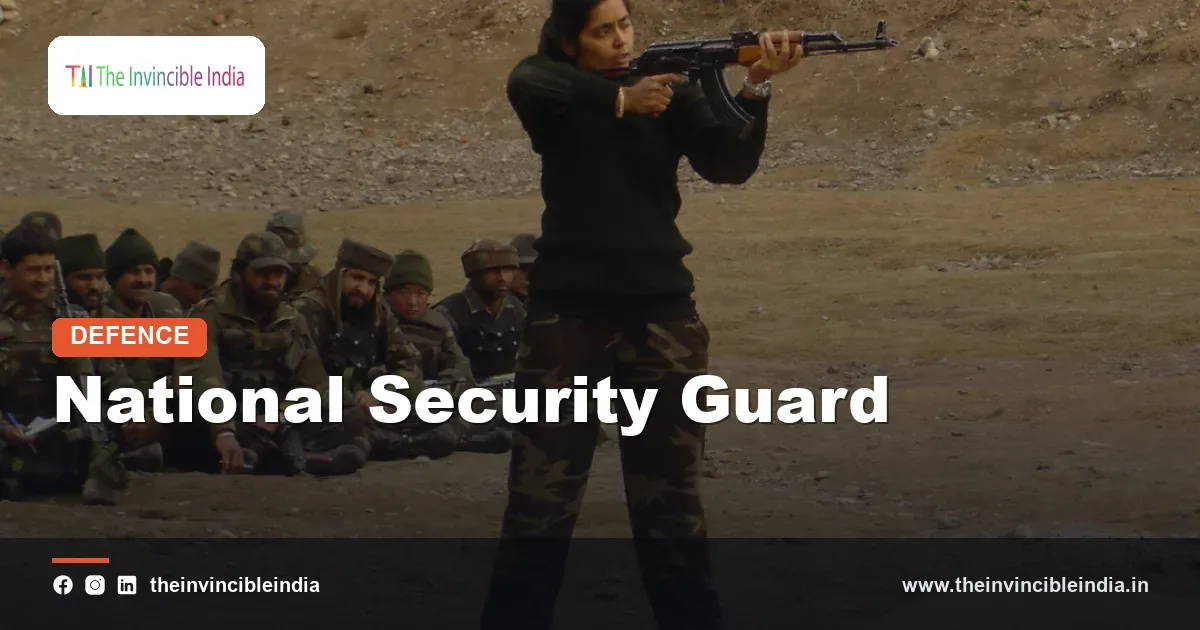
The National Security Guard (NSG) is India’s elite federal counter-terrorism and hostage-rescue force, raised in 1984 under the Ministry of Home Affairs and popularly known as the “Black Cats” because of its black uniforms. It was created as a specialised contingency force to deal with terrorist hijackings, hostage situations and other extreme threats that ordinary police forces are not equipped to handle.
The National Security Guard was modelled on elite units such as Germany’s GSG-9 and Britain’s Special Air Service (SAS), and it draws its personnel from both the Indian Army and the central police organisations. This explainer covers its origin, structure, roles, famous public operations including the 2008 Mumbai attacks, regional hubs and its changing role in protecting very important persons (VIPs). It describes the force at the institutional level only. 9 October 2026
| Quick Fact | Detail |
|---|---|
| Full name | National Security Guard (NSG) |
| Popular name | Black Cats |
| Raised | 1984; statutory basis in the National Security Guard Act, 1986 |
| Parent ministry | Ministry of Home Affairs, Government of India |
| Role | Counter-terrorism, anti-hijacking, hostage rescue and anti-sabotage response |
| Components | Special Action Group (SAG) and Special Ranger Group (SRG) |
| Headed by | Director General, traditionally an Indian Police Service (IPS) officer |
| Headquarters | New Delhi region, with a training centre at Manesar, Haryana |
| Motto | “Sarvatra Sarvottam Suraksha” (Omnipresent, Supreme Security) |
Key Takeaways
- The National Security Guard (NSG) was raised in 1984 as India’s federal counter-terrorism and hostage-rescue force, and it works under the Ministry of Home Affairs.
- The NSG is nicknamed the Black Cats because of its black combat dress, and its commandos are modelled on elite units such as Germany’s GSG-9 and the British SAS.
- The National Security Guard has two main components: the Special Action Group (SAG), drawn from the Indian Army, and the Special Ranger Group (SRG), drawn from the central police forces and, in the past, state police.
- The NSG was the lead force in clearing the hotels and Nariman House during the November 2008 Mumbai attacks, widely known as 26/11.
- After the 26/11 attacks, the National Security Guard set up regional hubs in 2009 to cut response time to attacks in distant cities.
- In 2020, the Government of India relieved the NSG of the task of providing close protection to VIPs so that it could focus on its core counter-terrorism mission.
What is the National Security Guard (NSG)?
The National Security Guard (NSG) is a special force of the Government of India that is trained and equipped to respond to terrorist attacks, hijackings and hostage crises anywhere in the country. It is often described as a federal contingency deployment force, meaning that it is kept in readiness and sent to a state when the state government or the Centre decides that a threat is beyond the capability of local forces.
The NSG is not a force that patrols streets or guards borders. Its function is specific and limited: to be deployed rapidly for a high-risk operation, neutralise the threat with minimum loss of life, and then return. Its commandos are selected through demanding screening and are placed in the force on deputation rather than being recruited directly into it.
Why and when was the NSG created?
The NSG was created in 1984 because India’s security establishment concluded that the country needed a dedicated, highly trained force to handle terrorism, after the violence that followed Operation Blue Star at the Golden Temple in Amritsar in June 1984 and the assassination of Prime Minister Indira Gandhi in October 1984. The government then drew up a plan for a specialised counter-terrorist unit.
The force was formally raised in 1984, and Parliament passed the National Security Guard Act in 1986, which gave it a statutory basis and set out its purpose and control. The Act describes the force as one to be used to combat terrorist activities in specific situations, with the Union Government as the competent authority to deploy it.
In designing the force, planners studied the experience of elite units abroad. Germany’s GSG-9 had been formed after the 1972 Munich Olympics hostage crisis, and Britain’s SAS was widely known for its counter-terrorism role. The NSG adopted ideas from these examples while adapting them to Indian conditions and Indian law.
How is the NSG structured?
The NSG is structured around two complementary groups, the Special Action Group (SAG) and the Special Ranger Group (SRG), supported by specialist and support units and headed by a Director General. The arrangement brings together military and police experience in a single force.
The two main components
- Special Action Group (SAG): This is the offensive component, with personnel drawn from the Indian Army. SAG units are the main assault element for operations such as hostage rescue.
- Special Ranger Group (SRG): This component draws personnel from the central armed police forces and, historically, from state police forces. The SRG has been used for support and protection roles, and the force also supplies specialised teams.
Alongside the two groups, the NSG maintains several specialised elements. These include bomb disposal and explosives detection units, a dog squad, aviation and hijack-response elements, and a technical wing. The force also runs the National Bomb Data Centre, which collects and shares information about explosive devices and incidents with police agencies across the country.
The Director General, usually an IPS officer, heads the force. Personnel are typically posted on deputation for a limited period before returning to their parent organisation, which keeps a steady flow of experienced people between the NSG and the Army and the central forces.
| Component | Source of personnel | Primary character |
|---|---|---|
| Special Action Group (SAG) | Indian Army | Offensive and assault operations |
| Special Ranger Group (SRG) | Central armed police forces and state police | Support, protection and cordon roles |
| Bomb disposal and detection units | Specialist personnel | Explosives and device handling |
| Training and support elements | Mixed | Instruction, logistics and technology |
Why are they called the Black Cats?
NSG commandos are called the Black Cats because of the black uniforms, black helmets and black masks that they wear during operations. The nickname became so widely used in the media and among the public that it is now almost synonymous with the force.
The black combat dress is partly symbolic and partly practical, since the force traditionally operates in close-quarter and low-light settings. The NSG’s badge shows the lightning bolt and sword associated with its character, and its motto, “Sarvatra Sarvottam Suraksha”, conveys the idea of the highest standard of security wherever it is needed.
How are NSG commandos selected and trained?
NSG commandos are selected from volunteers in the Army and the central police forces through a rigorous screening process and then undergo a long and difficult training course. The course is known for its high dropout rate, because it tests endurance, discipline, marksmanship and mental resilience.
Training is conducted at the NSG training centre at Manesar in Haryana and includes subjects such as close-quarter battle, counter-hijack procedures, sniping, explosives handling, driving, communication, and operations in built-up areas. Because the Act covers situations that are as diverse as aircraft hijackings and attacks on buildings, the course combines physical conditioning with technical and tactical instruction.
The force also takes part in joint exercises with other agencies and has had exchange arrangements with counterparts abroad. Details of curriculum and methods are not public, and this article does not describe them.
What are the roles and tasks of the NSG?
The roles of the NSG are to conduct counter-terrorist operations, to respond to hijackings of aircraft, to rescue hostages, to carry out anti-sabotage checks and to support bomb disposal efforts. These are the tasks for which the force was created and for which it remains primarily maintained.
- Counter-terrorism: Neutralising terrorists who have seized buildings or taken hostages.
- Anti-hijacking: Responding to the hijacking of aircraft, trains or other vehicles.
- Hostage rescue: Freeing hostages with minimum casualties.
- Bomb disposal: Locating, handling and neutralising explosive devices.
- Anti-sabotage checks: Sweeping venues and routes ahead of major events and visits.
- Post-blast investigation support: Providing technical assistance after explosions.
The Union Government can deploy the force in a state on request or after its own decision, and the deployment is usually coordinated with the state police. The NSG acts as a last-resort force rather than a first responder.
What are the famous public operations of the NSG?
The best-known public operations of the NSG include the 1988 Operation Black Thunder at the Golden Temple, the 1993 hijack response at Amritsar known as Operation Ashwamedh, the 2002 Akshardham temple operation in Gandhinagar, and the November 2008 operations during the Mumbai attacks. Each is widely documented in public sources.
Selected operations
- Operation Black Thunder (1988): A joint action to clear militants from the Golden Temple complex in Amritsar, in which the NSG participated.
- Operation Ashwamedh (1993): The response to the hijacking of an Indian Airlines aircraft that landed at Amritsar, in which the hijacker was overpowered and the passengers were freed.
- Akshardham (2002): The NSG operation to end the attack on the Akshardham temple complex in Gandhinagar, Gujarat, in September 2002.
- Mumbai (2008): The operations to clear the Taj Mahal Palace hotel, the Oberoi-Trident hotel and Nariman House, known collectively as Operation Black Tornado, with the Nariman House phase also referred to as Operation Cyclone.
- Pathankot (2016): The NSG’s part in operations after the attack on the Pathankot air force base in January 2016, where it also carried out explosives-related tasks.
The force has lost personnel in action. Major Sandeep Unnikrishnan and Havildar Gajender Singh Bisht of the NSG were awarded the Ashoka Chakra posthumously for their conduct in the Mumbai operations in 2008.
What was the role of the NSG in the 2008 Mumbai attacks?
During the 26/11 attacks in November 2008, the NSG was flown from its base near Delhi to Mumbai to take over the operations against the terrorists who had occupied two luxury hotels and a residential-cum-religious centre called Nariman House. Local police and the Marine Commandos had been engaged earlier, and the NSG arrived after a delay of several hours because the force was then based mainly near Delhi.
The operations lasted nearly three days, and the NSG cleared the targeted buildings and rescued many hostages and guests. The delay in reaching the city became a significant lesson for security planners and led directly to the decision to establish regional hubs so that the force could reach distant cities within a shorter time.
The Mumbai experience also led to broader changes in the country’s counter-terrorism structure, including the creation of the National Investigation Agency (NIA) in 2009 and improvements in coastal security.
Where are the regional hubs of the NSG?
The NSG operates regional hubs in several cities so that its teams can reach many parts of the country quickly, with new hubs set up in 2009 at Chennai, Hyderabad, Kolkata and Mumbai following the 26/11 attacks. These hubs supplement the main base near Delhi.
The idea behind the hubs is to reduce the time between a crisis and the arrival of specialist forces. Each hub maintains a team ready for deployment in its region, with transport and equipment on hand. Further regional presence has been discussed and developed over time, and the force continues to rely on air transport for long-distance movement.
| Location | Type of NSG presence |
|---|---|
| Delhi region (Manesar and Delhi) | Main base, headquarters and training centre |
| Mumbai | Regional hub, set up in 2009 |
| Chennai | Regional hub |
| Kolkata | Regional hub, set up in 2009 |
| Hyderabad | Regional hub, set up in 2009 |
What was the NSG’s role in VIP protection?
For many years, the NSG provided close protection, known as Z-plus security, to a small number of very high-threat protectees, in addition to its main counter-terrorism mission. This role was added in the late 1980s and continued for decades, with SRG personnel mostly assigned to these duties.
The role drew debate, because assigning commandos to close protection drew them away from specialised training and operational readiness. In January 2020, the Ministry of Home Affairs decided to relieve the NSG of VIP security duties, with the Central Reserve Police Force (CRPF) and other agencies taking over the protection of those protectees. The decision was intended to let the NSG concentrate on counter-terrorism and hostage-rescue tasks.
The NSG is distinct from the Special Protection Group (SPG), which protects the Prime Minister. The two forces were raised around the same period but have different missions and structures.
How does the NSG differ from other forces?
The NSG differs from other Indian forces in that it is a specialist, deployable, strike-oriented organisation rather than a territorial or guarding force. Border-guarding forces, the CRPF, the Central Industrial Security Force (CISF) and state police each have wide, continuing duties, while the NSG is a small, highly selected force intended for rare but severe events.
- The NSG differs from the Army’s special forces in that it works under the Home Ministry and is geared to internal security emergencies.
- The NSG differs from the SPG in that it is a response force, whereas the SPG is a protection force for the Prime Minister.
- The NSG differs from state-level units, such as state anti-terror squads and commando forces, in that it is a central force deployed across states.
Bottom Line
The National Security Guard is India’s specialist counter-terrorism and hostage-rescue force, formed in 1984 and shaped by international models, with an Army-derived assault element and a police-derived support element. Its regional hubs and the shift away from VIP protection reflect lessons from the 2008 Mumbai attacks and the need to concentrate on its core mission.
Frequently Asked Questions
What is the National Security Guard (NSG)?
The National Security Guard is India’s elite federal counter-terrorism and hostage-rescue force, working under the Ministry of Home Affairs. It was raised in 1984 and given statutory backing by the National Security Guard Act of 1986. Its commandos are known as the Black Cats.
Why are NSG commandos called Black Cats?
NSG commandos are called Black Cats because of the black uniforms, helmets and masks they wear on operations. The nickname was popularised by the media and is now widely used by the public. The force’s official motto is “Sarvatra Sarvottam Suraksha”.
What are the two components of the NSG?
The two components of the NSG are the Special Action Group (SAG) and the Special Ranger Group (SRG). The SAG is drawn from the Indian Army and forms the main assault element. The SRG draws personnel from the central armed police forces and state police and performs support and protection roles.
What did the NSG do during the 26/11 Mumbai attacks?
The NSG cleared the Taj Mahal Palace hotel, the Oberoi-Trident hotel and Nariman House in Mumbai in November 2008 after being flown in from the Delhi region. The operations, known as Operation Black Tornado, lasted nearly three days and saved many hostages. The delay in reaching Mumbai later led to the creation of regional hubs in 2009.
Where are the NSG regional hubs?
The NSG has regional hubs in Mumbai, Chennai, Kolkata and Hyderabad, set up following the 26/11 attacks, in addition to its main base and training centre near Delhi. The hubs reduce the time taken to deploy specialist teams to distant cities. The force still relies on air transport for long-range movement.
Does the NSG still provide VIP security?
No, the NSG no longer provides VIP close protection, because the Ministry of Home Affairs relieved it of those duties in January 2020. The Central Reserve Police Force and other agencies took over the protection of those protectees. This allowed the NSG to focus on counter-terrorism and hostage rescue.
{“@context”:”https://schema.org”,”@graph”:[{“@type”:”FAQPage”,”mainEntity”:[{“@type”:”Question”,”name”:”What is the National Security Guard (NSG)?”,”acceptedAnswer”:{“@type”:”Answer”,”text”:”The National Security Guard is India’s elite federal counter-terrorism and hostage-rescue force, working under the Ministry of Home Affairs. It was raised in 1984 and given statutory backing by the National Security Guard Act of 1986. Its commandos are known as the Black Cats.”}},{“@type”:”Question”,”name”:”Why are NSG commandos called Black Cats?”,”acceptedAnswer”:{“@type”:”Answer”,”text”:”NSG commandos are called Black Cats because of the black uniforms, helmets and masks they wear on operations. The nickname was popularised by the media and is now widely used by the public. The force’s official motto is “Sarvatra Sarvottam Suraksha”.”}},{“@type”:”Question”,”name”:”What are the two components of the NSG?”,”acceptedAnswer”:{“@type”:”Answer”,”text”:”The two components of the NSG are the Special Action Group (SAG) and the Special Ranger Group (SRG). The SAG is drawn from the Indian Army and forms the main assault element. The SRG draws personnel from the central armed police forces and state police and performs support and protection roles.”}},{“@type”:”Question”,”name”:”What did the NSG do during the 26/11 Mumbai attacks?”,”acceptedAnswer”:{“@type”:”Answer”,”text”:”The NSG cleared the Taj Mahal Palace hotel, the Oberoi-Trident hotel and Nariman House in Mumbai in November 2008 after being flown in from the Delhi region. The operations, known as Operation Black Tornado, lasted nearly three days and saved many hostages. The delay in reaching Mumbai later led to the creation of regional hubs in 2009.”}},{“@type”:”Question”,”name”:”Where are the NSG regional hubs?”,”acceptedAnswer”:{“@type”:”Answer”,”text”:”The NSG has regional hubs in Mumbai, Chennai, Kolkata and Hyderabad, set up following the 26/11 attacks, in addition to its main base and training centre near Delhi. The hubs reduce the time taken to deploy specialist teams to distant cities. The force still relies on air transport for long-range movement.”}},{“@type”:”Question”,”name”:”Does the NSG still provide VIP security?”,”acceptedAnswer”:{“@type”:”Answer”,”text”:”No, the NSG no longer provides VIP close protection, because the Ministry of Home Affairs relieved it of those duties in January 2020. The Central Reserve Police Force and other agencies took over the protection of those protectees. This allowed the NSG to focus on counter-terrorism and hostage rescue.”}}]}]}


