

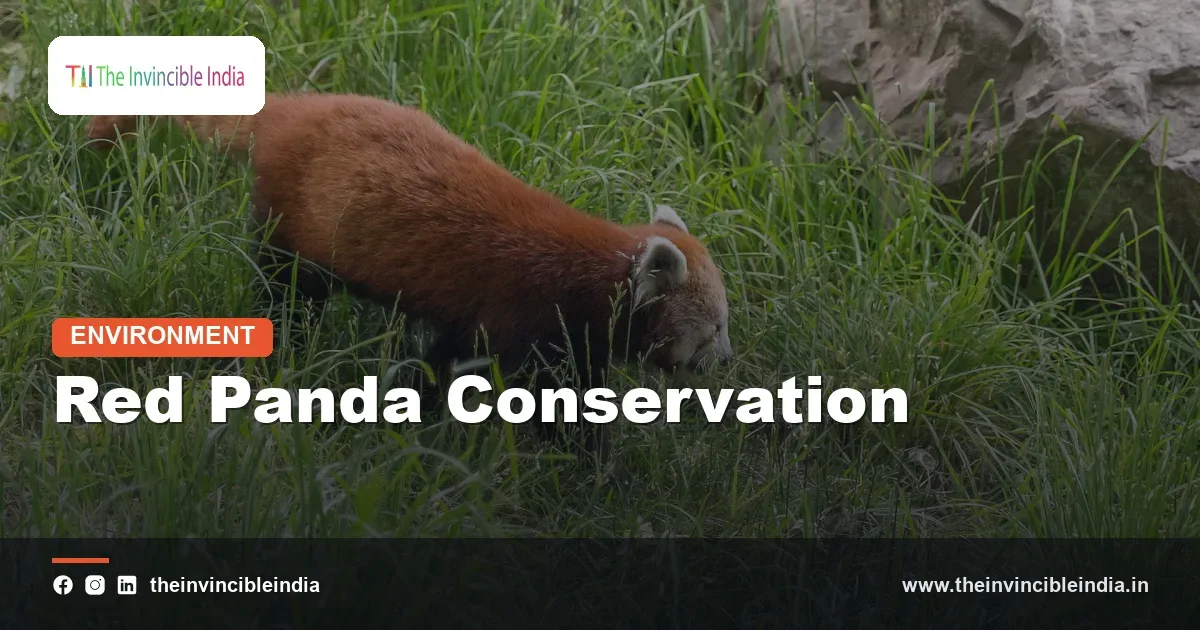
The red panda (Ailurus fulgens) is a small, tree-dwelling mammal of the Eastern Himalayas that feeds mainly on bamboo, is listed as Endangered by the IUCN, and is the state animal of Sikkim. In India it survives in a narrow band of temperate and subtropical mountain forest across Sikkim, northern West Bengal, Arunachal Pradesh and parts of the wider Northeast.
Red panda conservation in India is the combined effort of forest departments, zoos, research groups and mountain communities to stop the decline of this species by protecting bamboo-rich forest, reducing hunting and disturbance, and breeding animals in captivity. This explainer sets out what the animal is, where it lives, why it is declining and what is being done to save it (last updated 9 October 2026).
| Attribute | Detail |
|---|---|
| Scientific name | Ailurus fulgens (Himalayan red panda) |
| Family | Ailuridae, the only living member of its own family |
| IUCN status | Endangered |
| Indian legal protection | Schedule I, Wildlife (Protection) Act, 1972 |
| International trade control | CITES Appendix I |
| State animal of | Sikkim |
| Typical altitude | Roughly 2,200 to 4,800 metres in the wider Himalayan range |
| Main food | Bamboo leaves and shoots, supplemented by fruit, roots, eggs and insects |
| Key Indian breeding centre | Padmaja Naidu Himalayan Zoological Park, Darjeeling |
Key Takeaways
- The red panda is the only living species in the family Ailuridae and is not a close relative of the giant panda, despite the shared name.
- The IUCN lists the red panda as Endangered, and the global population of mature animals is estimated at well below 10,000.
- In India the red panda is found in Sikkim, the Darjeeling hills of West Bengal, Arunachal Pradesh and a few other parts of the Northeast, and it is the state animal of Sikkim.
- Habitat loss, fragmentation, livestock grazing, dogs and poaching are the main threats to the red panda in India.
- The Padmaja Naidu Himalayan Zoological Park in Darjeeling runs one of India’s best-known red panda breeding programmes and has attempted releases into the Singalila landscape.
- The red panda is an indicator species, because its survival depends on intact, bamboo-rich temperate forest that also shelters many other Himalayan plants and animals.
What is a red panda?
A red panda is a cat-sized, reddish-brown mammal that lives in trees, eats mostly bamboo, and belongs to the order Carnivora despite its largely vegetarian diet. An adult usually weighs between about 3 and 6 kilograms and measures roughly 50 to 65 centimetres in body length, with a bushy tail of nearly the same length marked by alternating reddish and pale rings.
The red panda has a rounded face with white patches around the eyes and muzzle, dense fur that insulates it against mountain cold, and furred soles that help it grip slippery branches and keep warm on snow. Its most unusual feature is a “false thumb”, an extension of a wrist bone that works with the true digits to hold bamboo stems.
Scientists once grouped the red panda with raccoons or with bears. Genetic studies have since placed it in its own family, Ailuridae, within a broader group of carnivores that includes weasels, skunks and raccoons. It is therefore a distinct evolutionary lineage rather than a miniature giant panda.
The red panda is also known by local names across the Himalaya, and in the English-speaking world it is sometimes called the lesser panda or the fire fox. Two species are now widely recognised: the Himalayan red panda (Ailurus fulgens), which occurs in India, and the Chinese red panda (Ailurus styani), which occurs further east in China and northern Myanmar.
Where is the red panda found in India?
The red panda in India is found in the Eastern Himalayas, mainly in Sikkim, the Darjeeling hills of West Bengal, and Arunachal Pradesh, with scattered records from other hill areas of the Northeast. The animal prefers cool, moist forest on steep mountain slopes and is rarely seen below the temperate zone.
Sikkim
Sikkim holds some of the best-known red panda habitat in the country, including forests in and around Khangchendzonga National Park and several smaller sanctuaries such as Fambong Lho, Maenam and Barsey. The species was named the state animal of Sikkim, and the state forest department has treated its protection as a long-term priority.
West Bengal
In West Bengal the red panda occurs in the Darjeeling district, especially in Singalila National Park along the border with Nepal and in Neora Valley National Park near the Bhutan border. These parks protect rhododendron, oak and bamboo forest at altitudes where the animal can find both food and cover.
Arunachal Pradesh and the Northeast
Arunachal Pradesh contains a large block of potential red panda habitat in its western and central districts, where high-altitude forest remains relatively continuous. Surveys and camera-trap studies in this state continue to add new records, and some other Northeastern hill areas have occasional reports, although the exact distribution outside Sikkim, Darjeeling and Arunachal Pradesh is less well mapped.
Because the red panda is shy, nocturnal in much of its activity and spread thinly across steep terrain, reliable population figures for India are difficult to obtain. Published estimates vary widely between surveys, and field researchers generally describe the Indian population as small and fragmented.
What kind of habitat does the red panda need?
The red panda needs cool temperate forest with a dense understorey of bamboo, old trees with hollows for shelter, and a continuous canopy that lets it move without descending to the ground. Such habitat typically lies between about 2,200 and 4,000 metres in the Indian Himalaya, although the species is recorded over a somewhat wider altitudinal range across its global distribution.
Typical red panda forest in India includes mixed broadleaf and conifer stands of oak, maple, rhododendron, fir and hemlock, with clumps of hill bamboo such as Yushania and Thamnocalamus species growing beneath. Moss-covered trunks, fallen logs and rocky outcrops add the cover and resting sites the animal uses during the day.
Water and moisture matter as much as food. Red pandas prefer steep, north-facing slopes near streams, where mist and monsoon rain keep the bamboo green. Dry, degraded or heavily grazed slopes support few animals even when some bamboo remains.
- Bamboo cover: supplies the bulk of the diet throughout the year.
- Large old trees: provide tree-hollows for resting and for raising cubs.
- Connected canopy: allows travel and dispersal without crossing open ground.
- Cool, humid climate: suits an animal whose thick fur makes it sensitive to heat.
What does the red panda eat and how does it behave?
The red panda eats mainly bamboo leaves and young shoots, which make up the large majority of its diet, and it adds fruit, acorns, roots, insects, birds’ eggs and small prey when they are available. Bamboo is a poor source of energy, so the animal lives at a slow pace and spends many hours each day feeding and resting.
The red panda has a digestive system typical of a carnivore, with a simple stomach and a short gut, and it cannot digest the fibrous cellulose in bamboo efficiently. It copes by selecting the most nutritious leaves and shoots, eating large quantities and conserving energy. Basking in sunlight on cold mornings and curling up with its tail over its face are part of this strategy.
Red pandas are generally solitary, except during the mating season and when a mother is raising young. They are mostly active at dawn, dusk and during the night, and they scent-mark trees and rocks to define territories. Females usually give birth in a tree hollow or rock crevice in early summer after a pregnancy of roughly four months, and a litter commonly has one to four cubs.
Cub survival in the wild is low, and the species reproduces slowly. This matters for conservation because a population that loses adults to hunting or accidents cannot recover quickly.
Why is the red panda Endangered?
The red panda is classed as Endangered by the International Union for Conservation of Nature (IUCN) because its numbers have fallen sharply over several generations and its remaining habitat is shrinking and broken into small patches. The decline is attributed mainly to human pressure on the forests where the animal lives.
The IUCN Red List first placed the species in a threatened category several decades ago and has kept it as Endangered in recent assessments. The most recent assessments estimate the global population of mature individuals at well below 10,000 and still declining, with the Indian population forming only a modest part of that total.
In India the species receives the highest level of legal protection. It is listed in Schedule I of the Wildlife (Protection) Act, 1972, which prohibits hunting and trade and prescribes imprisonment and fines for offenders, and it is listed in Appendix I of the Convention on International Trade in Endangered Species of Wild Fauna and Flora (CITES), which bans international commercial trade.
What are the main threats to red pandas in India?
The main threats to red pandas in India are the loss and fragmentation of bamboo forest, grazing by livestock, attacks and disease spread by free-ranging dogs, and poaching for fur and for the pet trade. Climate change is an additional, longer-term pressure on a species that depends on cool mountain forest.
Habitat loss and fragmentation
Roads, hydropower projects, settlements and agricultural expansion cut forests into isolated patches. A fragmented habitat leaves small groups of red pandas unable to meet or disperse, which raises the risk of local extinction and inbreeding.
Livestock and bamboo removal
Grazing by cattle, yaks and sheep in the forest understorey, and the collection of bamboo for fencing, baskets and fodder, reduce the food and cover that red pandas depend on. In some areas herders move livestock into high-altitude forest during summer, directly overlapping with red panda habitat.
Dogs, disease and poaching
Free-ranging dogs associated with villages and grazing camps may chase or kill red pandas and can carry infections such as canine distemper, to which red pandas are susceptible. Hunting for the animal’s thick, attractive fur, which has been used for caps and ornaments in some communities, and capture of live animals, have declined with stronger enforcement and awareness but have not disappeared.
Climate change
Warming temperatures and changing rainfall can shift the altitudinal zones where bamboo and cool forest grow. Researchers have warned that suitable habitat could contract uphill, and that the effect is greatest for a species with a narrow climatic niche and limited ability to move across fragmented landscapes.
What is the Padmaja Naidu Himalayan Zoological Park doing for red pandas?
The Padmaja Naidu Himalayan Zoological Park (PNHZP) in Darjeeling runs a captive breeding programme for the red panda and has been involved in efforts to return captive-bred animals to the wild. The zoo sits at roughly 2,100 metres, an altitude close to natural red panda habitat, which helps the animals stay healthy and breed.
The zoo opened in 1958 and is named after Padmaja Naidu, a former Governor of West Bengal. The zoo also keeps other Himalayan species such as the snow leopard and the Tibetan wolf, and it participates in coordinated conservation breeding of several of them.
The red panda programme at Darjeeling is part of a national conservation breeding effort overseen by the Central Zoo Authority, which coordinates the planned breeding of threatened species across Indian zoos to keep captive populations genetically healthy. Over the decades the zoo has bred red pandas successfully and has sent animals to other approved zoos, within India and abroad, under studbook management.
Release attempts
The park and the West Bengal forest department have attempted to release captive-bred red pandas into the Singalila National Park landscape. Early release attempts in the first decade of the 2000s showed how difficult it is to return captive-bred animals to the wild, as survival of some released animals was poor, and later efforts have relied on better preparation, acclimatisation and tracking.
Conservationists generally treat release as only one part of the response. Protecting the forest and reducing threats on the ground matter more over the long term, because animals released into degraded habitat are unlikely to survive.
How are red pandas protected beyond zoos?
Red pandas in India are protected mainly through national parks and sanctuaries, species recovery planning, community-based monitoring and anti-poaching patrols. Protected areas such as Khangchendzonga National Park and Singalila National Park include red panda habitat within their core zones, where grazing and extraction are restricted.
Several state-level and non-governmental initiatives support this work.
- Species recovery planning: the Sikkim forest department and partners have developed recovery plans that focus on habitat surveys, population monitoring and threat reduction.
- Camera-trap and scat surveys: researchers use remote cameras and genetic analysis of droppings to estimate occupancy and density without disturbing the animals.
- Community conservation: villagers in the Singalila and Sikkim landscapes serve as forest guards, guides and monitors, and some communities have formed groups that look after red panda forest.
- Awareness campaigns: International Red Panda Day, observed on the third Saturday of September, is used for school programmes and outreach in the hill districts.
- Dog management: vaccination and sterilisation of village dogs near red panda habitat reduce the risk of disease and attack.
Because red pandas range across borders, India also takes part in transboundary conservation discussions with Nepal, Bhutan, China and Myanmar. The Khangchendzonga landscape shared by India, Nepal and Bhutan is one of the regions where such cooperation is considered important.
Why is the red panda an indicator species?
The red panda is an indicator species because its presence signals healthy, connected, bamboo-rich temperate forest, and its disappearance signals that such forest has been degraded. A species with narrow habitat needs, a specialised diet and low reproductive rates responds quickly to environmental damage.
Protecting the red panda also protects the wider ecosystem, which is why conservationists call it an “umbrella” or “flagship” species. The same forests shelter the Himalayan black bear, musk deer, the Himalayan serow, several pheasants including the satyr tragopan, and many orchids and rhododendrons. Maintaining the forest corridors needed by red pandas also helps keep mountain streams flowing, stabilises slopes and supports the water supply of downstream communities.
A flagship species also helps raise funds and public attention. The red panda’s appealing appearance has made it a symbol of Eastern Himalayan biodiversity in tourism campaigns, school curricula and wildlife research.
How does the red panda compare with other Himalayan threatened species?
The red panda is one of several threatened mammals of the Eastern Himalaya, and its needs differ from those of larger carnivores such as the snow leopard. The table below compares three well-known species of this region.
| Species | Typical habitat | Main diet | IUCN status |
|---|---|---|---|
| Red panda | Temperate bamboo forest, roughly 2,200 to 4,000 m | Bamboo leaves and shoots | Endangered |
| Snow leopard | Alpine and trans-Himalayan rocky terrain | Blue sheep, ibex and other prey | Vulnerable |
| Himalayan musk deer | Alpine scrub and birch-rhododendron forest | Grasses, shrubs and lichens | Endangered |
The comparison shows that each species depends on a different altitudinal band. Effective Himalayan conservation therefore needs protection across the whole mountain gradient, from subtropical foothills to alpine meadows, and not only in a single high-profile reserve.
What can be done to secure the red panda’s future in India?
Securing the red panda’s future in India requires protecting and reconnecting bamboo forest, regulating grazing and development in its habitat, improving monitoring and working with local communities. Captive breeding supports these actions but cannot replace them.
- Safeguard corridors: maintain forest links between protected areas so that animals can disperse.
- Regulate grazing: manage seasonal livestock use of high-altitude forests and reduce bamboo extraction.
- Control dogs and disease: vaccinate and manage village dogs near red panda areas.
- Improve data: apply standard survey methods so that population trends can be tracked across states.
- Support livelihoods: offer ecotourism, homestay and guiding opportunities so that communities benefit from conservation.
- Plan for climate: identify higher-altitude refuges and protect them in advance.
Bottom Line
The red panda is a small, bamboo-eating specialist of the Eastern Himalaya whose Endangered status reflects the pressure on India’s mountain forests. Conservation depends on protecting connected bamboo-rich forest in Sikkim, Darjeeling and Arunachal Pradesh, with breeding programmes such as the one at Darjeeling’s Padmaja Naidu Himalayan Zoological Park acting as a safety net rather than a substitute for habitat protection.
Frequently Asked Questions
Is the red panda related to the giant panda?
No, the red panda is not a close relative of the giant panda. The red panda belongs to its own family, Ailuridae, while the giant panda is a member of the bear family, Ursidae. Both eat bamboo and have a false thumb for handling it, a similarity that arose through convergent evolution.
Which Indian states have red pandas?
Red pandas are found mainly in Sikkim, the Darjeeling hills of West Bengal and Arunachal Pradesh. A few other hill areas of the Northeast have occasional records. Sikkim has declared the red panda its state animal.
Is the red panda endangered?
Yes, the red panda is listed as Endangered by the IUCN. Its population is small, declining and fragmented, and the main causes are habitat loss, livestock grazing, dogs and poaching. In India it is also covered by Schedule I of the Wildlife (Protection) Act, 1972.
What does the red panda eat?
The red panda eats mostly bamboo leaves and young shoots. It also eats fruit, roots, acorns, insects and birds’ eggs when available. Bamboo gives little energy, so the animal feeds for many hours and rests for long periods.
Where can red pandas be seen in India?
Red pandas can be seen in captivity at the Padmaja Naidu Himalayan Zoological Park in Darjeeling and at some other approved zoos. In the wild they are very difficult to spot because they are shy and live in dense forest. Singalila National Park in West Bengal and forests in Sikkim are the places where sightings are most often reported.
Why is the red panda called an indicator species?
The red panda is called an indicator species because it can survive only in healthy, connected temperate forest with plenty of bamboo. Its presence therefore shows that the forest is in good condition, and its decline warns of wider ecological damage. Protecting the red panda also protects the many other plants and animals that share its habitat.
{“@context”:”https://schema.org”,”@graph”:[{“@type”:”FAQPage”,”mainEntity”:[{“@type”:”Question”,”name”:”Is the red panda related to the giant panda?”,”acceptedAnswer”:{“@type”:”Answer”,”text”:”No, the red panda is not a close relative of the giant panda. The red panda belongs to its own family, Ailuridae, while the giant panda is a member of the bear family, Ursidae. Both eat bamboo and have a false thumb for handling it, a similarity that arose through convergent evolution.”}},{“@type”:”Question”,”name”:”Which Indian states have red pandas?”,”acceptedAnswer”:{“@type”:”Answer”,”text”:”Red pandas are found mainly in Sikkim, the Darjeeling hills of West Bengal and Arunachal Pradesh. A few other hill areas of the Northeast have occasional records. Sikkim has declared the red panda its state animal.”}},{“@type”:”Question”,”name”:”Is the red panda endangered?”,”acceptedAnswer”:{“@type”:”Answer”,”text”:”Yes, the red panda is listed as Endangered by the IUCN. Its population is small, declining and fragmented, and the main causes are habitat loss, livestock grazing, dogs and poaching. In India it is also covered by Schedule I of the Wildlife (Protection) Act, 1972.”}},{“@type”:”Question”,”name”:”What does the red panda eat?”,”acceptedAnswer”:{“@type”:”Answer”,”text”:”The red panda eats mostly bamboo leaves and young shoots. It also eats fruit, roots, acorns, insects and birds’ eggs when available. Bamboo gives little energy, so the animal feeds for many hours and rests for long periods.”}},{“@type”:”Question”,”name”:”Where can red pandas be seen in India?”,”acceptedAnswer”:{“@type”:”Answer”,”text”:”Red pandas can be seen in captivity at the Padmaja Naidu Himalayan Zoological Park in Darjeeling and at some other approved zoos. In the wild they are very difficult to spot because they are shy and live in dense forest. Singalila National Park in West Bengal and forests in Sikkim are the places where sightings are most often reported.”}},{“@type”:”Question”,”name”:”Why is the red panda called an indicator species?”,”acceptedAnswer”:{“@type”:”Answer”,”text”:”The red panda is called an indicator species because it can survive only in healthy, connected temperate forest with plenty of bamboo. Its presence therefore shows that the forest is in good condition, and its decline warns of wider ecological damage. Protecting the red panda also protects the many other plants and animals that share its habitat.”}}]}]}


