

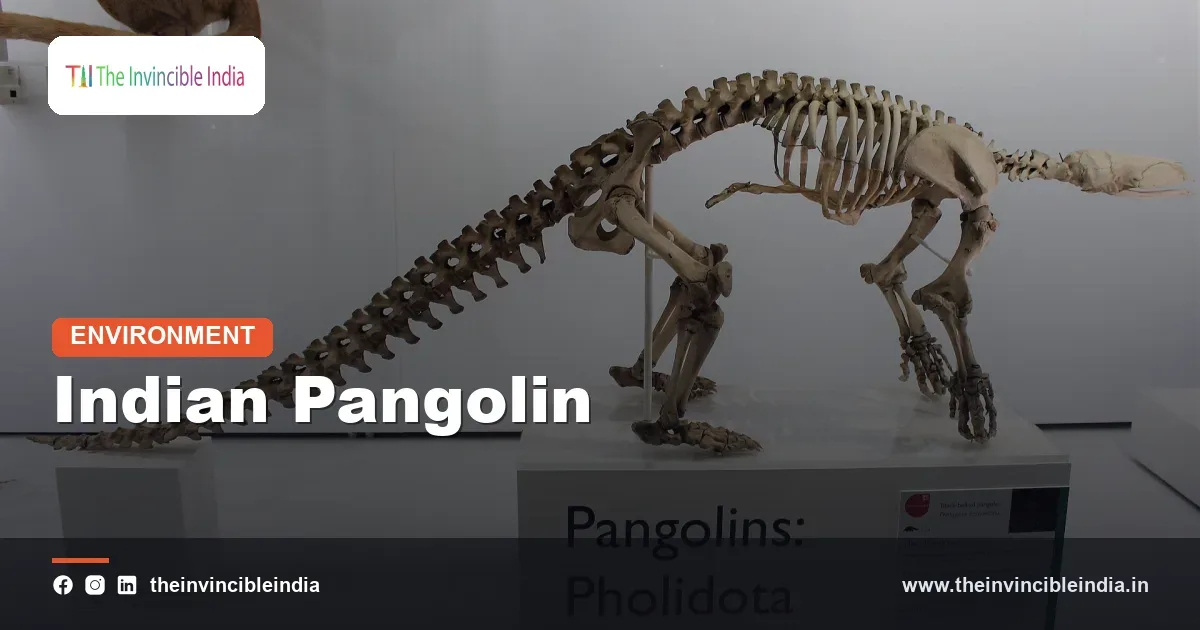
The Indian pangolin (Manis crassicaudata) is a nocturnal, scale-covered, ant-eating mammal found across much of South Asia, and it is one of the most heavily trafficked wild mammals in the world. In India, the Indian pangolin and its Northeastern relative the Chinese pangolin are protected under Schedule I of the Wildlife (Protection) Act, 1972, and international trade in them is banned under CITES Appendix I.
Indian pangolin conservation is the effort to stop poaching and smuggling of these animals, protect the grassland, scrub and forest where they dig their burrows, and rescue and release seized animals. This explainer covers what pangolins are, what they do for the ecosystem, why they are trafficked and what the law and conservation groups are doing (last updated 9 October 2026).
| Attribute | Detail |
|---|---|
| Species in India | Indian pangolin (Manis crassicaudata) and Chinese pangolin (Manis pentadactyla) |
| Order and family | Pholidota, family Manidae |
| IUCN status | Indian pangolin: Endangered; Chinese pangolin: Critically Endangered |
| Indian legal protection | Schedule I, Wildlife (Protection) Act, 1972 |
| International trade control | CITES Appendix I (all eight pangolin species since 2017) |
| Diet | Ants and termites |
| Activity | Nocturnal, burrowing, solitary |
| Unique feature | Overlapping keratin scales covering the body, the only mammal to have them |
| World Pangolin Day | Third Saturday of February |
Key Takeaways
- The Indian pangolin is a scaly, toothless, ant-and-termite-eating mammal whose body is covered with overlapping scales made of keratin, the same protein found in human nails.
- Pangolins are widely described as the most trafficked wild mammals in the world, with their scales and meat in demand in illegal markets abroad.
- The Indian pangolin is listed as Endangered and the Chinese pangolin as Critically Endangered on the IUCN Red List.
- Both pangolin species found in India are listed in Schedule I of the Wildlife (Protection) Act, 1972, and all eight pangolin species are listed in CITES Appendix I.
- A pangolin helps control ant and termite populations and aerates the soil through its burrowing, which gives the animal a useful ecological role.
- Conservation depends on stronger anti-trafficking enforcement, habitat protection, community engagement and careful rescue-and-release of seized animals.
What is an Indian pangolin?
An Indian pangolin is a medium-sized, long-bodied, toothless mammal covered in hard, overlapping scales, which curls into a tight ball when threatened. It is also called the thick-tailed pangolin and belongs to the order Pholidota, which contains a single family, Manidae.
An adult Indian pangolin usually measures about 80 centimetres to over a metre from nose to tail tip, including a thick, muscular tail, and typically weighs somewhere between about 10 and 16 kilograms, although individuals vary. Its scales are pale brown to dark and cover the back, flanks, tail and the outer surface of the limbs, while the underside, throat and face are covered with soft skin and sparse hair.
The pangolin has powerful front limbs with long claws for breaking open termite mounds and digging burrows, a small pointed head, and a long, sticky tongue that can extend well beyond the length of the head. Because it has no teeth, it swallows small stones and sand that help grind food in a muscular stomach.
When alarmed, the Indian pangolin rolls into a ball with the tail wrapped over the head and belly, presenting only the sharp-edged scales to a predator. This defence works well against many natural enemies, but it makes the animal easy for people to pick up, which is one reason it is so vulnerable to poachers.
Which pangolin species live in India?
Two pangolin species live in India: the Indian pangolin (Manis crassicaudata), which is widespread across the peninsula, and the Chinese pangolin (Manis pentadactyla), which occurs in the Himalayan foothills and the Northeast. Together they are the only pangolins found in the country.
| Feature | Indian pangolin | Chinese pangolin |
|---|---|---|
| Scientific name | Manis crassicaudata | Manis pentadactyla |
| Main range in India | Peninsular India, central and northern plains, parts of the Western Ghats and Eastern Ghats | Himalayan foothills, Northeast India and nearby hill regions |
| Habitat | Grassland, scrub, dry and moist deciduous forest, even near farmland | Tropical and subtropical forest, grassland and hill slopes |
| IUCN status | Endangered | Critically Endangered |
| Indian legal status | Schedule I | Schedule I |
The Indian pangolin also occurs in Nepal, Pakistan, Bangladesh and Sri Lanka. The Chinese pangolin ranges across parts of Nepal, Bhutan, Myanmar, Southern China and Taiwan and is considered to be under heavier pressure across most of its range than its Indian relative.
Pangolins are difficult to count because they are nocturnal, solitary and spend the day in burrows. As a result, no precise national population figure exists, and researchers rely on burrow surveys, camera traps, local knowledge and seizure records to infer trends. These indirect methods generally suggest a decline.
What do pangolins eat and what role do they play in the ecosystem?
Pangolins eat almost exclusively ants and termites, which they locate by smell and extract with a long, sticky tongue. By feeding in this way a pangolin helps regulate insect populations and plays a part in healthy soil and forest ecosystems.
An individual pangolin may consume a very large number of insects over a year, with figures commonly cited in the tens of millions, although the exact quantity depends on the species, season and local insect abundance. Because ants and termites can damage crops, timber and structures when they become too numerous, this feeding behaviour is often described as natural pest control.
Pangolins also modify the ground. They dig burrows that can reach several metres in depth, and in doing so they turn over soil, mix organic matter and create shelter that other small animals later use. Digging helps water and air move into the soil, which supports plant growth.
- Pest regulation: keeps termite and ant numbers in balance.
- Soil aeration: burrowing loosens and mixes the soil.
- Shelter creation: abandoned burrows are used by other small animals.
- Food web link: pangolins convert insect biomass into prey for large predators in some areas.
Why are pangolins the most trafficked mammals in the world?
Pangolins are trafficked mainly because their scales are used in some traditional medicines and their meat is eaten as a luxury food in parts of Asia and Africa. The combination of high demand, low legal supply and ease of capture has made them the most frequently seized wild mammals in international wildlife trade, according to widely cited assessments.
Pangolin scales are made of keratin, the same material found in human fingernails and animal hooves. No scientific evidence supports claims that the scales cure illness, yet belief in such properties continues to drive demand in some markets. Pangolin meat is considered a status dish in some regions, and some body parts are used in rituals or as charms.
Since Asian pangolins declined, traffickers have increasingly turned to African species and moved large shipments by sea and air through multiple countries. Indian seizures often involve scales that are sent onward to East and Southeast Asia through land borders, ports and air cargo.
How are pangolins trafficked in India?
Poachers in India typically trap pangolins by smoking them out of burrows or by using snares and nets, and they sell the live animals or scales to intermediaries. Local hunters sometimes receive only a small share of the price that the scales fetch at the end of the supply chain.
Forest departments, police and customs have regularly recovered live pangolins and bags of scales in states such as Odisha, Assam, Maharashtra, Tamil Nadu, Karnataka and Uttar Pradesh. A single seized shipment of scales can represent a large number of killed animals, since each pangolin yields a limited weight of scales.
What legal protection do pangolins have in India?
Pangolins have the highest level of legal protection in India under Schedule I of the Wildlife (Protection) Act, 1972, which makes hunting, possession and trade in the animal or its parts a serious offence. Offences involving Schedule I animals carry imprisonment of at least three years, extending up to seven years, along with a fine.
The Wildlife (Protection) Act, 1972 was amended in 2022 to align India’s schedules with international commitments and to strengthen penalties, and pangolins continue to receive the strictest category of protection. Possessing scales, claws or meat without lawful authority is treated as an offence just like possessing the live animal.
At the international level, pangolins are covered by the Convention on International Trade in Endangered Species of Wild Fauna and Flora (CITES). In 2016 member countries agreed to move all eight pangolin species from Appendix II to Appendix I, which prohibits commercial international trade, and the change took effect in January 2017.
Who enforces these laws?
Enforcement involves several bodies working together.
- State forest departments: patrol protected areas, investigate poaching and register offences.
- Wildlife Crime Control Bureau (WCCB): a statutory body under the Ministry of Environment, Forest and Climate Change that coordinates action against organised wildlife crime across states and borders.
- Customs and law enforcement agencies: intercept shipments at airports, ports and land borders.
- Courts and prosecutors: handle trials, although slow convictions remain a recognised challenge.
What are the main threats to pangolins in India besides trafficking?
Besides trafficking, the main threats to pangolins in India are habitat loss, accidental death on roads and from electric fences, local hunting for meat and traditional uses, and the use of pesticides that reduce insect prey. Slow reproduction makes it difficult for populations to recover from any of these pressures.
A female pangolin typically gives birth to a single young at a time, which clings to its mother’s tail or back for the first weeks of life. This low reproductive rate means that even moderate losses can push a local population into decline.
- Habitat conversion: grassland, scrub and forest are cleared for agriculture, mining, quarrying and infrastructure.
- Road deaths: pangolins move at night and often crawl slowly across roads.
- Electrocution: pangolins climbing or touching illegal electrified fencing or live power lines can die.
- Hunting and local consumption: hunting for meat and for supposed ritual benefit continues in some regions.
- Pesticide use: chemical use can reduce the ants and termites the animal relies on.
How are seized pangolins rescued and released?
Seized pangolins are first examined by veterinarians and wildlife officials, treated for injuries or stress, and then released back into suitable habitat if they are healthy enough to survive. The process needs careful handling because pangolins are delicate in captivity and many refuse food.
Rescuers must stabilise a confiscated animal, provide ants and termites or specialised substitutes, and check for dehydration, wounds from snares and gut problems. Pangolins often arrive weak, and mortality in captivity is a recognised problem. For this reason, experts generally recommend minimal time in rescue centres and early release in an area with suitable habitat, protection and monitoring.
Organisations such as the Wildlife Trust of India and other regional groups have trained forest staff in rescue, handling and release, and some projects fit rescued pangolins with radio or satellite tags to follow their movement and survival after release. Such studies help forest departments choose safer release sites and understand how far the animals travel from their burrows.
Who works on pangolin conservation in India?
Pangolin conservation in India is led by the Ministry of Environment, Forest and Climate Change and state forest departments, with support from wildlife organisations, universities and local communities. The effort covers enforcement, research, awareness and the involvement of villages that share land with pangolins.
Several complementary activities are under way.
- Population research: burrow surveys, camera traps and local knowledge are used to estimate where pangolins occur and how they use the landscape.
- Community engagement: forest-fringe villagers are trained as informants, trackers and conservation volunteers, and some are given alternative livelihood support.
- Capacity building: police, customs and forest officers are taught to recognise pangolin parts and handle live animals.
- Awareness drives: World Pangolin Day, observed on the third Saturday of February, is used for campaigns in schools and villages.
- Regional cooperation: India shares information with neighbouring countries and international networks to disrupt smuggling routes.
Specialist groups and international research networks, including the IUCN Species Survival Commission’s pangolin specialists, support the national effort with technical guidance. Conservation planners also stress that local people who live close to pangolin habitat are central to any long-term solution.
What challenges remain for pangolin conservation?
The biggest remaining challenges are limited knowledge of how many pangolins survive, the high financial incentive for poachers, uneven enforcement, the low survival of captive animals and the loss of habitat. Because pangolins are secretive, even basic data on population size is scarce.
Prosecution is another weak point. Cases can take years to reach a verdict, and the people caught are often low-level carriers rather than the organisers of the trade. Experts therefore stress financial investigation, intelligence sharing and action against buyers and traders, not only arrests of poachers.
Finally, demand reduction is essential. As long as scales and meat command high prices abroad, the pressure on wild pangolins will continue. Awareness efforts in consumer countries, together with stronger controls over transport routes, form the other half of the response to the trade.
Bottom Line
The Indian pangolin and the Chinese pangolin are slow-breeding, insect-eating mammals that are vulnerable because they are easy to catch and highly valued in illegal markets. India gives both species the strictest legal protection, but lasting conservation will depend on tackling the demand for pangolin products, enforcing the law effectively and protecting the habitat in which the animals dig and feed.
Frequently Asked Questions
Why is the Indian pangolin so heavily trafficked?
The Indian pangolin is trafficked because its scales are used in some traditional medicines and its meat is eaten as a luxury food in parts of Asia. The scales have no proven medicinal value, as they are made of keratin like human fingernails. The animal is slow, harmless and easy to capture, which makes poaching simple.
Is it illegal to keep or sell a pangolin in India?
Yes, keeping, hunting, selling or trading a pangolin or its parts is illegal in India. Both the Indian pangolin and the Chinese pangolin are listed in Schedule I of the Wildlife (Protection) Act, 1972. Offenders face imprisonment of at least three years, which can extend to seven years, and a fine.
What do pangolins eat?
Pangolins eat ants and termites almost exclusively. They tear open nests with their strong claws and collect insects with a long, sticky tongue. Because they have no teeth, they depend on a muscular stomach and ingested grit to grind their food.
What is the difference between the Indian pangolin and the Chinese pangolin?
The Indian pangolin (Manis crassicaudata) lives mainly in peninsular and central India, while the Chinese pangolin (Manis pentadactyla) lives in the Himalayan foothills and the Northeast. The IUCN lists the Indian pangolin as Endangered and the Chinese pangolin as Critically Endangered. Both are protected in Schedule I of the Wildlife (Protection) Act, 1972.
Are pangolins protected internationally?
Yes, all eight pangolin species are listed in Appendix I of CITES. This listing, which took effect in January 2017, prohibits commercial international trade in pangolins and their parts. Countries that are parties to the convention, including India, are required to enforce the ban.
When is World Pangolin Day?
World Pangolin Day is observed on the third Saturday of February each year. The day is used to raise awareness about the threats facing pangolins and the need to protect them. Wildlife groups, forest departments and schools in India organise talks, exhibitions and campaigns on this day.
{“@context”:”https://schema.org”,”@graph”:[{“@type”:”FAQPage”,”mainEntity”:[{“@type”:”Question”,”name”:”Why is the Indian pangolin so heavily trafficked?”,”acceptedAnswer”:{“@type”:”Answer”,”text”:”The Indian pangolin is trafficked because its scales are used in some traditional medicines and its meat is eaten as a luxury food in parts of Asia. The scales have no proven medicinal value, as they are made of keratin like human fingernails. The animal is slow, harmless and easy to capture, which makes poaching simple.”}},{“@type”:”Question”,”name”:”Is it illegal to keep or sell a pangolin in India?”,”acceptedAnswer”:{“@type”:”Answer”,”text”:”Yes, keeping, hunting, selling or trading a pangolin or its parts is illegal in India. Both the Indian pangolin and the Chinese pangolin are listed in Schedule I of the Wildlife (Protection) Act, 1972. Offenders face imprisonment of at least three years, which can extend to seven years, and a fine.”}},{“@type”:”Question”,”name”:”What do pangolins eat?”,”acceptedAnswer”:{“@type”:”Answer”,”text”:”Pangolins eat ants and termites almost exclusively. They tear open nests with their strong claws and collect insects with a long, sticky tongue. Because they have no teeth, they depend on a muscular stomach and ingested grit to grind their food.”}},{“@type”:”Question”,”name”:”What is the difference between the Indian pangolin and the Chinese pangolin?”,”acceptedAnswer”:{“@type”:”Answer”,”text”:”The Indian pangolin (Manis crassicaudata) lives mainly in peninsular and central India, while the Chinese pangolin (Manis pentadactyla) lives in the Himalayan foothills and the Northeast. The IUCN lists the Indian pangolin as Endangered and the Chinese pangolin as Critically Endangered. Both are protected in Schedule I of the Wildlife (Protection) Act, 1972.”}},{“@type”:”Question”,”name”:”Are pangolins protected internationally?”,”acceptedAnswer”:{“@type”:”Answer”,”text”:”Yes, all eight pangolin species are listed in Appendix I of CITES. This listing, which took effect in January 2017, prohibits commercial international trade in pangolins and their parts. Countries that are parties to the convention, including India, are required to enforce the ban.”}},{“@type”:”Question”,”name”:”When is World Pangolin Day?”,”acceptedAnswer”:{“@type”:”Answer”,”text”:”World Pangolin Day is observed on the third Saturday of February each year. The day is used to raise awareness about the threats facing pangolins and the need to protect them. Wildlife groups, forest departments and schools in India organise talks, exhibitions and campaigns on this day.”}}]}]}


