

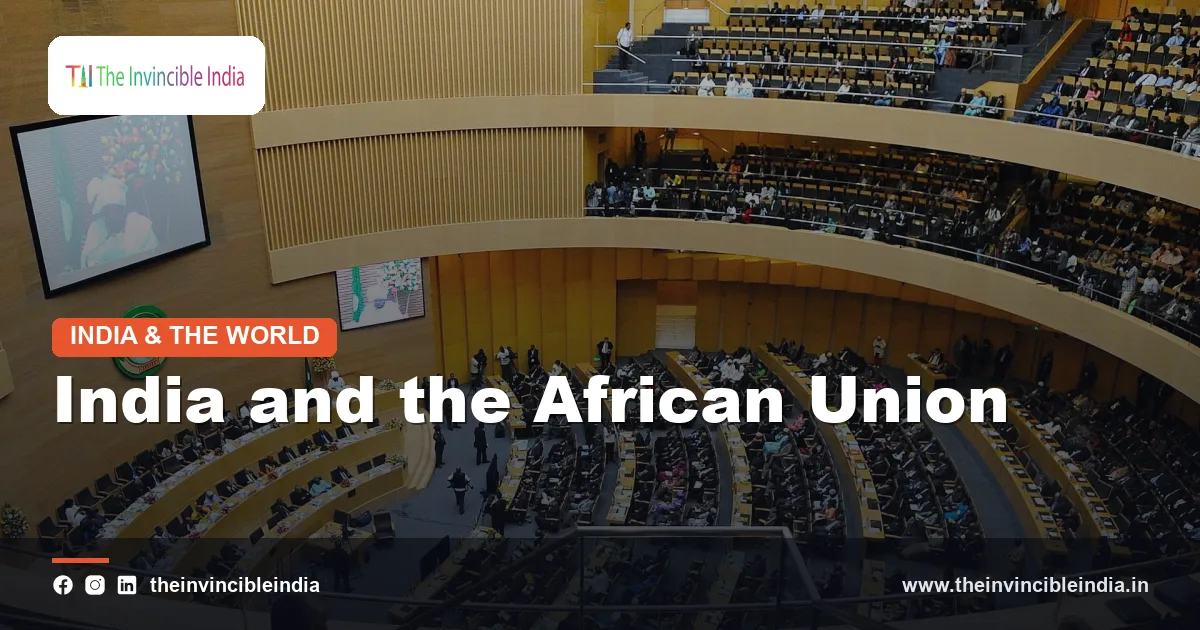
India and the African Union is a long-standing partnership between the Republic of India and the 55-member continental organisation of African states, built on development cooperation, trade, capacity-building, diaspora ties and a shared Global South outlook. The relationship gained fresh visibility in September 2023, when the African Union (AU) was admitted as a permanent member of the G20 at the New Delhi summit, a step India had actively championed during its G20 presidency.
India and the African Union interact at two levels: bilaterally, between New Delhi and individual African governments, and collectively, through the AU Commission in Addis Ababa and the India-Africa Forum Summit process. This explainer sets out how the partnership works, what India offers, what Africa seeks and where the relationship faces limits.
| Attribute | Detail |
|---|---|
| Partners | Republic of India and the African Union (AU) |
| AU founded | 2002, in Durban, South Africa, succeeding the Organisation of African Unity (OAU) of 1963 |
| AU headquarters | Addis Ababa, Ethiopia |
| AU members | 55 member states |
| India-Africa Forum Summits | First in New Delhi (2008), second in Addis Ababa (2011), third in New Delhi (2015) |
| Indian nodal ministry | Ministry of External Affairs (MEA), with the Exim Bank handling lines of credit |
| Key milestone | AU became a permanent member of the G20 at the New Delhi summit, September 2023 |
| Main instruments | Lines of credit, Duty Free Tariff Preference scheme, ITEC training, Pan-African e-Network, trade and investment |
Key Takeaways
- The African Union was admitted as a permanent member of the G20 at the New Delhi summit in September 2023, following a proposal that India had strongly supported during its G20 presidency.
- The India-Africa Forum Summit has been held three times, in New Delhi in 2008, in Addis Ababa in 2011 and in New Delhi in 2015, and it is the main collective platform between India and African countries.
- India offers Africa concessional lines of credit, a duty-free tariff preference for least developed countries, and training through the Indian Technical and Economic Cooperation (ITEC) programme.
- Trade between India and African countries has grown steadily since the early 2000s, and India is counted among the continent’s largest trading partners.
- Large communities of people of Indian origin live in countries such as South Africa, Kenya, Mauritius and Tanzania, giving the relationship a human and historical foundation.
- India describes its Africa policy as demand-driven and partnership-based, while observers note continuing challenges such as competition from other major powers and uneven project delivery.
What is the African Union?
The African Union (AU) is a continental organisation of 55 African states, launched in 2002 in Durban, South Africa, as the successor to the Organisation of African Unity (OAU) founded in 1963. Its headquarters are in Addis Ababa, Ethiopia, and its permanent secretariat is the African Union Commission.
The AU works toward political and economic integration, peace and security, and development across the continent. Its long-term blueprint is Agenda 2063, a strategic framework that sets out goals for prosperity, good governance, peace and cultural identity over fifty years. The AU also oversees initiatives such as the African Continental Free Trade Area (AfCFTA), which aims to create a single market across the continent.
Unlike a single country, the AU speaks for a very diverse group of states, from island economies to some of the most populous nations in the world. India therefore deals with the AU as a collective body on continental questions while keeping separate bilateral relations with each member.
How did India and Africa’s relationship begin?
India and Africa’s relationship began long before the AU existed, rooted in centuries of Indian Ocean trade, shared experience of colonial rule and the anti-colonial movements of the twentieth century. Merchants from Gujarat and the Malabar coast traded along the East African coast for centuries, and Swahili culture still reflects those exchanges.
Mahatma Gandhi spent more than two decades in South Africa, from 1893 to 1914, and developed his method of nonviolent resistance there. After independence in 1947, India became a strong voice against colonialism and apartheid, supporting liberation movements and raising the issue at the United Nations. India was also a founding force in the Non-Aligned Movement, which many newly independent African states joined.
These early ties created a political language of solidarity that continues to shape the modern relationship. The shift from solidarity alone to structured economic and institutional cooperation came in the 2000s, when India began to organise its Africa engagement through regular summits and dedicated financial instruments.
What are the India-Africa Forum Summits?
The India-Africa Forum Summit (IAFS) is the principal institutional framework through which India meets African leaders collectively, and it has been held three times so far. The first summit took place in New Delhi in 2008, the second in Addis Ababa in 2011, and the third again in New Delhi in 2015, which brought together a large number of African heads of state and government.
| Summit | Year | Host city | Notable focus |
|---|---|---|---|
| First India-Africa Forum Summit | 2008 | New Delhi | Launch of a structured partnership, with the Delhi Declaration and the Africa-India Framework for Cooperation |
| Second India-Africa Forum Summit | 2011 | Addis Ababa | Expanded lines of credit and capacity-building; the Addis Ababa Declaration |
| Third India-Africa Forum Summit | 2015 | New Delhi | All African countries invited; emphasis on development, skills, health and a 2015 action framework |
The summits set priorities in areas such as agriculture, health, education, energy, infrastructure and information technology. They also serve as occasions to announce new lines of credit, scholarships and training places. A fourth summit has been discussed repeatedly, but the planned timetable has been affected by global disruptions, so the three summits above remain the established milestones.
Alongside the summits, India holds regular consultations with the AU Commission, and it has opened many new diplomatic missions across Africa in the last two decades to support closer engagement.
How did India help the African Union join the G20?
India helped the African Union join the G20 by proposing and building consensus for the AU’s inclusion during its 2023 G20 presidency, and the AU became a permanent member at the New Delhi summit in September 2023. The announcement was made at the opening of the summit, and the AU took its seat alongside the other members, joining the European Union as the second regional bloc with full membership.
Before this step, the African presence in the G20 was limited to South Africa as a single country member, with other African states attending only as invited guests. The AU’s admission gave the continent a collective voice in the forum that discusses global finance, debt, climate and development.
India linked the move to its wider emphasis on making global institutions more representative of the Global South. In the same year, India also convened the Voice of Global South Summit, a virtual gathering in which many developing countries, including a large number from Africa, shared their priorities before the G20 meetings. The AU’s entry is widely seen as one of the most concrete outcomes of that process, and it is now cited as an example of how a middle-income country can use a rotating presidency to widen participation in a major forum.
The decision was welcomed by African leaders, though they also stress that the continent’s priorities, such as debt relief, climate finance and fairer trade rules, still need sustained follow-up inside the G20.
What trade links exist between India and Africa?
India and Africa share a substantial and growing trade relationship, and India is regarded as one of the continent’s major trading partners. Total trade has expanded considerably since the early 2000s, driven by India’s demand for energy and resources and by Africa’s demand for affordable manufactured goods and medicines.
What India buys and sells
- Imports from Africa: crude oil and other energy products, gold, precious stones, pulses, cashew nuts, coal and other minerals.
- Exports to Africa: pharmaceutical products, vehicles and machinery, refined petroleum products, textiles, rice and engineering goods.
- Services: information technology, healthcare, education and financial services, which are increasingly important.
Investment
Indian companies have invested in telecom, banking, pharmaceuticals, agriculture, power and mining across the continent. Indian firms in telecom and automobiles have built a visible presence in several African markets, and Indian pharmaceutical companies supply a large share of generic medicines used in Africa.
Trade balance
The trade pattern is uneven in composition, with African exports concentrated in a few primary commodities and Indian exports spread across manufactured goods. African policymakers often ask for more value addition within Africa, such as local processing of agricultural and mineral products, and for greater market access for African goods in India.
What are India’s lines of credit and the duty-free tariff preference?
India’s lines of credit are concessional loans extended through the Export-Import Bank of India (Exim Bank) to African governments for projects built using Indian goods and services, while the Duty Free Tariff Preference (DFTP) scheme gives least developed countries preferential access to the Indian market.
Lines of credit
Lines of credit have financed power plants and transmission lines, railways, water supply, irrigation, agriculture, industrial parks and public buildings in many African countries. They are offered on terms softer than commercial loans, and the borrowing government selects projects within agreed sectors. Over the years, India has extended lines of credit worth several billion US dollars to African countries, making Africa one of the largest recipient regions of Indian concessional finance.
Duty Free Tariff Preference scheme
India launched the DFTP scheme for least developed countries (LDCs) in 2008, offering duty-free access for a large share of Indian tariff lines. Many African countries are classified as LDCs and are therefore eligible. The scheme aims to help LDC exports reach the Indian market on better terms, although the actual use of the preference depends on whether exporters can meet quality standards and supply volumes.
Points of debate
- Supporters say the credit model is faster and more flexible than some multilateral lending and includes training and technology transfer.
- Critics note that some projects have faced delays and that the tied-procurement feature favours Indian suppliers.
- Debt sustainability remains a general concern for many African borrowers from all lenders, and India’s share is smaller than that of some other creditors.
How does India support capacity-building in Africa?
India supports capacity-building in Africa mainly through the Indian Technical and Economic Cooperation (ITEC) programme, scholarships, institution-building and the Pan-African e-Network project. Capacity-building is often described as the signature element of India’s Africa policy because it relies on sharing skills rather than only financing infrastructure.
ITEC
The ITEC programme was launched in 1964 and offers short- and medium-term training in India for officials and professionals from partner countries. African participants form a large share of ITEC trainees, studying fields such as public administration, agriculture, renewable energy, information technology, healthcare and small enterprise development. Alongside training, ITEC funds experts, study tours and project support in partner countries.
Pan-African e-Network
The Pan-African e-Network project was launched in 2009 to connect African countries with Indian universities and hospitals through satellite and fibre links. It provided tele-education and telemedicine services, with Indian institutions delivering courses and specialist consultations to students and doctors across Africa. The initiative was later expanded and reorganised into a new platform covering tele-education and tele-medicine, known as e-VidyaBharti and e-ArogyaBharti.
Institutions and scholarships
- India has set up or supported vocational training centres, information technology centres, and entrepreneurship and agricultural institutions in several African countries.
- Scholarships for African students at Indian universities are offered through the Indian Council for Cultural Relations (ICCR) and other schemes.
- Indian institutions have opened campuses and partnerships in parts of Africa, particularly in higher education and technology.
What role does the Indian diaspora play?
The Indian diaspora in Africa plays a significant role in India-Africa relations by providing commercial networks, cultural links and a human bridge between societies. People of Indian origin live across the continent, with especially large communities in South Africa, Mauritius, Kenya, Tanzania, Uganda and parts of West and Central Africa.
Many Indian-origin families arrived in the nineteenth and early twentieth centuries, some as indentured labourers on sugar plantations and railway construction, others as traders and clerks. Over generations they have taken part in business, professions, politics and civil society in their adopted countries. In Mauritius, people of Indian origin form a large part of the population, and in South Africa the community has been closely tied to the anti-apartheid struggle.
The diaspora also shapes day-to-day cooperation. Indian-origin businesses often help new Indian investors find partners, and community institutions run schools, hospitals and cultural centres. At the same time, the history of the diaspora is not without tension, as in several countries the community has experienced periods of political and economic hostility, and India’s policy generally focuses on the welfare of Indian nationals while respecting the sovereignty of host countries.
How does Global South solidarity shape the partnership?
Global South solidarity shapes the India-Africa partnership by giving both sides a shared agenda on reform of global institutions, climate justice, fair trade and development financing. India and many African countries argue that institutions created after the Second World War do not adequately reflect today’s world, and they coordinate positions in forums such as the United Nations and the World Trade Organization.
Several concrete themes recur:
- United Nations reform: India and the AU both call for broader representation, including Africa, on the Security Council. The AU’s collective position on this is known as the Ezulwini Consensus.
- Climate and energy: India launched the International Solar Alliance in 2015 with France, and a number of African countries are members, with a focus on affordable solar energy.
- Health: India supplied medicines and vaccines to many African countries during the COVID-19 period and has long been a supplier of low-cost generics.
- Digital public infrastructure: India has offered to share its experience of digital identity and payment systems with interested African partners.
The Global South framing also helps India position itself as a partner without a colonial past in Africa. However, African governments increasingly want partnerships that deliver jobs, technology and investment rather than rhetoric alone, and they deal with many partners at once, including China, the European Union, the United States, Gulf states, Turkey and others.
What challenges does the India-Africa relationship face?
The India-Africa relationship faces challenges that include competition from other external powers, uneven project implementation, limited trade diversification and the sheer diversity of the African continent. Recognising these limits is part of understanding the partnership realistically.
- Competition: China, the European Union, the United States, Gulf states and others are also deepening their African engagement, often with larger financial resources.
- Delivery gaps: some Indian-financed projects have been slow to complete, which affects confidence.
- Trade concentration: African exports to India rely heavily on a small group of commodities, and non-tariff barriers can limit gains.
- Logistics and connectivity: direct shipping and air links between India and several African countries remain limited.
- Security and stability: conflict, coups and economic stress in parts of Africa can disrupt projects and investment.
India has responded by stressing partnership principles, such as African ownership, local capacity and respect for national priorities, and by increasing the number of its diplomatic missions on the continent.
Timeline of key milestones in India-Africa ties
| Year | Milestone |
|---|---|
| 1893-1914 | Mahatma Gandhi lives and works in South Africa, shaping nonviolent resistance |
| 1947 | India becomes independent and begins to support decolonisation in Africa |
| 1963 | Organisation of African Unity (OAU) formed |
| 1964 | ITEC programme launched |
| 2002 | African Union launched, replacing the OAU |
| 2008 | First India-Africa Forum Summit; Duty Free Tariff Preference scheme announced |
| 2009 | Pan-African e-Network project launched |
| 2011 | Second India-Africa Forum Summit in Addis Ababa |
| 2015 | Third India-Africa Forum Summit; International Solar Alliance launched |
| 2023 | African Union becomes a permanent member of the G20 at the New Delhi summit |
Bottom Line
India and the African Union have moved from shared anti-colonial solidarity to a structured partnership that covers trade, credit, training and diplomacy. The African Union’s admission to the G20 at New Delhi in 2023 is the most visible recent milestone, while delivery on projects, trade diversification and competition from other powers will decide how deep the partnership becomes.
Frequently Asked Questions
When did the African Union become a member of the G20?
The African Union became a permanent member of the G20 at the New Delhi summit in September 2023. India, which held the G20 presidency that year, had championed the proposal. The AU now participates alongside the group’s other members, giving the continent a collective voice.
How many India-Africa Forum Summits have been held?
Three India-Africa Forum Summits have been held so far. The first was in New Delhi in 2008, the second in Addis Ababa in 2011 and the third in New Delhi in 2015. A fourth summit has been discussed but is not part of the established record.
What is the ITEC programme and how does it help African countries?
The Indian Technical and Economic Cooperation (ITEC) programme is India’s flagship capacity-building scheme, launched in 1964. It funds training courses in India for officials and professionals from partner countries, with African participants forming a large group. The courses cover areas such as public administration, agriculture, health and information technology.
What is the Duty Free Tariff Preference scheme for Africa?
The Duty Free Tariff Preference (DFTP) scheme is an Indian trade programme launched in 2008 that offers least developed countries duty-free access to the Indian market for a large share of products. Many African countries qualify because they are classified as least developed. The benefit depends on exporters being able to meet quality standards and deliver sufficient volumes.
Is India a major trading partner of Africa?
Yes, India is regarded as one of Africa’s major trading partners, and trade has grown considerably since the early 2000s. India imports energy products, gold and agricultural goods from Africa, and exports pharmaceuticals, vehicles, machinery and refined fuels. African countries continue to seek greater value addition and more diversified exports to India.
Why does the Indian diaspora matter for India-Africa relations?
The Indian diaspora matters because it provides historical roots, business networks and cultural links across many African countries. Communities in South Africa, Mauritius, Kenya, Tanzania and elsewhere trace their arrival to the nineteenth and early twentieth centuries. They contribute to local economies and help connect new Indian investors with African partners.
{“@context”:”https://schema.org”,”@graph”:[{“@type”:”FAQPage”,”mainEntity”:[{“@type”:”Question”,”name”:”When did the African Union become a member of the G20?”,”acceptedAnswer”:{“@type”:”Answer”,”text”:”The African Union became a permanent member of the G20 at the New Delhi summit in September 2023. India, which held the G20 presidency that year, had championed the proposal. The AU now participates alongside the group’s other members, giving the continent a collective voice.”}},{“@type”:”Question”,”name”:”How many India-Africa Forum Summits have been held?”,”acceptedAnswer”:{“@type”:”Answer”,”text”:”Three India-Africa Forum Summits have been held so far. The first was in New Delhi in 2008, the second in Addis Ababa in 2011 and the third in New Delhi in 2015. A fourth summit has been discussed but is not part of the established record.”}},{“@type”:”Question”,”name”:”What is the ITEC programme and how does it help African countries?”,”acceptedAnswer”:{“@type”:”Answer”,”text”:”The Indian Technical and Economic Cooperation (ITEC) programme is India’s flagship capacity-building scheme, launched in 1964. It funds training courses in India for officials and professionals from partner countries, with African participants forming a large group. The courses cover areas such as public administration, agriculture, health and information technology.”}},{“@type”:”Question”,”name”:”What is the Duty Free Tariff Preference scheme for Africa?”,”acceptedAnswer”:{“@type”:”Answer”,”text”:”The Duty Free Tariff Preference (DFTP) scheme is an Indian trade programme launched in 2008 that offers least developed countries duty-free access to the Indian market for a large share of products. Many African countries qualify because they are classified as least developed. The benefit depends on exporters being able to meet quality standards and deliver sufficient volumes.”}},{“@type”:”Question”,”name”:”Is India a major trading partner of Africa?”,”acceptedAnswer”:{“@type”:”Answer”,”text”:”Yes, India is regarded as one of Africa’s major trading partners, and trade has grown considerably since the early 2000s. India imports energy products, gold and agricultural goods from Africa, and exports pharmaceuticals, vehicles, machinery and refined fuels. African countries continue to seek greater value addition and more diversified exports to India.”}},{“@type”:”Question”,”name”:”Why does the Indian diaspora matter for India-Africa relations?”,”acceptedAnswer”:{“@type”:”Answer”,”text”:”The Indian diaspora matters because it provides historical roots, business networks and cultural links across many African countries. Communities in South Africa, Mauritius, Kenya, Tanzania and elsewhere trace their arrival to the nineteenth and early twentieth centuries. They contribute to local economies and help connect new Indian investors with African partners.”}}]}]}


