

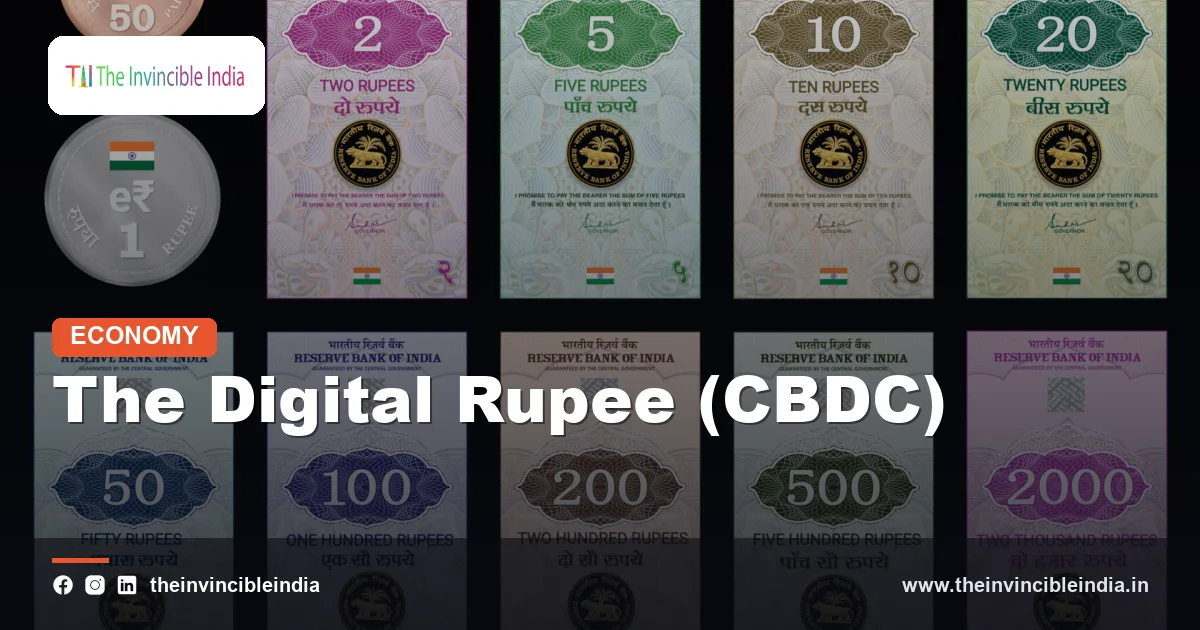
The digital rupee, also called the e-rupee or e₹, is the Reserve Bank of India’s central bank digital currency (CBDC): a digital form of the Indian rupee that is issued by the central bank, is legal tender, and is meant to work like a banknote in electronic form. Unlike a balance in a bank account or a UPI transfer, a unit of digital rupee is a direct liability of the Reserve Bank of India (RBI), in the same way that a physical currency note is.
The RBI launched pilots of two versions of the digital rupee in late 2022: a wholesale version for banks and financial institutions and a retail version for the public. This explainer covers what the digital rupee is, how the two models differ, how it compares with UPI and private cryptocurrencies, which features such as programmability and offline use are being tested, and what privacy and policy questions it raises.
| Quick Facts | Details |
|---|---|
| Issuer | Reserve Bank of India (RBI), the central bank |
| Also known as | E-rupee, e₹, central bank digital currency (CBDC) |
| Announced | Union Budget 2022-23 (February 2022) |
| Wholesale pilot (CBDC-W) | Launched 1 November 2022, initially for settling secondary-market government securities transactions |
| Retail pilot (CBDC-R) | Launched 1 December 2022 in a limited number of cities with a few banks |
| Legal basis | Reserve Bank of India Act, 1934, as amended in 2022 to recognise “bank note” in digital form |
| Retail design | Token-based digital currency held in wallets, available in the same denominations as physical currency |
| Interest | Not interest-bearing, in the same way as cash |
| Legal status | Legal tender, a direct claim on the RBI |
Key Takeaways
- The digital rupee is a central bank digital currency issued by the Reserve Bank of India and is the digital counterpart of physical rupee currency notes.
- The RBI began a wholesale digital rupee pilot (CBDC-W) on 1 November 2022 and a retail digital rupee pilot (CBDC-R) on 1 December 2022.
- A digital rupee differs from a UPI payment because the digital rupee is a liability of the RBI and is legal tender, while UPI is merely a channel that moves money held in bank accounts.
- The digital rupee differs from private cryptocurrencies because it is issued and backed by the central bank, is denominated in rupees and has a stable one-to-one value with physical cash.
- The RBI has tested features such as offline payments and programmability on the digital rupee, but these remain subject to pilot-stage design choices.
- Privacy, bank deposit disintermediation and cyber-security are the main concerns that experts raise about the digital rupee.
What is the digital rupee?
The digital rupee is a legal-tender digital token issued by the Reserve Bank of India that represents the same value as the equivalent rupee note or coin. It is the Indian version of what economists generally call a central bank digital currency (CBDC), a form of central bank money that exists only in electronic form.
The idea has a simple parallel with physical cash. A ₹100 note is a claim on the RBI and can be used to settle any debt in the country. A ₹100 digital rupee is intended to carry exactly the same status, but it can be stored in an electronic wallet on a phone or device, and it can be moved digitally without a bank intermediating each transfer.
The RBI has described the digital rupee as a complement to cash, not a replacement for it. Physical currency and the digital rupee are expected to coexist, and users can convert one into the other at par.
When and why did India launch the digital rupee?
India announced its plan for a digital rupee in the Union Budget for 2022-23, presented in February 2022, and the RBI began pilots in November and December of that year. The Finance Act, 2022 amended the Reserve Bank of India Act, 1934 so that the term “bank note” explicitly covered a digital form, giving the central bank a legal basis to issue the currency.
The RBI released a concept note on the central bank digital currency in October 2022 which set out its objectives. These included reducing the operational costs of managing physical cash, offering a safe digital settlement asset, supporting innovation in payments and encouraging financial inclusion. The central bank also noted that a CBDC could make cross-border payments more efficient over time.
Many other countries have explored or launched CBDCs. The wider global context includes the growth of private cryptocurrencies and stablecoins, which prompted central banks to consider whether they should offer a safe public alternative in digital form.
What are the wholesale and retail versions of the digital rupee?
The digital rupee has two versions: the wholesale CBDC (CBDC-W), used by banks and other financial institutions for large-value settlement, and the retail CBDC (CBDC-R), meant for use by the general public and businesses. The RBI treats these as separate pilots with different purposes and users.
Wholesale CBDC (CBDC-W)
The wholesale digital rupee was launched as a pilot on 1 November 2022, and its first use case was settlement of secondary-market transactions in government securities. The aim is to make interbank settlement more efficient by reducing the need for collateral and settlement guarantees, and to cut settlement risk and cost. Participants are banks and financial institutions that already hold accounts with the RBI.
The RBI later extended the wholesale pilot to other uses, such as the call money market, where banks lend to each other for very short periods. In this setting, central bank money in tokenised form can allow near-instant settlement.
Retail CBDC (CBDC-R)
The retail digital rupee was launched as a pilot on 1 December 2022 with a closed user group of customers and merchants in selected cities, using a handful of participating banks. Users access the digital rupee through a digital wallet offered by a participating bank, and can pay merchants by scanning a QR code or by transferring directly to another wallet.
The retail pilot was gradually widened over time to include more banks, more cities and additional use cases, such as certain government payments. Readers should check the RBI for the current extent of the pilot, which has changed since launch.
| Feature | Wholesale CBDC (CBDC-W) | Retail CBDC (CBDC-R) |
|---|---|---|
| Intended users | Banks and financial institutions | Individuals and businesses |
| Pilot start | 1 November 2022 | 1 December 2022 |
| Main purpose | Interbank and securities settlement | Everyday payments and store of value |
| Typical transaction size | Large value | Small and medium value |
| Access | Through RBI accounts held by institutions | Through wallets offered by banks |
How does the retail digital rupee work?
The retail digital rupee works as a token-based digital currency held in a wallet on the user’s device, which the user can fund by exchanging bank deposits for digital rupees. The RBI issues the digital rupee to banks, and the banks distribute it to customers, so the public deals with a familiar commercial bank rather than with the central bank directly. This is called a two-tier or hybrid model.
In a “token-based” design, the digital rupee itself is the object of value, similar to a banknote, and a recipient verifies that the token is genuine. This differs from an “account-based” design, where a ledger records who owns how much and a transaction updates the balances. The RBI has described the retail CBDC as token-based, while noting that wholesale use is more likely to rely on verifying the status of the holder.
- Loading the wallet: The user moves money from a bank account into the digital rupee wallet provided by the bank.
- Paying: The user transfers digital rupees to another wallet or scans a merchant’s QR code, and the transfer is settled directly in central bank money.
- Interoperability: The RBI has worked on making the e-rupee QR codes usable across different apps, so that a user is not locked in to one wallet.
- Redemption: The user can convert digital rupees back into a bank deposit at par.
How is the digital rupee different from UPI?
The digital rupee is different from UPI because the digital rupee is itself money, a direct liability of the RBI, whereas UPI (Unified Payments Interface) is a payment system that instructs the transfer of money held in bank accounts. When a person pays by UPI, the sum moves from one bank deposit to another, and the underlying money remains a claim on a commercial bank.
UPI was developed by the National Payments Corporation of India (NPCI) and works as a real-time interface across banks. It provides convenience, but it does not create a new form of money. The digital rupee, by contrast, is a new form of central bank money that can circulate in electronic form.
| Aspect | Digital rupee (CBDC) | UPI |
|---|---|---|
| Nature | A form of money, a digital currency | A payment system or interface |
| Issuer or operator | Reserve Bank of India | National Payments Corporation of India (NPCI) |
| Liability of | The RBI (central bank) | The bank holding the account |
| Legal tender | Yes | No, it moves bank deposits |
| Needs a bank account | Not necessarily at the point of use, since a wallet holds the tokens | Yes, linked to a bank account |
| Offline use | Being piloted | Limited offline options |
The two are not rivals in a strict sense. The RBI has allowed digital rupee wallets to be used with interoperable QR codes that also work with UPI-style scanning, so the user experience is meant to feel similar even though the underlying money is different.
How is the digital rupee different from cryptocurrency?
The digital rupee is different from cryptocurrency because it is issued, controlled and backed by the central bank, it is denominated in rupees, and it is legal tender, while private cryptocurrencies such as Bitcoin are issued by no sovereign, fluctuate widely in price and are not legal tender in India. A digital rupee is always worth one rupee, whereas a cryptocurrency can swing sharply in value.
Although both may use digital tokens and some similar technology, the underlying structure is different. Private cryptocurrencies typically rely on decentralised networks and are not liabilities of any central authority. A CBDC is a centralised instrument whose supply the central bank decides, which means the RBI retains control over monetary policy and financial stability.
- Issuer: The RBI for the digital rupee; decentralised networks or private firms for most crypto assets.
- Value: Fixed at par with the rupee for the digital rupee; market-determined and volatile for most crypto assets.
- Legal status: Legal tender for the digital rupee; not recognised as currency for crypto assets, which India taxes and monitors as virtual digital assets.
- Purpose: A payment and settlement instrument for the digital rupee; largely speculative investment for many crypto assets.
What features does the digital rupee offer, such as offline payments and programmability?
The digital rupee offers features beyond ordinary cash, and the RBI has been testing several of them in its pilots, including offline payments and programmability. These features are experimental, and their availability and design may change as the pilots develop.
Offline payments
Offline functionality allows a digital rupee transaction between two devices without an active internet connection at the moment of payment. This is intended to support areas with weak connectivity and to give the digital rupee a cash-like feature that other digital payment systems do not easily match. The RBI has tested offline modes, including approaches using near-field communication or similar short-range technology.
Programmability
Programmability means that digital rupees can carry conditions on how, when or for what purpose they can be spent. The RBI has run pilots for programmable use cases, for example benefits that can only be used for a defined purpose or that expire after a set period. Supporters see this as a way to improve the targeting of subsidies and reduce leakage. Critics note that restrictions on spending raise questions about autonomy and privacy, and that the central bank has said it would avoid features that make money behave in ways the holder cannot control for general-purpose use.
Other features
- Cash-like, interest-free holding, so that digital rupees do not compete directly with bank deposits as an interest-earning asset.
- Interoperability across participating banks and wallets.
- Potential use in cross-border payments, which the RBI has said it is exploring with other central banks.
What are the benefits of the digital rupee?
The main benefits of the digital rupee are lower costs of handling cash, safer and faster settlement, wider financial inclusion and a public, central-bank-backed alternative to private digital money. The RBI and other analysts cite these as reasons to pursue it.
- Lower cash management cost: Printing, transporting, storing and replacing physical notes is costly, and a digital form could reduce part of that burden.
- Settlement efficiency: Wholesale use can make interbank and securities settlement nearly instant and cut counterparty risk.
- Financial inclusion: A simple wallet and offline mode could help people in places with weak bank or internet access.
- Safe digital asset: Because it is central bank money, the digital rupee carries no credit risk of a commercial bank.
- Policy delivery: Programmable features could improve the targeting of welfare payments.
- Cross-border potential: A CBDC could make remittances and trade payments cheaper and quicker if designed to link with other countries’ systems.
It is worth noting that India already has a highly successful digital payments ecosystem through UPI, so the incremental gains from a retail CBDC in everyday payments are a matter of discussion among experts.
What are the privacy and policy concerns about the digital rupee?
The main concerns about the digital rupee are privacy, the possible effect on bank deposits, cyber-security and the technical complexity of running a CBDC at scale. The RBI has acknowledged these and has said that it is proceeding in a phased manner to learn from the pilots.
- Privacy: Digital transactions can create a record, and critics worry that a central bank or government could, in principle, see detailed spending data. The RBI has indicated it wishes to balance anonymity for small-value transactions with traceability to prevent illicit use.
- Bank disintermediation: If people shift large amounts from bank deposits into digital rupees, banks could have less money to lend. Features such as no interest and holding limits are intended to reduce this risk.
- Cyber-security and operational risk: A central bank-run digital currency would be an attractive target, and the technology must be secure and resilient.
- Digital divide: People without smartphones or digital literacy may not benefit equally.
- Monetary and financial stability: During a crisis, people could rapidly move money from banks to the central bank’s digital currency, creating a digital form of a bank run.
The RBI has also stated that it does not intend the CBDC to replace cash. Legal and regulatory questions, including data-protection rules, also apply to how wallet providers handle information.
What is the legal and regulatory framework for the digital rupee?
The legal framework for the digital rupee rests on the Reserve Bank of India Act, 1934, which was amended in 2022 to define “bank note” so as to include a digital form issued by the RBI. This gives the digital rupee the same status as physical currency as legal tender, issued under the Act’s powers.
The RBI regulates participation in the digital rupee ecosystem. Banks must be authorised to take part in pilots, and customers use the digital rupee through wallets provided by those banks. Anti-money-laundering and know-your-customer norms apply in line with the broader financial framework, and the central bank issues operational guidelines for wallet providers and merchants.
It is useful to note that the RBI has described the pilots as exploratory. The final scope, limits on holdings and transaction caps may be refined as the central bank gathers evidence.
How does the digital rupee fit into the wider world of CBDCs?
The digital rupee is one of many CBDC projects around the world, which range from fully launched retail currencies in a few smaller economies to research and pilot programmes in many larger ones. Central banks of major economies have been studying designs, and international bodies such as the Bank for International Settlements (BIS) have coordinated research.
India’s approach has been to run separate wholesale and retail pilots and to expand them gradually, with attention to interoperability with existing systems such as UPI and with the possibility of cross-border links. The central bank has been cautious about announcing a full nationwide rollout, preferring to learn from the pilots.
Bottom Line
The digital rupee is the RBI’s digital version of cash: legal tender, issued by the central bank and held in wallets, with a wholesale pilot (November 2022) for banks and a retail pilot (December 2022) for the public. It is distinct from UPI, which moves bank deposits, and from private cryptocurrencies, which are not backed by the state. Its future depends on how well the pilots address privacy, bank stability and the real value it adds over existing digital payments. Details evolve, so check the RBI for the latest as of 14 October 2026.
Frequently Asked Questions
What is the digital rupee?
The digital rupee is the Reserve Bank of India’s central bank digital currency, a digital form of the rupee that is legal tender. It is a direct liability of the RBI, just like a currency note. It is also known as the e-rupee or e₹.
When was the digital rupee launched in India?
The digital rupee was launched in pilot form in late 2022. The wholesale pilot (CBDC-W) began on 1 November 2022, and the retail pilot (CBDC-R) began on 1 December 2022. Both started with limited groups of participants and have been expanded in stages.
What is the difference between the digital rupee and UPI?
The digital rupee is a form of money issued by the RBI, whereas UPI is a payment system that transfers money held in bank accounts. A digital rupee is a claim on the central bank and is legal tender. A UPI payment moves bank deposits, which are claims on a commercial bank.
Is the digital rupee the same as cryptocurrency?
No, the digital rupee is not a cryptocurrency. It is issued and backed by the RBI, always has the same value as the rupee and is legal tender. Private cryptocurrencies are not issued by any government, vary widely in price and are not legal tender in India.
Does the digital rupee work without internet?
The RBI has piloted offline functionality that lets two devices transact a digital rupee without an active internet connection at the time of payment. This is meant to help in areas with poor connectivity. The feature has been tested in the pilot and its availability may change as the design evolves.
Will the digital rupee replace cash?
No, the RBI has said the digital rupee is meant to complement physical cash, not replace it. Both forms can be exchanged at par. Users would be able to choose between cash, bank deposits, UPI and the digital rupee depending on convenience.
{“@context”:”https://schema.org”,”@graph”:[{“@type”:”FAQPage”,”mainEntity”:[{“@type”:”Question”,”name”:”What is the digital rupee?”,”acceptedAnswer”:{“@type”:”Answer”,”text”:”The digital rupee is the Reserve Bank of India’s central bank digital currency, a digital form of the rupee that is legal tender. It is a direct liability of the RBI, just like a currency note. It is also known as the e-rupee or eu20b9.”}},{“@type”:”Question”,”name”:”When was the digital rupee launched in India?”,”acceptedAnswer”:{“@type”:”Answer”,”text”:”The digital rupee was launched in pilot form in late 2022. The wholesale pilot (CBDC-W) began on 1 November 2022, and the retail pilot (CBDC-R) began on 1 December 2022. Both started with limited groups of participants and have been expanded in stages.”}},{“@type”:”Question”,”name”:”What is the difference between the digital rupee and UPI?”,”acceptedAnswer”:{“@type”:”Answer”,”text”:”The digital rupee is a form of money issued by the RBI, whereas UPI is a payment system that transfers money held in bank accounts. A digital rupee is a claim on the central bank and is legal tender. A UPI payment moves bank deposits, which are claims on a commercial bank.”}},{“@type”:”Question”,”name”:”Is the digital rupee the same as cryptocurrency?”,”acceptedAnswer”:{“@type”:”Answer”,”text”:”No, the digital rupee is not a cryptocurrency. It is issued and backed by the RBI, always has the same value as the rupee and is legal tender. Private cryptocurrencies are not issued by any government, vary widely in price and are not legal tender in India.”}},{“@type”:”Question”,”name”:”Does the digital rupee work without internet?”,”acceptedAnswer”:{“@type”:”Answer”,”text”:”The RBI has piloted offline functionality that lets two devices transact a digital rupee without an active internet connection at the time of payment. This is meant to help in areas with poor connectivity. The feature has been tested in the pilot and its availability may change as the design evolves.”}},{“@type”:”Question”,”name”:”Will the digital rupee replace cash?”,”acceptedAnswer”:{“@type”:”Answer”,”text”:”No, the RBI has said the digital rupee is meant to complement physical cash, not replace it. Both forms can be exchanged at par. Users would be able to choose between cash, bank deposits, UPI and the digital rupee depending on convenience.”}}]}]}


