

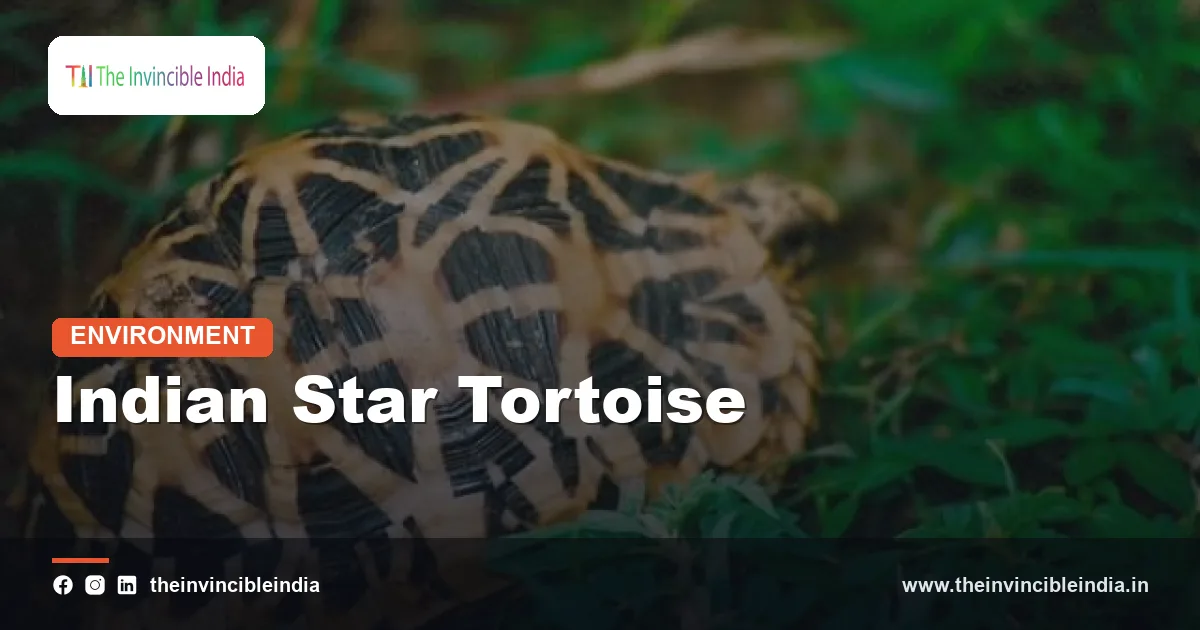
The Indian star tortoise (Geochelone elegans) is a medium-sized land tortoise named for the yellow, star-like lines that radiate across its high, domed shell, and it lives in the dry scrub, thorn forest and grasslands of India, Sri Lanka and Pakistan. The Indian star tortoise is one of the world’s most heavily trafficked reptiles because its patterned shell and small size make it a popular exotic pet, which led to its listing in Appendix I of CITES in 2019 and to Schedule I protection in India.
Indian star tortoise conservation therefore combines habitat protection with a fight against wildlife crime. Thousands of hatchlings are poached from the wild each year, smuggled through airports and sea routes, and sold abroad. This explainer describes the species, its range and ecological role, the pet trade that endangers it, the legal protections that now apply, and how seizures, repatriations and rescue centres are helping. Information was last reviewed on 14 October 2026.
| Attribute | Details |
|---|---|
| Scientific name | Geochelone elegans |
| Family | Testudinidae (land tortoises) |
| Shell length | Males about 15 to 25 cm; females larger, up to about 30 cm or more |
| Habitat | Dry scrub, thorn forest, semi-arid grassland, dry deciduous forest edges |
| Range | Western and peninsular India, southeastern and northern Sri Lanka, Sindh in Pakistan |
| Diet | Herbivore: grasses, leaves, flowers, fruit, fallen produce |
| International listing | CITES Appendix I since 2019 (earlier Appendix II) |
| Indian legal status | Schedule I, Wildlife (Protection) Act, 1972 (as amended in 2022) |
| Main threat | Illegal collection for the international pet trade |
Key Takeaways
- The Indian star tortoise (Geochelone elegans) is a land tortoise recognised by the radiating yellow star pattern on its domed black or brown shell.
- The Indian star tortoise lives in the dry scrub, thorn forest and grasslands of western and peninsular India, parts of Sri Lanka and parts of Pakistan.
- Illegal collection of hatchlings for the exotic pet trade is the most serious threat to the Indian star tortoise, with large numbers trafficked abroad every year.
- In 2019, CITES moved the Indian star tortoise from Appendix II to Appendix I, which prohibits international commercial trade in the species.
- The Indian star tortoise is protected in India under Schedule I of the Wildlife (Protection) Act, 1972, so capturing, keeping or selling it is a punishable offence.
- The Indian star tortoise feeds on fruit, flowers and grasses and helps to disperse seeds, which gives it a role in the health of dry-land ecosystems.
What is the Indian star tortoise?
The Indian star tortoise is a herbivorous land tortoise whose shell carries a pattern of yellow lines radiating from the centre of each dark plate, like a star. This pattern, which is the origin of the common name, is a form of camouflage that breaks up the outline of the tortoise among dry grass and shadows.
The carapace is strongly domed and often shows raised, pyramid-like plates called scutes. Females grow larger than males, reaching a shell length of roughly 25 to 30 centimetres, while males are smaller and have longer tails. Hatchlings measure only a few centimetres, which makes them easy to conceal and transport. In the wild, the Indian star tortoise can live for several decades.
Behaviour and daily life
Indian star tortoises are most active in the monsoon and the cooler parts of the day, and they shelter under bushes, in shallow burrows or in grass tussocks during hot afternoons. They are mostly solitary but are often seen close together during the rains, when food and mates are abundant. They are not aggressive animals and rely on their shell for defence.
Where does the Indian star tortoise live?
The Indian star tortoise lives in arid and semi-arid habitats across western and peninsular India, including parts of Gujarat, Rajasthan, Maharashtra, Karnataka, Andhra Pradesh, Telangana and Tamil Nadu, with populations in the rain-shadow areas of Kerala. Outside India, it occurs in the dry zones of Sri Lanka and in Sindh in Pakistan.
The preferred habitat includes thorn scrub, open dry deciduous forest, scrubby grassland and agricultural edges. The species avoids wet evergreen forest. A well-known pocket of habitat is the dry rain-shadow forest of Chinnar Wildlife Sanctuary in Kerala, and many other populations live in scrub patches outside protected areas. Because the tortoise often lives close to farms and village land, it is exposed to both conversion of land and local collection.
What does the Indian star tortoise eat and what role does it play?
The Indian star tortoise eats mostly grasses, herbs, leaves, flowers and fallen fruit, and in doing so it spreads seeds and returns nutrients to the soil. In dry ecosystems where fruit is scarce, a tortoise that swallows seeds and later excretes them far from the parent plant can be a useful seed disperser.
- Seed dispersal: Seeds in the droppings of tortoises can germinate in new places, helping scrub vegetation regenerate.
- Grazing: Slow, selective feeding on grasses and herbs affects plant community structure.
- Burrows and shelter: Shallow scrapes used for shade can be reused by small animals.
- Food web: Eggs and hatchlings are eaten by birds, mongooses, monitor lizards and other predators.
- Indicator value: A healthy star tortoise population suggests that dry scrub habitats are intact.
How does the Indian star tortoise breed?
The Indian star tortoise breeds mainly in the monsoon and post-monsoon season, when the female digs a shallow nest and lays a small clutch of hard-shelled eggs, usually fewer than ten. Incubation takes several months, and hatchlings often emerge around the next rainy season when food is plentiful.
Reproduction is slow. Tortoises take many years to reach maturity, females lay only a few eggs per year, and many nests are lost to predators, drought or farm activity. This slow reproductive pace means that populations recover only gradually when adult females or large numbers of hatchlings are removed. It is one reason why trafficking is so damaging to the species.
Why is the Indian star tortoise trafficked?
The Indian star tortoise is trafficked because its attractive star pattern, small size and docile nature make it a sought-after exotic pet, especially in parts of Southeast Asia, the Middle East, Europe and North America. Dealers can sell a single hatchling for a price far higher than a local poacher is paid, which makes the trade profitable.
Wildlife trade monitoring bodies have described the Indian star tortoise as among the most traded tortoises in the world. Poachers collect hatchlings and young adults from scrub and farmland, and they are held in sacks and boxes before being moved to cities and ports. Traffickers have also tried to conceal tortoises in luggage, parcels and cargo, and many animals die from stress, dehydration or poor conditions before reaching their destination.
Why captive breeding does not remove the problem
Some buyers assume that pet tortoises come from captive breeding. In practice, legal captive breeding can sometimes be used to launder wild-caught animals, and the pet market creates a steady demand that encourages poaching. Authorities and conservationists therefore treat the trade as a major enforcement challenge even when some animals are bred in captivity abroad.
What happened at CITES in 2019 for the Indian star tortoise?
In 2019, the Conference of the Parties to CITES, meeting in Geneva, agreed to move the Indian star tortoise from Appendix II to Appendix I, which prohibits international commercial trade in the species. The proposal was put forward by India together with Bangladesh and Sri Lanka, reflecting the shared range of the animal and shared concern at the scale of trafficking.
Before the uplisting, the species was in Appendix II, which allowed regulated international trade with permits. In practice, large volumes of tortoises were still moving illegally. Appendix I status removes the legal route for commercial export and makes it easier for customs and wildlife authorities to treat any international shipment as a serious violation. The CITES decision does not stop trafficking by itself, but it strengthens the legal framework for seizures and prosecutions.
| Year or period | Development |
|---|---|
| 1972 | India enacts the Wildlife (Protection) Act, giving statutory protection to listed species |
| 1975 | The species is covered by CITES Appendix II regulating international trade |
| Decades of trade | Large-scale poaching and smuggling for the exotic pet market |
| 2019 | CITES CoP18 in Geneva moves the Indian star tortoise to Appendix I |
| 2022 amendment | Amended Wildlife (Protection) Act places the species in Schedule I |
How is the Indian star tortoise protected under Indian law?
The Indian star tortoise is protected in India under the Wildlife (Protection) Act, 1972, and following the 2022 amendment it is placed in Schedule I, which provides the strictest level of protection and the heaviest penalties. Hunting, capturing, possessing, selling or transporting the tortoise without authorisation is an offence.
The law is supported by the Wildlife Crime Control Bureau (WCCB), a statutory body under the Ministry of Environment, Forest and Climate Change, which coordinates enforcement against wildlife trafficking with customs, police, state forest departments and the Railway Protection Force. The Indian rules on import and export also require permits for any scheduled species. Keeping a star tortoise as a pet, even if it was bought in good faith, can be illegal, and people are encouraged to hand over any tortoise they have to the forest department.
What are seizures and repatriations of Indian star tortoises?
Seizures of Indian star tortoises occur when customs, police or forest officers intercept animals being smuggled, and repatriations occur when seized tortoises found abroad are returned to India. Airports and ports in cities such as Chennai, Mumbai, Hyderabad and Bengaluru, along with road routes in the southern and western states, are known locations for interceptions.
Seizures sometimes involve hundreds of animals in a single consignment, packed in luggage or cartons. Many of the tortoises have been found in poor health. After a seizure, officials must decide what to do with the animals. Because tortoises of uncertain origin could carry diseases or belong to different genetic stocks, they are not always released straight back to the wild. They may instead be treated and checked at rescue centres and released into suitable habitats where the species naturally occurs.
India has also worked with authorities in Southeast Asian and other countries to arrange the return of tortoises seized overseas, and such cases show the international reach of the trade. International cooperation under CITES and information sharing between enforcement agencies are central to catching trafficking networks rather than only couriers.
How is the Indian star tortoise being conserved?
Conservation of the Indian star tortoise relies on habitat protection, stricter enforcement, rescue and rehabilitation, community engagement and reduction of demand. Because the animal lives largely outside strictly protected areas, conservation must also involve the villagers who share the land.
- Enforcement: Tighter checks at airports, railways, ports and roads, and prosecution of trafficking networks.
- Rescue centres: Veterinary care, quarantine and release of seized animals where the species naturally occurs.
- Habitat protection: Safeguarding dry scrub and grassland from conversion and from fires that can kill tortoises.
- Community involvement: Engaging local people, including tribal and farming communities, as guardians and informants.
- Research and monitoring: Surveys to estimate populations and genetic studies to identify the origin of seized animals.
- Demand reduction: Public awareness that buying star tortoises, even as pets, supports the trade.
What is the conservation status of the Indian star tortoise?
The Indian star tortoise is considered a threatened species, assessed by the International Union for Conservation of Nature (IUCN) as Vulnerable, with a decreasing population trend because of collection from the wild. Exact numbers are not known, but surveys in several areas have recorded sharp local declines.
The combination of a slow breeding rate, strong demand and the loss of dry-land habitat explains why the species is a conservation priority. The scale of the problem is illustrated by the many individual seizures reported in the news, which probably represent only a fraction of the animals actually removed from the wild. If current pressures are not reduced, local populations in intensively farmed or accessible areas may continue to disappear.
Bottom Line
The Indian star tortoise is an easily recognised herbivore of India’s dry scrub and grasslands, and it is now both highly protected and highly threatened. Its CITES Appendix I listing in 2019 and Schedule I protection in India give strong legal backing, but only enforcement, habitat protection and a fall in pet demand can secure its future.
Frequently Asked Questions
Why is it called the Indian star tortoise?
The Indian star tortoise is called so because the yellow lines on each plate of its shell radiate outward like the rays of a star. The pattern gives camouflage in dry grass. The species also occurs in Sri Lanka and Pakistan.
Is it legal to keep an Indian star tortoise as a pet in India?
No, keeping an Indian star tortoise as a pet is not legal without authorisation, because it is protected under Schedule I of the Wildlife (Protection) Act, 1972. Capturing, buying, selling or possessing the tortoise can lead to prosecution. People who own one are encouraged to inform the state forest department.
What did CITES decide about the Indian star tortoise in 2019?
At its 2019 meeting in Geneva, CITES moved the Indian star tortoise from Appendix II to Appendix I. This bans international commercial trade in the species. India, Bangladesh and Sri Lanka had proposed the change because of heavy illegal trade.
Where do Indian star tortoises live?
Indian star tortoises live in the dry scrub, thorn forest and grasslands of western and peninsular India, and also in parts of Sri Lanka and Pakistan. They are found in states such as Gujarat, Rajasthan, Maharashtra, Karnataka, Andhra Pradesh and Tamil Nadu. They avoid wet evergreen forests.
What do Indian star tortoises eat?
Indian star tortoises are herbivores that eat grasses, leaves, flowers and fallen fruit. They also eat some succulent plants. By eating fruit and passing seeds, they help spread plants in dry habitats.
What is the biggest threat to the Indian star tortoise?
The biggest threat to the Indian star tortoise is illegal collection for the international pet trade. Poachers take large numbers of hatchlings and juveniles from the wild. Habitat loss and slow reproduction make it harder for populations to recover.
{“@context”:”https://schema.org”,”@graph”:[{“@type”:”FAQPage”,”mainEntity”:[{“@type”:”Question”,”name”:”Why is it called the Indian star tortoise?”,”acceptedAnswer”:{“@type”:”Answer”,”text”:”The Indian star tortoise is called so because the yellow lines on each plate of its shell radiate outward like the rays of a star. The pattern gives camouflage in dry grass. The species also occurs in Sri Lanka and Pakistan.”}},{“@type”:”Question”,”name”:”Is it legal to keep an Indian star tortoise as a pet in India?”,”acceptedAnswer”:{“@type”:”Answer”,”text”:”No, keeping an Indian star tortoise as a pet is not legal without authorisation, because it is protected under Schedule I of the Wildlife (Protection) Act, 1972. Capturing, buying, selling or possessing the tortoise can lead to prosecution. People who own one are encouraged to inform the state forest department.”}},{“@type”:”Question”,”name”:”What did CITES decide about the Indian star tortoise in 2019?”,”acceptedAnswer”:{“@type”:”Answer”,”text”:”At its 2019 meeting in Geneva, CITES moved the Indian star tortoise from Appendix II to Appendix I. This bans international commercial trade in the species. India, Bangladesh and Sri Lanka had proposed the change because of heavy illegal trade.”}},{“@type”:”Question”,”name”:”Where do Indian star tortoises live?”,”acceptedAnswer”:{“@type”:”Answer”,”text”:”Indian star tortoises live in the dry scrub, thorn forest and grasslands of western and peninsular India, and also in parts of Sri Lanka and Pakistan. They are found in states such as Gujarat, Rajasthan, Maharashtra, Karnataka, Andhra Pradesh and Tamil Nadu. They avoid wet evergreen forests.”}},{“@type”:”Question”,”name”:”What do Indian star tortoises eat?”,”acceptedAnswer”:{“@type”:”Answer”,”text”:”Indian star tortoises are herbivores that eat grasses, leaves, flowers and fallen fruit. They also eat some succulent plants. By eating fruit and passing seeds, they help spread plants in dry habitats.”}},{“@type”:”Question”,”name”:”What is the biggest threat to the Indian star tortoise?”,”acceptedAnswer”:{“@type”:”Answer”,”text”:”The biggest threat to the Indian star tortoise is illegal collection for the international pet trade. Poachers take large numbers of hatchlings and juveniles from the wild. Habitat loss and slow reproduction make it harder for populations to recover.”}}]}]}


