

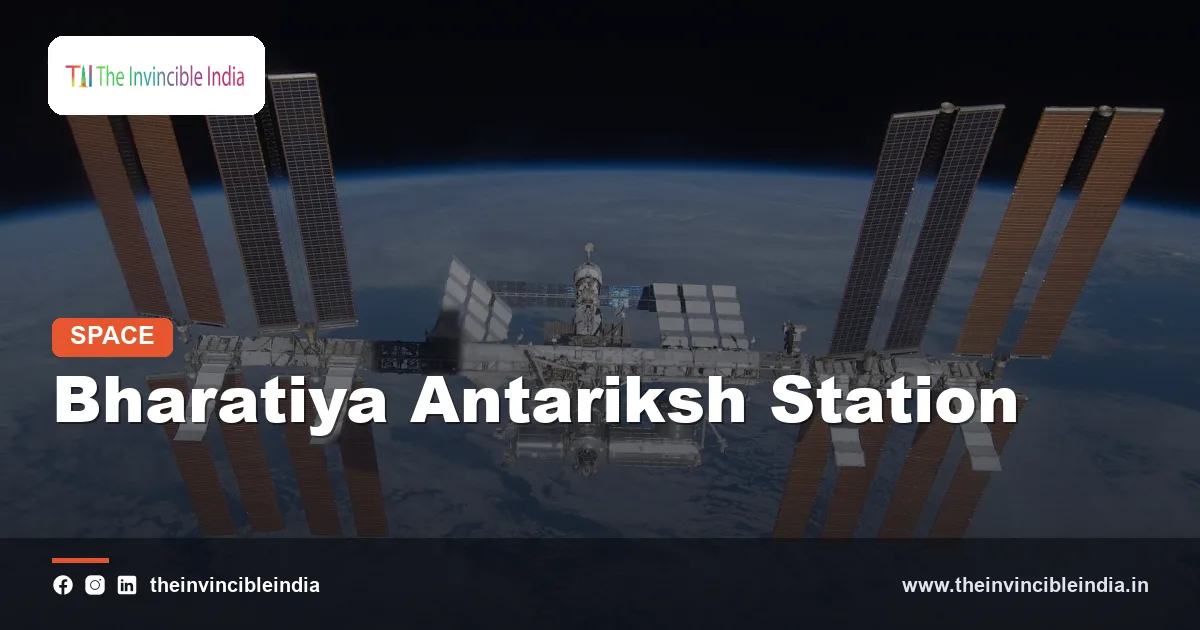
The Bharatiya Antariksh Station (BAS), meaning the Indian Space Station, is a planned modular space station that the Indian Space Research Organisation (ISRO) intends to place in low Earth orbit for microgravity research and long-duration human spaceflight. The station is under development and has not yet been launched; India has announced a goal of putting its first module in orbit in the late 2020s and completing the full station by around 2035.
The Bharatiya Antariksh Station follows the Gaganyaan human spaceflight programme and relies on technologies such as crew modules, life support, rendezvous and docking. It is intended to give India an independent, long-term crewed presence in space, similar in purpose to the International Space Station (ISS) and China’s Tiangong, though smaller in scale.
| Attribute | Details |
|---|---|
| Name | Bharatiya Antariksh Station (BAS), the Indian Space Station |
| Status | Planned and under development; no module in orbit yet |
| Lead agency | Indian Space Research Organisation (ISRO), under the Department of Space |
| Announced | 2024, as a long-term goal following Gaganyaan |
| Orbit | Low Earth orbit (roughly 400 km altitude) |
| First module target | Late 2020s |
| Full assembly target | Around 2035 |
| Design | Modular, assembled in orbit from several modules |
| Predecessor programmes | Gaganyaan (human spaceflight), SpaDeX (docking demonstration) |
Key Takeaways
- The Bharatiya Antariksh Station is India’s planned space station, which is under development by the Indian Space Research Organisation (ISRO) and has not yet been launched.
- India has set a target of launching the first Bharatiya Antariksh Station module in the late 2020s and completing the full multi-module station by around 2035.
- The Bharatiya Antariksh Station is meant to operate in low Earth orbit and to support microgravity experiments, technology demonstrations and crewed missions.
- The Bharatiya Antariksh Station builds on the Gaganyaan human spaceflight programme, which develops India’s crew vehicle, life support and astronaut training.
- The SpaDeX mission, which demonstrated in-orbit docking of two Indian satellites in January 2025, supplied a capability that is essential to assembling a modular space station.
- If completed, the Bharatiya Antariksh Station would make India one of a small number of countries to operate its own crewed space station, alongside the United States-led International Space Station partnership and China.
What is the Bharatiya Antariksh Station?
The Bharatiya Antariksh Station is a proposed Indian crewed orbital laboratory, to be built by ISRO as a set of modules that would be launched separately and joined together in space. The name is Hindi for the Indian Space Station, and it is commonly shortened to BAS.
Unlike a single satellite, a space station is a long-term, habitable facility in orbit where astronauts can live and work for weeks or months. It provides power, air, water, thermal control and communications, and it hosts experiments that cannot be done on Earth because of gravity.
India’s plan is for a station considerably smaller than the ISS, built from several modules. ISRO has publicly described a modest first stage, in which an early module would be put into orbit and tested, followed by further modules that add living space, laboratories and support systems. Exact masses, crew capacity and module designs may change as the project advances.
Since the station is still in the planning and development phase, all dates and configurations are targets rather than commitments, and space programmes frequently adjust their schedules.
When and how was the Bharatiya Antariksh Station announced?
The Bharatiya Antariksh Station was announced as a national goal in 2024, when the Government of India approved the development of its first module as an extension of the Gaganyaan programme. The announcement followed several years of statements from ISRO and the government about long-term ambitions in human spaceflight.
In 2023, India set out a vision of having its own space station by 2035 and of landing an Indian astronaut on the Moon by 2040. In September 2024, the Union Cabinet approved the development of the first unit of the station, known as BAS-1, along with a revised and expanded Gaganyaan programme that includes additional missions.
The timeline can be summarised as follows.
| Year | Development |
|---|---|
| 2018 | India announces the Gaganyaan human spaceflight programme |
| 2023 | Government outlines the goal of a national space station by 2035 and a crewed Moon landing by 2040 |
| 2024 | Union Cabinet approves development of BAS-1 and an expanded Gaganyaan programme |
| 2025 | SpaDeX demonstrates in-orbit docking |
| Late 2020s | Target for launching the first module (BAS-1) |
| Around 2035 | Target for completing the full station |
All dates after the announcement remain targets. Readers should treat them as the stated plan and not as confirmed events.
What is the purpose of the Bharatiya Antariksh Station?
The purpose of the Bharatiya Antariksh Station is to provide India with a permanent orbital platform for microgravity research, technology development and human spaceflight experience. The station is expected to serve scientific, technological and strategic goals.
The main intended uses are:
- Microgravity research: Experiments in materials science, fluid physics, combustion and pharmaceuticals, where gravity affects results on Earth.
- Life sciences: Studies of how the human body, plants and microbes behave in space, which are needed for longer missions.
- Technology testing: A place to test life-support, robotics, thermal control, power systems and other equipment in real space conditions.
- Astronaut training and operations: Experience of long-duration stays, in-orbit maintenance and crew rotation.
- Industry and academic participation: Opportunities for Indian universities, start-ups and private companies to fly experiments.
The station is also meant to be a stepping stone. Experience in long-duration crewed flight in low Earth orbit is considered a prerequisite for more ambitious goals such as crewed lunar missions.
How does the Gaganyaan programme lead to the Bharatiya Antariksh Station?
The Gaganyaan programme leads to the Bharatiya Antariksh Station because it develops the basic capabilities needed for any crewed space mission: a human-rated launch vehicle, a crew module, a life support system and a trained astronaut corps. The Bharatiya Antariksh Station can then be seen as the next step in the same sequence.
Gaganyaan is ISRO’s programme to send a crew of astronauts to low Earth orbit, at roughly 400 kilometres, and return them safely to Earth. It uses the LVM3 launch vehicle, adapted for human spaceflight, together with a crew module and a service module. Before any crewed flight, ISRO has planned a series of uncrewed test flights and abort tests, including a test of the crew escape system in 2023.
India’s astronaut corps includes a small group of test pilots selected from the Indian Air Force, who trained in Russia and in India. In 2025, one of these astronauts, Group Captain Shubhanshu Shukla, travelled to the International Space Station on a commercial mission, becoming the first Indian to visit the ISS. Earlier, Rakesh Sharma flew to the Soviet Salyut 7 station in 1984. These experiences supply operational knowledge to Indian planners.
The crewed Gaganyaan flights are targeted for the late 2020s after the uncrewed missions, and the schedule has shifted more than once. The Bharatiya Antariksh Station plan depends on these missions succeeding first.
What role does SpaDeX docking technology play?
SpaDeX, short for Space Docking Experiment, plays a central role because docking, the process of joining two spacecraft in orbit, is essential for building and servicing a modular space station. ISRO launched the SpaDeX mission in December 2024 on a Polar Satellite Launch Vehicle (PSLV) with two small satellites, a chaser and a target.
The two satellites carried out a rendezvous and docking in January 2025, which made India the fourth country to demonstrate this capability, after the United States, the Soviet Union or Russia, and China. The mission also tested transfer of electrical power between the docked spacecraft and later undocking.
Why docking matters for a space station
- Modules are launched separately and must join with precision in orbit.
- Crew and cargo spacecraft need to dock with the station for visits and resupply.
- A station needs a standard docking interface so that different vehicles can connect.
- Docking allows repair, replacement and growth of the station over time.
ISRO developed its own docking mechanism for SpaDeX, which gives India an indigenous interface standard that can be adapted for crewed vehicles and station modules. Further docking tests with larger spacecraft are expected before the first station module flies.
What will the station look like and how will it be built?
The Bharatiya Antariksh Station is planned as a modular station built in stages, with the first module launched and tested before further modules are added. ISRO has indicated that the full station would consist of several modules, with a total mass much smaller than the ISS.
Reports from ISRO suggest an initial module with a mass of around twenty tonnes, a full station of the order of fifty tonnes, and an orbital altitude near 400 kilometres. These are indicative figures that may change as the design matures, and they should not be read as final specifications.
A typical modular station includes several functional elements, which are likely to be reflected in the Indian design:
- A core module with living quarters, control systems and life support
- Laboratory modules for science and technology experiments
- Power generation through large solar arrays
- Docking ports for crew vehicles and cargo vehicles
- Thermal control, communications and navigation systems
The modules would be launched on Indian rockets such as the LVM3, and the programme also envisages a more powerful next-generation launch vehicle for heavier payloads. The station would be assembled in orbit by docking, and astronauts would visit in crewed Gaganyaan-type spacecraft.
How does the Bharatiya Antariksh Station compare with the ISS and Tiangong?
The Bharatiya Antariksh Station is planned to be much smaller than the International Space Station and broadly comparable to China’s Tiangong station in scale, though its eventual configuration is not final. The ISS is the largest structure ever built in space, assembled by a partnership of the United States, Russia, Europe, Japan and Canada beginning in 1998.
| Feature | International Space Station (ISS) | Tiangong (China) | Bharatiya Antariksh Station (planned) |
|---|---|---|---|
| Operators | International partnership led by NASA and Roscosmos | China Manned Space Agency | ISRO (India) |
| First module launched | 1998 | 2021 | Targeted late 2020s |
| Status | Operating; retirement planned around 2030 | Operating | Under development |
| Scale | Very large, multi-nation | Compact, multi-module | Planned modest, multi-module |
| Orbit | Low Earth orbit | Low Earth orbit | Low Earth orbit (about 400 km) |
The planned retirement of the ISS around 2030, a date that is itself subject to change, has led several countries and companies to plan new stations. India’s project fits this broader trend of national and commercial stations in low Earth orbit.
What are the challenges and risks?
The Bharatiya Antariksh Station faces substantial technical, financial and schedule challenges, as any new crewed space station programme would. Building a station requires reliable human-rated launches, long-lived life support, safe docking, and the ability to supply and repair the station over many years.
Among the main challenges are:
- Human safety: Crewed systems require extremely high reliability, extensive testing and abort provisions.
- Life support: Recycling air and water for long missions is complex, and India must mature these systems.
- Launch capacity: Heavier modules and a regular crew and cargo schedule need dependable launch vehicles.
- Cost and schedule: Space projects often slip, and funding must be sustained over a decade or more.
- Space debris and radiation: A station must be protected from debris impacts and radiation exposure.
Observers also note that success depends on the pace of Gaganyaan. If crewed flights are delayed, the station schedule may also move. Government support, private industry participation and international cooperation could help address some of these risks.
What is the wider significance for India?
The wider significance of the Bharatiya Antariksh Station for India lies in strategic autonomy, scientific capability and technological spin-offs. A national space station would give India an independent platform in orbit, not dependent on access to other countries’ facilities.
India’s space programme began in the 1960s and was formalised with ISRO’s founding in 1969. It has since built a reputation for cost-efficient missions, including Chandrayaan lunar missions, the Mars Orbiter Mission and the Aditya-L1 solar observatory. A crewed station would extend that record into long-duration human spaceflight.
The programme is also expected to involve the growing Indian private space sector, supported by the regulator IN-SPACe, which authorises and promotes non-government space activities. Start-ups and industry partners may supply components, services or experiments.
The station could also support international cooperation. India has worked with space agencies in the United States, France, Russia and others, and a station could host foreign payloads or crew under future agreements, though no such arrangements should be assumed until they are announced.
Bottom Line
The Bharatiya Antariksh Station is India’s planned, still-in-development space station, with a first module targeted for the late 2020s and full assembly around 2035. It builds on Gaganyaan and the SpaDeX docking success, and its realisation will depend on steady progress in crewed flight, launch capacity and funding.
Frequently Asked Questions
What is the Bharatiya Antariksh Station?
The Bharatiya Antariksh Station is India’s planned modular space station, to be built by ISRO in low Earth orbit. It is intended for microgravity research and long-duration human spaceflight, and it is still under development.
When will the Bharatiya Antariksh Station be launched?
India’s stated plan is to launch the first module in the late 2020s and complete the full station around 2035. These are targets, and the schedule may change as the Gaganyaan programme and station design progress.
Has India already built a space station?
No, India has not yet launched any module of its space station. The Bharatiya Antariksh Station is in the planning and development phase, following government approval in 2024 for the first module.
How is the Bharatiya Antariksh Station related to Gaganyaan?
The station builds on Gaganyaan, which develops India’s crewed launch system, crew module, life support and astronaut training. Gaganyaan must succeed first so that astronauts can be sent to and returned from a future station.
What is SpaDeX and why does it matter for the space station?
SpaDeX, the Space Docking Experiment, is an ISRO mission that demonstrated docking of two satellites in orbit in January 2025. Docking is essential for assembling a modular station and for visits by crew and cargo vehicles, so SpaDeX supplies a key technology.
How does India’s planned space station differ from the ISS?
India’s planned station is expected to be much smaller than the International Space Station and operated by a single nation. The ISS is a multinational facility that has been in orbit since 1998, whereas the Bharatiya Antariksh Station is still being developed.
{“@context”:”https://schema.org”,”@graph”:[{“@type”:”FAQPage”,”mainEntity”:[{“@type”:”Question”,”name”:”What is the Bharatiya Antariksh Station?”,”acceptedAnswer”:{“@type”:”Answer”,”text”:”The Bharatiya Antariksh Station is India’s planned modular space station, to be built by ISRO in low Earth orbit. It is intended for microgravity research and long-duration human spaceflight, and it is still under development.”}},{“@type”:”Question”,”name”:”When will the Bharatiya Antariksh Station be launched?”,”acceptedAnswer”:{“@type”:”Answer”,”text”:”India’s stated plan is to launch the first module in the late 2020s and complete the full station around 2035. These are targets, and the schedule may change as the Gaganyaan programme and station design progress.”}},{“@type”:”Question”,”name”:”Has India already built a space station?”,”acceptedAnswer”:{“@type”:”Answer”,”text”:”No, India has not yet launched any module of its space station. The Bharatiya Antariksh Station is in the planning and development phase, following government approval in 2024 for the first module.”}},{“@type”:”Question”,”name”:”How is the Bharatiya Antariksh Station related to Gaganyaan?”,”acceptedAnswer”:{“@type”:”Answer”,”text”:”The station builds on Gaganyaan, which develops India’s crewed launch system, crew module, life support and astronaut training. Gaganyaan must succeed first so that astronauts can be sent to and returned from a future station.”}},{“@type”:”Question”,”name”:”What is SpaDeX and why does it matter for the space station?”,”acceptedAnswer”:{“@type”:”Answer”,”text”:”SpaDeX, the Space Docking Experiment, is an ISRO mission that demonstrated docking of two satellites in orbit in January 2025. Docking is essential for assembling a modular station and for visits by crew and cargo vehicles, so SpaDeX supplies a key technology.”}},{“@type”:”Question”,”name”:”How does India’s planned space station differ from the ISS?”,”acceptedAnswer”:{“@type”:”Answer”,”text”:”India’s planned station is expected to be much smaller than the International Space Station and operated by a single nation. The ISS is a multinational facility that has been in orbit since 1998, whereas the Bharatiya Antariksh Station is still being developed.”}}]}]}


