

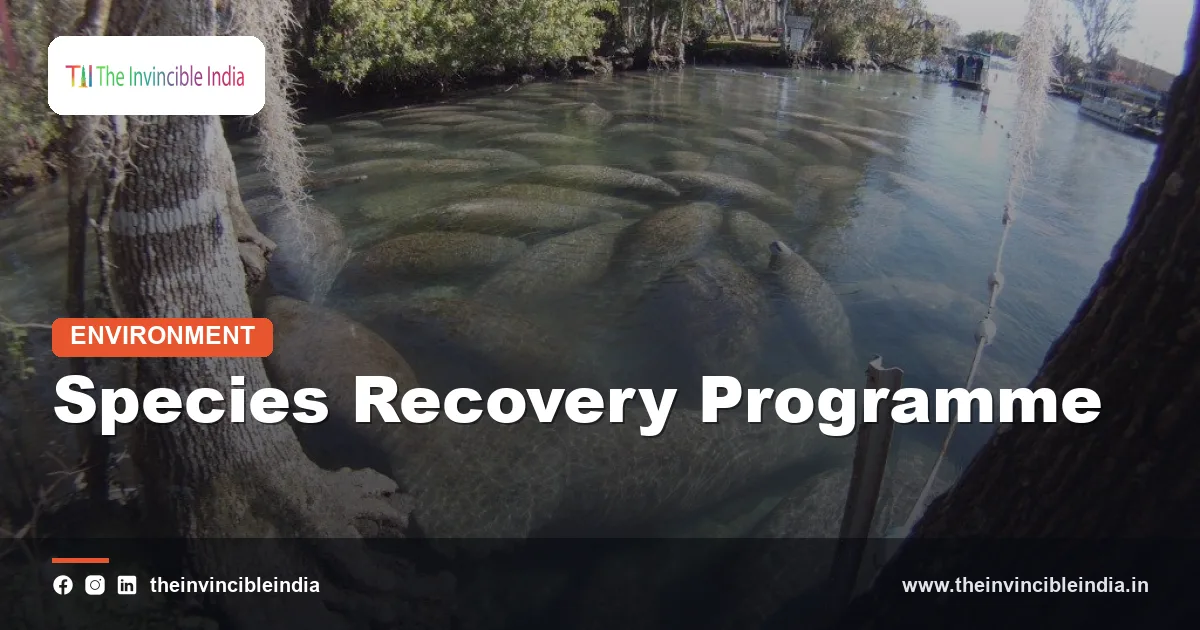
India’s species recovery programme is the component of the centrally sponsored Integrated Development of Wildlife Habitats (IDWH) scheme that gives dedicated funding and technical support to the recovery of critically endangered species and habitats, through targeted work such as habitat restoration, conservation breeding and scientific monitoring. The programme is run by the Ministry of Environment, Forest and Climate Change (MoEFCC) and carried out mainly by State and Union Territory forest departments, with technical backing from institutions such as the Wildlife Institute of India (WII).
Instead of spreading money thinly across all wildlife, the species recovery programme concentrates on a defined list of species that are on the brink, including the Great Indian Bustard, the dugong, the Manipur brow-antlered deer (sangai), the hangul, the Nilgiri tahr, vultures, the Gangetic dolphin and marine turtles. It complements flagship efforts such as Project Tiger and Project Elephant, which have their own dedicated schemes.
| Attribute | Detail |
|---|---|
| Full name | Recovery of Critically Endangered Species (a component of IDWH) |
| Parent scheme | Integrated Development of Wildlife Habitats (IDWH) |
| Scheme type | Centrally sponsored scheme |
| Nodal ministry | Ministry of Environment, Forest and Climate Change (MoEFCC) |
| Implementing agencies | State and Union Territory forest departments, with technical help from WII, BNHS and research institutions |
| Other IDWH components | Support to protected areas; protection of wildlife outside protected areas |
| Approach | Habitat improvement, conservation breeding, monitoring, community involvement |
| Legal backbone | Wildlife (Protection) Act, 1972 |
Key Takeaways
- The species recovery programme is one of the three components of the Integrated Development of Wildlife Habitats (IDWH), a centrally sponsored scheme of the Ministry of Environment, Forest and Climate Change.
- The programme targets a priority list of critically endangered or severely threatened species, including the Great Indian Bustard, dugong, sangai, hangul, Nilgiri tahr, vultures, Gangetic dolphin and marine turtles.
- Each species gets a species-specific recovery plan that combines habitat protection, scientific monitoring, conservation breeding where needed, and community engagement.
- State forest departments implement the plans on the ground, while institutions such as the Wildlife Institute of India provide scientific guidance and training.
- Results are mixed but real: vulture breeding centres and a ban on the veterinary painkiller diclofenac have helped stabilise vultures, and conservation breeding of the Great Indian Bustard has started to produce chicks in captivity.
- The programme is a complement to, and not a replacement for, species-specific schemes such as Project Tiger and Project Elephant.
What is India’s species recovery programme?
India’s species recovery programme is a government funding and planning mechanism that supports the revival of species whose populations are so low that ordinary protected-area management is not enough. It sits inside the Integrated Development of Wildlife Habitats scheme and pays for activities that are tailored to each species, such as captive breeding, nest protection, habitat enrichment and reintroduction.
The idea behind the programme is simple. A species with only a few hundred, or even a few dozen, individuals cannot be saved only by guarding a forest. It needs a plan with measurable targets, a named lead agency, trained staff and dedicated money. The programme therefore asks each State to prepare a recovery plan for a priority species, get it approved at the national level and then implement it.
How does the Integrated Development of Wildlife Habitats scheme work?
The Integrated Development of Wildlife Habitats scheme works by funding three broad kinds of work: support to national parks and sanctuaries, protection of wildlife outside protected areas, and recovery of critically endangered species. The scheme is centrally sponsored, which means the Union government provides a major share of the funds and the States implement the work and often contribute a share.
- Support to protected areas: Funds for staff, patrolling, infrastructure, fire control, water sources and habitat management in national parks, wildlife sanctuaries, conservation reserves and community reserves.
- Protection of wildlife outside protected areas: Support for habitats such as grasslands, wetlands, coasts and corridors that lie outside formal reserves but are home to wildlife.
- Recovery of critically endangered species: Species-specific programmes for animals and plants that need emergency intervention.
Over time, the scheme has been folded into a broader umbrella of wildlife habitat development, along with the dedicated tiger and elephant schemes, to simplify funding.
Which species are covered under the recovery programme?
The recovery programme covers a list of around twenty species and groups, which has been revised over time and includes birds, mammals, reptiles, aquatic animals and sea creatures. The list is chosen by the Ministry on the basis of the severity of the threat, and it can be updated as new information emerges.
| Species | Main region or habitat | Key recovery focus |
|---|---|---|
| Great Indian Bustard | Rajasthan, Gujarat and other semi-arid grasslands | Conservation breeding, protected enclosures, power-line mitigation |
| Dugong (sea cow) | Gulf of Mannar, Palk Bay, Andaman and Nicobar Islands, Gulf of Kutch | Seagrass restoration, fishing-net regulation |
| Manipur brow-antlered deer (sangai) | Keibul Lamjao, Manipur | Floating-meadow habitat protection, second-home planning |
| Hangul (Kashmir stag) | Dachigam, Jammu and Kashmir | Habitat protection, breeding, monitoring |
| Nilgiri tahr | Western Ghats | Habitat protection, surveys, translocation |
| Vultures | Across India | Ban on toxic drugs, captive breeding, safe feeding sites |
| Gangetic river dolphin | Ganga and Brahmaputra river systems | River-flow protection, fisheries bycatch reduction |
| Marine turtles | Odisha, Tamil Nadu, Andaman and Nicobar coasts | Nesting beach protection, turtle excluder devices |
The longer list has also included species such as the snow leopard, Asiatic wild buffalo, Asiatic lion, Indian rhinoceros, swamp deer, Bengal florican, Jerdon’s courser, clouded leopard, Nicobar megapode, edible-nest swiftlet, Malabar civet and the northern river terrapin, depending on the revision of the list.
How does a species recovery plan work?
A species recovery plan works by first assessing why a species is declining, then setting numerical goals and assigning specific activities, responsible agencies and timelines to reach them. The plan is drawn up with scientists, State forest departments and, increasingly, local communities who live in the species’ habitat.
Step 1: Assess the threats
Scientists survey the species to establish how many individuals remain, where they live and what is killing them or limiting their breeding. For vultures, this meant identifying a veterinary drug as the cause. For the Great Indian Bustard, it meant studying collisions with overhead power lines and loss of grassland.
Step 2: Protect and restore habitat
The plan sets out measures such as fencing breeding areas, managing grasslands, restoring wetlands and seagrass beds, and regulating activities that harm the habitat.
Step 3: Breed in captivity where needed
For species too depleted to recover unaided, the programme supports conservation breeding centres. These centres produce young animals that can later be released into protected habitat, and they act as an insurance population.
Step 4: Monitor and adapt
Regular surveys, camera traps, satellite or radio tags and genetic studies measure progress, so that plans can be adjusted if a measure is not working.
Step 5: Involve local communities
Local people are trained as watchers, guides or nest protectors, and awareness programmes reduce hunting and accidental harm.
How has the programme helped the Great Indian Bustard?
The programme has helped the Great Indian Bustard (GIB) mainly by funding conservation breeding and by protecting the grassland sites where the bird survives. The Great Indian Bustard is a large ground-nesting bird that is critically endangered, with the remaining population concentrated in the Thar desert region of Rajasthan and in small groups in Gujarat and a few other States.
Conservation breeding centres in Jaisalmer in Rajasthan, run by the State forest department with the Wildlife Institute of India, collect eggs from the wild, hatch them safely and raise chicks in a protected environment. These centres have reported successful hatchings since 2019, which creates a captive insurance population that could be used to support wild numbers.
Collision with high-tension power lines remains a major cause of death for the bird, so measures such as marking or undergrounding of lines are an important part of the effort, together with protection of the open grassland that the bird needs for nesting.
What has been done for vultures, dolphins, turtles and other species?
For vultures, dolphins, turtles and other species, the programme combines species-specific measures with wider habitat protection. These measures differ because each species faces a different threat.
- Vultures: India’s vulture population crashed by more than ninety percent in the 1990s and 2000s after livestock were treated with the painkiller diclofenac. The drug’s veterinary use was banned in 2006, and vulture conservation breeding centres, including those at Pinjore in Haryana, were set up with support from the Bombay Natural History Society (BNHS) and State governments. Safe vulture feeding sites and checks on other harmful drugs continue.
- Gangetic dolphin: The Gangetic river dolphin was declared India’s National Aquatic Animal in 2009. Conservation focuses on keeping river flow adequate, reducing accidental entanglement in fishing nets, and monitoring populations in the Ganga and Brahmaputra systems.
- Marine turtles: Nesting beaches along the Odisha, Andhra Pradesh, Tamil Nadu and island coasts are protected, hatcheries are managed, and the use of turtle excluder devices on trawl nets is encouraged to reduce drowning.
- Dugong: The dugong, a seagrass-eating marine mammal, benefits from protection of seagrass meadows in the Gulf of Mannar and Palk Bay, and from regulation of fishing gear.
- Sangai: The brow-antlered deer of Manipur survives on the floating “phumdi” meadows of Keibul Lamjao National Park, and the plan aims to keep these habitats healthy and to identify an additional home to reduce risk.
- Hangul: The Kashmir stag, restricted to the Dachigam landscape, receives habitat protection, monitoring and breeding support.
- Nilgiri tahr: This mountain goat of the Western Ghats benefits from habitat protection and population surveys.
Who funds and runs the species recovery programme?
The species recovery programme is funded mainly by the Government of India through the Ministry of Environment, Forest and Climate Change and run by State forest departments and designated expert institutions. The Ministry approves the annual plans of operation, releases the funds and monitors progress, while the States do the field work.
Technical support comes from bodies such as the Wildlife Institute of India in Dehradun, the Bombay Natural History Society, the Zoological Survey of India and the Central Zoo Authority, which oversees breeding in zoos. Universities, non-governmental organisations and local communities add scientific data and field presence.
The funding pattern, in which the Union government bears a larger share for some States and for special-category regions, is designed to make sure that poorer or ecologically sensitive States can implement the plans.
What are the results and limitations of the programme?
The programme has produced real progress for some species and limited progress for others, because species recovery is slow, uncertain and dependent on factors beyond the control of forest departments. Success stories include the stabilisation of vulture numbers after the diclofenac ban and the start of captive breeding for the Great Indian Bustard.
Limitations are also evident. Some species have seen continued declines, partly because their threats, such as power lines, fishing nets, development projects and habitat conversion, lie outside the forest department’s control. Captive breeding is slow, and releasing animals back into the wild is difficult. Limited monitoring data can also make it hard to measure success accurately.
- Strengths: Clear targets for each species, dedicated money, expert involvement and a focus on underfunded species.
- Challenges: Coordination across departments, long timelines, threats from infrastructure and the need for sustained funding.
- Way forward: Stronger links with power, fisheries and veterinary authorities, better data, and wider community participation.
Why does the species recovery programme matter?
The species recovery programme matters because many of India’s most threatened animals do not live in tiger reserves and so would not benefit from the large flagship schemes. Grassland birds, river dolphins, marine mammals and mountain ungulates need specialised attention, and the programme gives them a place in national planning.
The programme also supports India’s international commitments to conserve biological diversity and to prevent extinctions, and it provides a framework in which new species can be added as threats change. Recovering a species typically also protects the broader habitat that it shares with other wildlife, so the benefits spread across ecosystems.
Bottom Line
India’s species recovery programme gives targeted, funded and science-based help to species that are close to extinction, from the Great Indian Bustard to the Gangetic dolphin. Its success depends on tackling the specific threat to each species and on coordination beyond the forest department, and it remains a vital safety net for India’s most vulnerable wildlife.
Frequently Asked Questions
What is the species recovery programme in India?
The species recovery programme is the component of the Integrated Development of Wildlife Habitats (IDWH) scheme that funds focused recovery of critically endangered species. It is run by the Ministry of Environment, Forest and Climate Change and implemented by State forest departments.
Which species are included in the recovery programme?
The list includes the Great Indian Bustard, dugong, Manipur brow-antlered deer (sangai), hangul, Nilgiri tahr, vultures, Gangetic dolphin and marine turtles, along with several other species. The list has been revised over time as the status of species has changed.
What does the programme actually fund?
The programme funds habitat improvement, conservation breeding, protection and monitoring, along with training and community awareness. Each species has its own recovery plan with specific activities and targets.
Is the species recovery programme the same as Project Tiger?
No, the species recovery programme is separate from Project Tiger, which is a dedicated scheme for tigers and their habitats. The recovery programme focuses on other critically endangered species that need targeted help.
Has the programme been successful?
The programme has had partial success. Vulture numbers have stabilised after a ban on the drug diclofenac and breeding efforts, and conservation breeding of the Great Indian Bustard has begun to produce chicks, but several species remain under severe pressure.
Who implements the species recovery programme on the ground?
State and Union Territory forest departments implement the programme on the ground. Institutions such as the Wildlife Institute of India, the Bombay Natural History Society and the Central Zoo Authority provide technical support.
{“@context”:”https://schema.org”,”@graph”:[{“@type”:”FAQPage”,”mainEntity”:[{“@type”:”Question”,”name”:”What is the species recovery programme in India?”,”acceptedAnswer”:{“@type”:”Answer”,”text”:”The species recovery programme is the component of the Integrated Development of Wildlife Habitats (IDWH) scheme that funds focused recovery of critically endangered species. It is run by the Ministry of Environment, Forest and Climate Change and implemented by State forest departments.”}},{“@type”:”Question”,”name”:”Which species are included in the recovery programme?”,”acceptedAnswer”:{“@type”:”Answer”,”text”:”The list includes the Great Indian Bustard, dugong, Manipur brow-antlered deer (sangai), hangul, Nilgiri tahr, vultures, Gangetic dolphin and marine turtles, along with several other species. The list has been revised over time as the status of species has changed.”}},{“@type”:”Question”,”name”:”What does the programme actually fund?”,”acceptedAnswer”:{“@type”:”Answer”,”text”:”The programme funds habitat improvement, conservation breeding, protection and monitoring, along with training and community awareness. Each species has its own recovery plan with specific activities and targets.”}},{“@type”:”Question”,”name”:”Is the species recovery programme the same as Project Tiger?”,”acceptedAnswer”:{“@type”:”Answer”,”text”:”No, the species recovery programme is separate from Project Tiger, which is a dedicated scheme for tigers and their habitats. The recovery programme focuses on other critically endangered species that need targeted help.”}},{“@type”:”Question”,”name”:”Has the programme been successful?”,”acceptedAnswer”:{“@type”:”Answer”,”text”:”The programme has had partial success. Vulture numbers have stabilised after a ban on the drug diclofenac and breeding efforts, and conservation breeding of the Great Indian Bustard has begun to produce chicks, but several species remain under severe pressure.”}},{“@type”:”Question”,”name”:”Who implements the species recovery programme on the ground?”,”acceptedAnswer”:{“@type”:”Answer”,”text”:”State and Union Territory forest departments implement the programme on the ground. Institutions such as the Wildlife Institute of India, the Bombay Natural History Society and the Central Zoo Authority provide technical support.”}}]}]}


