

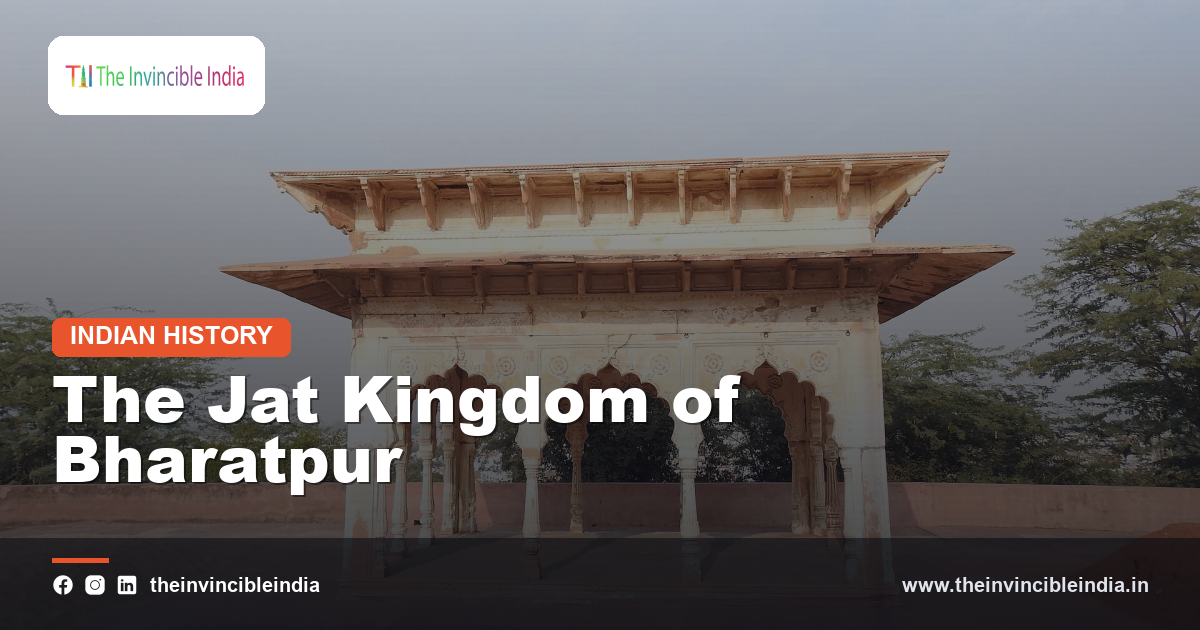
The Jat kingdom of Bharatpur, also called Bharatpur State or the Jat state of Braj, was a princely kingdom founded by Jat leaders in the eighteenth century in the region around Agra, Mathura and eastern Rajasthan. Rising from a peasant community that resisted heavy Mughal taxation, its rulers built forts, palaces and gardens and made themselves a significant regional power during the decline of imperial authority. Its best-known monuments are the Iron Fort of Lohagarh at Bharatpur and the water palaces of Deeg, and its most celebrated ruler is Maharaja Suraj Mal. In the larger story of medieval and early modern India the kingdom sits alongside the Rajput and Maratha states that filled the space left by the Mughals.
Quick answer: The Jat kingdom of Bharatpur, also called Bharatpur State, was a princely kingdom founded by Jat leaders in the eighteenth century around Agra, Mathura and eastern Rajasthan. It rose under Churaman, Badan Singh and Maharaja Suraj Mal, and it is remembered for the Iron Fort of Lohagarh, the water palaces of Deeg and its resistance to British sieges.
Key Takeaways
- The Jat kingdom of Bharatpur, also called Bharatpur State, was a princely kingdom founded by Jat chiefs in the eighteenth century in eastern Rajasthan and the Braj region.
- Churaman founded the first durable Jat power, Badan Singh gave it formal recognition, and Maharaja Suraj Mal expanded it into a major regional state.
- Lohagarh, the Iron Fort of Bharatpur, resisted British sieges in the early nineteenth century with thick earthen walls and a wide water moat.
- Deeg Palace is a complex of garden palaces and fountains that blends Rajput, Mughal and Braj architectural styles.
- Keoladeo National Park, a World Heritage Site, grew from a former royal hunting reserve of the Bharatpur rulers.
- The kingdom merged into Rajasthan soon after Indian independence, and its forts and palaces are now heritage sites.
Quick Facts
| Detail | Information |
|---|---|
| Name | Jat kingdom of Bharatpur (Bharatpur State) |
| Region | Eastern Rajasthan and the Braj area near Agra and Mathura |
| Capital | Bharatpur, with a second royal seat at Deeg |
| Best-known ruler | Maharaja Suraj Mal |
| Famous monuments | Lohagarh Fort, Deeg Palace, Keoladeo reserve |
| Status after 1947 | Merged into independent India as part of Rajasthan |
What was the Jat kingdom of Bharatpur?
The Jat kingdom of Bharatpur was a princely state in the Braj region that emerged in the early eighteenth century and lasted until the integration of princely states after Indian independence. It was ruled by a dynasty of Jat chiefs who gradually turned a network of fortified villages into a regular kingdom with a capital, an army and a court. The state occupied fertile land close to Agra and Mathura, a position that gave it influence over important roads and markets. Its rulers claimed descent from the Yadava lineage associated with Krishna, a claim in keeping with the religious character of Braj. They were skilled in diplomacy as well as war, balancing among the Mughals, Marathas, Rajputs and later the British. The kingdom is therefore a notable example of a regional power created by an agrarian community.
Who are the Jats?
The Jats are a large agrarian community of north-western India, living in parts of Punjab, Haryana, Rajasthan, Delhi and western Uttar Pradesh. They are traditionally associated with farming and cattle keeping, and over the centuries many Jat groups held land and organised themselves into clans and village councils. Their social position varied from region to region, and Jat communities followed different faiths, including Hinduism, Sikhism and Islam. The origins of the community are debated by scholars, and there are several theories linked to ancient migrations and settlement. In the Braj region they developed a strong tradition of local leadership, which later supported the rise of the Bharatpur kingdom. Understanding the Jats as a diverse and rooted community helps explain how a peasant movement could grow into a state.
Why did Jat communities rise against the Mughals?
Jat communities in the Braj region rose against the Mughals in the late seventeenth century mainly because of heavy revenue demands, local grievances and the growing weakness of imperial control. A leader named Gokula led an early revolt near Mathura, and further risings followed under other chiefs. These movements were fought by village armies who knew the terrain well and were able to retreat into forts and forests. Mughal forces eventually suppressed some of the uprisings, but the pattern of resistance continued and left a legacy of military organisation. Historians describe the revolts in different ways, as peasant protests, local assertions of power or a combination of both. Whatever the best label, they prepared the ground for the first real Jat state in the following generation.
Who was Churaman?
Churaman was a Jat chieftain of the late seventeenth and early eighteenth centuries who built the first durable Jat power in the Braj region. Based at the fort of Thun, he took advantage of the confusion that followed the death of Aurangzeb and the struggle for the Mughal throne to extend his authority over neighbouring villages and roads. He made agreements and fought battles with various Mughal and Rajput rivals, and his strength gave the Jats a bargaining position they had not had before. He is usually regarded as the real founder of the Jat state, though his own power rested on a loose network of followers. His career ended in difficult circumstances, but the foundation he laid was developed by his successors into a stable kingdom.
How did Badan Singh build the state?
Badan Singh built the state by gaining recognition from powerful neighbours and by investing in forts, palaces and administration at Deeg. He allied with Sawai Jai Singh II of Amber, a leading Rajput ruler, who helped him secure the support of the Mughal court, and he received titles that formalised his position. With this security he began constructing a royal residence at Deeg, which became the first major seat of the dynasty. His rule shifted the Jats from raiding chiefs to rulers with a court, revenue officials and a settled capital. Later accounts treat him as the first true king of the line, since he had both political recognition and a plan for building. His work provided the structure that his son Suraj Mal then used to expand the kingdom.
Who was Maharaja Suraj Mal?
Maharaja Suraj Mal was the most celebrated ruler of Bharatpur, who ruled in the mid-eighteenth century and expanded the kingdom into a strong regional power. He is remembered for his careful statecraft, his military strength and his ability to play rival powers against each other without losing his own position. Under him the kingdom reached from the neighbourhood of Agra and Mathura across a wide area of the Doab and Mewat, and its treasury grew from revenue and tribute. He also invested in forts, tanks and palaces. Writers of his time and later generations praised his sense of practical politics, though some details of his campaigns come from partisan sources. His reign is generally treated as the high point of Bharatpur, and he remains a significant figure of regional pride in Rajasthan and Uttar Pradesh.
What is the Lohagarh Fort?
Lohagarh, meaning the Iron Fort, is the main fortress of Bharatpur and one of the best-known forts of Rajasthan, built in the eighteenth century under Suraj Mal. Its reputation rests on the way it was designed to resist artillery: thick walls of packed earth and clay surrounded by an outer wall and a wide moat filled with water, so that cannon shot sank into the soft earth rather than shattering the stone. Within the complex are palaces, gateways, towers and courtyards, including the Kamra Khas and the Kishori Mahal, and two tall towers commemorating Jat victories. The gate known as the Ashtadhatu Gate is traditionally said to have been made of eight metals. The fort remains a symbol of the kingdom’s strength and ingenuity in the face of stronger armies.
How did Bharatpur resist British sieges?
Bharatpur became famous for resisting British sieges in the early nineteenth century, when its rulers refused to hand over a guest and held out against large forces. In the first siege, commanded by Lord Lake in the first decade of the century, the Company’s assaults on the Iron Fort failed several times and caused heavy losses, and the Jat ruler eventually reached a treaty. The event became a proud memory for the kingdom, though some writers note that the final settlement involved compromise. A later siege in the 1820s ended differently, when a much larger force under Lord Combermere took the fort after a long bombardment and mining of its walls. Both episodes show the military significance of Lohagarh and the importance of Bharatpur in the politics of north India.
What is Deeg Palace?
Deeg Palace is a complex of garden palaces, pavilions and water features built by the Jat rulers, mainly in the eighteenth century, and it is regarded as one of the most elegant royal residences in Rajasthan. The buildings, known as bhawans, include Gopal Bhawan, Suraj Bhawan, Keshav Bhawan and Nand Bhawan, set in formal gardens modelled on the Mughal charbagh. Large tanks and a system of fountains once sprayed water in a way that imitated the monsoon, so that the complex felt cool and lush in summer. Carved sandstone, curved eaves and arched openings combine Rajput, Mughal and local Braj styles. Tradition says that some decorative elements were brought from Mughal buildings in Delhi, though this is hard to verify. Deeg is admired for the harmony of its architecture and landscape.
What is the Keoladeo National Park connected with Bharatpur?
Keoladeo National Park, also known as the Bharatpur Bird Sanctuary, is a wetland and woodland reserve that grew out of a royal hunting ground of the Bharatpur rulers. The park takes its name from an old temple of Shiva within its boundaries, and it is recognised as a World Heritage Site because of its importance for birds. Marshes created by diverting water into low-lying land attracted large numbers of waterfowl, and the rulers held organised shoots there in the past. After the end of princely rule the area was protected, and it became a leading conservation site, famous for migratory birds from Central Asia and Europe. Its history shows how royal landholdings sometimes became public heritage. The park is now among the best-known wildlife destinations in the country.
How did the Jat rulers relate to the Marathas and Rajputs?
The Jat rulers related to the Marathas and Rajputs through a mix of alliance, rivalry and negotiation that depended on the needs of the moment. In the mid-eighteenth century the Marathas were expanding into northern India, and Suraj Mal sometimes cooperated with them and sometimes disagreed over strategy and resources. Rajput states such as Amber helped establish the early Jat position, but later conflicts over territory and influence caused friction. These relationships illustrate the fluid politics of the period, when no single power controlled the plains and every ruler looked for partners. Bharatpur survived by being useful to larger powers while holding strong forts. The result was a kingdom that remained independent through a very uncertain age, which later historians regard as a considerable political achievement.
How was the kingdom governed?
The kingdom was governed through a mix of royal authority, local clan leadership and a system of land revenue that depended on the cooperation of village headmen. The ruler was supported by ministers, military commanders and a growing body of clerks, and forts were placed at strategic points to protect roads and markets. Land revenue was the main income, and the rulers took care to protect cultivators in order to maintain the supply of crops and soldiers. The kingdom also drew income from trade and from tribute collected from smaller chiefs. Many of the institutions followed Mughal patterns, which the Jat rulers adapted to their own needs. The result was a stable government for its time, which combined the loyalty of village communities with the structure of a regular state.
What cultural traditions marked Bharatpur?
Bharatpur’s cultural traditions were shaped by the devotional life of Braj, the courtly styles of Rajasthan and the craft skills of local stone workers and painters. The rulers were devotees of Krishna, and they supported temples, festivals such as Holi and Janmashtami, and poets who wrote in Braj Bhasha. Stone carvers produced ornamental screens, brackets and balconies in the palaces, while painters developed a regional style of miniatures that drew from both Mughal and Rajput schools. The kingdom’s court also patronised music and dance linked to the Krishna tradition. These cultural currents made Bharatpur not only a military power but also a centre of artistic life. The monuments that survive, together with continuing festivals in the region, show how deeply the Jat rulers were involved in Braj culture.
How did Bharatpur become part of independent India?
Bharatpur became part of independent India when its ruler, like other princes, agreed to the integration of princely states soon after 1947. The state first joined a union of neighbouring princely territories and was then merged into the new state of Rajasthan. The process was largely peaceful, though the rulers lost their political powers and received privy purses in exchange, an arrangement that was later ended. The royal family continued to hold a respected place in society, and some of its members entered politics. The forts and palaces passed into public use, and Keoladeo and Lohagarh became important tourist and heritage sites. The change closed the political story of the kingdom while keeping its monuments and traditions as part of the national heritage.
What do historians debate about the Jat kingdom?
Historians debate several aspects of the Jat kingdom, including the origins of the community, the nature of the early revolts and the degree of Suraj Mal’s role in the larger politics of north India. The sources include Persian chronicles written by Mughal observers, Jat bardic traditions and British accounts, each with its own viewpoint. Some writers describe the early movements as peasant rebellions, while others stress the leadership of local chiefs. There are also debates about specific episodes, including Suraj Mal’s advice to his allies before the great battle at Panipat in the mid-eighteenth century and his actions in Agra and Delhi. A balanced reading therefore treats the traditions respectfully while noting that many details are disputed and rely on partisan sources.
The Jat Kingdom of Bharatpur Today
The Jat kingdom of Bharatpur lives on today through the Lohagarh Fort, the palaces of Deeg, the Keoladeo reserve and the pride of local communities in their history. The fort and palace museums display weapons, paintings and royal objects that tell the story of the dynasty, while the gardens at Deeg are used for annual festivals. Scholars continue to study the kingdom as an example of how an agrarian society built a state in a period of imperial decline. Visitors can combine a trip to the fort, the bird sanctuary and the palaces in a single region of eastern Rajasthan. The history of Bharatpur shows how local leaders, skilled design and a strong sense of identity created a kingdom that left a deep mark on Braj culture.
Sources & Further Reading
- Ministry of Culture, Government of India (indiaculture.gov.in).
- Archaeological Survey of India (asi.nic.in).
Frequently Asked Questions
Who founded the Jat kingdom of Bharatpur?
Churaman is generally regarded as the real founder of Jat power in the Braj region, while Badan Singh formalised it with recognition from neighbouring rulers. Maharaja Suraj Mal then expanded it into a major regional kingdom.
Who was Maharaja Suraj Mal?
Maharaja Suraj Mal was the most celebrated ruler of Bharatpur, who ruled in the mid-eighteenth century. He expanded the kingdom, built forts and palaces and is remembered for his shrewd politics.
Why is Lohagarh Fort called the Iron Fort?
Lohagarh is called the Iron Fort because it resisted heavy attack so well. Its thick earthen walls and wide water moat absorbed cannon fire that would have broken ordinary stone walls.
What is Deeg Palace known for?
Deeg Palace is known for its garden palaces, called bhawans, and its fountains and water tanks. It was built mainly in the eighteenth century by the Jat rulers and blends Rajput, Mughal and Braj styles.
Did the British capture Bharatpur?
The British failed to capture Bharatpur in their first siege in the early nineteenth century, when Lord Lake’s assaults were repulsed. A second siege in the 1820s under Lord Combermere succeeded.
What is the connection between Bharatpur and Keoladeo National Park?
Keoladeo National Park grew from a former royal hunting reserve of the Bharatpur rulers. It is now a protected wetland and World Heritage Site known for migratory birds.


