

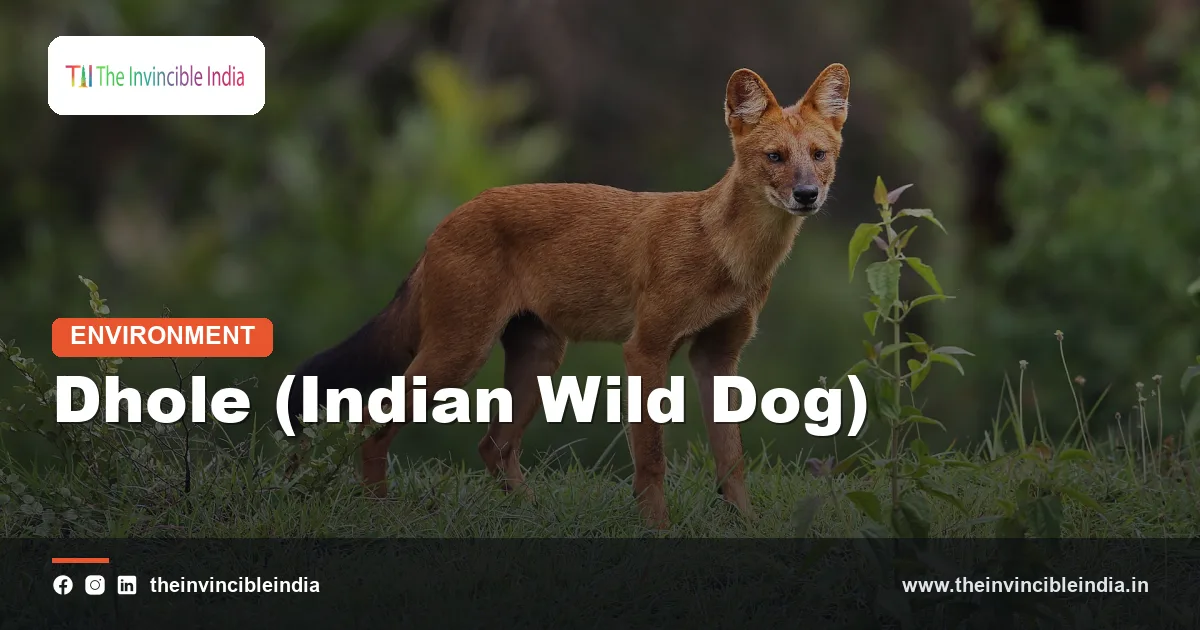
The dhole (Cuon alpinus), also called the Asiatic wild dog or Indian wild dog, is a reddish, highly social pack-hunting canid of Asian forests that is listed as Endangered by the International Union for Conservation of Nature (IUCN). In India, the dhole lives mainly in the Western Ghats, central India and the Northeast, where it ranks among the forest’s apex predators alongside the tiger and the leopard.
The dhole is known for its whistling calls, its cooperative hunting and its communal care of pups. Its numbers have fallen sharply because of habitat loss, depletion of the deer and wild pigs it feeds on, and diseases passed on by domestic dogs, which makes the species a priority for Indian conservation.
| Attribute | Detail |
|---|---|
| Common names | Dhole, Asiatic wild dog, Indian wild dog, red dog, jungli kutta |
| Scientific name | Cuon alpinus, the only living species in the genus Cuon |
| Family | Canidae (dog family) |
| Body weight | Roughly 10 to 20 kg, about the size of a medium dog |
| Appearance | Reddish or tawny coat, paler underparts, bushy dark tail |
| Social structure | Packs commonly of 5 to 12 animals, sometimes larger |
| IUCN status | Endangered |
| Legal protection in India | Protected under the Wildlife (Protection) Act 1972; also listed in CITES Appendix II |
| Key Indian strongholds | Nilgiri landscape (Nagarhole, Bandipur, Mudumalai, Wayanad), Pench, Kanha, Tadoba, Satpura and parts of the Northeast |
Key Takeaways
- The dhole (Cuon alpinus) is a medium-sized, reddish wild canid that hunts in cooperative packs and is the only living member of the genus Cuon.
- The dhole is classified as Endangered by the IUCN, and its global population is believed to number only a few thousand animals.
- In India, the dhole is found in three main regions: the Western Ghats, the forests of central India and the Northeast.
- The dhole is an apex predator that regulates populations of chital, sambar and wild pig, and it coexists with the tiger and leopard in the same forests.
- The main threats to the dhole are habitat loss, depletion of prey, disease transmitted by domestic and free-ranging dogs, and historical persecution.
- Many tiger reserves, including Nagarhole, Bandipur and Pench, serve as strongholds for the dhole because they protect both forest habitat and its prey.
What is a dhole?
A dhole is a wild canid of the dog family that lives and hunts in packs in the forests of Asia, and in India it is commonly called the Indian wild dog. Despite the name, the dhole is a distinct species, not an ancestor or feral version of the domestic dog.
The dhole is classified in its own genus, Cuon, and has several features that set it apart from wolves, jackals and domestic dogs. It has a more rounded muzzle, a slightly shorter jaw, fewer molar teeth than most canids and a bushy tail with a dark tip. Adults generally weigh about 10 to 20 kg and stand around 50 cm at the shoulder.
In regional languages the animal has many names. It is known as kolsun in Marathi, adavi kukka in Telugu, and simply jungli kutta in Hindi, meaning wild dog of the forest. The dhole also appears in literature: the pack of red dogs in Rudyard Kipling’s Jungle Book stories is based on it.
What does a dhole look like?
A dhole has a rusty red to sandy brown coat, a lighter chest and belly, and a long bushy tail that ends in black. The colour is its most distinctive feature and gives rise to the name red dog.
The shade of the coat varies with season and region. Dholes in colder and higher forests tend to have thicker and paler winter coats, while those in southern forests are a deeper reddish colour. The ears are rounded and upright, the legs are long and the body is lean.
Because of its size and colour, the dhole can be mistaken for a jackal or a domestic dog from a distance. Experienced observers recognise it by its red coat, black-tipped tail and the way a pack moves together through the undergrowth.
How does a dhole communicate and live in a pack?
Dholes communicate through a varied repertoire of vocal sounds, notably a high-pitched whistle used to keep the pack together in dense forest, and they live in cooperative packs with shared duties. The whistle is the call most associated with the species and carries well through thick vegetation, where members cannot always see one another.
Besides whistles, dholes use clucks, yaps, mews and growls. Researchers have described the whistle as a rallying call that brings scattered pack members back together after a hunt.
Pack life
- Pack size: Packs commonly have 5 to 12 members, though larger groups have been recorded.
- Breeding: A pack usually has one breeding female, and several adults help raise the pups.
- Dens: Pups are born in a den, often a burrow or a rocky cavity, after a gestation of about two months.
- Cooperative care: Pack members feed pups by regurgitating food and guard the den together.
- Low aggression: Dholes are noted for relatively low levels of conflict within the pack compared with many other social carnivores.
How does a dhole hunt?
A dhole hunts by tracking and chasing prey cooperatively as a pack, wearing the target down over distance and then bringing it down together. The pack can tackle animals much larger than a single dhole, such as sambar and gaur calves.
Dholes are diurnal and crepuscular, which means they are most active during the day and at dawn and dusk. Unlike the tiger or leopard, they rely on stamina and coordination rather than ambush. They often kill by attacking the hindquarters and flanks of the prey, a method that is quick when many animals work together, though it is not the instant kill associated with big cats.
Dholes typically eat their prey immediately and in groups, which reduces the chance that larger predators will steal the kill. Because of this behaviour, they leave behind relatively little carcass compared with tigers.
What do dholes eat?
Dholes eat mainly medium-sized and large hoofed mammals, with chital (spotted deer), sambar and wild boar forming the core of their diet in Indian forests. They also take muntjac, hares, rodents and, rarely, the young of larger animals such as gaur.
| Prey | Importance in the dhole’s diet |
|---|---|
| Chital (spotted deer) | A principal prey wherever it is common |
| Sambar | A major prey, especially for large packs |
| Wild boar | Important, particularly the young |
| Muntjac and mouse deer | Locally important in dense forest |
| Hares and rodents | Supplementary food |
The dhole’s dependence on a healthy prey base is the single biggest reason it is so sensitive to the condition of a forest. If wild prey declines, dholes cannot easily switch to other food and may turn to livestock, which increases conflict with people.
Where do dholes live in India?
Dholes live in India in three main regions: the Western Ghats in the south, the forests of central India across Madhya Pradesh, Maharashtra and Chhattisgarh, and the Northeast, with scattered populations in the Eastern Ghats and parts of the Himalayan foothills. They favour dense, mixed forests with plenty of wild ungulates.
Key strongholds
- Nilgiri landscape: Nagarhole, Bandipur, Mudumalai and Wayanad form one of the best-known dhole landscapes in the world.
- Central India: Pench, Kanha, Satpura and Tadoba hold stable populations in the Satpura-Maikal belt.
- Northeast: Forests of Arunachal Pradesh, Assam and neighbouring states support smaller, poorly studied populations.
- Eastern Ghats: Scattered populations remain in the forests of Andhra Pradesh and Odisha.
Outside India, the dhole ranges across South and Southeast Asia, including Nepal, Bhutan, Myanmar, Thailand and Indonesia, but its range there has shrunk greatly. India is generally regarded as one of the species’ most important remaining strongholds.
Why is the dhole ecologically important?
The dhole is ecologically important because it is an apex predator that helps control populations of deer and wild pigs, and in doing so it shapes the structure of the whole forest. Its presence indicates that the forest still has a complete food chain.
The dhole shares its habitat with the tiger and the leopard, and the three predators divide resources by prey size, hunting style and timing. This coexistence, studied in reserves like Nagarhole and Bandipur, is a sign of a healthy and diverse prey base. Where the dhole disappears, the loss often points to a wider decline of wildlife.
By keeping herbivore numbers in check, the dhole indirectly protects young vegetation from over-browsing. A forest with all its predators in place is also more resilient, because no single species dominates the ecosystem.
What is the conservation status of the dhole?
The conservation status of the dhole is Endangered on the IUCN Red List, and the species is protected in India under the Wildlife (Protection) Act 1972 and listed in Appendix II of CITES. The IUCN estimates that only a few thousand mature dholes remain globally, split among small, isolated populations.
The dhole was once treated as vermin. Before the Wildlife (Protection) Act of 1972, hunters often killed dholes, and some regions paid bounties for them because they were believed to harm game animals. The legal protection granted after 1972 ended these practices and brought the species into the scope of India’s protected areas.
Because dholes range over large areas and often cross reserve boundaries, protection inside parks alone is not enough. Their survival depends on connected forests and healthy prey populations on a landscape scale.
What are the threats to the dhole?
The main threats to the dhole are loss and fragmentation of forest habitat, decline of its prey, diseases from domestic dogs, and persecution by people. These pressures often act together, which makes recovery difficult.
- Habitat loss and fragmentation: Roads, plantations, mining, dams and farmland divide forests and isolate packs.
- Prey depletion: Illegal hunting of deer and wild pigs for meat reduces the food available to dholes.
- Disease: Canine distemper, rabies, parvovirus and mange can spread from village dogs to wild dholes.
- Persecution: Dholes are sometimes killed in retaliation for livestock loss, and their dens are occasionally destroyed.
- Competition: Larger carnivores can displace dholes from kills, and the dhole population can suffer where prey is already scarce.
Disease is a particular concern in small populations. A single outbreak can wipe out a pack, and recovery is slow because dholes breed only once a year and pup survival is often low.
How is the dhole being conserved in India?
The dhole is conserved in India mainly through protected areas, tiger reserves and the protection of wild prey, supported by research, monitoring and community engagement. Because tiger reserves protect large forest blocks and their prey, they also safeguard the dhole.
Key conservation measures
- Legal protection: The Wildlife (Protection) Act 1972 prohibits hunting and trade in the dhole.
- Tiger reserves: Reserves under Project Tiger, including Nagarhole, Bandipur, Pench and Tadoba, give dholes secure habitat.
- Prey recovery: Anti-poaching patrols and habitat management help increase deer and wild pig numbers.
- Disease control: Vaccination of village dogs near forests reduces the risk of disease reaching wild canids.
- Research: Camera-trap surveys and field studies estimate pack numbers and track movement across landscapes.
- Corridors: Protecting forest corridors lets packs move between reserves and helps genetic exchange.
Conservation specialists also stress that the dhole needs more survey attention. It is far less studied than the tiger, so many populations, especially in the Northeast, remain poorly documented.
Bottom Line
The dhole is one of India’s most remarkable but least appreciated predators. Its survival depends on protecting large forests, rebuilding prey populations and reducing disease from domestic dogs. Safeguarding the dhole therefore protects the entire forest community around it. Last updated: 15 October 2026.
Frequently Asked Questions
What is a dhole?
A dhole is a reddish wild canid, also called the Asiatic wild dog or Indian wild dog, that lives and hunts in packs. It belongs to the dog family but is a separate species, Cuon alpinus. In India it lives mainly in the forests of the Western Ghats, central India and the Northeast.
Is the dhole endangered?
Yes, the dhole is listed as Endangered by the IUCN. Only a few thousand mature animals are thought to remain worldwide, in small and fragmented populations. In India it is protected under the Wildlife (Protection) Act 1972.
Why do dholes whistle?
Dholes whistle to keep their pack together and to regroup after a hunt, especially in thick forest where members cannot see one another. The whistle is a high-pitched call that travels well through vegetation. Dholes also use clucks, yaps and growls to communicate.
Where can I see dholes in India?
Dholes are most often seen in tiger reserves such as Nagarhole, Bandipur, Mudumalai, Pench, Kanha and Tadoba. Sightings are never guaranteed because the animals roam over large areas. Visiting with an experienced guide and in the cooler hours improves the chances.
What do dholes eat?
Dholes eat mainly chital, sambar and wild boar, along with smaller prey such as hares and rodents. They hunt cooperatively in packs and can bring down animals larger than themselves. Their survival depends strongly on a healthy supply of wild prey.
Are dholes dangerous to humans?
No, dholes are not considered dangerous to humans, and attacks on people are extremely rare. They tend to avoid human settlements and are shy of people. Conflict is mostly limited to occasional livestock loss near forest edges.
{“@context”:”https://schema.org”,”@graph”:[{“@type”:”FAQPage”,”mainEntity”:[{“@type”:”Question”,”name”:”What is a dhole?”,”acceptedAnswer”:{“@type”:”Answer”,”text”:”A dhole is a reddish wild canid, also called the Asiatic wild dog or Indian wild dog, that lives and hunts in packs. It belongs to the dog family but is a separate species, Cuon alpinus. In India it lives mainly in the forests of the Western Ghats, central India and the Northeast.”}},{“@type”:”Question”,”name”:”Is the dhole endangered?”,”acceptedAnswer”:{“@type”:”Answer”,”text”:”Yes, the dhole is listed as Endangered by the IUCN. Only a few thousand mature animals are thought to remain worldwide, in small and fragmented populations. In India it is protected under the Wildlife (Protection) Act 1972.”}},{“@type”:”Question”,”name”:”Why do dholes whistle?”,”acceptedAnswer”:{“@type”:”Answer”,”text”:”Dholes whistle to keep their pack together and to regroup after a hunt, especially in thick forest where members cannot see one another. The whistle is a high-pitched call that travels well through vegetation. Dholes also use clucks, yaps and growls to communicate.”}},{“@type”:”Question”,”name”:”Where can I see dholes in India?”,”acceptedAnswer”:{“@type”:”Answer”,”text”:”Dholes are most often seen in tiger reserves such as Nagarhole, Bandipur, Mudumalai, Pench, Kanha and Tadoba. Sightings are never guaranteed because the animals roam over large areas. Visiting with an experienced guide and in the cooler hours improves the chances.”}},{“@type”:”Question”,”name”:”What do dholes eat?”,”acceptedAnswer”:{“@type”:”Answer”,”text”:”Dholes eat mainly chital, sambar and wild boar, along with smaller prey such as hares and rodents. They hunt cooperatively in packs and can bring down animals larger than themselves. Their survival depends strongly on a healthy supply of wild prey.”}},{“@type”:”Question”,”name”:”Are dholes dangerous to humans?”,”acceptedAnswer”:{“@type”:”Answer”,”text”:”No, dholes are not considered dangerous to humans, and attacks on people are extremely rare. They tend to avoid human settlements and are shy of people. Conflict is mostly limited to occasional livestock loss near forest edges.”}}]}]}


