

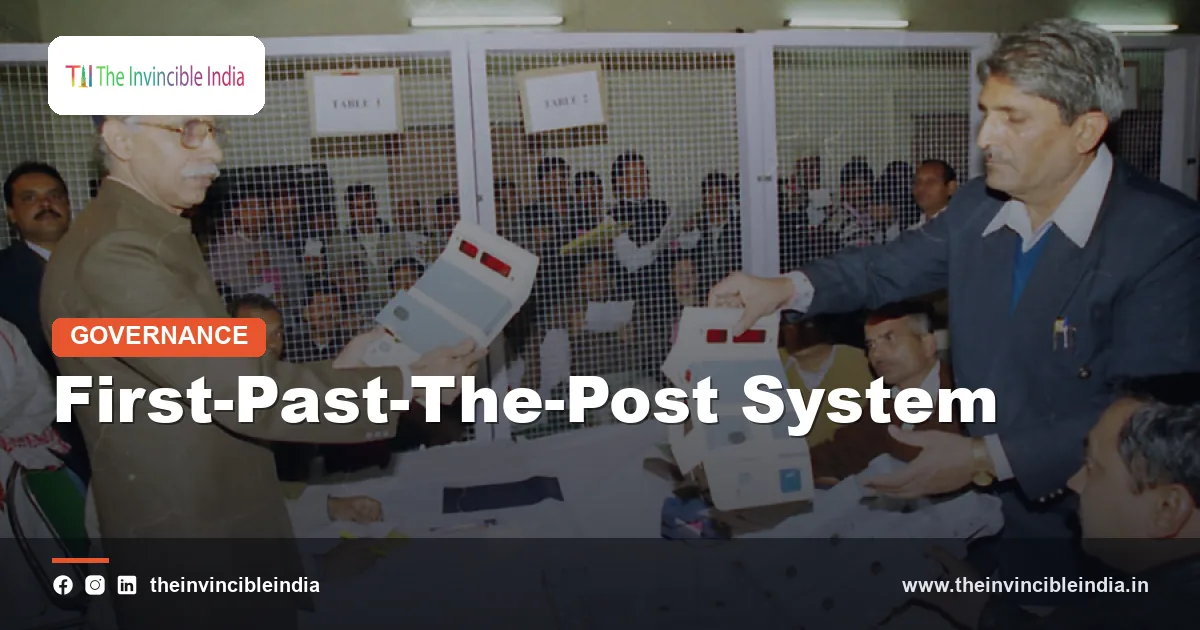
The first-past-the-post system is the simple-majority voting method in which the candidate who receives the highest number of votes in a single-member constituency wins, even without an absolute majority of the votes cast. India uses first-past-the-post to elect the members of the Lok Sabha and of the State Legislative Assemblies, which makes it the method that decides who governs at the Centre and in most states.
The first-past-the-post electoral system in India is often described in plain terms: whoever gets one vote more than the runner-up wins the seat. The method is easy for voters to understand and tends to produce clear governing majorities, but it can also produce large gaps between the share of votes a party receives and the share of seats it wins. This explainer covers how the system works, where it is mandated, what its strengths and criticisms are, and how it differs from the proportional methods India uses elsewhere. It was last reviewed on 15 October 2026.
Quick Facts: First-Past-The-Post in India
| Attribute | Detail |
|---|---|
| Also known as | Simple plurality system, relative majority system, winner-takes-all |
| Used for | Lok Sabha, State Legislative Assemblies (Vidhan Sabhas), and most local-body elections |
| Constitutional basis | Article 81 (Lok Sabha) and Article 170 (State Assemblies), with elections conducted under Article 324 |
| Governing law | Representation of the People Act, 1951 |
| Constituency type | Single-member territorial constituencies |
| Winning rule | The candidate with the most valid votes wins; no minimum vote share is required |
| Tie-breaker | Decided by drawing lots |
| Election body | Election Commission of India |
| Not used for | Rajya Sabha, President, Vice-President and Legislative Councils, which use proportional representation by single transferable vote |
Key Takeaways
- The first-past-the-post system in India awards each constituency’s seat to the candidate who secures the most votes, with no requirement to cross fifty percent.
- India uses first-past-the-post for Lok Sabha and State Legislative Assembly elections, with each constituency electing exactly one member.
- The Representation of the People Act, 1951 provides that the returning officer declares elected the candidate who has received the largest number of valid votes.
- First-past-the-post often produces stable single-party or coalition-leading majorities but can leave large vote shares without proportionate seats.
- The Rajya Sabha, the President and the Vice-President are elected by proportional representation through the single transferable vote, not by first-past-the-post.
- The Constitution’s Constituent Assembly chose the single-member plurality system after considering proportional alternatives, largely for its simplicity in a vast, diverse, largely unlettered electorate at the time.
What is the first-past-the-post system?
The first-past-the-post system is an electoral method in which each constituency elects one representative and the candidate with the most votes, called a plurality, wins. The name comes from horse racing, where the first horse past the post wins regardless of the margin, even though in elections no fixed winning line exists.
Three features define first-past-the-post. First, the country is divided into territorial constituencies, each electing a single member. Second, voters choose one candidate rather than ranking several or voting for a party list. Third, the candidate with a plurality is declared the winner, even if the total of the other candidates’ votes is larger.
For example, in a five-way contest, a candidate who receives 34 percent of the votes can win if no other candidate receives more than 33 percent. The remaining 66 percent of voters have supported other candidates, but those votes do not count toward representation in that seat.
How does first-past-the-post work in a Lok Sabha election?
In a Lok Sabha election, India is divided into 543 single-member constituencies, and the candidate with the highest number of votes in each constituency is declared elected. The party or coalition that wins at least 272 of the 543 seats can usually form the government, because that is a majority of the elected House.
The steps in a typical contest are as follows:
- The Election Commission of India announces the schedule and candidates file nominations for each constituency.
- Voters in the constituency cast one vote each, today on Electronic Voting Machines (EVMs) with voter-verifiable paper audit trail (VVPAT) units.
- Votes are counted constituency by constituency on counting day.
- The returning officer declares elected the candidate with the largest number of valid votes, under the Representation of the People Act, 1951.
- If two candidates tie, the winner is decided by drawing lots.
The same logic applies to State Assembly elections, where the number of single-member constituencies varies from state to state according to population. The party or alliance with a majority of seats in the Assembly is invited to form the state government.
What does the Constitution say about this system?
The Constitution of India prescribes territorial constituencies and direct election for the Lok Sabha and State Assemblies, which is the structural basis of first-past-the-post, while the winning rule itself is laid down in the Representation of the People Act, 1951. Article 81 provides that members of the Lok Sabha are chosen by direct election from territorial constituencies in the states, and Article 170 does the same for State Legislative Assemblies.
- Article 81: composition of the Lok Sabha, with members directly elected from territorial constituencies.
- Article 82: readjustment of constituencies after each census, carried out by a Delimitation Commission.
- Article 170: composition of State Legislative Assemblies.
- Article 326: elections based on adult suffrage, giving every citizen aged 18 or above the right to vote.
- Articles 330 and 332: reservation of seats for Scheduled Castes and Scheduled Tribes in the Lok Sabha and Assemblies.
- Article 324: superintendence, direction and control of elections vested in the Election Commission.
The Constitution does not use the phrase “first-past-the-post” anywhere. The system emerges from the combination of single-member constituencies and the plurality rule in the 1951 Act. Parliament can therefore, in principle, change the winning rule by ordinary legislation, though changing the structure of constituencies would require wider reform.
Why did India choose first-past-the-post?
India chose first-past-the-post because it was simple to administer, familiar from colonial-era elections, and suited to a country with a very large and then largely unlettered electorate. The Government of India Act, 1935 had already used territorial constituencies with plurality outcomes for many seats, and the framers of the Constitution carried that tradition into independent India.
The Constituent Assembly debated alternatives such as proportional representation. Several arguments favoured the simpler method. A voter marking a single candidate on the ballot was easier to educate than a voter ranking many choices. Constituency-based representation gave each area an identifiable member of the legislature. There was also a concern that proportional systems in a country of such diversity could produce fragmented legislatures and unstable governments, which the new republic could ill afford.
The first general election was held in 1951-52, with first-past-the-post at its core, and the method has been used in every Lok Sabha election since.
How does the winner get declared if a candidate has less than 50 percent?
A candidate is declared the winner with less than 50 percent of the votes because first-past-the-post requires only a plurality, meaning more votes than any other individual candidate. India has no run-off round and no minimum threshold for victory.
This feature has two practical consequences. In contests with many candidates, a winner can be elected with a relatively small share of the votes in the constituency. It also means that vote splitting matters: if several similar candidates divide a bloc of voters, a rival with a smaller base but a united vote can win. This is sometimes called the spoiler or vote-splitting effect, and it encourages parties to form alliances before the election.
Since 2013, voters have also had the option of “None of the Above” (NOTA), introduced after a Supreme Court direction. NOTA allows a voter to formally reject all candidates, but under current rules it does not change the result: even if NOTA receives the most votes, the candidate with the highest votes among the actual contestants is declared elected.
What are the advantages of first-past-the-post?
The main advantages of first-past-the-post are simplicity, clear results, a direct link between voters and their representative, and a tendency to produce stable governing majorities. Supporters of the system point to several benefits.
- Simplicity: voters mark one candidate, and counting is quick and easy to audit.
- Local accountability: every constituency has a single, identifiable member who answers to local voters.
- Decisive outcomes: the system tends to convert even a moderate lead in votes into a workable parliamentary majority.
- Stable government: a single party or a pre-poll alliance can usually form a government without lengthy post-election bargaining.
- Cost and administration: the method is relatively cheap to run in a country with hundreds of millions of registered voters.
- Moderation incentives: parties often try to appeal broadly to win pluralities across diverse constituencies.
What are the criticisms of first-past-the-post?
The main criticism of first-past-the-post is that the number of seats a party wins can differ greatly from the share of votes it receives, so many voters end up without proportionate representation. This mismatch has been visible in several elections in India.
- Seats versus votes: in the 1984 general election, the Indian National Congress won over 400 seats with roughly half of the votes cast, while in later elections winning parties have obtained comfortable majorities with a vote share in the 30s.
- Wasted votes: votes cast for losing candidates, or for a winner beyond what was needed, do not influence the outcome.
- Small and regional parties: a party with a few percent of votes spread thinly across the country can win very few seats or none, as the Bahujan Samaj Party experienced in 2014, while a party with the same vote share concentrated in one region can win many.
- Minority winners: a candidate can be elected although most voters in the constituency voted for someone else.
- Tactical voting: voters may back a less-preferred but more viable candidate to avoid splitting the vote.
- Delimitation sensitivity: the way constituency boundaries are drawn can influence results.
These concerns have led to periodic suggestions to reform the system. The Law Commission of India, in its report on the reform of electoral laws, has discussed adding a limited element of proportional representation to the existing structure, though no such change has been enacted.
How is first-past-the-post different from proportional representation?
First-past-the-post differs from proportional representation in that it elects one winner per constituency by plurality, whereas proportional representation allocates seats to parties or candidates in rough proportion to the votes they receive. The two methods answer different questions: first-past-the-post asks who should represent this constituency, while proportional systems ask how the whole legislature should reflect the electorate.
| Feature | First-past-the-post | Proportional representation (single transferable vote) |
|---|---|---|
| Seats per constituency | One | More than one in the general form, or a defined electoral college |
| Winning rule | Highest number of votes wins | A quota of votes is required, with surplus and eliminated votes transferred |
| Voter’s ballot | Mark one candidate | Rank candidates in order of preference |
| Seat-vote match | Often disproportionate | Close to proportionate |
| Government formation | Often produces clear majorities | More often produces coalitions |
| Where used in India | Lok Sabha, State Assemblies | Rajya Sabha, President, Vice-President, Legislative Councils |
India therefore uses both families of systems. Members of the Rajya Sabha are elected by the elected members of State Assemblies under Article 80(4) using proportional representation by single transferable vote. The President is elected by an electoral college under Article 55, and the Vice-President under Article 66, by the same method.
What alternatives and reforms have been discussed?
Alternatives to first-past-the-post discussed in India include a mixed system with a proportional component, a two-round run-off, and ranked-choice voting. None has been adopted for the Lok Sabha or State Assemblies.
- Mixed member system: keeps constituency seats but adds a number of seats allotted by party vote share to correct imbalances.
- Two-round run-off: if no candidate secures an absolute majority, the top two contest a second round, as in some presidential elections elsewhere.
- Ranked-choice (preferential) voting: voters rank candidates, and lower-ranked preferences are counted if no one has a majority.
- Full proportional list system: seats are allotted purely by party vote share, as in several European countries.
Arguments against change usually cite India’s size, the complexity of ranked ballots for a very large electorate, and the risk of fragmented legislatures. Arguments in favour stress fairer representation of smaller parties and minority communities. The question is a matter for Parliament, which can amend the Representation of the People Act, 1951 for many of these changes.
How do delimitation and reserved seats shape the system?
Delimitation and reservation shape first-past-the-post in India by determining where the constituency boundaries run and which constituencies are reserved for Scheduled Castes and Scheduled Tribes. A Delimitation Commission redraws constituency boundaries after the census so that each member represents roughly equal population.
In reserved constituencies, only candidates from the specified community may contest, but all voters in the constituency vote, and the winner is still decided by plurality. The total number of Lok Sabha seats has been held at its existing level by constitutional amendment, with the freeze on readjustment linked to population counts after the 2001 census extended until the first census taken after the year 2026.
Bottom Line
The first-past-the-post system gives India a simple, locally rooted way of electing its legislatures and usually delivers workable majorities. The trade-off is that seat shares can diverge sharply from vote shares, which is why the debate on partial proportional reform continues without any change in the law so far.
Frequently Asked Questions
What is the first-past-the-post system in India?
The first-past-the-post system in India is the method in which each constituency elects one member and the candidate with the most votes wins. It is used for the Lok Sabha and State Legislative Assemblies. The winner does not need more than 50 percent of the votes.
Does India use first-past-the-post or proportional representation?
India uses both, depending on the office. First-past-the-post is used for Lok Sabha and State Assembly elections, while proportional representation by single transferable vote is used for the Rajya Sabha, the President and the Vice-President. The Legislative Councils also use proportional methods for part of their membership.
Can a candidate win with less than 50 percent of the votes in India?
Yes, a candidate can win with less than 50 percent of the votes in India because first-past-the-post requires only a plurality. The candidate with the highest number of valid votes is declared elected. There is no run-off round and no minimum vote share.
What happens if two candidates get the same number of votes?
If two candidates receive an equal number of votes, the winner is decided by drawing lots. This rule is laid down in the Representation of the People Act, 1951. Such ties are extremely rare in practice.
What are the main advantages of first-past-the-post?
The main advantages are simplicity, a direct link between voters and a local representative, and a tendency to produce stable majorities. Voters mark only one candidate, so counting is quick and easy to verify. Pre-poll alliances can also help form governments without long negotiations afterwards.
What is the biggest criticism of the first-past-the-post system?
The biggest criticism is that the share of seats a party wins can be very different from its share of votes. Parties with widely spread support may win few seats, while others convert a moderate vote share into a large majority. This is why partial proportional reforms are discussed from time to time.
{“@context”:”https://schema.org”,”@graph”:[{“@type”:”FAQPage”,”mainEntity”:[{“@type”:”Question”,”name”:”What is the first-past-the-post system in India?”,”acceptedAnswer”:{“@type”:”Answer”,”text”:”The first-past-the-post system in India is the method in which each constituency elects one member and the candidate with the most votes wins. It is used for the Lok Sabha and State Legislative Assemblies. The winner does not need more than 50 percent of the votes.”}},{“@type”:”Question”,”name”:”Does India use first-past-the-post or proportional representation?”,”acceptedAnswer”:{“@type”:”Answer”,”text”:”India uses both, depending on the office. First-past-the-post is used for Lok Sabha and State Assembly elections, while proportional representation by single transferable vote is used for the Rajya Sabha, the President and the Vice-President. The Legislative Councils also use proportional methods for part of their membership.”}},{“@type”:”Question”,”name”:”Can a candidate win with less than 50 percent of the votes in India?”,”acceptedAnswer”:{“@type”:”Answer”,”text”:”Yes, a candidate can win with less than 50 percent of the votes in India because first-past-the-post requires only a plurality. The candidate with the highest number of valid votes is declared elected. There is no run-off round and no minimum vote share.”}},{“@type”:”Question”,”name”:”What happens if two candidates get the same number of votes?”,”acceptedAnswer”:{“@type”:”Answer”,”text”:”If two candidates receive an equal number of votes, the winner is decided by drawing lots. This rule is laid down in the Representation of the People Act, 1951. Such ties are extremely rare in practice.”}},{“@type”:”Question”,”name”:”What are the main advantages of first-past-the-post?”,”acceptedAnswer”:{“@type”:”Answer”,”text”:”The main advantages are simplicity, a direct link between voters and a local representative, and a tendency to produce stable majorities. Voters mark only one candidate, so counting is quick and easy to verify. Pre-poll alliances can also help form governments without long negotiations afterwards.”}},{“@type”:”Question”,”name”:”What is the biggest criticism of the first-past-the-post system?”,”acceptedAnswer”:{“@type”:”Answer”,”text”:”The biggest criticism is that the share of seats a party wins can be very different from its share of votes. Parties with widely spread support may win few seats, while others convert a moderate vote share into a large majority. This is why partial proportional reforms are discussed from time to time.”}}]}]}


