

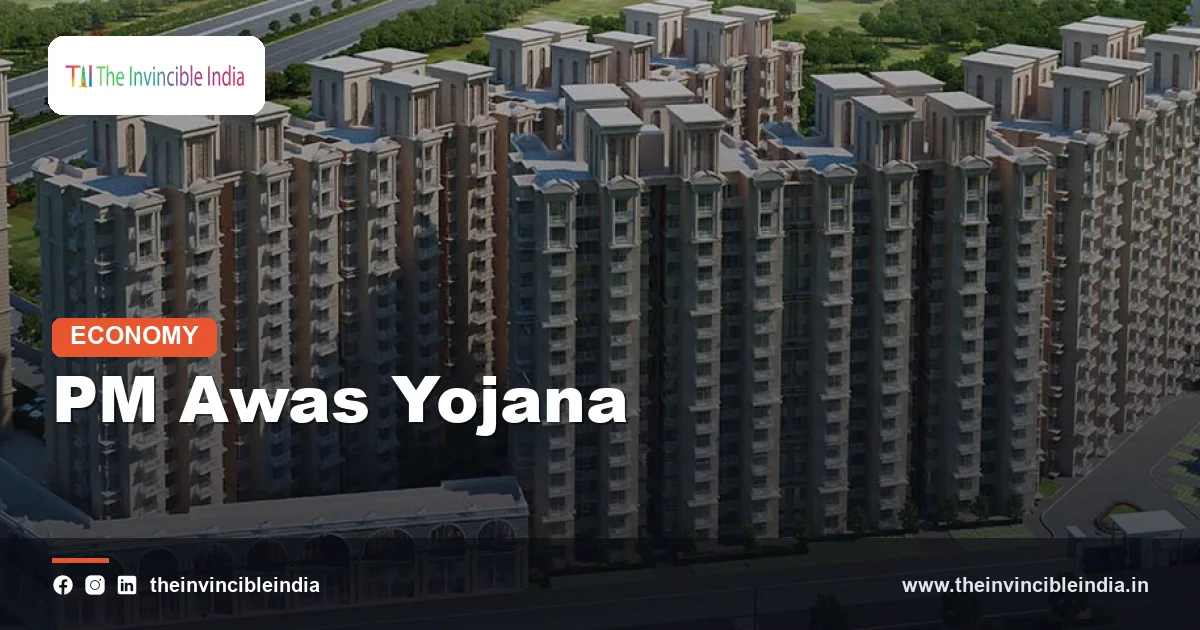
PM Awas Yojana (PMAY) is the Government of India’s flagship housing mission, launched in 2015 to provide a pucca (permanent) house with basic amenities to every eligible urban and rural household under the banner “Housing for All”. The mission runs through two arms: PMAY-Urban (PMAY-U), administered by the Ministry of Housing and Urban Affairs (MoHUA), and PMAY-Gramin (PMAY-G), administered by the Ministry of Rural Development.
PMAY replaced and widened earlier housing programmes such as the Indira Awaas Yojana and the Rajiv Awas Yojana. It combines direct central assistance, interest subsidy on home loans, slum redevelopment and partnerships with builders, and it relies on technology such as geo-tagging and Direct Benefit Transfer (DBT) to monitor progress and curb leakage.
| Attribute | Detail |
|---|---|
| Full name | Pradhan Mantri Awas Yojana (PMAY), also called Housing for All |
| Launched | 2015 (urban arm in June 2015; rural arm restructured from the Indira Awaas Yojana in 2016) |
| Nodal ministries | Ministry of Housing and Urban Affairs (urban); Ministry of Rural Development (rural) |
| Type | Centrally sponsored housing mission with a central-sector interest subsidy component |
| Core goal | A pucca house with water, toilet, electricity and cooking-fuel connectivity for eligible families |
| Urban verticals | In-situ Slum Redevelopment, Credit Linked Subsidy Scheme, Affordable Housing in Partnership, Beneficiary-Led Construction |
| Ownership norm | House registered in the name of the woman or jointly with the male head of the household |
| Second phase | PMAY-U 2.0, approved in 2024 for urban poor and middle-class families |
Key Takeaways
- PM Awas Yojana was launched in 2015 with the aim of providing a pucca house with basic amenities to eligible households under the “Housing for All” goal.
- PMAY has two arms: PMAY-Urban, run by the Ministry of Housing and Urban Affairs, and PMAY-Gramin, run by the Ministry of Rural Development.
- PMAY-Urban offers four verticals: In-situ Slum Redevelopment, the Credit Linked Subsidy Scheme (CLSS), Affordable Housing in Partnership (AHP) and Beneficiary-Led Construction (BLC).
- PM Awas Yojana promotes women’s ownership by requiring houses to be registered in the name of a woman or jointly with a male member of the household.
- PMAY-Gramin selects beneficiaries from socio-economic census data verified by Gram Sabhas, and tracks each house through geo-tagged photographs and direct bank transfers.
- PMAY-U 2.0, approved in 2024, continues the urban mission with a renewed focus on the urban poor and middle class, including interest subsidy and affordable rental housing.
What is PM Awas Yojana?
PM Awas Yojana is a national housing mission that supports the construction, purchase or improvement of homes for economically weaker and lower-income families across India’s cities and villages. It takes its name from the idea that every family should have a safe, permanent roof by the time the country marks 75 years of independence in 2022, a target that has since been extended through further phases.
The scheme consolidated several older efforts. In rural areas it grew out of the Indira Awaas Yojana, which had been providing housing assistance since the 1980s. In cities, it drew on lessons from the Rajiv Awas Yojana and the Jawaharlal Nehru National Urban Renewal Mission, which had focused largely on slum redevelopment and basic services.
PM Awas Yojana is unusual in combining several delivery models under one name. A family may receive a cash grant to build on its own plot, a subsidised home loan to buy a flat, or a unit in a slum redevelopment project built with public and private partners. Which route applies depends on income, land ownership and whether the family lives in a city or village.
Why was PM Awas Yojana launched?
PM Awas Yojana was launched to close the large housing shortage that the 2011 Census and later expert committees identified, especially among low-income families living in kutcha houses, slums or overcrowded rooms. A pucca house with a proper roof, walls, toilet and water connection is closely linked to health, safety and dignity, which is why housing is treated as a core welfare outcome rather than only a real estate matter.
Several concerns shaped the design:
- Many urban poor families lacked secure tenure and lived in informal settlements without sanitation or legal title.
- Formal housing finance was out of reach for many lower-income and middle-income buyers because of high interest costs.
- Earlier rural schemes had faced delays, leakage and uneven quality, which called for better targeting and tracking.
- Housing construction generates demand for cement, steel, labour and materials, so the mission also supports employment and local economies.
What are the two arms of PM Awas Yojana?
The two arms of PM Awas Yojana are PMAY-Urban (PMAY-U) for towns and cities and PMAY-Gramin (PMAY-G) for villages. They share the same objective but differ in ministry, beneficiary selection, funding pattern and delivery method.
PMAY-Urban (PMAY-U)
PMAY-Urban covers statutory towns and was launched in June 2015 under the Ministry of Housing and Urban Affairs. It targets the Economically Weaker Section (EWS), the Low Income Group (LIG) and, for the interest subsidy component, the Middle Income Group (MIG), with eligibility defined by annual household income bands and a condition that the family should not already own a pucca house in India.
PMAY-Gramin (PMAY-G)
PMAY-Gramin was launched in November 2016 by restructuring the Indira Awaas Yojana, and it is run by the Ministry of Rural Development. It supports rural households that are houseless or live in kutcha or dilapidated homes, using priority lists drawn from the Socio-Economic and Caste Census (SECC) 2011 and verified by Gram Sabhas.
How does PMAY-Urban work?
PMAY-Urban works through four verticals, each designed for a different situation, so that a city family can be served whether it lives in a slum, owns a small plot or wishes to buy a ready flat. The verticals are listed below.
| Vertical | Who it serves | How it works |
|---|---|---|
| In-situ Slum Redevelopment (ISSR) | Slum dwellers | Land occupied by a slum is used as a resource; private developers build housing on part of it, and slum families are rehabilitated on the same site with central assistance. |
| Credit Linked Subsidy Scheme (CLSS) | EWS, LIG and, for a period, MIG buyers | An upfront interest subsidy is credited to the home loan account, lowering the effective interest rate and monthly instalment on purchase, construction or improvement. |
| Affordable Housing in Partnership (AHP) | EWS families | States, urban local bodies or private builders develop affordable projects, and the central government supports a share of the cost per eligible unit. |
| Beneficiary-Led Construction or Enhancement (BLC) | EWS families owning land | Families construct a new house or extend an existing one on their own plot with a central grant, supplemented by state and local support. |
Of these, the Credit Linked Subsidy Scheme became the most widely recognised, because it directly changed the cost of a home loan for first-time buyers. The scheme worked through banks, housing finance companies and designated central nodal agencies, which verified claims and released the subsidy to lenders.
What is the Credit Linked Subsidy Scheme (CLSS)?
The Credit Linked Subsidy Scheme (CLSS) is the vertical of PMAY-Urban that gives eligible first-time home buyers an upfront interest subsidy on a home loan, reducing the loan’s effective cost and the equated monthly instalment. The subsidy is calculated on a capped portion of the loan and discounted to its present value, then credited to the borrower’s loan account by the lending institution.
Key features of CLSS include:
- Eligibility is based on household income category, with a higher subsidy rate for EWS and LIG families than for MIG families.
- The subsidy applies to loans for buying a ready or under-construction house, building a new one or improving an existing one.
- There are limits on the carpet area of the dwelling for each income category, so that the benefit stays with modest homes.
- The MIG window of CLSS was time-bound and closed in 2022, while support for EWS and LIG families continued under later arrangements.
How does PMAY-Gramin work?
PMAY-Gramin works by giving an eligible rural family a fixed central and state grant, paid in instalments directly into the beneficiary’s bank account as construction progresses. The family builds the house itself, usually with the help of local masons, so the scheme encourages local design and employment.
The main features of the rural arm are:
- Minimum unit size: the house must meet a minimum area standard and include a dedicated cooking space.
- Cost sharing: the Centre and states share the cost, with the Centre bearing a larger share for the North-Eastern and Himalayan states.
- Convergence: beneficiaries are entitled to paid unskilled labour days under the Mahatma Gandhi National Rural Employment Guarantee Scheme (MGNREGS), and to support for a toilet under the Swachh Bharat Mission.
- Basic amenities: the house is meant to be linked to a clean cooking connection, electricity and drinking water through other national schemes.
- Training: rural mason training is offered so that skilled labour is available locally.
How are beneficiaries selected and monitored?
Beneficiaries under PM Awas Yojana are selected through documented eligibility rules and verified lists, and their progress is monitored through technology to reduce errors and leakage. The approach differs between urban and rural areas, but both emphasise transparency.
Selection
- In rural areas, the priority list is drawn from SECC 2011 deprivation criteria and is then placed before the Gram Sabha for verification, so that villagers can raise objections.
- In urban areas, applicants apply through urban local bodies, banks or online portals, and eligibility is checked against income, land and existing-house conditions.
- Aadhaar-based identification helps prevent duplicate benefits for the same family.
Monitoring
- Geo-tagging: photographs of the house at defined construction stages are uploaded with location data, so officials can confirm that work has actually taken place.
- Direct Benefit Transfer (DBT): funds move electronically from the government to the beneficiary’s bank account, usually through the Public Financial Management System (PFMS), without intermediaries.
- Management information systems: online dashboards and mobile applications let administrators track sanctions, instalments and completions.
What is the pucca house with basic amenities goal?
The pucca house with basic amenities goal means that a PMAY house should be a permanent structure of durable materials, equipped with at least a toilet, drinking water, electricity and a clean cooking arrangement. The idea is that a house is more than four walls and a roof, and that its value to a family depends on the services attached to it.
To deliver this, PMAY works alongside other national programmes. Toilets link to the Swachh Bharat Mission, electricity to the Saubhagya scheme, piped water to the Jal Jeevan Mission and cooking gas to the PM Ujjwala Yojana. This convergence approach is intended to make each new home liveable from the start rather than leaving families to arrange services separately.
The mission also encourages disaster-resilient and climate-friendly building practices, the use of local materials and designs that suit regional conditions. Demonstration projects using newer construction technologies have been supported to speed up building and improve quality.
How does PM Awas Yojana support women and inclusion?
PM Awas Yojana supports women by requiring that houses be registered in the name of a woman or jointly with a male family member, which strengthens women’s property rights and bargaining power within the household. In cases where there is no adult woman in the family, a house may be registered in the name of a male member.
The mission also gives priority to other groups. Widows, persons with disabilities, senior citizens, Scheduled Castes, Scheduled Tribes, minorities and transgender persons receive attention in beneficiary selection, and ground-floor allotment is encouraged for elderly and differently abled residents. In rural areas, special provisions have supported families such as those in manual scavenging or other vulnerable situations, and in urban areas there is a focus on street vendors and workers.
What is PMAY-U 2.0?
PMAY-U 2.0 is the second phase of the urban mission, approved in 2024 to assist urban poor and middle-class families who still lack a suitable house, and to extend the Housing for All goal beyond its original timeline. It retains the principle of aid for construction, purchase and rental, but is organised around updated verticals and the experience of the first phase.
| Component of PMAY-U 2.0 | Purpose |
|---|---|
| Beneficiary-Led Construction (BLC) | Supports families to build or enhance a house on land they own |
| Affordable Housing in Partnership (AHP) | Supports affordable housing projects developed with public or private partners |
| Affordable Rental Housing (ARH) | Encourages rental housing for migrant workers, students and urban poor |
| Interest Subsidy Scheme (ISS) | Offers interest relief on home loans to EWS, LIG and middle-income families |
The second phase also draws on the broader push for sustainable construction, digital application systems and inclusion of the urban middle class, who often face high land prices and rising loan costs. Parallel approval has been given to continue PMAY-Gramin for a further period so that remaining rural households can be covered.
What are the challenges and criticisms of PM Awas Yojana?
The main challenges facing PM Awas Yojana are land availability in cities, the pace of construction, quality of workmanship and the difficulty of reaching the poorest families, even though the mission has delivered a very large number of homes. Independent audits and academic studies have pointed out several recurring issues.
- Land and tenure: in dense cities, land is expensive and scarce, and many slum families lack the documents needed to qualify.
- Affordability: in urban projects, even subsidised units can be hard for the poorest families to finance, and some completed houses have been slow to find occupants.
- Quality and timeliness: grant amounts have not always kept pace with rising construction costs, and delays in instalments can stall building.
- Location: houses built on city outskirts may be far from jobs, schools and transport, reducing real usability.
- Data and exclusion: reliance on older census-based lists can leave out newly eligible families or include outdated entries.
The government has responded by revising guidelines, raising the share of assistance, adding rental housing and improving digital tracking. How well these changes work depends on state governments and local bodies, since land and implementation are state subjects.
How does PM Awas Yojana compare with earlier housing schemes?
PM Awas Yojana differs from earlier housing schemes by covering both rural and urban areas under one mission, by linking subsidy to home loans, by mandating women’s ownership and by using technology for tracking. The table below summarises the main contrasts.
| Feature | Earlier schemes | PM Awas Yojana |
|---|---|---|
| Coverage | Separate rural and urban programmes | Single mission with urban and rural arms |
| Ownership | Usually in the male head’s name | Woman or joint ownership required |
| Payment | Often through local agencies | Direct Benefit Transfer to bank accounts |
| Monitoring | Paper-based inspection | Geo-tagged photographs and online dashboards |
| Housing finance | Limited link with credit | Interest subsidy through banks and housing finance companies |
| Amenities | House alone | House linked to toilet, water, power and cooking fuel |
Bottom Line
PM Awas Yojana is India’s central effort to give every eligible family a safe, permanent home, combining grants, interest subsidy, slum redevelopment and rental housing under the urban and rural arms. Its use of women’s ownership, geo-tagging and direct transfers marks a more accountable approach than earlier schemes, while land, cost and quality remain the main tests as PMAY-U 2.0 and the continued rural mission proceed. This article is for general information and is not financial or legal advice; eligibility and benefit levels change, so applicants should check the official portals. Last reviewed: 15 October 2026.
Frequently Asked Questions
What is PM Awas Yojana in simple words?
PM Awas Yojana is a government housing mission that helps eligible families in cities and villages get a pucca house with basic services. It offers cash assistance to build on one’s own plot, interest subsidy on home loans and rehabilitation in slum redevelopment projects. The urban arm and the rural arm are managed by different ministries.
Who is eligible for PMAY-Urban?
PMAY-Urban is meant for families in the EWS, LIG and, for interest subsidy, MIG categories who do not own a pucca house anywhere in India. Eligibility depends on annual household income, and the benefit is generally limited to a family’s first home. The house is expected to be registered in a woman’s name or jointly with a male member.
What is the difference between PMAY-U and PMAY-G?
PMAY-U covers towns and cities and is run by the Ministry of Housing and Urban Affairs, while PMAY-G covers villages and is run by the Ministry of Rural Development. PMAY-U offers four verticals including interest subsidy and slum redevelopment, whereas PMAY-G gives a grant for self-construction. Rural beneficiaries are selected using SECC 2011 data verified by the Gram Sabha.
How does geo-tagging work in PM Awas Yojana?
Geo-tagging means that photographs of a house at set construction stages are uploaded with location and time details through a mobile application. Officials use these records to confirm that work has actually been carried out before the next instalment is released. It reduces fake claims and helps maintain a verifiable record for each sanctioned house.
Is PMAY money paid in cash?
No, PMAY assistance is paid through Direct Benefit Transfer straight into the beneficiary’s bank account, typically in stages linked to construction progress. This avoids intermediaries and creates a digital trail. For urban interest subsidy, the amount is credited by the lender to the borrower’s home loan account.
What is PMAY-U 2.0?
PMAY-U 2.0 is the second phase of the urban housing mission, approved in 2024 to help urban poor and middle-class families who still need a home. It includes beneficiary-led construction, affordable housing in partnership, affordable rental housing and an interest subsidy scheme. It continues the Housing for All goal beyond the original timeline.
{“@context”:”https://schema.org”,”@graph”:[{“@type”:”FAQPage”,”mainEntity”:[{“@type”:”Question”,”name”:”What is PM Awas Yojana in simple words?”,”acceptedAnswer”:{“@type”:”Answer”,”text”:”PM Awas Yojana is a government housing mission that helps eligible families in cities and villages get a pucca house with basic services. It offers cash assistance to build on one’s own plot, interest subsidy on home loans and rehabilitation in slum redevelopment projects. The urban arm and the rural arm are managed by different ministries.”}},{“@type”:”Question”,”name”:”Who is eligible for PMAY-Urban?”,”acceptedAnswer”:{“@type”:”Answer”,”text”:”PMAY-Urban is meant for families in the EWS, LIG and, for interest subsidy, MIG categories who do not own a pucca house anywhere in India. Eligibility depends on annual household income, and the benefit is generally limited to a family’s first home. The house is expected to be registered in a woman’s name or jointly with a male member.”}},{“@type”:”Question”,”name”:”What is the difference between PMAY-U and PMAY-G?”,”acceptedAnswer”:{“@type”:”Answer”,”text”:”PMAY-U covers towns and cities and is run by the Ministry of Housing and Urban Affairs, while PMAY-G covers villages and is run by the Ministry of Rural Development. PMAY-U offers four verticals including interest subsidy and slum redevelopment, whereas PMAY-G gives a grant for self-construction. Rural beneficiaries are selected using SECC 2011 data verified by the Gram Sabha.”}},{“@type”:”Question”,”name”:”How does geo-tagging work in PM Awas Yojana?”,”acceptedAnswer”:{“@type”:”Answer”,”text”:”Geo-tagging means that photographs of a house at set construction stages are uploaded with location and time details through a mobile application. Officials use these records to confirm that work has actually been carried out before the next instalment is released. It reduces fake claims and helps maintain a verifiable record for each sanctioned house.”}},{“@type”:”Question”,”name”:”Is PMAY money paid in cash?”,”acceptedAnswer”:{“@type”:”Answer”,”text”:”No, PMAY assistance is paid through Direct Benefit Transfer straight into the beneficiary’s bank account, typically in stages linked to construction progress. This avoids intermediaries and creates a digital trail. For urban interest subsidy, the amount is credited by the lender to the borrower’s home loan account.”}},{“@type”:”Question”,”name”:”What is PMAY-U 2.0?”,”acceptedAnswer”:{“@type”:”Answer”,”text”:”PMAY-U 2.0 is the second phase of the urban housing mission, approved in 2024 to help urban poor and middle-class families who still need a home. It includes beneficiary-led construction, affordable housing in partnership, affordable rental housing and an interest subsidy scheme. It continues the Housing for All goal beyond the original timeline.”}}]}]}


