

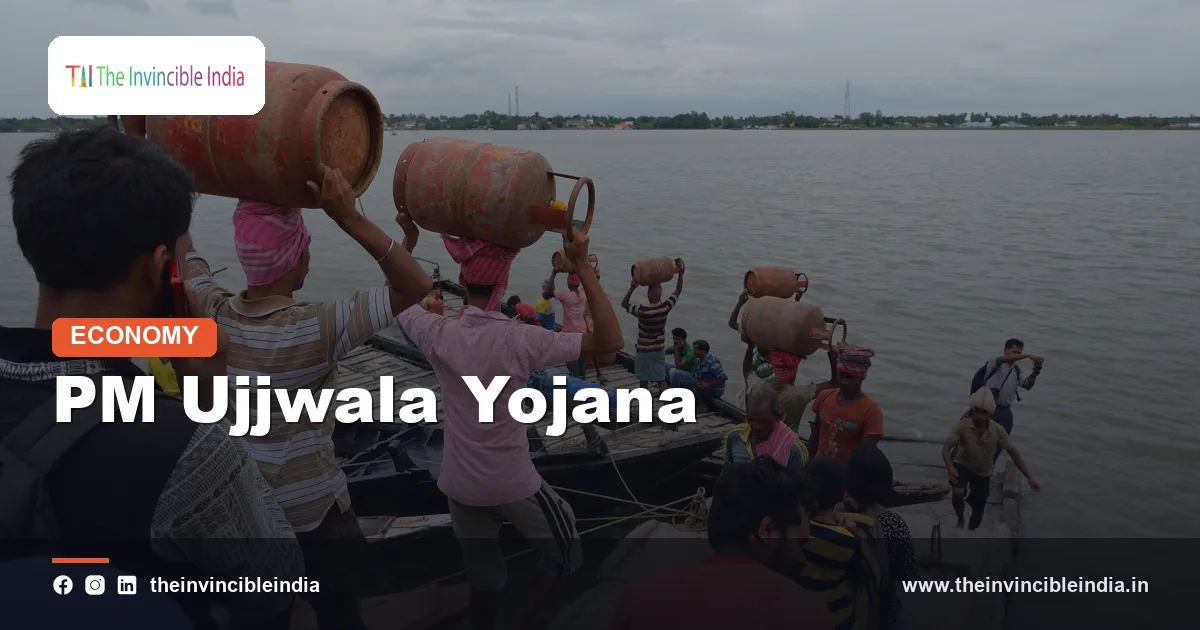
PM Ujjwala Yojana (PMUY) is a Government of India scheme, launched in 2016, that gives deposit-free Liquefied Petroleum Gas (LPG) connections to women from poor households so that they can cook with clean fuel instead of firewood, cow dung and coal. The scheme is run by the Ministry of Petroleum and Natural Gas through the public sector oil marketing companies, and it treats clean cooking as both a health measure and a step towards women’s empowerment.
PM Ujjwala Yojana was formally launched in May 2016 and has since been expanded through a second phase, Ujjwala 2.0. It has brought LPG to many crore households, but the continuing challenge is affordability of refills, because owning a connection does not by itself guarantee that a family will use gas regularly.
| Attribute | Detail |
|---|---|
| Full name | Pradhan Mantri Ujjwala Yojana (PMUY) |
| Launched | 1 May 2016, from Ballia in Uttar Pradesh |
| Ministry | Ministry of Petroleum and Natural Gas |
| Implementing agencies | Indian Oil, Bharat Petroleum and Hindustan Petroleum, through their LPG distributors |
| Type | Central-sector welfare scheme providing deposit-free LPG connections |
| Target beneficiary | Adult woman from a poor or vulnerable household without an existing LPG connection |
| Main aims | Clean cooking fuel, better health, reduced drudgery and women’s empowerment |
| Second phase | Ujjwala 2.0, launched in 2021, with a free first refill and stove and simpler documents for migrants |
Key Takeaways
- PM Ujjwala Yojana was launched on 1 May 2016 to provide deposit-free LPG connections to women from poor households.
- PM Ujjwala Yojana is administered by the Ministry of Petroleum and Natural Gas and delivered by Indian Oil, Bharat Petroleum and Hindustan Petroleum.
- The LPG connection under PM Ujjwala Yojana is issued in the name of an adult woman of the household, which recognises her as the primary cook and decision-maker for the kitchen.
- Ujjwala 2.0, launched in 2021, added further connections, a free first refill and stove, and relaxed address-proof rules for migrant families.
- Cooking on firewood, dung cakes and coal causes household air pollution linked to respiratory and eye problems, which PM Ujjwala Yojana aims to reduce.
- The biggest remaining challenge of PM Ujjwala Yojana is refill affordability, which the government addresses through a targeted subsidy credited directly to beneficiaries.
What is PM Ujjwala Yojana?
PM Ujjwala Yojana is a welfare scheme that provides a free LPG connection, with the security deposit paid by the government, to women belonging to poor households. Before the scheme, a large share of rural and low-income families relied on traditional biomass fuels such as firewood, crop residue and dried cow dung, because the up-front deposit for a gas connection and the cost of a stove were beyond their means.
The scheme lowers this entry barrier. The government meets the cost of the connection, and the oil marketing companies offered the stove and first refill through an easy repayment option in the first phase. The connection is issued in the woman’s name, and she is expected to be the main user of the cylinder.
The name “Ujjwala”, meaning bright or radiant, reflects the aim of replacing smoky kitchens with cleaner ones. The scheme is closely linked with the earlier Direct Benefit Transfer for LPG (PAHAL) initiative of 2015, which made it easier to deliver subsidy straight into bank accounts.
Why was PM Ujjwala Yojana started?
PM Ujjwala Yojana was started because indoor smoke from solid cooking fuels was recognised as a major health risk for women and children, and because many households could not afford the cost of switching to LPG. International health agencies, including the World Health Organization, have long identified household air pollution as one of the leading environmental health risks in developing countries.
The main motivations were:
- Health: smoke from burning biomass contains fine particles and gases that contribute to chronic respiratory disease, eye irritation and complications during pregnancy.
- Drudgery: collecting firewood takes hours, often from women and girls, and exposes them to safety risks.
- Environment: reducing the use of firewood eases pressure on forests and lowers black carbon emissions from kitchens.
- Equity: LPG use had been concentrated in urban and better-off homes, leaving poor rural families behind.
Who is eligible for PM Ujjwala Yojana?
The beneficiary of PM Ujjwala Yojana must be an adult woman from a poor or vulnerable household, and the household must not already have an LPG connection from any oil marketing company. The scheme initially covered women from households below the poverty line, identified through the Socio-Economic and Caste Census (SECC) 2011 list.
The eligible categories were widened over time to include women from groups such as:
- Scheduled Castes and Scheduled Tribes households
- Beneficiaries of Pradhan Mantri Awas Yojana (Gramin)
- Antyodaya Anna Yojana (AAY) card holders
- Most Backward Classes, tea and ex-tea garden tribes
- Forest dwellers and residents of islands and river islands
Applicants submit a simple application form with a KYC document, a bank account detail and a ration card or similar proof of household, through the LPG distributor. Aadhaar is commonly used for identity verification and for linking the subsidy to the bank account.
How does PM Ujjwala Yojana work?
PM Ujjwala Yojana works by combining a government-funded connection with a repayment option for the stove and first cylinder, delivered through the existing LPG distributor network. The process has a few steps.
- An eligible woman applies at an LPG distributor or through the online portal, with identity, address and bank details.
- The oil marketing company verifies the application and checks that no other LPG connection exists in the household.
- The connection is released and the government bears the security deposit cost for the cylinder and regulator.
- Under the first phase, the stove and first refill could be taken on an EMI basis, with the amount recovered from later subsidy on refills.
- Subsequent refills are bought at the market price, and the applicable subsidy, where available, is credited to the beneficiary’s bank account.
In Ujjwala 2.0, the first refill and the stove were provided free to eligible new beneficiaries, which removed the up-front cost almost entirely.
What is Ujjwala 2.0?
Ujjwala 2.0 is the second phase of PM Ujjwala Yojana, launched in August 2021, intended to reach the remaining poor households and migrant families who had been left out of the first phase. It provides additional connections along with a free first refill and a free hotplate or stove for new beneficiaries.
The key changes in the second phase were:
- Migrant families can use a self-declaration for proof of address, which had earlier been a major obstacle because migrants often lack a local address document.
- A simplified application process with fewer documents, intended to reduce delays at the distributor level.
- Free first refill and stove to lower the upfront burden for new beneficiaries.
- A continued focus on households in remote areas and on groups that were not covered earlier.
The first phase originally targeted five crore connections and later raised its goal to eight crore, which was reached ahead of the revised timeline. The second phase then added a further large group of connections.
What are the health and women’s empowerment benefits?
The health and women’s empowerment benefits of PM Ujjwala Yojana come from replacing smoky cooking with a clean flame, saving time spent gathering fuel and putting a valuable asset in a woman’s name. Researchers have linked clean cooking fuel to lower exposure to household air pollution, which is associated with respiratory illness and eye problems.
Health gains
- Cleaner indoor air reduces exposure to smoke from solid fuels.
- Pregnant women and young children, who spend long hours near the kitchen, gain particular benefit.
- Cooking with LPG is faster and reduces the risk of burns from open fires in many cases.
Empowerment gains
- Time saved from collecting firewood can be used for work, education or rest.
- Registering the connection in a woman’s name gives her an official identity as a head of a household asset.
- Access to bank accounts for subsidy transfers supports financial inclusion.
These benefits depend on regular use. A family that keeps LPG but returns to firewood for most cooking will see only part of the intended gain.
What is the refill affordability challenge?
The refill affordability challenge is that many Ujjwala households own an LPG connection but buy fewer cylinders than expected, because the market price of a refill is a large share of a poor family’s monthly budget. Studies of consumption have found that average refills per year among newer beneficiaries have been lower than for the general LPG population.
Several factors contribute:
- A refill must be paid for in a lump sum, which is difficult for families with irregular income.
- Firewood and dung cakes often cost little or nothing in cash terms, so families may “stack” fuels and use LPG only for quick tasks.
- Distance from the distributor in remote areas raises delivery costs and effort.
- Rises in the international price of LPG can push the refill cost up.
The government has responded with measures such as a targeted subsidy on refills for Ujjwala beneficiaries, smaller 5 kg cylinders for easier purchase, and an effort to widen distributor networks in remote areas.
How does the subsidy on refills work?
The subsidy on refills works through Direct Benefit Transfer, where the beneficiary pays the market price of the cylinder and the government credits a fixed subsidy to the linked bank account. This structure follows the PAHAL model introduced in 2015, which removed the older system of selling subsidised and non-subsidised cylinders at different prices.
For Ujjwala households, a targeted subsidy per cylinder has been announced on a limited number of refills each year. The amount is revised from time to time by the government, so beneficiaries should check the current figure with their distributor or the oil company portal. Because the subsidy is paid after purchase, families must first be able to pay the full amount, which is part of the affordability issue.
| Step | What happens |
|---|---|
| 1 | Beneficiary books a refill through the distributor, phone or app |
| 2 | Beneficiary pays the market price on delivery |
| 3 | Government subsidy is credited to the bank account linked with the connection |
| 4 | Account linking and KYC remain necessary for the credit to arrive |
How does PM Ujjwala Yojana compare with other clean-cooking efforts?
PM Ujjwala Yojana is the largest government effort to promote LPG for poor households in India, and it complements other clean-cooking efforts such as improved biomass cookstoves, biogas plants and piped natural gas. The table below summarises how these options compare in general terms.
| Option | Fuel | Typical strength | Typical limitation |
|---|---|---|---|
| LPG under Ujjwala | Liquefied petroleum gas | Clean, convenient, quick to cook | Recurring cost of refills; supply chain in remote areas |
| Improved cookstoves | Biomass | Lower smoke than open fires; low cost | Still emits particulates |
| Biogas plants | Cattle dung and waste | Free fuel after setup; slurry as manure | Needs livestock and regular feeding |
| Piped natural gas | Natural gas | Continuous supply, no cylinders | Limited to cities with pipeline networks |
Many experts recommend viewing these as complementary. LPG suits areas with reliable supply, while biogas or electric induction cooking may suit others, especially as renewable electricity grows.
What is the way forward for clean cooking in India?
The way forward for clean cooking in India is to move from connections to sustained use, by making refills cheaper and more accessible and by encouraging a wider mix of clean options. Success is increasingly measured not by the number of connections issued but by how often a household actually cooks on clean fuel.
Policy directions discussed include:
- Continued targeted subsidy and flexible payment options for small, frequent refills.
- Expansion of distributor and delivery networks in hilly, tribal and remote areas.
- Awareness campaigns about the safe use of LPG and the health impact of smoke.
- Support for alternatives such as biogas, piped gas and electric cooking in suitable locations.
Bottom Line
PM Ujjwala Yojana has widened access to clean cooking gas by removing the connection cost for women from poor households, with Ujjwala 2.0 extending the reach to migrants and further beneficiaries. The remaining task is to make regular refilling affordable, so that the health and empowerment benefits are realised in daily practice. This article is general information, not advice; subsidy amounts and rules change, so check official sources. Last reviewed: 15 October 2026.
Frequently Asked Questions
What is PM Ujjwala Yojana?
PM Ujjwala Yojana is a government scheme, launched in 2016, that gives deposit-free LPG connections to women from poor households. It is run by the Ministry of Petroleum and Natural Gas through oil marketing companies. The goal is to replace firewood and dung with clean cooking fuel.
Who can get a connection under PM Ujjwala Yojana?
An adult woman from a poor or vulnerable household without an existing LPG connection can get a connection. Eligible groups include Scheduled Castes, Scheduled Tribes, Antyodaya Anna Yojana card holders and PMAY-Gramin beneficiaries, among others. The application is made through an LPG distributor with identity, address and bank details.
Is the LPG connection under Ujjwala really free?
The connection itself is free because the government pays the security deposit, but the refills are bought at the market price. Under Ujjwala 2.0, the first refill and a stove are also provided free to new beneficiaries. Later refills are paid for by the family, with a targeted subsidy credited afterwards.
What is Ujjwala 2.0?
Ujjwala 2.0 is the second phase launched in August 2021 to cover remaining poor households and migrant families. It provides a free first refill and stove and allows self-declaration as address proof for migrants. It aims to remove documentation barriers that blocked many families earlier.
Why do some Ujjwala households still use firewood?
Some Ujjwala households still use firewood because the cash cost of an LPG refill is high compared with free or cheap biomass fuels. Families often use both fuels in a practice called fuel stacking. Distance from distributors and irregular income also reduce the number of refills purchased.
How is the refill subsidy paid?
The refill subsidy is paid through Direct Benefit Transfer into the bank account linked to the LPG connection. The beneficiary first pays the market price and then receives the subsidy amount. The amount is revised by the government from time to time.
{“@context”:”https://schema.org”,”@graph”:[{“@type”:”FAQPage”,”mainEntity”:[{“@type”:”Question”,”name”:”What is PM Ujjwala Yojana?”,”acceptedAnswer”:{“@type”:”Answer”,”text”:”PM Ujjwala Yojana is a government scheme, launched in 2016, that gives deposit-free LPG connections to women from poor households. It is run by the Ministry of Petroleum and Natural Gas through oil marketing companies. The goal is to replace firewood and dung with clean cooking fuel.”}},{“@type”:”Question”,”name”:”Who can get a connection under PM Ujjwala Yojana?”,”acceptedAnswer”:{“@type”:”Answer”,”text”:”An adult woman from a poor or vulnerable household without an existing LPG connection can get a connection. Eligible groups include Scheduled Castes, Scheduled Tribes, Antyodaya Anna Yojana card holders and PMAY-Gramin beneficiaries, among others. The application is made through an LPG distributor with identity, address and bank details.”}},{“@type”:”Question”,”name”:”Is the LPG connection under Ujjwala really free?”,”acceptedAnswer”:{“@type”:”Answer”,”text”:”The connection itself is free because the government pays the security deposit, but the refills are bought at the market price. Under Ujjwala 2.0, the first refill and a stove are also provided free to new beneficiaries. Later refills are paid for by the family, with a targeted subsidy credited afterwards.”}},{“@type”:”Question”,”name”:”What is Ujjwala 2.0?”,”acceptedAnswer”:{“@type”:”Answer”,”text”:”Ujjwala 2.0 is the second phase launched in August 2021 to cover remaining poor households and migrant families. It provides a free first refill and stove and allows self-declaration as address proof for migrants. It aims to remove documentation barriers that blocked many families earlier.”}},{“@type”:”Question”,”name”:”Why do some Ujjwala households still use firewood?”,”acceptedAnswer”:{“@type”:”Answer”,”text”:”Some Ujjwala households still use firewood because the cash cost of an LPG refill is high compared with free or cheap biomass fuels. Families often use both fuels in a practice called fuel stacking. Distance from distributors and irregular income also reduce the number of refills purchased.”}},{“@type”:”Question”,”name”:”How is the refill subsidy paid?”,”acceptedAnswer”:{“@type”:”Answer”,”text”:”The refill subsidy is paid through Direct Benefit Transfer into the bank account linked to the LPG connection. The beneficiary first pays the market price and then receives the subsidy amount. The amount is revised by the government from time to time.”}}]}]}


