

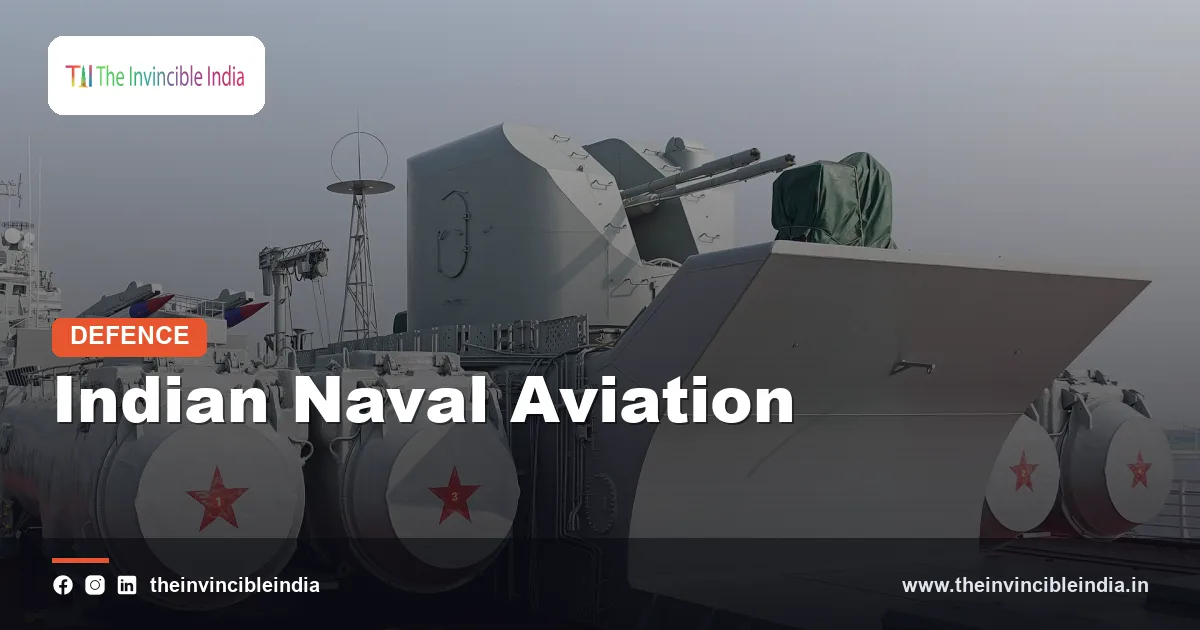
Indian Naval Aviation is the air arm of the Indian Navy, a force of ship-borne and shore-based fixed-wing aircraft, helicopters and unmanned aerial vehicles that extends the Navy’s ability to find, track and strike targets at sea. The Navy’s air component was formally born in 1953 and has since grown from a small training and communications unit into a full-spectrum force that operates from aircraft carriers, destroyers, frigates and a chain of naval air stations along the coastline and island territories.
Naval aviation matters because the Indian Ocean Region is vast and ships alone cannot watch it. Aircraft and helicopters multiply the reach of every warship, giving the Indian Navy eyes over the horizon, a means to hunt submarines, and the ability to project air power from the sea. This explainer covers the history, aircraft types, carriers, air stations, organisation and roles of the force.
| Attribute | Detail |
|---|---|
| Parent service | Indian Navy, under the Ministry of Defence |
| Also known as | Naval Air Arm, Fleet Air Arm (informal usage) |
| Formal beginning | 1953, with the commissioning of INS Garuda at Kochi |
| First aircraft carrier | INS Vikrant (ex-HMS Hercules), commissioned in 1961 |
| Carrier-borne fighters | Sea Hawk, Sea Harrier (historic); MiG-29K (current) |
| Maritime patrol aircraft | Dornier Do-228, Il-38 (historic), Tu-142M (historic), P-8I Poseidon |
| Helicopters | Sea King, Kamov Ka-28 and Ka-31, Chetak, ALH Dhruv, MH-60R |
| Squadron designation | Indian Naval Air Squadron (INAS) |
| Carriers in service | INS Vikramaditya and the indigenously built INS Vikrant |
Key Takeaways
- Indian Naval Aviation began formally in 1953, when INS Garuda was commissioned as the first naval air station at Kochi.
- The Indian Navy’s first aircraft carrier, INS Vikrant, was commissioned in 1961.
- Indian Naval Aviation flies the MiG-29K as its carrier-borne fighter, the successor to the Sea Harrier that operated from Indian carriers between the 1980s and 2016.
- The P-8I Poseidon, a long-range maritime patrol and anti-submarine aircraft built on the Boeing 737 airframe, is the most capable fixed-wing patrol platform of Indian Naval Aviation.
- Indian Naval Aviation units are called Indian Naval Air Squadrons (INAS), and each squadron is based at a named naval air station, many of which carry an “INS” prefix.
- INS Vikrant, commissioned in 2022 and built at Cochin Shipyard, is India’s first indigenously designed and built aircraft carrier.
What is Indian Naval Aviation?
Indian Naval Aviation is the branch of the Indian Navy responsible for operating aircraft, helicopters and unmanned systems for maritime missions. Its work covers surveillance, anti-submarine warfare, anti-surface warfare, search and rescue, transport, training and, through carrier-borne fighters, air defence and strike.
The force is not a separate service like the Indian Air Force. Its aircrew, technical staff and ground personnel are naval personnel, and its aircraft carry naval markings. Naval aviators are trained as pilots or as observers, who handle sensors and weapons in multi-crew aircraft. Maintenance is the responsibility of naval air technicians and engineers, organised in a specialised aviation branch.
The squadrons are designated Indian Naval Air Squadrons and are numbered, for example INAS 303 for the MiG-29K squadron known as the Black Panthers and INAS 300 for the former Sea Harrier squadron known as the White Tigers. Each squadron has a flight role, an aircraft type and a home station.
How did Indian Naval Aviation begin?
Indian Naval Aviation began in 1953, when the Navy set up a Fleet Requirements Unit and commissioned INS Garuda, its first naval air station, at Kochi, then called Cochin. Before that date, the Royal Indian Navy had no dedicated air component, and ship-based air cover was provided by the colonial-era air forces.
The decision to build a naval air arm was taken in the early years after independence, as the Indian Navy began planning an aircraft carrier fleet. India acquired the former British light fleet carrier HMS Hercules and commissioned it in 1961 as INS Vikrant. Its air group initially included Hawker Sea Hawk fighter-bombers and French-built Breguet Alizé anti-submarine aircraft. These aircraft established the carrier-borne tradition that continues today.
During the 1971 war, aircraft from INS Vikrant struck targets in what was then East Pakistan, demonstrating the value of sea-based air power in a regional conflict. The war remains the best-known early test of Indian Naval Aviation.
Key phases in the history of the Naval Air Arm
- 1953: The Naval Air Arm is established, and INS Garuda is commissioned at Kochi.
- 1961: INS Vikrant joins the fleet as the first Indian aircraft carrier.
- 1971: Carrier-borne aircraft support operations in the Bay of Bengal.
- 1983 onwards: The Sea Harrier enters service, bringing vertical and short take-off capability.
- 1987: INS Viraat, the former HMS Hermes, joins the fleet.
- 2013: INS Vikramaditya is commissioned and the MiG-29K enters carrier service.
- 2022: The indigenous INS Vikrant is commissioned.
What aircraft does Indian Naval Aviation operate?
Indian Naval Aviation operates four broad categories of aircraft: carrier-borne fighters, maritime patrol aircraft, helicopters, and unmanned aerial vehicles. A fifth category, trainers and communications aircraft, supports flight instruction and logistics. Each category has a distinct role in maritime operations.
| Category | Aircraft | Primary role |
|---|---|---|
| Carrier-borne fighters | MiG-29K (current); Sea Harrier FRS Mk 51 (retired 2016) | Fleet air defence, strike, reconnaissance |
| Maritime patrol | P-8I Poseidon, Dornier Do-228; formerly Tu-142M and Il-38 | Surveillance, anti-submarine, anti-ship |
| Anti-submarine helicopters | Sea King Mk 42 series, Ka-28, MH-60R | Submarine hunting, ship-borne operations |
| Airborne early warning | Kamov Ka-31 | Radar picket for the fleet |
| Utility and light helicopters | Chetak, ALH Dhruv | Search and rescue, transport, coastal patrol |
| Unmanned aerial vehicles | Searcher, Heron | Surveillance and reconnaissance |
| Trainers | Hawk Mk 132, HAL HJT-16 Kiran | Pilot and observer training |
What are the carrier-borne fighters of the Indian Navy?
The carrier-borne fighter of Indian Naval Aviation today is the Russian-built MiG-29K, a multi-role aircraft that replaced the British-built Sea Harrier. The MiG-29K is a navalised version of the MiG-29 with a strengthened airframe, folding wings, an arrester hook and a larger fuel capacity, and it operates from carriers using a ski-jump launch and arrested recovery.
The Sea Harrier, in service from 1983, was a vertical and short take-off aircraft. It served first aboard INS Viraat. Its radar and missile fit gave the Navy an air defence capability at sea, but it was limited in range and payload. The Sea Harrier fleet was progressively retired and withdrawn from service in 2016.
The MiG-29K operates from INS Vikramaditya and INS Vikrant, and it can also fly from shore bases such as INS Hansa in Goa. In the future, the Navy has also considered other carrier-capable aircraft, including indigenous designs, through the Ministry of Defence’s acquisition processes.
What maritime patrol aircraft does Indian Naval Aviation use?
The principal maritime patrol aircraft of Indian Naval Aviation are the Boeing P-8I Poseidon and the Dornier Do-228. The P-8I is a long-range, multi-role aircraft based on the Boeing 737 airliner, fitted with search radar, sonobuoys, an electro-optical suite and weapons such as torpedoes and anti-ship missiles. It entered Indian service from 2013 and is based at INS Rajali, Arakkonam, in Tamil Nadu.
Earlier long-range patrol was flown by the Tupolev Tu-142M, a Soviet-era turboprop known for its endurance, and the Ilyushin Il-38. These aircraft retired after decades of service, with the Tu-142M squadron stood down in 2017. The Dornier Do-228, a light utility aircraft built by Hindustan Aeronautics Limited under licence, provides short-range coastal surveillance and is also used for transport.
Maritime patrol aircraft are central to monitoring India’s Exclusive Economic Zone, which covers a very large sea area around the mainland and island territories. They detect surface vessels, track submarines and support search and rescue operations.
What helicopters are used by Indian Naval Aviation?
Indian Naval Aviation uses helicopters for anti-submarine warfare, airborne early warning, search and rescue, utility transport and training. Types in use have included the Westland Sea King, the Kamov Ka-28 and Ka-31, the HAL Chetak, the indigenously developed HAL Advanced Light Helicopter (ALH) Dhruv, and the American MH-60R Seahawk.
Sea King and Kamov helicopters
The Westland Sea King Mk 42 series was the long-serving anti-submarine and utility helicopter of the Navy, flying from carriers, destroyers and shore bases. The Russian-built Kamov Ka-28 is an anti-submarine helicopter operated from Russian-origin warships, while the Ka-31 carries a rotating radar that gives the fleet airborne early warning against low-flying aircraft and missiles.
ALH Dhruv, Chetak and MH-60R
The ALH Dhruv is a twin-engine helicopter designed and built in India by Hindustan Aeronautics Limited, with maritime variants used for coastal surveillance and rescue. The Chetak, a licence-built French light helicopter, has served as a light utility and rescue helicopter for decades. The MH-60R Seahawk, a Lockheed Martin Sikorsky multi-role helicopter, was ordered from the United States in 2020 to strengthen anti-submarine and anti-surface capability.
Which aircraft carriers does Indian Naval Aviation fly from?
Indian Naval Aviation flies from two aircraft carriers in service, INS Vikramaditya and INS Vikrant, after the retirement of INS Viraat in 2017. A carrier is the mobile airfield around which a carrier battle group is built, and it embarks fighters, helicopters and airborne early warning aircraft in a single air wing.
- INS Vikrant (R11): the first carrier, commissioned 1961, originally HMS Hercules, retired in 1997.
- INS Viraat: the former HMS Hermes, in Indian service from 1987 to 2017, which operated Sea Harriers and helicopters.
- INS Vikramaditya: the former Soviet Admiral Gorshkov, modified in Russia and commissioned in 2013.
- INS Vikrant (IAC-1): the first indigenous carrier, designed by the Directorate of Naval Design and built by Cochin Shipyard Limited, commissioned in 2022.
Both current carriers use the STOBAR method, short take-off but arrested recovery. Fighters take off from a ski-jump ramp at the bow and land by catching an arrester wire with a tail hook.
Where are the naval air stations of India?
Naval air stations of India are shore establishments, mostly named with the prefix “INS”, from which squadrons operate and train. They are spread across the west coast, east coast and island territories so that maritime patrol and fleet support reach all sea approaches.
| Naval air station | Location | Notable role |
|---|---|---|
| INS Garuda | Kochi, Kerala | The first naval air station, commissioned in 1953; helicopters and training |
| INS Hansa | Dabolim, Goa | Major fighter and training base, home to MiG-29K operations |
| INS Rajali | Arakkonam, Tamil Nadu | Large air station for maritime patrol aircraft |
| INS Dega | Visakhapatnam, Andhra Pradesh | Air station for the Eastern Naval Command |
| INS Parundu | Uchipuli, Tamil Nadu | Coastal air station near the Palk Strait |
| INS Kunjali | Mumbai, Maharashtra | Air station in the Western Naval Command |
| INS Shikra | Mumbai, Maharashtra | Helicopter base |
| INS Baaz | Campbell Bay, Great Nicobar | Island air station for surveillance |
| INS Utkrosh | Port Blair, Andaman | Island air station in the Andaman and Nicobar Command |
In addition to these air stations, naval aircraft use air bases of other services and civil airports by agreement. Warships carry helicopters embarked on their decks, which is why a destroyer or frigate can be considered a small naval air station at sea.
Who commands Indian Naval Aviation, and how is it organised?
Indian Naval Aviation is commanded through the Navy’s normal chain of command, with a Flag Officer Naval Aviation responsible for the aviation function and Naval Headquarters in New Delhi setting policy. The Navy has three operational commands, the Western, Eastern and Southern Naval Commands, headquartered at Mumbai, Visakhapatnam and Kochi, and aviation assets are assigned to each.
Squadrons are grouped by role and location. Fighter squadrons embark on carriers or fly from shore bases; patrol squadrons operate from stations such as INS Rajali; helicopter squadrons embark on ships or operate from shore. Training for aircrew follows a path through basic flying training, advanced training on jets, and operational conversion on the specific aircraft.
The Navy has opened aircrew roles to women. In 2018, the first women pilots in the Navy’s maritime reconnaissance stream began flying, expanding participation in the aviation branch.
Why does Indian Naval Aviation matter for India?
Indian Naval Aviation matters because India has a long coastline, large island territories and a maritime zone that spans a huge area of the Indian Ocean. Aircraft extend surveillance far beyond the horizon of warship radars, supporting maritime domain awareness, anti-submarine warfare, anti-piracy patrols, humanitarian assistance and disaster relief.
- Surveillance: Patrol aircraft and unmanned systems monitor shipping lanes and the Exclusive Economic Zone.
- Anti-submarine warfare: Maritime patrol aircraft and helicopters detect and engage submarines.
- Air defence of the fleet: Carrier-borne fighters and airborne early warning helicopters protect ships.
- Strike: Fighters and helicopters can carry anti-ship missiles to engage surface targets.
- Humanitarian missions: Helicopters conduct rescue after floods, cyclones and maritime accidents.
Naval aviation has also supported evacuation, medical missions and relief operations along the coast, where speed and reach matter.
What are the unmanned systems and future directions of Indian Naval Aviation?
Unmanned aerial vehicles are a growing part of Indian Naval Aviation, with Israeli-origin Searcher and Heron systems providing long-endurance surveillance for decades. These systems extend patrol endurance, reduce risk to crew and add persistent sensing over wide ocean areas, and the Navy has also leased and evaluated additional long-endurance platforms.
Future directions are shaped by the government’s push for self-reliance in defence. Indigenous designs such as the ALH Dhruv and the indigenous aircraft carrier INS Vikrant reflect that direction, as does ongoing work on deck-based fighter options and indigenous unmanned systems. The Navy’s approach is to combine imported high-end platforms with locally built aircraft, ships and weapons.
Bottom Line
Indian Naval Aviation has grown in seven decades from a single air station at Kochi into a force with carrier-borne fighters, long-range patrol aircraft, helicopters and unmanned systems. Its mission is to give the Indian Navy reach, persistence and striking power across the Indian Ocean. As new platforms and indigenous designs enter service, the Naval Air Arm will remain central to India’s maritime security.
Frequently Asked Questions
When was Indian Naval Aviation established?
Indian Naval Aviation was established in 1953, when the Navy created its air arm and commissioned INS Garuda at Kochi. The first aircraft carrier, INS Vikrant, followed in 1961. The air arm has expanded steadily since.
Which fighter aircraft does the Indian Navy use on its carriers?
The Indian Navy uses the MiG-29K as its carrier-borne fighter. It replaced the Sea Harrier, which was withdrawn in 2016 after serving from 1983. The MiG-29K operates from INS Vikramaditya and INS Vikrant.
What is the P-8I Poseidon?
The P-8I Poseidon is a long-range maritime patrol and anti-submarine aircraft built by Boeing on a 737 airframe for the Indian Navy. It carries search radar, sonobuoys and weapons, and it is based at INS Rajali, Arakkonam. It has been in Indian service since 2013.
How many aircraft carriers does India have?
India has two aircraft carriers in service: INS Vikramaditya, commissioned in 2013, and the indigenous INS Vikrant, commissioned in 2022. The earlier carriers INS Vikrant (R11) and INS Viraat have been retired. INS Viraat left service in 2017.
What is an Indian Naval Air Squadron?
An Indian Naval Air Squadron, abbreviated INAS, is a numbered flying unit of the Indian Navy that operates a particular aircraft type from a particular station. For example, INAS 303 flies the MiG-29K. Squadron numbers also identify the role, such as patrol, helicopter or training.
Which naval air station is the oldest?
INS Garuda at Kochi is the oldest naval air station of the Indian Navy, commissioned in 1953. It started as the base of the Naval Air Arm and still hosts helicopters and training. Other major stations include INS Hansa in Goa and INS Rajali in Arakkonam.
{“@context”:”https://schema.org”,”@graph”:[{“@type”:”FAQPage”,”mainEntity”:[{“@type”:”Question”,”name”:”When was Indian Naval Aviation established?”,”acceptedAnswer”:{“@type”:”Answer”,”text”:”Indian Naval Aviation was established in 1953, when the Navy created its air arm and commissioned INS Garuda at Kochi. The first aircraft carrier, INS Vikrant, followed in 1961. The air arm has expanded steadily since.”}},{“@type”:”Question”,”name”:”Which fighter aircraft does the Indian Navy use on its carriers?”,”acceptedAnswer”:{“@type”:”Answer”,”text”:”The Indian Navy uses the MiG-29K as its carrier-borne fighter. It replaced the Sea Harrier, which was withdrawn in 2016 after serving from 1983. The MiG-29K operates from INS Vikramaditya and INS Vikrant.”}},{“@type”:”Question”,”name”:”What is the P-8I Poseidon?”,”acceptedAnswer”:{“@type”:”Answer”,”text”:”The P-8I Poseidon is a long-range maritime patrol and anti-submarine aircraft built by Boeing on a 737 airframe for the Indian Navy. It carries search radar, sonobuoys and weapons, and it is based at INS Rajali, Arakkonam. It has been in Indian service since 2013.”}},{“@type”:”Question”,”name”:”How many aircraft carriers does India have?”,”acceptedAnswer”:{“@type”:”Answer”,”text”:”India has two aircraft carriers in service: INS Vikramaditya, commissioned in 2013, and the indigenous INS Vikrant, commissioned in 2022. The earlier carriers INS Vikrant (R11) and INS Viraat have been retired. INS Viraat left service in 2017.”}},{“@type”:”Question”,”name”:”What is an Indian Naval Air Squadron?”,”acceptedAnswer”:{“@type”:”Answer”,”text”:”An Indian Naval Air Squadron, abbreviated INAS, is a numbered flying unit of the Indian Navy that operates a particular aircraft type from a particular station. For example, INAS 303 flies the MiG-29K. Squadron numbers also identify the role, such as patrol, helicopter or training.”}},{“@type”:”Question”,”name”:”Which naval air station is the oldest?”,”acceptedAnswer”:{“@type”:”Answer”,”text”:”INS Garuda at Kochi is the oldest naval air station of the Indian Navy, commissioned in 1953. It started as the base of the Naval Air Arm and still hosts helicopters and training. Other major stations include INS Hansa in Goa and INS Rajali in Arakkonam.”}}]}]}


