

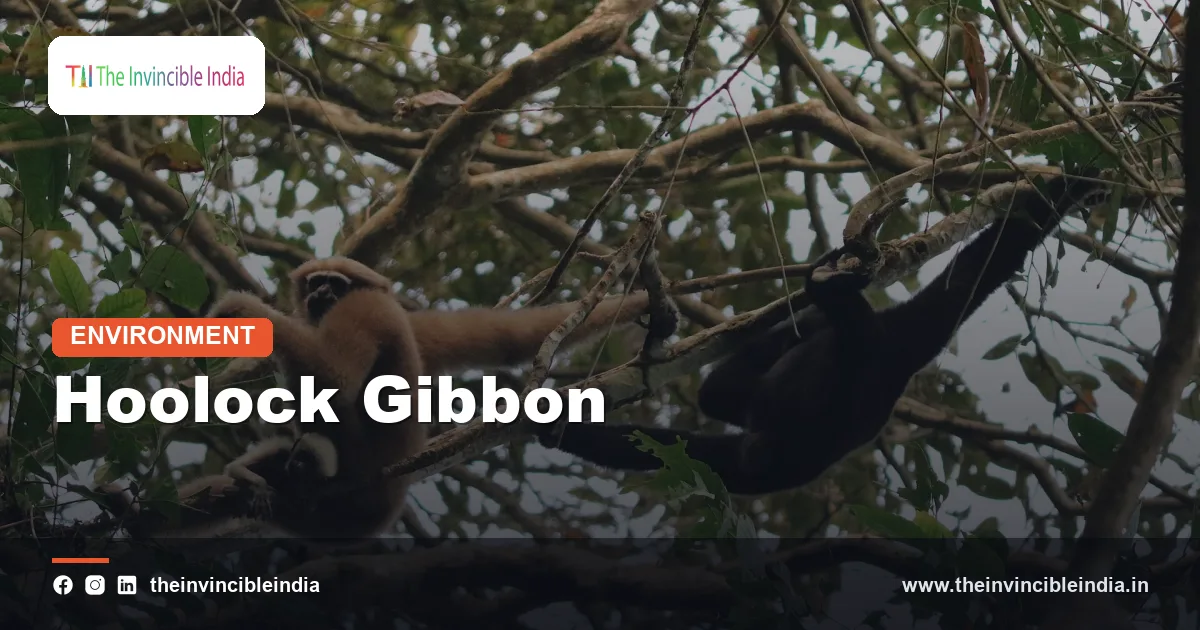
The hoolock gibbon is India’s only ape, a long-armed, tailless, tree-dwelling primate of the rainforests of Northeast India that swings through the canopy by brachiation and announces its territory with loud, haunting duets. India has two species, the western hoolock gibbon (Hoolock hoolock) and the eastern hoolock gibbon (Hoolock leuconedys), and both are threatened by the loss and fragmentation of the forests on which they depend.
Hoolock gibbon conservation in India focuses on protecting tall evergreen forest, reconnecting broken canopy, and curbing hunting and capture. This explainer describes what the animal is, how it lives, where it survives, what threatens it, and what conservation measures such as canopy bridges and protected sanctuaries are doing to help.
Quick Facts
| Attribute | Detail |
|---|---|
| Common name | Hoolock gibbon |
| Species in India | Western hoolock gibbon (Hoolock hoolock) and eastern hoolock gibbon (Hoolock leuconedys) |
| Group | Apes (family Hylobatidae, the lesser apes) |
| Distinction | The only ape species found in India |
| Range in India | Assam, Arunachal Pradesh, Meghalaya, Nagaland, Manipur, Mizoram and Tripura |
| Habitat | Tall evergreen and semi-evergreen tropical rainforest with continuous canopy |
| Social structure | Monogamous pairs with their young |
| IUCN status | Western hoolock: Endangered; eastern hoolock: Vulnerable |
| Legal protection in India | Schedule I of the Wildlife (Protection) Act, 1972 |
Key Takeaways
- The hoolock gibbon is the only ape found in India, and it lives in the evergreen forests of the Northeast.
- Hoolock gibbons are tailless and move by brachiation, swinging hand over hand beneath branches, and they almost never come down to the ground.
- A hoolock gibbon pair lives as a monogamous couple and sings loud duets that advertise their territory and strengthen their bond.
- The western hoolock gibbon is classified as Endangered and the eastern hoolock gibbon as Vulnerable by the IUCN.
- Loss of tall continuous forest, canopy gaps created by roads, railways and tea gardens, and hunting and capture are the main threats to hoolock gibbons.
- Hollongapar Gibbon Wildlife Sanctuary in Assam is India’s best-known gibbon sanctuary, and artificial canopy bridges are used to reconnect forest fragments.
What is a hoolock gibbon?
A hoolock gibbon is a small ape that lives high in the canopy of tropical rainforests and is the only member of the ape family native to India. Gibbons are called lesser apes to distinguish them from the great apes such as orangutans, gorillas, chimpanzees and humans.
Hoolock gibbons weigh only a few kilograms, have no tail, and have extremely long arms, longer than their legs. Their name is thought to come from their loud calls, which sound like a rising “hoo-lock” and can carry through the forest for a considerable distance.
How can you tell male and female hoolock gibbons apart?
Male and female hoolock gibbons differ in colour, which is unusual among apes. Adult males are black or very dark with white brow marks above the eyes, while adult females are buff, golden or pale brown with darker patches on the face. Infants are born pale and turn dark within months. Females stay dark until they reach maturity, when their coat gradually turns lighter.
What is the difference between the western and eastern hoolock gibbon?
The western hoolock gibbon and the eastern hoolock gibbon are two distinct species that differ in facial markings, genetics and geographic range. They were once treated as subspecies of one hoolock gibbon but are now generally recognised as separate species.
| Feature | Western hoolock gibbon | Eastern hoolock gibbon |
|---|---|---|
| Scientific name | Hoolock hoolock | Hoolock leuconedys |
| Brow marks in males | White brow bars that are joined or nearly joined | White brow marks that are clearly separated |
| Range in India | South of the Brahmaputra in Assam and the hill states of the Northeast | Far-eastern Arunachal Pradesh and adjoining parts of Assam |
| Range outside India | Bangladesh and Myanmar west of the Chindwin | Myanmar east of the Chindwin and southwestern China |
| IUCN status | Endangered | Vulnerable |
The Brahmaputra and other large rivers act as barriers because gibbons will not cross open water or open ground, which helps explain how separate species arose in neighbouring forests.
Where do hoolock gibbons live in India?
Hoolock gibbons live in the tropical evergreen and semi-evergreen forests of Northeast India, mainly in Assam, Arunachal Pradesh, Meghalaya, Nagaland, Manipur, Mizoram and Tripura. They are strictly arboreal and need tall trees with a continuous canopy so they can move, feed and sleep without touching the ground.
Key sites include Hollongapar Gibbon Wildlife Sanctuary in Jorhat district of Assam, the forests of Dehing Patkai in eastern Assam, parts of Arunachal Pradesh’s Eastern Himalayan reserves, and hill forests in Meghalaya, Mizoram and Tripura. Some groups also live in small forest patches, tea estates and community forests.
What is Hollongapar Gibbon Wildlife Sanctuary?
Hollongapar Gibbon Wildlife Sanctuary is a small protected forest in Jorhat district, Assam, and is the only sanctuary in India named for gibbons. The sanctuary covers roughly twenty square kilometres and is named after the hollong tree, a tall evergreen tree that forms much of its canopy. It supports a notable gibbon population and shelters several other primates, including the stump-tailed macaque, the capped langur, the northern pig-tailed macaque, the Assamese macaque, the rhesus macaque and the Bengal slow loris, which together give it an exceptionally rich primate community.
A railway line passes alongside the area and tea estates surround it, which makes the sanctuary a textbook case of an isolated forest island and highlights why connectivity matters.
How does a hoolock gibbon move through the forest?
A hoolock gibbon moves through the forest by brachiation, a swinging motion in which it uses its long arms to travel hand over hand from branch to branch beneath the canopy. Brachiation lets gibbons cross gaps of several metres at speed while using relatively little energy.
Their hands are hook-shaped, their wrists are highly flexible, and their shoulders rotate freely. Gibbons also leap, bipedally walk along thick branches with arms raised for balance, and may jump between trees. They usually avoid the ground, because it exposes them to predators and because gibbons are poorly suited to walking long distances on it. Where a gap opens in the canopy, a gibbon group may be unable to cross.
What do hoolock gibbons eat?
Hoolock gibbons eat mainly ripe fruit, especially figs, supplemented by leaves, shoots, flowers and insects. Their diet makes them important seed dispersers, because the seeds of the fruit they eat are carried through the forest and spread in their droppings.
Because ripe fruit varies through the year, gibbons depend on a mix of tree species that fruit at different times. A forest stripped of large fruiting trees can no longer feed a gibbon family, even if some trees remain standing.
Why do hoolock gibbons sing?
Hoolock gibbons sing to claim territory, to attract mates and to strengthen the bond between a pair. Their songs are loud, complex and repeated, usually in the morning, and they can be heard from far away across the forest.
A mated pair often sings a duet, with the male and female using different calls that fit together. Neighbouring groups answer one another, which allows gibbons to mark boundaries without physically fighting. Researchers can use these calls to estimate how many groups live in a forest, because the songs are easier to detect than the animals themselves.
How do hoolock gibbon families live and breed?
Hoolock gibbon families live as monogamous pairs with their young, defending a territory through song and display. A typical group has an adult male, an adult female and between one and a few offspring of different ages.
- Pair bonding: Adult pairs tend to stay together over many years.
- Slow breeding: A female usually produces a single infant after a gestation of roughly seven months, and then cares for it for a long period, so births are spaced about two or three years apart.
- Parental care: Both parents help look after the young, and juveniles stay with the family until they approach maturity and leave to find a mate.
- Long lifespan: Gibbons can live for decades, which means that a loss of adults has a long-lasting effect on the population.
Slow reproduction is a major reason why hoolock gibbon populations recover slowly once they decline.
What threatens the hoolock gibbon in India?
The hoolock gibbon in India is threatened mainly by habitat loss and fragmentation, hunting and capture, and the isolation of small forest patches. Because a gibbon needs unbroken canopy, even a narrow gap in the trees can divide a population.
- Deforestation: Forests have been cleared for tea, agriculture, settlement, timber, mining and shifting cultivation, leaving many gibbon groups in small patches.
- Canopy gaps: Roads, railway lines, pipelines, power lines and clearings split forest into islands that gibbons cannot cross without descending to the ground.
- Hunting and capture: Gibbons are hunted in some areas for meat and for traditional medicine. Infants are sometimes captured for the pet trade, which usually involves killing the mother.
- Small, isolated populations: Groups cut off from one another face inbreeding and local extinction from chance events.
- Disturbance and electrocution: Gibbons are occasionally killed by low-hanging power lines or disturbed by logging and human activity.
What is the conservation status of the hoolock gibbon?
The western hoolock gibbon is classified as Endangered and the eastern hoolock gibbon as Vulnerable by the International Union for Conservation of Nature (IUCN). Both species have shrunk in range and numbers as forest has been lost across the region.
In India, both species are protected under Schedule I of the Wildlife (Protection) Act, 1972. This bans hunting and trade and provides the highest level of legal safeguards. Internationally, hoolock gibbons are covered by the Convention on International Trade in Endangered Species (CITES), which restricts international trade. Because the species occurs in Bangladesh and Myanmar as well, cross-border cooperation matters.
What are canopy bridges and how do they help hoolock gibbons?
Canopy bridges are artificial structures, usually made of ropes or poles strung between trees, that give gibbons a way to cross gaps in the forest without descending to the ground. They are used where roads, railways or clearings have split a gibbon group’s territory.
In the Northeast, forest departments and conservation organisations have installed rope and pole bridges in and near gibbon habitat, including around Hollongapar, and groups have been recorded using them. Canopy bridges are a short-term remedy rather than a permanent solution, because the long-term goal is to restore continuous natural canopy by planting native trees such as the hollong, nahor and figs, so that the gap closes on its own.
| Conservation tool | How it helps hoolock gibbons |
|---|---|
| Protected sanctuaries | Secure core forest, such as Hollongapar, from clearing and hunting |
| Canopy bridges | Reconnect groups separated by roads, tracks or railway lines |
| Native tree planting | Restores canopy gaps and creates food trees |
| Community engagement | Reduces hunting and capture and supports forest protection by villages |
| Population surveys using calls | Tracks how many groups remain and where they live |
| Rescue and rehabilitation | Treats confiscated or injured gibbons and, where possible, returns them to the wild |
How else is the hoolock gibbon being conserved?
The hoolock gibbon is being conserved through a combination of habitat protection, community work, scientific surveys, and restoration of degraded forest. Strong results typically depend on local communities, because many gibbons live in forest that people own or use.
Conservation organisations and forest departments run awareness programmes in villages near gibbon habitat, support alternative livelihoods and train local people as forest guards. Researchers monitor gibbon groups by listening for songs at dawn from fixed points, a method that avoids disturbing the animals. India has also taken part in regional action planning for hoolock gibbons that brings together India, Bangladesh and Myanmar.
Restoration is increasingly important. Planting native fruit and canopy trees along degraded edges and corridors helps rebuild the habitat structure that the apes need and reduces dependence on temporary structures.
Why does the hoolock gibbon matter for Northeast India?
The hoolock gibbon matters for Northeast India because it is a flagship species whose survival signals the health of tall tropical rainforest, one of the region’s most threatened habitats. Protecting the apes means protecting an entire forest community of primates, hornbills, orchids and trees.
As seed dispersers, gibbons help regenerate forest. As a charismatic and culturally recognised species, they also draw attention, funding and tourism to forests that might otherwise be viewed only for timber or farmland. The Northeast sits within the Indo-Burma biodiversity hotspot, so losing gibbons would be a warning about wider damage.
Bottom Line
Hoolock gibbon conservation in India is about keeping a continuous canopy in the forests of the Northeast so that the country’s only ape can still travel, feed and sing. Both species are threatened, but protected sanctuaries, canopy bridges, tree planting and local support offer practical ways to give gibbon families room to survive.
Frequently Asked Questions
Is the hoolock gibbon the only ape in India?
Yes, the hoolock gibbon is the only ape found in India. India has two hoolock species, the western and the eastern hoolock gibbon, and both live in the forests of the Northeast.
Why is it called a hoolock gibbon?
The hoolock gibbon is called that because of its loud, rising call, which sounds like “hoo-lock”. The word gibbon refers to the group of lesser apes to which it belongs.
Where can I see hoolock gibbons in India?
Hoolock gibbons can be seen at Hollongapar Gibbon Wildlife Sanctuary in Jorhat, Assam, and in forests in other Northeast states. Early morning is the best time to hear their duets, though sightings in the canopy are never guaranteed.
Are hoolock gibbons endangered?
The western hoolock gibbon is classified as Endangered by the IUCN, and the eastern hoolock gibbon is classified as Vulnerable. Both are fully protected in India under Schedule I of the Wildlife (Protection) Act, 1972.
What is a canopy bridge for gibbons?
A canopy bridge is an artificial rope or pole structure that connects tree crowns across a gap so gibbons can cross without touching the ground. These bridges are used where roads, railways or clearings have split gibbon habitat.
Do hoolock gibbons live on the ground?
No, hoolock gibbons almost never live on the ground. They are arboreal apes that travel by swinging through the treetops, so they need unbroken canopy to move between feeding trees.
{“@context”:”https://schema.org”,”@graph”:[{“@type”:”FAQPage”,”mainEntity”:[{“@type”:”Question”,”name”:”Is the hoolock gibbon the only ape in India?”,”acceptedAnswer”:{“@type”:”Answer”,”text”:”Yes, the hoolock gibbon is the only ape found in India. India has two hoolock species, the western and the eastern hoolock gibbon, and both live in the forests of the Northeast.”}},{“@type”:”Question”,”name”:”Why is it called a hoolock gibbon?”,”acceptedAnswer”:{“@type”:”Answer”,”text”:”The hoolock gibbon is called that because of its loud, rising call, which sounds like “hoo-lock”. The word gibbon refers to the group of lesser apes to which it belongs.”}},{“@type”:”Question”,”name”:”Where can I see hoolock gibbons in India?”,”acceptedAnswer”:{“@type”:”Answer”,”text”:”Hoolock gibbons can be seen at Hollongapar Gibbon Wildlife Sanctuary in Jorhat, Assam, and in forests in other Northeast states. Early morning is the best time to hear their duets, though sightings in the canopy are never guaranteed.”}},{“@type”:”Question”,”name”:”Are hoolock gibbons endangered?”,”acceptedAnswer”:{“@type”:”Answer”,”text”:”The western hoolock gibbon is classified as Endangered by the IUCN, and the eastern hoolock gibbon is classified as Vulnerable. Both are fully protected in India under Schedule I of the Wildlife (Protection) Act, 1972.”}},{“@type”:”Question”,”name”:”What is a canopy bridge for gibbons?”,”acceptedAnswer”:{“@type”:”Answer”,”text”:”A canopy bridge is an artificial rope or pole structure that connects tree crowns across a gap so gibbons can cross without touching the ground. These bridges are used where roads, railways or clearings have split gibbon habitat.”}},{“@type”:”Question”,”name”:”Do hoolock gibbons live on the ground?”,”acceptedAnswer”:{“@type”:”Answer”,”text”:”No, hoolock gibbons almost never live on the ground. They are arboreal apes that travel by swinging through the treetops, so they need unbroken canopy to move between feeding trees.”}}]}]}


