

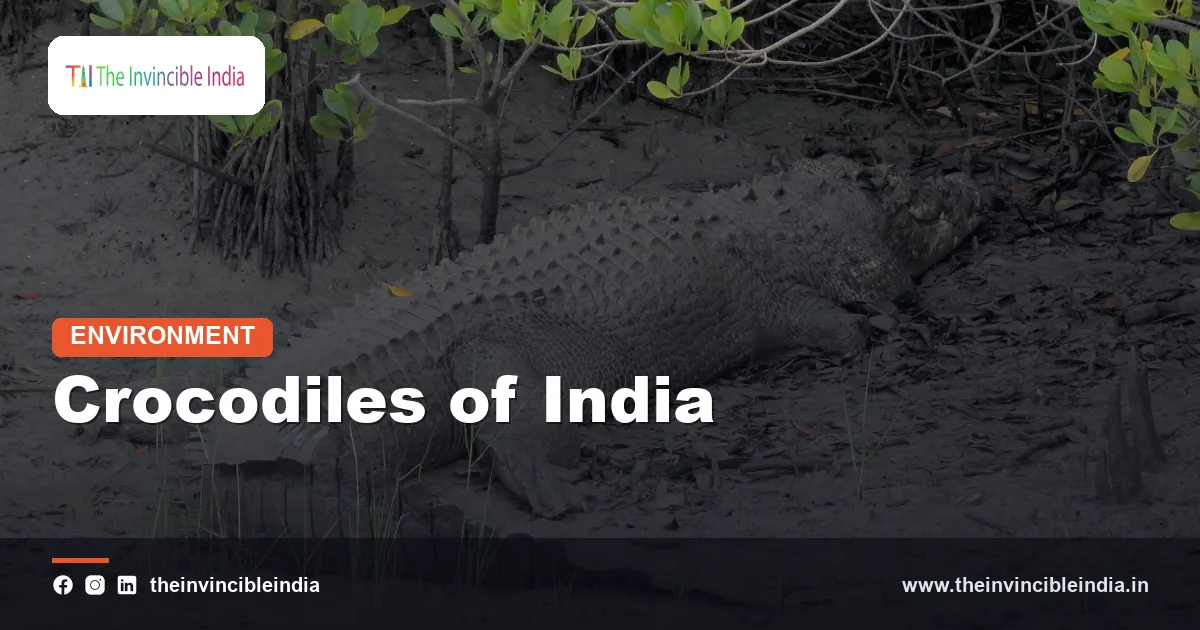
The effort known as crocodile conservation in India is the long-running programme of legal protection, captive breeding, habitat management and community engagement that safeguards the country’s three crocodilian species: the mugger, the saltwater crocodile and the gharial. It began in a systematic way with the Wildlife (Protection) Act, 1972 and Project Crocodile, launched in 1975 with technical support from the United Nations Development Programme (UNDP) and the Food and Agriculture Organization (FAO).
This explainer concentrates on the mugger (marsh crocodile, Crocodylus palustris) and the saltwater or estuarine crocodile (Crocodylus porosus), the two true crocodiles found in India, and explains how the gharial fits into the same story. It covers biology, strongholds, threats, human-crocodile conflict and the conservation lessons that five decades of work have produced.
| Quick Fact | Detail |
|---|---|
| Crocodilians native to India | Three: mugger (marsh crocodile), saltwater (estuarine) crocodile and gharial |
| Flagship programme | Project Crocodile, launched in 1975 with UNDP and FAO assistance |
| Main law | Wildlife (Protection) Act, 1972, which lists all three species in Schedule I |
| Mugger status | Vulnerable on the IUCN Red List |
| Saltwater crocodile status | Least Concern globally, but the Indian populations are small and localised |
| Gharial status | Critically Endangered on the IUCN Red List |
| Stronghold for saltwater crocodile | Bhitarkanika mangroves, Odisha; also the Sundarbans and the Andaman and Nicobar Islands |
| Strongholds for mugger | Rivers, lakes and reservoirs of Gujarat, Maharashtra, Rajasthan, Madhya Pradesh, Karnataka, Tamil Nadu and the National Chambal Sanctuary |
| International trade control | Indian crocodilians are listed on Appendix I of CITES |
Key Takeaways
- India is home to three crocodilian species: the mugger, the saltwater crocodile and the gharial, and all three receive the highest level of legal protection under Schedule I of the Wildlife (Protection) Act, 1972.
- Project Crocodile, begun in 1975 with UNDP and FAO support, rescued Indian crocodilians from near-extinction by combining wild-egg collection, captive rearing and release into protected waters.
- The mugger is a freshwater crocodile of rivers, lakes, marshes and reservoirs and is assessed as Vulnerable, while the saltwater crocodile lives in mangroves and estuaries and is the largest living reptile.
- Bhitarkanika in Odisha holds the largest breeding population of saltwater crocodiles in India and is a model for protected nesting and hatchery-based recovery.
- Habitat loss, fishing nets, pollution, sand mining and retaliation after attacks remain the main pressures on Indian crocodilians today.
- Long-term crocodile conservation in India depends as much on reducing human-crocodile conflict through compensation, awareness and safe water access as on protecting nesting sites.
What Are the Crocodilians Found in India?
India has three native crocodilians: the mugger or marsh crocodile, the saltwater or estuarine crocodile, and the gharial. The mugger and the saltwater crocodile belong to the genus Crocodylus, while the gharial belongs to its own family, Gavialidae, and is recognised instantly by its long, narrow, fish-catching snout.
No other country in South Asia hosts all three so widely. Each species occupies a different niche. The mugger occupies slow, still or seasonal freshwater. The saltwater crocodile occupies brackish creeks, tidal mangrove channels and, historically, coastlines. The gharial occupies deep, fast-flowing river channels with sandbanks. Because they use different habitats and different prey, the three do not directly compete across most of their range, although they overlap in places such as the Chambal river system.
How the three species compare
| Feature | Mugger | Saltwater crocodile | Gharial |
|---|---|---|---|
| Scientific name | Crocodylus palustris | Crocodylus porosus | Gavialis gangeticus |
| Preferred habitat | Freshwater lakes, marshes, rivers, reservoirs, village tanks | Mangroves, tidal creeks, estuaries, lagoons | Deep, clean, fast rivers with sandbanks |
| Snout | Broad and short | Broad with prominent ridges behind the eyes | Long, narrow, with a bulbous knob in adult males |
| Typical diet | Fish, frogs, reptiles, birds and mammals up to deer or livestock size | Crabs, fish, birds and large mammals | Almost entirely fish |
| Indian stronghold | Peninsular and western India, Chambal | Bhitarkanika, Sundarbans, Andaman and Nicobar Islands | Chambal, with remnants in the Ganga system and Mahanadi |
| IUCN status | Vulnerable | Least Concern (global) | Critically Endangered |
What Is a Mugger Crocodile?
The mugger crocodile, also called the marsh crocodile or Crocodylus palustris, is a medium-sized freshwater crocodile native to the Indian subcontinent. The name mugger comes from the Hindi word magar, meaning crocodile. Adults usually reach about three to four metres, with large males sometimes longer, and have a broad, rough, almost triangular snout that gives the species its heavy-headed look.
Muggers are adaptable. They live in natural rivers and marshes but also in irrigation reservoirs, village ponds, temple tanks and rain-fed pools. During hot, dry months they may bury themselves in burrows or move overland to find water, which allows them to persist in drought-prone regions of Gujarat, Rajasthan and the Deccan. Their ability to live near people explains both their survival in some places and their involvement in conflict.
Breeding and behaviour
The female mugger digs a hole nest in sandy soil during the dry season and lays a clutch of roughly two to three dozen eggs. She guards the nest, and after hatching she may help the young reach water. The sex of the hatchlings depends on the temperature at which the eggs incubate, a feature shared with many reptiles and one that makes climate and nest-site choice important for conservation.
Young muggers eat insects, small fish and frogs, and larger animals take progressively bigger prey. Adults are opportunistic, and in some reservoirs they are important regulators of fish and carrion. Their conservation status of Vulnerable reflects a historic population collapse followed by only partial recovery.
What Is the Saltwater Crocodile and Where Does It Live in India?
The saltwater crocodile, or estuarine crocodile (Crocodylus porosus), is the largest living reptile and, in India, lives mainly in the mangrove creeks of Odisha’s Bhitarkanika, the Sundarbans of West Bengal and the Andaman and Nicobar Islands. Despite the name, it tolerates freshwater, brackish water and open sea, and individuals travel long distances along coasts.
In India, the species is much rarer than the mugger. The Bhitarkanika mangroves in Kendrapara district, where the Brahmani and Baitarani rivers meet the Bay of Bengal, hold the largest breeding population. The Sundarbans and the Andaman and Nicobar archipelago have smaller, scattered populations. Elsewhere on the mainland, the species was once reported along the coasts of several states but has disappeared from many of these areas.
Size and biology
Male saltwater crocodiles can exceed five metres, and very large individuals exceed six. Females are considerably smaller. Unlike the mugger, which digs a hole, the female saltwater crocodile builds a mound nest of vegetation and mud above the high-water line. She stays close to guard it during incubation. Young crocodiles feed on crabs, insects and small fish, and large adults take fish, birds, deer and sometimes domestic animals.
How Did Project Crocodile Begin?
Project Crocodile began in 1975 as a national conservation programme supported by the UNDP and FAO to save India’s crocodilians from extinction after decades of hunting for skins and the decline of rivers. The effort was led by the Government of India and the state forest departments, with scientists and conservationists such as Romulus Whitaker and H. R. Bustard contributing field and breeding expertise.
In the 1950s and 1960s, the global leather trade drove heavy hunting, and by the early 1970s all three Indian species had declined sharply. The Wildlife (Protection) Act, 1972 gave the first national legal shield, and Project Crocodile then built the practical machinery for recovery.
Core methods of the project
- Egg collection: Eggs were collected from vulnerable wild nests, where predation, flooding or human disturbance would have destroyed them.
- Captive rearing: Hatchlings were raised in rearing centres so that they could survive the most dangerous early years.
- Release: Sub-adults were released into protected rivers, lakes and mangroves to establish or strengthen breeding populations.
- Sanctuaries: Protected areas such as Bhitarkanika, Satkosia Gorge and the National Chambal Sanctuary were created or strengthened.
- Training and research: Forest staff were trained in nest protection, monitoring and rescue techniques.
The Madras Crocodile Bank, established near Chennai in 1976, became one of the world’s best-known centres for breeding and research on reptiles and amphibians, and it supported captive stock for several release programmes.
Why Is Bhitarkanika Important for Saltwater Crocodiles?
Bhitarkanika in Odisha is important because it hosts the largest breeding population of saltwater crocodiles in India and is the best-known example of a successful hatchery-based recovery. Its dense mangroves, tidal creeks and mudbanks provide food, nesting ground and shelter in a landscape of rivers and estuary.
The area was declared a wildlife sanctuary in 1975, the same year Project Crocodile started, and it was upgraded in part to Bhitarkanika National Park in 1998. It was later recognised as a Ramsar wetland of international importance in 2002. The nearby Gahirmatha coast is famous for olive ridley turtle nesting, so the region protects several linked coastal species.
At Dangmal inside the sanctuary, eggs are collected and hatchlings are reared in enclosures, then released into creeks after reaching a safer size. This conservation work produced a steady recovery in numbers. The population now includes many adults, and the sanctuary regularly records large individuals.
Bhitarkanika also shows the consequences of success. As crocodiles increased, interactions with villagers using creeks for fishing, crab collection, bathing and cattle watering also grew, making conflict management a central part of its management.
Where Are the Strongholds of the Mugger?
The mugger’s strongholds are the inland waters of peninsular and western India, including parts of Gujarat, Maharashtra, Rajasthan, Madhya Pradesh, Karnataka and Tamil Nadu, along with the National Chambal Sanctuary. Because the species uses so many kinds of freshwater, it is found in both natural and human-made water bodies.
- Gujarat: Rivers such as the Vishwamitri, which flows through the city of Vadodara, support a notable mugger population living alongside a dense urban settlement.
- Rajasthan: Lakes in Ranthambore and the water bodies of the Chambal valley provide habitat.
- Madhya Pradesh and Uttar Pradesh: The National Chambal Sanctuary, notified in 1979, protects a long stretch of the Chambal river with both gharial and mugger.
- Maharashtra and Karnataka: The Savitri river in the Konkan and the Kaveri river basin host populations, along with reservoirs across the Deccan.
- Tamil Nadu: Reservoirs and rivers in the south, together with captive-breeding stock at the Madras Crocodile Bank, support restocking.
Many mugger populations live outside formal protected areas, in village tanks and irrigation reservoirs. This means conservation depends strongly on local tolerance and on the maintenance of water bodies by communities, temples and irrigation departments.
How Is the Gharial Linked to Crocodile Conservation in India?
The gharial is linked to crocodile conservation in India because it was a main target of Project Crocodile and still shares habitat, laws and conservation methods with the mugger and the saltwater crocodile. Although it is not a true crocodile, it belongs to the same order, Crocodylia, and is the most threatened of India’s three species.
Gharial numbers fell steeply during the twentieth century because of hunting, fishing nets, sand mining, dams and barrages that fragment rivers. The Chambal river became the species’ last major stronghold, protected by the National Chambal Sanctuary. Other sites such as Katarniaghat in Uttar Pradesh and Satkosia Gorge in Odisha have received captive-bred gharials.
The same techniques of egg collection, head-starting and release that worked for the mugger and saltwater crocodile were first applied broadly to the gharial. Gharial recovery has been slower, because the species is highly specialised, needs clean, deep rivers and is easily drowned in fishing nets. Its conservation therefore also protects freshwater dolphins, turtles and many other river species that depend on the same stretches.
What Laws Protect Crocodiles in India?
Crocodiles in India are protected primarily by the Wildlife (Protection) Act, 1972, which lists the mugger, saltwater crocodile and gharial in Schedule I, giving them the strongest protection available. Schedule I prohibits hunting, capture and trade, and the penalties for offences are the most severe in the Act.
Internationally, Indian crocodilians appear in Appendix I of the Convention on International Trade in Endangered Species of Wild Fauna and Flora (CITES), which bans commercial trade in wild-sourced specimens. India has been a party to CITES since 1976.
Protected areas and habitat laws
- Wildlife sanctuaries and national parks such as Bhitarkanika, Satkosia and the National Chambal Sanctuary provide area-based protection.
- Ramsar listing of Bhitarkanika offers international recognition for its wetlands.
- The Environment (Protection) Act, 1986 and the coastal regulation rules help regulate pollution and construction near creeks and estuaries.
- State fisheries and sand-mining regulations influence river habitats outside protected areas.
What Are the Main Threats to Crocodiles in India?
The main threats to crocodiles in India are habitat loss, fishing-net entanglement, river pollution, sand mining, dams and retaliatory killing after attacks. Although commercial hunting for skins has been largely stopped, these ongoing pressures continue to limit recovery.
- Habitat loss: Wetlands are drained for agriculture or urban expansion, and mangroves are cleared for aquaculture, farmland and settlement.
- Fishing nets: Crocodiles and gharials are drowned in gill nets, and fishers sometimes destroy crocodiles that damage nets.
- Pollution: Industrial effluent, sewage and agricultural chemicals reduce prey and harm health, especially in rivers near cities.
- Sand mining and river engineering: Removing sandbanks destroys nesting sites, and barrages alter flows and block movement.
- Nest disturbance: Livestock trampling, egg collection and predators reduce hatching success in areas without protection.
- Climate and sea level: Changing temperatures affect the sex ratio of hatchlings, and storms and sea-level rise affect coastal nesting mounds.
How Does Human-Crocodile Conflict Happen in India?
Human-crocodile conflict in India happens when people and crocodiles use the same water for bathing, washing, fishing, cattle watering and crossing, leading to attacks on people and livestock and, in turn, to retaliation against crocodiles. The risk is highest during the breeding season, in dry months when water is scarce, and in places where villages abut crocodile-inhabited waters.
Conflict is not uniform. In Bhitarkanika, people entering creeks to fish or collect crabs are most exposed. In parts of Gujarat and Maharashtra, bathing ghats and livestock crossings are the usual points of contact. In Vadodara, crocodiles occasionally enter residential areas along the Vishwamitri during floods, which prompts rescue operations by forest staff and local volunteers.
Measures that reduce conflict
- Compensation: State governments provide ex gratia payments for loss of life, injury and livestock, which reduces the incentive for revenge killing.
- Safe access points: Fenced bathing areas, hand pumps and alternative water sources keep people away from risky banks.
- Awareness: Village campaigns teach safe behaviour, especially during nesting and dry seasons.
- Rapid rescue: Trained teams capture and relocate problem animals rather than killing them.
- Cultural tolerance: In some places, crocodiles are treated as sacred or are protected in temple ponds, which strengthens local acceptance.
What Is the Way Forward for Crocodile Conservation?
Crocodiles are top predators and scavengers whose presence signals clean, functioning freshwater and mangrove ecosystems, so protecting them also protects fish stocks and river health. The way forward for crocodile conservation in India combines protecting nesting habitat, managing rivers and mangroves sustainably, and investing in community-based conflict reduction. Much of the early work was about numbers, and the next phase is about long-term habitat quality and coexistence.
- Protect sandbanks and nesting sites from mining and disturbance.
- Maintain environmental flows in rivers so that crocodilian habitat stays connected and clean.
- Monitor populations regularly so that policy responds to evidence.
- Promote fishing practices that reduce accidental entanglement.
- Strengthen compensation, response teams and awareness around high-conflict locations.
- Support genetic management in captive stocks so that released animals strengthen wild populations.
Timeline of key milestones
| Year | Milestone |
|---|---|
| 1972 | Wildlife (Protection) Act enacted, giving national legal protection to crocodilians |
| 1975 | Project Crocodile launched with UNDP and FAO support; Bhitarkanika declared a sanctuary |
| 1976 | Madras Crocodile Bank established; India joins CITES |
| 1979 | National Chambal Sanctuary notified for gharial, mugger and river wildlife |
| 1998 | Bhitarkanika National Park notified |
| 2002 | Bhitarkanika recognised as a Ramsar wetland |
Bottom Line
Crocodile conservation in India is one of the country’s clearest wildlife recovery stories, built on Project Crocodile, strict legal protection and carefully managed breeding. The mugger, the saltwater crocodile and the gharial now survive because of this work, but their future depends on clean rivers, protected mangroves and communities that can live safely alongside them.
Frequently Asked Questions
How many species of crocodile are found in India?
India has three native crocodilian species: the mugger or marsh crocodile, the saltwater or estuarine crocodile, and the gharial. Only the mugger and the saltwater crocodile are true crocodiles, while the gharial belongs to a separate family. All three are listed in Schedule I of the Wildlife (Protection) Act, 1972.
What is Project Crocodile in India?
Project Crocodile is a national conservation programme launched in 1975 with UNDP and FAO support to save India’s crocodilians from extinction. It collected eggs from vulnerable nests, reared hatchlings in captivity and released them into protected waters. It also strengthened sanctuaries such as Bhitarkanika and the National Chambal Sanctuary.
Where can you see saltwater crocodiles in India?
The best place to see saltwater crocodiles in India is Bhitarkanika in Odisha, which holds the largest breeding population in the country. Smaller populations live in the Sundarbans of West Bengal and in the Andaman and Nicobar Islands. Visits to Bhitarkanika are normally made by boat through the mangrove creeks.
Is the mugger crocodile endangered?
The mugger crocodile is listed as Vulnerable on the IUCN Red List, which is one step below Endangered. It declined sharply because of hunting and habitat loss, and it has only partly recovered. It remains in Schedule I of the Wildlife (Protection) Act, 1972 and is covered by Appendix I of CITES.
Are crocodiles dangerous to people in India?
Crocodiles can be dangerous in India, especially the saltwater crocodile and large muggers, when people enter water where they live. Attacks are uncommon relative to the number of people using shared waters, and they are mostly linked to fishing, bathing and crossing at risky spots. Safe access points, awareness and rapid response by forest staff reduce the risk.
How is the gharial different from the mugger and the saltwater crocodile?
The gharial differs because it has a long, thin snout adapted to catching fish, while the mugger and saltwater crocodile have broad snouts and eat a wider range of prey. The gharial lives in deep, fast rivers, whereas the mugger prefers still freshwater and the saltwater crocodile prefers mangroves and estuaries. The gharial is also the most threatened, listed as Critically Endangered.
{“@context”:”https://schema.org”,”@graph”:[{“@type”:”FAQPage”,”mainEntity”:[{“@type”:”Question”,”name”:”How many species of crocodile are found in India?”,”acceptedAnswer”:{“@type”:”Answer”,”text”:”India has three native crocodilian species: the mugger or marsh crocodile, the saltwater or estuarine crocodile, and the gharial. Only the mugger and the saltwater crocodile are true crocodiles, while the gharial belongs to a separate family. All three are listed in Schedule I of the Wildlife (Protection) Act, 1972.”}},{“@type”:”Question”,”name”:”What is Project Crocodile in India?”,”acceptedAnswer”:{“@type”:”Answer”,”text”:”Project Crocodile is a national conservation programme launched in 1975 with UNDP and FAO support to save India’s crocodilians from extinction. It collected eggs from vulnerable nests, reared hatchlings in captivity and released them into protected waters. It also strengthened sanctuaries such as Bhitarkanika and the National Chambal Sanctuary.”}},{“@type”:”Question”,”name”:”Where can you see saltwater crocodiles in India?”,”acceptedAnswer”:{“@type”:”Answer”,”text”:”The best place to see saltwater crocodiles in India is Bhitarkanika in Odisha, which holds the largest breeding population in the country. Smaller populations live in the Sundarbans of West Bengal and in the Andaman and Nicobar Islands. Visits to Bhitarkanika are normally made by boat through the mangrove creeks.”}},{“@type”:”Question”,”name”:”Is the mugger crocodile endangered?”,”acceptedAnswer”:{“@type”:”Answer”,”text”:”The mugger crocodile is listed as Vulnerable on the IUCN Red List, which is one step below Endangered. It declined sharply because of hunting and habitat loss, and it has only partly recovered. It remains in Schedule I of the Wildlife (Protection) Act, 1972 and is covered by Appendix I of CITES.”}},{“@type”:”Question”,”name”:”Are crocodiles dangerous to people in India?”,”acceptedAnswer”:{“@type”:”Answer”,”text”:”Crocodiles can be dangerous in India, especially the saltwater crocodile and large muggers, when people enter water where they live. Attacks are uncommon relative to the number of people using shared waters, and they are mostly linked to fishing, bathing and crossing at risky spots. Safe access points, awareness and rapid response by forest staff reduce the risk.”}},{“@type”:”Question”,”name”:”How is the gharial different from the mugger and the saltwater crocodile?”,”acceptedAnswer”:{“@type”:”Answer”,”text”:”The gharial differs because it has a long, thin snout adapted to catching fish, while the mugger and saltwater crocodile have broad snouts and eat a wider range of prey. The gharial lives in deep, fast rivers, whereas the mugger prefers still freshwater and the saltwater crocodile prefers mangroves and estuaries. The gharial is also the most threatened, listed as Critically Endangered.”}}]}]}


