

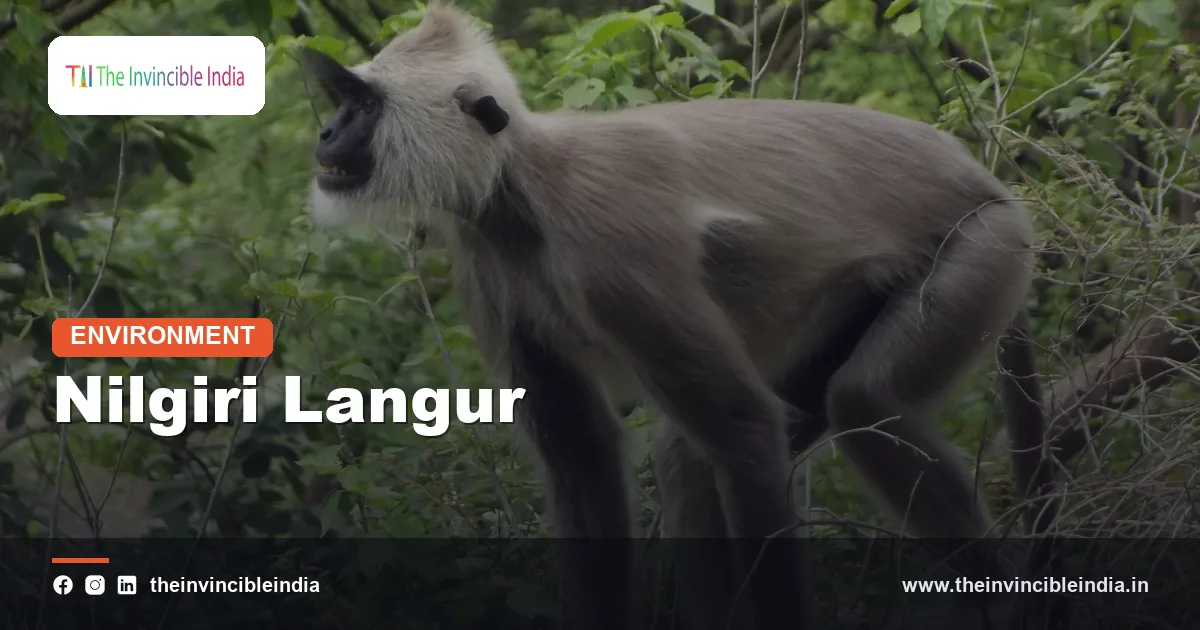
The Nilgiri langur (Trachypithecus johnii) is a glossy black leaf-eating monkey found only in the rainforests and shola forests of the southern Western Ghats in India, and it is listed as Vulnerable on the IUCN Red List and in Schedule I of the Wildlife (Protection) Act, 1972. It spends most of its life in the forest canopy, feeding on leaves, and it is considered an indicator of the health of the wet evergreen forests it inhabits.
This explainer describes the animal, its habitat, diet and troop life, the threats that have shrunk its range, and the legal and field measures that now protect it. Nilgiri langur conservation matters beyond one monkey, because the species depends on intact forest canopy that also shelters the lion-tailed macaque, the Nilgiri tahr, elephants and thousands of plant species.
| Quick Fact | Detail |
|---|---|
| Common name | Nilgiri langur, also called Nilgiri black leaf monkey or John’s langur |
| Scientific name | Trachypithecus johnii (placed in Semnopithecus in some classifications) |
| Range | Southern Western Ghats of Karnataka, Kerala and Tamil Nadu, with small outlying populations |
| Habitat | Tropical wet evergreen forest, shola forest and adjoining plantations |
| Diet | Mainly young and mature leaves, with fruits, seeds, flowers and buds |
| IUCN status | Vulnerable |
| Indian legal status | Schedule I, Wildlife (Protection) Act, 1972 |
| International trade status | CITES Appendix II |
| Main threats | Habitat fragmentation, plantations, hunting for meat and skin, capture for supposed medicinal use, road and power-line accidents |
Key Takeaways
- The Nilgiri langur is a glossy black leaf monkey that is endemic to the southern Western Ghats of India, meaning it occurs naturally nowhere else in the world.
- Nilgiri langur troops are small, usually led by one adult male with several females and their young, and they communicate with loud whooping calls across the canopy.
- The species is assessed as Vulnerable by the IUCN and receives the highest legal protection in India under Schedule I of the Wildlife (Protection) Act, 1972.
- Habitat fragmentation from tea, coffee and eucalyptus plantations, roads and settlements is the most important long-term threat to the Nilgiri langur.
- Hunting for meat and skin, and capture driven by an unproven belief in medicinal value, have reduced Nilgiri langur numbers in some areas.
- Protected landscapes such as the Nilgiri Biosphere Reserve, Silent Valley and the Anamalai hills form the core of Nilgiri langur conservation, and forest corridors are essential to connect them.
What Is the Nilgiri Langur?
The Nilgiri langur is a medium-sized Old World monkey with glossy black fur and a golden-brown or tawny crown, found in the forests of the southern Western Ghats. Its scientific name is Trachypithecus johnii, and the species is also known as the Nilgiri black leaf monkey or John’s langur.
The animal belongs to the group of leaf monkeys called langurs, which have long tails, slender limbs and complex stomachs adapted to digest leaves. Adults weigh a few kilograms to about a dozen, males being larger than females. The tail is long and unbroken and is carried hanging or arched for balance, never used for gripping.
Young Nilgiri langurs are born with a different coat from adults, being paler and sometimes brownish, and they darken as they mature. Adult males often show a pale or whitish patch on the inner thigh, a feature that helps field workers tell the sexes apart.
Where Does the Nilgiri Langur Live?
The Nilgiri langur lives in the southern Western Ghats of Karnataka, Kerala and Tamil Nadu, from the Kodagu region of Karnataka southward through the Nilgiri, Anamalai, Palni and Cardamom hills. It is a true endemic of the Western Ghats, a mountain chain recognised by UNESCO as a World Heritage Site in 2012 for its biodiversity.
Its habitat is tropical wet evergreen forest at low and middle elevations, together with the high-elevation shola forests of the Nilgiris, Anamalais and Palnis. Within this range, the animal is patchily distributed, being common in intact forest and absent from open or heavily degraded blocks.
Key protected landscapes
- Nilgiri Biosphere Reserve: India’s first biosphere reserve, declared in 1986, spanning parts of Tamil Nadu, Kerala and Karnataka, including Mudumalai, Wayanad, Bandipur and Silent Valley.
- Silent Valley National Park, Kerala: A large block of undisturbed evergreen forest that is a well-known langur stronghold.
- Anamalai and Parambikulam landscapes: Forest tracts in Tamil Nadu and Kerala that support healthy populations.
- Periyar and the Cardamom hills: Evergreen and semi-evergreen forests in southern Kerala and neighbouring Tamil Nadu.
- Brahmagiri and Pushpagiri in Karnataka: Forest ranges at the northern edge of the species’ range.
What Are Shola Forests and Why Do They Matter?
Shola forests are patches of stunted, dense evergreen forest that occupy sheltered valleys and folds in the high hills of the southern Western Ghats, usually surrounded by open montane grassland. They matter because they capture mist and rain, feed streams and rivers, and shelter specialised species such as the Nilgiri langur.
The shola-grassland mosaic is a distinctive ecosystem of the Nilgiri, Anamalai and Palni ranges. The forest patches are cool and moist, with a low, tangled canopy of small, thick-leaved trees. The surrounding grasslands are home to the Nilgiri tahr and the Nilgiri pipit. Together, they form a delicately balanced landscape in which each element supports the others.
For the langur, sholas offer shade, shelter from cold, fruiting trees and young leaves. Troops use them for sleeping and feeding and travel between patches where tree cover or corridors permit. When sholas are cleared or planted with exotic trees, langurs lose both food and the canopy routes that connect them.
What Does the Nilgiri Langur Eat?
The Nilgiri langur eats mainly leaves, supplemented by fruits, seeds, flowers, buds and sometimes bark, and it is therefore classed as a folivore. Young leaves are preferred because they are richer in protein and lower in toxins than mature leaves.
Like other leaf monkeys, the Nilgiri langur has a large, multi-chambered stomach in which bacteria ferment tough plant fibre, allowing it to extract nutrients from food that few other primates could digest. This diet has ecological consequences. Langurs disperse some seeds and prune new growth, and their droppings return nutrients to the forest floor.
Diet varies by season and location. In areas with plantations or crop fields on forest edges, langurs sometimes feed on cultivated plants, such as coffee berries or garden produce, which can cause friction with farmers.
How Is a Nilgiri Langur Troop Organised?
A Nilgiri langur troop is usually a small group led by a single adult male with several adult females and their offspring, although all-male bands also exist. Troop size is typically around ten animals, with larger groups in rich forest and smaller groups in disturbed areas.
The resident male defends the group from rival males, and takeovers by outside males can occur. Females form the stable core of the troop and care for young, and other females sometimes help with infants. Troops occupy relatively small home ranges, which they patrol and defend with calls.
Communication and behaviour
- Whooping calls: Adult males give loud, far-carrying calls, often at dawn and dusk, to signal position to neighbouring troops.
- Canopy life: Langurs rarely descend to the ground and move by leaping between branches and walking along them.
- Resting periods: Because leaf digestion is slow, troops rest for long periods during the day.
- Slow reproduction: Females typically give birth to a single infant, and young depend on mothers for an extended period, so population recovery is slow.
How Is the Nilgiri Langur Different from Other Western Ghats Primates?
The Nilgiri langur differs from other Western Ghats primates in its all-black coat, its leaf-based diet and its strict dependence on forest canopy. The Western Ghats are home to a small set of primates, and the Nilgiri langur shares forests with the lion-tailed macaque, the bonnet macaque and the grey langurs of the drier foothills.
| Primate | Appearance | Main habitat | Main food |
|---|---|---|---|
| Nilgiri langur | Glossy black with golden-brown crown | Wet evergreen and shola forest | Leaves, some fruit and flowers |
| Lion-tailed macaque | Black with a silvery-grey mane | Rainforest canopy | Fruit, seeds, insects |
| Bonnet macaque | Brownish with a whorl of hair on the crown | Forest edge, villages, temples | Fruit, grain, human food |
| Southern plains grey langur | Greyish, with a dark face | Dry deciduous forest, scrub and foothills | Leaves, fruit, flowers |
The lion-tailed macaque, a rarer and more endangered species, often lives in the same rainforest as the Nilgiri langur, and the two sometimes forage in the same trees without serious conflict. Conservation measures aimed at one often help the other, since both depend on large, connected rainforest blocks.
What Are the Threats to the Nilgiri Langur?
The main threats to the Nilgiri langur are habitat fragmentation, conversion of forest to plantations and settlements, hunting for meat and skin, capture for a supposed medicinal value, and accidents on roads and power lines. Together, these have caused local declines and isolated several populations.
Habitat fragmentation and conversion
Large areas of forest in the Western Ghats have been cleared for tea, coffee, cardamom, rubber and exotic timber trees such as eucalyptus and wattle. These plantations do not provide the continuous canopy and varied food that langurs need. Hydroelectric reservoirs, roads and townships further divide the forest. Small, isolated groups are vulnerable to local extinction and inbreeding.
Hunting and trade
In some places, langurs have been hunted for meat and for their skin. There has also been a long-standing but unproven belief that parts of the animal have medicinal power, which drove capture and killing. There is no scientific basis for such uses, and the practice is an offence under the Wildlife (Protection) Act. Hunting pressure is difficult to measure, but it has been implicated in local declines.
Accidents and conflict
Langurs that cross open gaps between forest patches face traffic on roads and electrocution on uninsulated power lines. Where forests have been converted to estates, they may be harassed or shot by those who perceive them as crop pests, and dogs occasionally attack troops that come to the ground.
What Is the Conservation Status and Legal Protection of the Nilgiri Langur?
The Nilgiri langur is classified as Vulnerable by the IUCN, is placed in Schedule I of the Wildlife (Protection) Act, 1972, and is included in Appendix II of CITES. Vulnerable means that the species faces a high risk of extinction in the wild because of a continuing decline and shrinking habitat.
Schedule I gives the animal the same legal protection as tigers and elephants in India, prohibiting hunting, capture and trade and carrying severe penalties. CITES Appendix II regulates international trade to prevent exploitation. Most Nilgiri langurs live within protected areas such as national parks, sanctuaries and tiger reserves, which add further safeguards.
Population estimates are uncertain because the animal is shy, lives high in the canopy and occupies steep, forested terrain. The total is generally considered to be in the low tens of thousands at most, and the trend is believed to be downward, particularly outside protected areas.
How Is the Nilgiri Langur Being Conserved?
The Nilgiri langur is being conserved through protected areas, habitat restoration, corridor protection, anti-poaching patrols and community awareness in the Western Ghats. Because the species cannot survive outside forest, conserving its habitat is the most effective form of protection.
- Protected areas: National parks, sanctuaries and tiger reserves across the Western Ghats safeguard core populations.
- Corridors: Linking forest patches lets troops move and exchange genes, and projects restoring native vegetation in gaps help.
- Restoration of sholas: Removing exotic trees and replanting native species help rebuild natural shola and grassland.
- Canopy bridges and insulation: Rope bridges and insulated cables can reduce road and power-line deaths in places where langurs cross.
- Anti-poaching and awareness: Forest patrols and education in forest-fringe communities discourage hunting and trade.
- Research and monitoring: Field studies of troop size, diet and movement guide management choices.
Community participation is critical. Many forest-edge residents, including tribal communities, hold detailed knowledge of langur movement, and their involvement in monitoring and protecting habitat has proved effective in several landscapes.
Why Does the Nilgiri Langur Matter?
The Nilgiri langur matters because it is an endemic species of a global biodiversity hotspot and a sensitive indicator of the quality and continuity of the Western Ghats rainforest. Its presence suggests that the forest still has a healthy, connected canopy.
The Western Ghats are among the world’s eight hottest hotspots of biodiversity and are a source for many of south India’s major rivers. Protecting the langur’s habitat therefore protects water supply, climate regulation and a very large number of other species. Because langurs are conspicuous and charismatic, they also help build public support for conservation of the forests they inhabit.
Bottom Line
The Nilgiri langur is a Vulnerable, Schedule I species whose survival depends on connected rainforest and shola habitat in the southern Western Ghats. Protecting forest corridors, ending hunting and restoring native vegetation are the actions that will do the most to keep the species secure.
Frequently Asked Questions
What is a Nilgiri langur?
The Nilgiri langur is a glossy black leaf-eating monkey that is endemic to the southern Western Ghats of India. It has a long tail and a golden-brown crown, and it lives high in the canopy of evergreen and shola forests. Its scientific name is Trachypithecus johnii.
Where is the Nilgiri langur found?
The Nilgiri langur is found in the southern Western Ghats of Karnataka, Kerala and Tamil Nadu. It occurs in the Nilgiri, Anamalai, Palni and Cardamom hills, including protected areas such as Silent Valley and the Nilgiri Biosphere Reserve. It is not found naturally anywhere else in the world.
What does the Nilgiri langur eat?
The Nilgiri langur eats mainly leaves, especially young leaves, along with fruits, seeds, flowers and buds. It has a multi-chambered stomach that ferments plant fibre. In some forest-edge areas, it may also feed on cultivated crops such as coffee berries.
Is the Nilgiri langur endangered?
The Nilgiri langur is assessed as Vulnerable by the IUCN, which means it faces a high risk of extinction in the wild. It is placed in Schedule I of the Wildlife (Protection) Act, 1972, the highest level of legal protection in India. Habitat loss and hunting are the main reasons for its decline.
Why is the Nilgiri langur hunted?
The Nilgiri langur has been hunted in some places for meat and skin, and it has also been captured because of an unproven belief in its medicinal value. There is no scientific evidence that its body parts have any medicinal benefit. Killing or capturing the animal is a punishable offence under Indian law.
How can the Nilgiri langur be protected?
The Nilgiri langur can best be protected by conserving and reconnecting the rainforest and shola habitat it depends on. Useful measures include corridor protection, native-forest restoration, anti-poaching patrols, canopy bridges and community awareness. Reducing plantation expansion into forest areas is also important.
{“@context”:”https://schema.org”,”@graph”:[{“@type”:”FAQPage”,”mainEntity”:[{“@type”:”Question”,”name”:”What is a Nilgiri langur?”,”acceptedAnswer”:{“@type”:”Answer”,”text”:”The Nilgiri langur is a glossy black leaf-eating monkey that is endemic to the southern Western Ghats of India. It has a long tail and a golden-brown crown, and it lives high in the canopy of evergreen and shola forests. Its scientific name is Trachypithecus johnii.”}},{“@type”:”Question”,”name”:”Where is the Nilgiri langur found?”,”acceptedAnswer”:{“@type”:”Answer”,”text”:”The Nilgiri langur is found in the southern Western Ghats of Karnataka, Kerala and Tamil Nadu. It occurs in the Nilgiri, Anamalai, Palni and Cardamom hills, including protected areas such as Silent Valley and the Nilgiri Biosphere Reserve. It is not found naturally anywhere else in the world.”}},{“@type”:”Question”,”name”:”What does the Nilgiri langur eat?”,”acceptedAnswer”:{“@type”:”Answer”,”text”:”The Nilgiri langur eats mainly leaves, especially young leaves, along with fruits, seeds, flowers and buds. It has a multi-chambered stomach that ferments plant fibre. In some forest-edge areas, it may also feed on cultivated crops such as coffee berries.”}},{“@type”:”Question”,”name”:”Is the Nilgiri langur endangered?”,”acceptedAnswer”:{“@type”:”Answer”,”text”:”The Nilgiri langur is assessed as Vulnerable by the IUCN, which means it faces a high risk of extinction in the wild. It is placed in Schedule I of the Wildlife (Protection) Act, 1972, the highest level of legal protection in India. Habitat loss and hunting are the main reasons for its decline.”}},{“@type”:”Question”,”name”:”Why is the Nilgiri langur hunted?”,”acceptedAnswer”:{“@type”:”Answer”,”text”:”The Nilgiri langur has been hunted in some places for meat and skin, and it has also been captured because of an unproven belief in its medicinal value. There is no scientific evidence that its body parts have any medicinal benefit. Killing or capturing the animal is a punishable offence under Indian law.”}},{“@type”:”Question”,”name”:”How can the Nilgiri langur be protected?”,”acceptedAnswer”:{“@type”:”Answer”,”text”:”The Nilgiri langur can best be protected by conserving and reconnecting the rainforest and shola habitat it depends on. Useful measures include corridor protection, native-forest restoration, anti-poaching patrols, canopy bridges and community awareness. Reducing plantation expansion into forest areas is also important.”}}]}]}


