

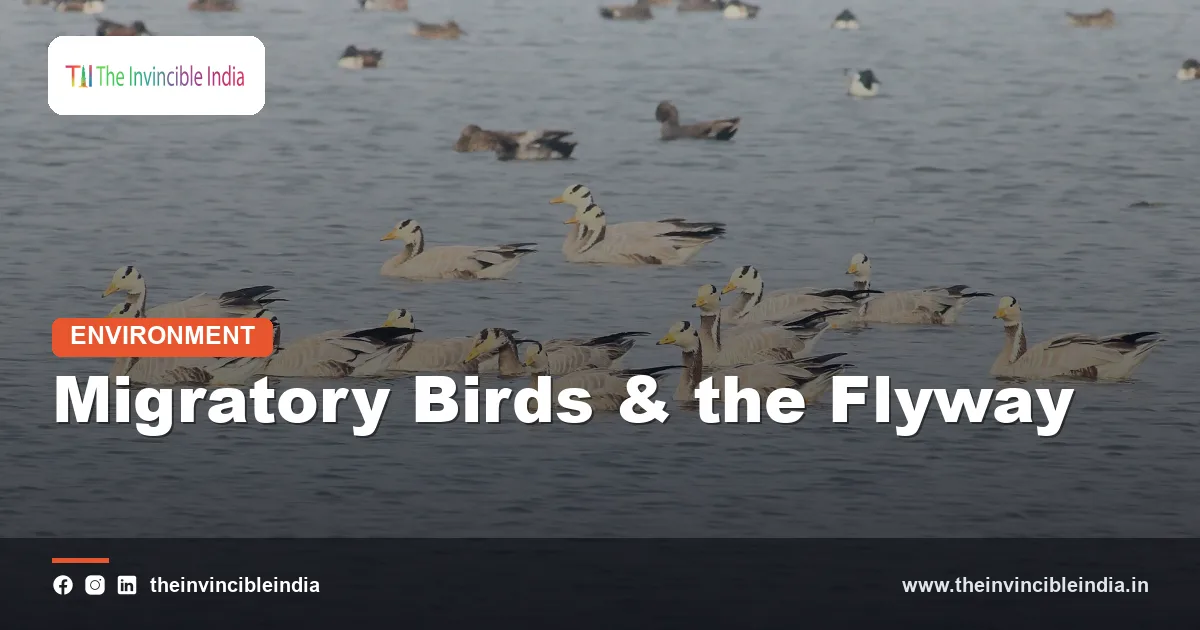
The Central Asian Flyway is the network of migratory routes used by waterbirds and other birds that breed in the Arctic and Central Asia and travel south to winter in South Asia, the Maldives and the Indian Ocean, and India sits at its heart as one of the most important wintering and stopover regions. Every year, millions of birds follow these routes across the Himalaya, the Thar and the river plains to reach India’s wetlands, lakes, coasts and grasslands.
In 2018, India released a national action plan for the conservation of migratory birds and their habitats along the Central Asian Flyway, giving the country a formal framework for protecting these birds. This explainer describes the flyway, the birds that use it, the key Indian sites, the threats they face and the conservation measures that matter most.
| Quick Fact | Detail |
|---|---|
| Full name | Central Asian Flyway (CAF), one of the world’s major bird migration systems |
| Geographic scope | From the Arctic Ocean in the north to the Indian Ocean in the south, covering about thirty countries |
| India’s role | Major wintering and stopover ground for migratory waterbirds and other species |
| National plan | National Action Plan for the Conservation of Migratory Birds and their Habitats along the Central Asian Flyway, released in 2018 |
| Lead ministry | Ministry of Environment, Forest and Climate Change (MoEFCC) |
| International framework | Convention on the Conservation of Migratory Species of Wild Animals (CMS), with India a party since 1983 |
| Wetland treaty | Ramsar Convention on Wetlands, with India a party since 1982 |
| Iconic species | Bar-headed goose, demoiselle crane, greater and lesser flamingos, black-necked crane, ruddy shelduck, sandpipers and plovers |
| Main threats | Wetland loss, power lines, hunting and poisoning, pollution, disease risk and climate change |
Key Takeaways
- The Central Asian Flyway is a migration system linking Arctic and Central Asian breeding grounds with wintering sites in South Asia and the Indian Ocean, and it covers about thirty countries.
- India lies at the southern end of the Central Asian Flyway and hosts millions of migratory birds each winter in wetlands, coasts, lakes and grasslands.
- India released its National Action Plan for the Conservation of Migratory Birds and their Habitats along the Central Asian Flyway in 2018 to protect species and the sites they depend on.
- Bar-headed geese, which cross the Himalaya on their journey, are among the best-known migratory birds that winter in India.
- Wetland loss, power-line collisions, hunting and pollution are the main threats to migratory birds on the Central Asian Flyway in India.
- Protecting migratory birds in India depends on keeping wetlands healthy and on cooperation among countries, because the birds cross many borders on every journey.
What Is the Central Asian Flyway?
The Central Asian Flyway is a bird migration route system that links breeding areas in Central Asia and Siberia with wintering areas in South Asia and the islands of the Indian Ocean such as the Maldives. It is one of the major flyways recognised worldwide, alongside the East Asian-Australasian Flyway and the African-Eurasian Flyway.
A flyway is the entire geographical region used by a group of migratory birds over their annual cycle, including breeding grounds, stopover sites and wintering grounds. The Central Asian Flyway is shaped like a broad corridor running roughly north to south, funnelling birds from vast northern landscapes towards the warm, food-rich wetlands of the Indian subcontinent.
The flyway includes birds of many families: ducks, geese, swans, cranes, waders, gulls, terns, flamingos and birds of prey. Waterbirds are the main focus of flyway planning, because they depend on a chain of wetlands, and the loss of any link in the chain can affect the entire population.
Which Countries Are Covered by the Central Asian Flyway?
The Central Asian Flyway covers about thirty countries, including Russia, the Central Asian republics, Afghanistan, Pakistan, India, Nepal, Bhutan, Bangladesh, Sri Lanka and the Maldives. This wide span means that conserving the birds needs cooperation across many national borders.
India’s position is strategic. Birds arriving from the north cross the high Himalaya or the arid plains of Pakistan and Rajasthan and spread out across the subcontinent. Many continue to Sri Lanka and the Maldives. Because the flyway is long and crosses countries with different laws and priorities, its management depends on shared action under international frameworks.
The idea of a joint action plan for the flyway gained momentum at a meeting in New Delhi in 2005, which produced a draft regional framework. Since then, countries have continued to discuss coordinated measures under the Convention on Migratory Species (CMS), and India hosted the 13th meeting of the Conference of the Parties to the CMS in Gandhinagar, Gujarat, in 2020.
Why Is India Important to the Central Asian Flyway?
India is important to the Central Asian Flyway because its wetlands, coasts and river systems provide food, water and safety to enormous numbers of birds at the end of long journeys. The subcontinent’s warm winters, productive lakes and floodplains make it a prime wintering destination.
The country has a wide range of wetland types, from Himalayan lakes and high-altitude marshes to river floodplains, reservoirs, salt pans, mudflats, lagoons and mangroves. A single flyway bird may use several of these in a season. For example, waders may feed on the mudflats of the Gujarat or Maharashtra coast, ducks may use inland lakes, and cranes may use agricultural fields and village ponds.
Records show that India hosts several hundred species of migratory birds. Many of these are waterbirds, but forest, grassland and raptor species also migrate. The presence of such a large and diverse winter population makes India a global responsibility for flyway conservation.
Which Migratory Birds Use the Central Asian Flyway in India?
The migratory birds using the Central Asian Flyway in India include bar-headed geese, demoiselle cranes, ruddy shelducks, northern pintails, common teal, flamingos, pelicans, sandpipers, plovers and curlews. They arrive mostly between September and November and leave by March or April.
| Bird | Breeding region | Typical Indian wintering habitat | Notable feature |
|---|---|---|---|
| Bar-headed goose | High-altitude lakes of Central Asia and the Tibetan plateau | Lakes, reservoirs and rivers across northern and central India | Crosses the Himalaya at great altitude |
| Demoiselle crane | Steppes of Central Asia | Rajasthan and Gujarat, including village sites such as Khichan | Smallest crane, crosses mountain ranges on migration |
| Ruddy shelduck | Central Asia and Tibet | Rivers, sandbars and lakes | Orange-brown plumage, known as the Brahminy duck |
| Greater and lesser flamingos | Rann of Kutch, Central Asian lakes | Coastal mudflats, saline lagoons and salt pans | Form large flocks, filter feed |
| Black-necked crane | Ladakh and the Tibetan plateau | High-altitude wetlands and nearby valleys | The only crane that breeds at high altitude |
| Waders (sandpipers, plovers, curlews) | Arctic and northern Eurasia | Coastal and inland mudflats | Make some of the longest migrations of any bird |
What Happened to the Siberian Crane in India?
The Siberian crane (Leucogeranus leucogeranus) once wintered in India, especially at Keoladeo National Park in Rajasthan, but the western population that used this route has not been recorded in India for many years. It is Critically Endangered and became a symbol of the risks that migratory birds face along their routes.
The birds were once a celebrated winter visitor to Keoladeo, near Bharatpur. Their disappearance is attributed to hunting along the route, especially in parts of Afghanistan and Pakistan, and to wetland loss on the breeding and wintering grounds. The story drew global attention and fostered an international effort to protect the species through cooperative agreements among range countries.
The Siberian crane is a reminder that a bird that is fully protected in one country can still be lost if the threats on other parts of its journey are not addressed. This is why flyway-level cooperation, rather than single-country protection, is central to modern conservation.
What Are the Key Wetland Sites for Migratory Birds in India?
The key wetland sites for migratory birds in India include Chilika Lake in Odisha, Keoladeo National Park in Rajasthan, the Rann of Kutch and Nal Sarovar in Gujarat, Pong Dam Lake in Himachal Pradesh, Sambhar Lake in Rajasthan and Tso Moriri in Ladakh. Many of these are recognised as Ramsar wetlands of international importance.
Selected sites
- Chilika Lake, Odisha: Asia’s largest brackish-water lagoon, one of India’s first two Ramsar sites designated in 1981, and a major wintering ground for ducks, waders and flamingos.
- Keoladeo National Park, Rajasthan: A man-made, managed wetland near Bharatpur, a Ramsar site and a UNESCO World Heritage Site known for waterbirds.
- Pong Dam Lake, Himachal Pradesh: A reservoir that attracts large numbers of bar-headed geese and other waterfowl.
- Nal Sarovar, Gujarat: A shallow lake and bird sanctuary that hosts large flocks of waterbirds in winter.
- Rann of Kutch and Little Rann, Gujarat: Salt marshes and mudflats that support flamingos and are a breeding site for the lesser flamingo in good monsoon years.
- Sambhar Lake, Rajasthan: A large saline lake in the Thar region, regularly used by flamingos and waders.
- Tso Moriri and Hanle region, Ladakh: High-altitude wetlands where the black-necked crane and the bar-headed goose breed.
- Coastal mudflats of Gujarat and Maharashtra: Including areas around Mumbai, where flamingos and waders gather in winter.
India has designated a large and growing number of Ramsar sites, more than eighty at the time of writing, giving many migratory bird habitats an international profile. Ramsar status does not itself guarantee protection but supports management planning, monitoring and funding.
How Do Bar-Headed Geese Cross the Himalaya?
Bar-headed geese cross the Himalaya by flying at very high altitudes, using strong, efficient flight muscles and a blood chemistry adapted to low oxygen, sometimes crossing the mountains in a sustained push. They are among the highest-flying birds known and have become a symbol of the Central Asian Flyway.
The geese breed on high lakes in Central Asia and the Tibetan plateau and winter on lakes, rivers and fields across the Indian plains. Tracking studies using satellite and GPS transmitters have shown that many fly through valleys and passes, often at night or in the early morning, when winds are calmer, rather than simply climbing over the highest peaks.
In India, bar-headed geese can be seen at sites such as Pong Dam Lake, Chilika Lake and many rivers and reservoirs. They feed on grain, grass and aquatic plants and often use agricultural fields, which brings them into contact with farmers.
What Is India’s National Action Plan for the Central Asian Flyway?
India’s National Action Plan for the Conservation of Migratory Birds and their Habitats along the Central Asian Flyway is a government plan released by the Ministry of Environment, Forest and Climate Change in 2018 to protect migratory birds and the sites they use. It was developed with technical input from conservation organisations including the Bombay Natural History Society (BNHS) and Wetlands International.
The plan sets out priorities for species and habitat protection, monitoring, research, awareness and cooperation with neighbouring countries. Its core idea is that India should use the flyway as a framework for planning, protecting key sites and reducing threats in a coordinated way.
Main elements of the plan
- Species and sites: Identify priority migratory species and the habitats on which they depend.
- Monitoring: Strengthen bird counts, ringing and satellite tracking to understand movements and trends.
- Habitat protection: Maintain wetlands and secure critical sites, including those outside protected areas.
- Reducing threats: Address hunting, poisoning, power-line collisions and disturbance.
- Cooperation: Work with other flyway countries through the CMS and regional initiatives.
- Awareness: Involve communities, schools and local authorities in protecting birds.
The Bombay Natural History Society has run bird ringing studies in India for many decades, building the long-term data that make such planning possible.
What Are the Threats to Migratory Birds on the Flyway?
The main threats to migratory birds on the Central Asian Flyway are the loss and degradation of wetlands, collisions with power lines and wind turbines, hunting and poisoning, pollution, disease outbreaks and climate change. Because the birds depend on a chain of sites, damage to even one link can reduce survival.
- Wetland loss: Drainage, reclamation, encroachment, sand and salt extraction, and urban expansion have shrunk and degraded wetlands in India and across the flyway.
- Power lines and turbines: Large birds such as cranes and geese can collide with overhead lines, especially in poor light or fog.
- Hunting and poisoning: Illegal shooting, netting and poisoning of waterbirds still occur in some places, and baits laced with pesticide in fields can kill large numbers.
- Pollution: Industrial effluent, sewage, plastics and agrochemicals reduce water quality and food.
- Disturbance: Boats, noise, dogs and development near feeding and roosting sites cause stress and reduce feeding time.
- Disease: Avian influenza can spread in dense bird flocks, which has led to surveillance and, sometimes, to conflict between public health and conservation goals.
- Climate change: Altered rainfall, drying wetlands and shifting temperatures change the timing and success of migration and breeding.
How Are Migratory Birds Legally Protected in India?
Migratory birds are protected in India mainly through the Wildlife (Protection) Act, 1972, which prohibits hunting of most wild birds and provides for sanctuaries, national parks and wetland reserves. India is also a party to international agreements that support flyway conservation.
- Wildlife (Protection) Act, 1972: Offers legal protection to species and sites, and later amendments have strengthened provisions on migratory species and international commitments.
- Convention on Migratory Species (CMS): India has been a party since 1983 and has taken part in agreements on species such as the Siberian crane.
- Ramsar Convention: India has been a party since 1982 and has designated many wetlands as sites of international importance.
- Wetlands rules: National wetland regulations guide the conservation and wise use of wetlands.
- CITES: Controls international trade in listed bird species.
Legal protection is most effective when combined with local engagement. In many villages, communities have long protected visiting birds, such as the demoiselle cranes of Khichan in Rajasthan, which are fed grain by residents each winter.
How Can People Help Protect Migratory Birds?
People can help protect migratory birds by safeguarding local wetlands, avoiding disturbance at roosts, reporting poaching and joining bird-count programmes. Citizen scientists contribute much of the data on bird numbers and distribution in India.
- Join organised counts such as the Asian Waterbird Census, held each January.
- Keep a respectful distance from feeding and roosting flocks, and avoid noise and drones.
- Reduce plastic and waste near lakes, rivers and coasts.
- Support local authorities and communities that protect wetlands.
- Report hunting, trapping or poisoning to forest officials.
- Record sightings on citizen-science platforms, helping scientists follow trends.
Bottom Line
The Central Asian Flyway connects India to a vast network of breeding and stopover sites across Asia, and India’s wetlands are among its most important winter refuges. Keeping those wetlands healthy and working with neighbouring countries are the surest ways to protect the millions of birds that return each year.
Frequently Asked Questions
What is the Central Asian Flyway?
The Central Asian Flyway is a bird migration route system linking breeding grounds in Central Asia and the Arctic with wintering grounds in South Asia and the Indian Ocean. It covers about thirty countries and is used by waterbirds such as geese, ducks, cranes and waders. India is a major wintering and stopover area on this flyway.
Which birds migrate to India along the Central Asian Flyway?
Bar-headed geese, demoiselle cranes, ruddy shelducks, northern pintails, flamingos, pelicans and many waders migrate to India along the Central Asian Flyway. Most arrive between September and November and leave by spring. They use wetlands, coasts, lakes and agricultural land across the country.
Which are the best places in India to see migratory birds?
Some of the best places in India to see migratory birds are Chilika Lake in Odisha, Keoladeo National Park in Rajasthan, Nal Sarovar and the Rann of Kutch in Gujarat, and Pong Dam Lake in Himachal Pradesh. The main season is from November to February. Many of these sites are protected as sanctuaries or Ramsar wetlands.
What is India’s national action plan for the Central Asian Flyway?
India’s national action plan is a 2018 programme of the Ministry of Environment, Forest and Climate Change to protect migratory birds and their habitats along the Central Asian Flyway. It focuses on monitoring, habitat protection, reducing threats and cooperation with other countries. Conservation groups such as the Bombay Natural History Society contributed to its development.
Why are migratory birds declining along the Central Asian Flyway?
Migratory birds are declining along the Central Asian Flyway mainly because wetlands are being lost or degraded. Other causes include hunting, poisoning, power-line collisions, pollution and climate change. Since the birds use many countries, damage at any point along the route can reduce their numbers.
Do Siberian cranes still come to India?
Siberian cranes no longer come to India in regular numbers, and the western population that once wintered at Keoladeo National Park has not been recorded there for many years. The species is Critically Endangered, and its loss is linked to hunting along the migration route and the loss of wetlands. Its story is often used to explain why flyway-wide conservation is necessary.
{“@context”:”https://schema.org”,”@graph”:[{“@type”:”FAQPage”,”mainEntity”:[{“@type”:”Question”,”name”:”What is the Central Asian Flyway?”,”acceptedAnswer”:{“@type”:”Answer”,”text”:”The Central Asian Flyway is a bird migration route system linking breeding grounds in Central Asia and the Arctic with wintering grounds in South Asia and the Indian Ocean. It covers about thirty countries and is used by waterbirds such as geese, ducks, cranes and waders. India is a major wintering and stopover area on this flyway.”}},{“@type”:”Question”,”name”:”Which birds migrate to India along the Central Asian Flyway?”,”acceptedAnswer”:{“@type”:”Answer”,”text”:”Bar-headed geese, demoiselle cranes, ruddy shelducks, northern pintails, flamingos, pelicans and many waders migrate to India along the Central Asian Flyway. Most arrive between September and November and leave by spring. They use wetlands, coasts, lakes and agricultural land across the country.”}},{“@type”:”Question”,”name”:”Which are the best places in India to see migratory birds?”,”acceptedAnswer”:{“@type”:”Answer”,”text”:”Some of the best places in India to see migratory birds are Chilika Lake in Odisha, Keoladeo National Park in Rajasthan, Nal Sarovar and the Rann of Kutch in Gujarat, and Pong Dam Lake in Himachal Pradesh. The main season is from November to February. Many of these sites are protected as sanctuaries or Ramsar wetlands.”}},{“@type”:”Question”,”name”:”What is India’s national action plan for the Central Asian Flyway?”,”acceptedAnswer”:{“@type”:”Answer”,”text”:”India’s national action plan is a 2018 programme of the Ministry of Environment, Forest and Climate Change to protect migratory birds and their habitats along the Central Asian Flyway. It focuses on monitoring, habitat protection, reducing threats and cooperation with other countries. Conservation groups such as the Bombay Natural History Society contributed to its development.”}},{“@type”:”Question”,”name”:”Why are migratory birds declining along the Central Asian Flyway?”,”acceptedAnswer”:{“@type”:”Answer”,”text”:”Migratory birds are declining along the Central Asian Flyway mainly because wetlands are being lost or degraded. Other causes include hunting, poisoning, power-line collisions, pollution and climate change. Since the birds use many countries, damage at any point along the route can reduce their numbers.”}},{“@type”:”Question”,”name”:”Do Siberian cranes still come to India?”,”acceptedAnswer”:{“@type”:”Answer”,”text”:”Siberian cranes no longer come to India in regular numbers, and the western population that once wintered at Keoladeo National Park has not been recorded there for many years. The species is Critically Endangered, and its loss is linked to hunting along the migration route and the loss of wetlands. Its story is often used to explain why flyway-wide conservation is necessary.”}}]}]}


