

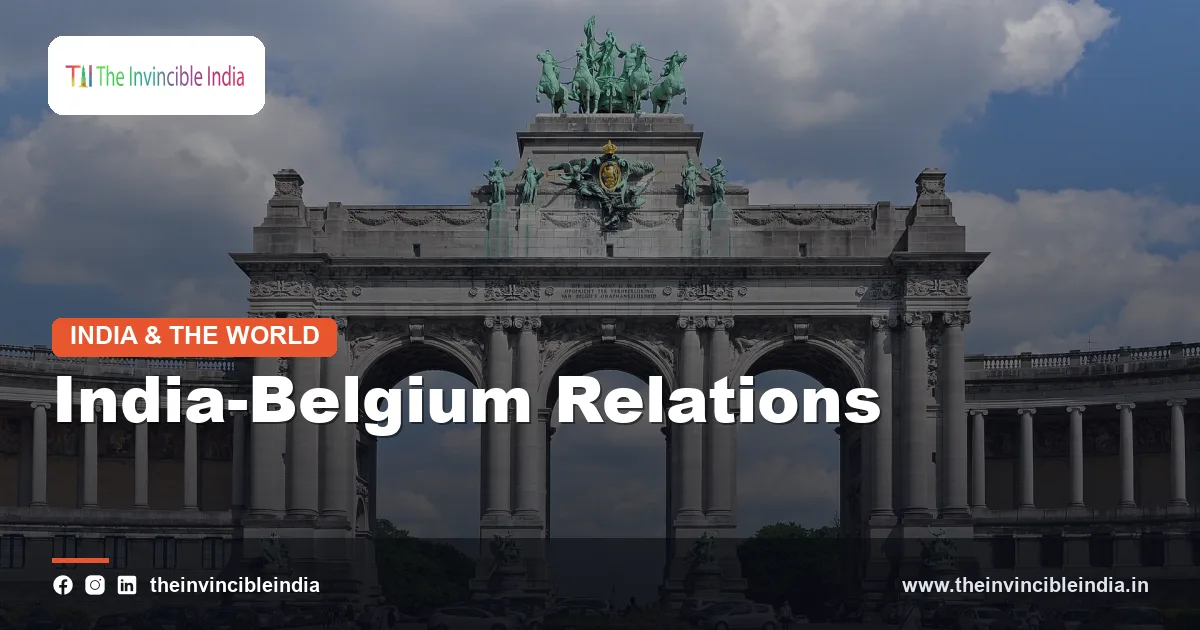
India-Belgium relations are the bilateral partnership between India and the Kingdom of Belgium, best known for the diamond trade that links the cutting and polishing industry of Surat with the trading hub of Antwerp, and for Brussels’ role as the political capital of the European Union. Diplomatic relations date from 1948, and the two countries today cooperate in diamonds and jewellery, pharmaceuticals, chemicals, logistics, technology and higher education.
Belgium is a small country with an outsized role in global trade, hosting one of Europe’s busiest ports, the world’s leading rough-diamond marketplace and the headquarters of the European Union’s main institutions and of NATO. For India, it is therefore both a commercial partner in its own right and a gateway to the wider EU. This explainer covers the history, the diamond corridor, the economic links, the Brussels connection and the present challenges. It was last reviewed on 15 October 2026.
| Attribute | Detail |
|---|---|
| Diplomatic relations established | 1948 |
| Indian mission | Embassy of India, Brussels (also covering Luxembourg and accredited to the EU) |
| Belgian mission | Embassy of Belgium, New Delhi, with consulates and trade offices in other Indian cities |
| Signature economic link | Diamonds: rough stones traded in Antwerp, cut and polished in Surat |
| Other key sectors | Pharmaceuticals, chemicals, machinery, logistics, information technology |
| Belgian capital and EU seat | Brussels, home of the European Commission and the Council of the EU |
| Gateway role | Antwerp port and Brussels institutions provide access to the European single market |
| Wider framework | India-EU Strategic Partnership and India-EU trade and investment negotiations |
Key Takeaways
- India and Belgium established diplomatic relations in 1948, shortly after Indian independence, and have maintained steady ties since.
- The diamond trade is the core of India-Belgium relations: Antwerp is the world’s leading hub for rough-diamond trade and Surat is the centre of Indian cutting and polishing.
- Belgium is among India’s significant trading partners in the European Union, with exchanges in diamonds, chemicals, pharmaceuticals, machinery and plastics.
- Brussels hosts the European Commission, the Council of the European Union and NATO headquarters, so Belgium is the base for India’s diplomacy with the EU.
- Indian businesspeople, particularly from Gujarat, have been prominent in Antwerp’s diamond sector for several decades.
- Rules on diamond traceability, lab-grown stones and sanctions on Russian-origin diamonds are among the main contemporary issues in the diamond corridor.
What are India-Belgium relations?
India-Belgium relations are a long-standing, mostly economic partnership between India and Belgium that rests on the diamond industry and has widened to include pharmaceuticals, chemicals, logistics, research and EU-level diplomacy. Belgium is a federal constitutional monarchy of about 11 million people, divided into three regions (Flanders, Wallonia and the Brussels-Capital Region) and three language communities (Dutch, French and German).
That federal structure matters for the relationship, because economic promotion, trade missions and many investment decisions are handled by regional bodies rather than only by the federal government. Flanders, where Antwerp is located, has historically been the region most connected to India through diamonds, ports and chemicals, while Brussels is the diplomatic and institutional centre.
For India, relations with Belgium complement its ties with larger European partners such as Germany, France and the Netherlands. Belgium is small but well connected, and its economy is open and trade-dependent, which suits Indian exporters and investors who want a European base.
How did India-Belgium relations develop?
India-Belgium relations developed from the post-independence establishment of diplomatic ties in 1948 through steady commercial growth in diamonds, and then through expanded cooperation after India’s economic liberalisation in 1991 and the deepening of India-EU contacts in the 2000s. Belgium was one of the European countries that recognised India early, and the countries have since had few political disputes.
The diamond link grew in practice before it was formalised. Gujarati diamond merchants, many from the Palanpur region, began settling in Antwerp in the 1960s and 1970s, and by the 1980s and 1990s Indian traders had become a major presence in Antwerp’s diamond quarter. This community built the supply chain in which rough stones bought in Antwerp were sent to India for cutting and then returned as polished diamonds.
In the 2000s and 2010s, Belgian royal-led economic missions to India and Indian ministerial visits to Brussels added institutional depth. Belgium also held the rotating presidency of the Council of the EU in the first half of 2024, giving it a role in shaping the agenda of EU-India engagement.
Selected milestones
- 1948: Diplomatic relations established between India and Belgium.
- 1960s-1980s: Indian diamond merchants settle in Antwerp and build the cutting-and-trading corridor with Surat.
- 1991: Indian economic liberalisation opens the door to wider trade and investment.
- 2004: The India-EU Strategic Partnership is established, with Brussels as its institutional base.
- 2016: India-EU summit is held in Brussels, bringing the Indian Prime Minister to Belgium.
- 2022: India and the EU relaunch negotiations on trade and investment agreements.
How does the diamond trade link Surat and Antwerp?
The diamond trade links Surat and Antwerp through a division of labour in which Antwerp is the leading world market for rough diamonds and Surat is the leading centre for cutting and polishing them. Industry sources commonly state that around nine out of every ten diamonds in the world are cut and polished in India, with the great majority of that work done in Surat in Gujarat.
Antwerp, for its part, has been a diamond centre since the fifteenth century and has a cluster of diamond bourses, banks, certification laboratories and security firms in a small district near its central railway station. A large share of the world’s rough diamonds, and a significant share of polished diamonds, pass through or are traded in Antwerp at some stage. The Antwerp World Diamond Centre (AWDC) represents the sector and works with Indian bodies such as the Gem and Jewellery Export Promotion Council (GJEPC).
The corridor works in a recognisable sequence: rough stones are sourced from mining countries and traded in Antwerp, shipped to Surat and Mumbai for manufacturing, then sold as polished stones or jewellery to markets in the United States, Europe, the Middle East and East Asia, with Antwerp, Dubai and Hong Kong serving as trading points.
Why does the corridor work?
- Antwerp provides financing, certification, security and a trusted trading platform.
- Surat offers large-scale, skilled and cost-effective manufacturing.
- Family business networks of Indian origin operate on both sides, reducing transaction costs and building trust.
What other goods and services do India and Belgium trade?
India and Belgium trade chemicals, pharmaceuticals, machinery, plastics, textiles, petroleum products and engineering goods in addition to diamonds. Diamonds and related jewellery make up a very large share of the total, so trade values depend significantly on the diamond cycle and on rough-stone prices.
Belgium has a strong chemicals and life-sciences cluster, and Belgian firms in pharmaceuticals, biotechnology, materials and industrial technology are active in India. Indian generic and specialty pharmaceutical firms, as well as chemical companies, look to Belgium for European distribution through the port of Antwerp-Bruges and the large logistics network around it.
| Direction | Typical products |
|---|---|
| Indian exports to Belgium | Polished diamonds and jewellery, petroleum products, chemicals, pharmaceuticals, textiles and garments, engineering goods |
| Belgian exports to India | Rough and some polished diamonds, chemicals, machinery, plastics, pharmaceutical inputs, metals and industrial equipment |
| Services and investment | Information technology, logistics, research collaboration, education, port and shipping services |
Belgian companies operating in India include firms in steel wire, materials, chemicals and industrial equipment, and a number of Indian IT, pharmaceutical and engineering firms have offices in Belgium. Antwerp-Bruges, formed by the merger of the Antwerp and Zeebrugge ports, is among the largest port systems in Europe and a natural entry point for Indian cargo.
Why is Belgium a gateway to the European Union for India?
Belgium is a gateway to the European Union for India because it hosts the main EU institutions in Brussels, has one of Europe’s biggest ports and sits at the centre of the dense road, rail and river network that serves the single market. An Indian exporter or investor can reach most of the EU’s consumers within a day’s transport from Belgium.
Belgium also has a multilingual, highly educated workforce, a central location between France, Germany, the Netherlands and Luxembourg, and a tradition of hosting international business. Many Indian firms set up regional European offices there, partly to maintain contact with the EU institutions that write rules affecting their products.
The gateway function is practical rather than legal. Goods entering the EU through Antwerp-Bruges are subject to the common EU customs rules and tariffs, so India’s access to the whole bloc depends on the EU’s trade policy and on any agreement India and the EU conclude, not just on bilateral arrangements with Belgium.
What is Brussels’ role in India-EU diplomacy?
Brussels’ role in India-EU diplomacy is that of the institutional base for the relationship, because the European Commission, the Council of the EU and the European External Action Service (EEAS) are headquartered there, and the European Parliament holds many of its sessions and committee meetings in the city. India maintains a Mission to the European Union in Brussels in addition to its bilateral embassy to Belgium.
India and the EU established diplomatic ties in 1962, signed a Strategic Partnership in 2004 and have held regular leaders’ summits. They created a Trade and Technology Council in 2022 to coordinate on digital policy, green technologies and supply chains, and relaunched trade and investment negotiations the same year after a pause that began in 2013. Brussels is where much of that work is done.
Belgium itself is one of the EU member states that support closer links with India, and as a country that benefits from open trade it has generally favoured an ambitious India-EU economic agreement. The status of the negotiations has changed over time, so readers should consult current statements from the European Commission and India’s Ministry of Commerce and Industry.
How do India and Belgium cooperate in science, education and culture?
India and Belgium cooperate in science, education and culture through university partnerships, research links in life sciences and materials, student exchanges and Indology studies. Belgian universities such as those at Leuven and Ghent have a record of research and teaching connected to South Asia.
Belgian scholarship on India has a respected tradition. The Belgian Indologist Etienne Lamotte, who taught at the University of Louvain, produced influential studies of Indian Buddhism in the twentieth century. Today, Indian students come to Belgium for degrees in engineering, business, biotechnology and the sciences, and research collaboration is supported by programmes of the European Union as well as by bilateral funds.
Cultural contact is supported by Indian cultural events, yoga, classical dance and music performances, and by an Indian community of several thousand people concentrated in Antwerp, Brussels and other cities. Indian restaurants, festivals such as Diwali, and cinema screenings contribute to public awareness.
What policy issues affect the diamond corridor?
The main policy issues affecting the India-Belgium diamond corridor are traceability rules for diamonds, sanctions on Russian-origin stones, the growth of laboratory-grown diamonds and the need to prevent trade in conflict diamonds. These issues are discussed in industry bodies, in the Kimberley Process and in government dialogue.
- Kimberley Process: The Kimberley Process Certification Scheme, launched in 2003, is meant to stop the trade in conflict diamonds. India and the EU are both participants, and India chaired the scheme in 2019.
- Russian-origin diamonds: Since 2024, G7 and EU measures on diamonds of Russian origin have required traders in Antwerp and cutting centres in India to improve documentation of where stones come from.
- Laboratory-grown diamonds: Surat has become a major producer of laboratory-grown stones, which compete with mined diamonds and raise questions about disclosure and certification.
- Demand cycles: Changes in consumer demand in the United States and China affect polished-diamond prices and the employment of cutters in Surat.
Belgium and India share an interest in a transparent, well-regulated trade, since reputation is the main asset of the Antwerp market.
What are the challenges in India-Belgium relations?
The challenges in India-Belgium relations are a heavy dependence of trade on diamonds, the absence so far of a comprehensive India-EU agreement, regulatory differences and occasional questions around compliance and financial crime in the diamond sector. None of these is a bilateral dispute, but together they limit the diversification of the relationship.
- Concentration: Diamond trade swings affect the overall trade figures, and expanding non-diamond trade is a stated goal on both sides.
- Investment framework: India ended many older bilateral investment treaties, including the one with the Belgium-Luxembourg Economic Union, in the review of investment treaties it undertook around 2016-17, so a new framework is expected to come through EU-level talks.
- Regulation and standards: EU rules on chemicals, product safety and the environment require Indian exporters to adapt.
- Financial-crime scrutiny: Cases of fraud involving diamond merchants have drawn attention to due diligence and cross-border cooperation between agencies.
What is the future of India-Belgium relations?
The future of India-Belgium relations lies in widening cooperation beyond diamonds into green technology, pharmaceuticals and biotechnology, port and logistics connectivity, and research, while using Brussels as the venue for deeper India-EU engagement. Belgium’s strength in life sciences, hydrogen technology, offshore wind and ports matches India’s needs in energy transition and manufacturing.
Indian firms are also well placed to invest in Belgian and European supply chains, and a concluded India-EU agreement would lower tariffs and give both economies more stable rules. Increased student mobility and joint research would further strengthen the relationship.
Bottom Line
India-Belgium relations are a stable, commercially driven partnership centred on the Surat-Antwerp diamond corridor and enriched by Belgium’s role as a gateway to the EU. Wider growth depends on diversifying beyond diamonds and on progress in India-EU negotiations.
Frequently Asked Questions
When were India-Belgium diplomatic relations established?
India and Belgium established diplomatic relations in 1948. Both countries maintain embassies in each other’s capitals, and India also has a separate mission to the European Union in Brussels. Relations have been cordial and free of major political disputes.
Why is Antwerp important for India?
Antwerp is important for India because it is the world’s leading market for rough diamonds, which are then cut and polished mainly in Surat. The city also has a large Indian business community and a major port, Antwerp-Bruges, that gives Indian goods access to the European market.
What does India export to Belgium?
India exports polished diamonds and jewellery, petroleum products, chemicals, pharmaceuticals, textiles and engineering goods to Belgium. Diamonds are the largest category by value, so export totals vary with the diamond cycle. Many Indian goods then move on to other EU countries.
Is Belgium a gateway to the EU for Indian companies?
Yes, Belgium is a practical gateway to the EU for Indian companies. It hosts the main EU institutions in Brussels and one of Europe’s largest ports in Antwerp-Bruges. Market access still depends on common EU rules rather than on Belgium alone.
How are Surat and Antwerp connected in the diamond industry?
Surat and Antwerp are connected through a supply chain in which Antwerp trades rough diamonds and Surat cuts and polishes them. Indian merchants and family firms operate in both cities, and the stones are then sold worldwide as polished diamonds and jewellery.
What are the main issues in India-Belgium relations today?
The main issues are diamond traceability, the effect of sanctions on Russian-origin stones, the rise of laboratory-grown diamonds and the need to diversify trade. The lack of a concluded India-EU agreement and the end of older investment treaties are also relevant. Both countries are working on these points through bilateral dialogue and EU channels.
{“@context”:”https://schema.org”,”@graph”:[{“@type”:”FAQPage”,”mainEntity”:[{“@type”:”Question”,”name”:”When were India-Belgium diplomatic relations established?”,”acceptedAnswer”:{“@type”:”Answer”,”text”:”India and Belgium established diplomatic relations in 1948. Both countries maintain embassies in each other’s capitals, and India also has a separate mission to the European Union in Brussels. Relations have been cordial and free of major political disputes.”}},{“@type”:”Question”,”name”:”Why is Antwerp important for India?”,”acceptedAnswer”:{“@type”:”Answer”,”text”:”Antwerp is important for India because it is the world’s leading market for rough diamonds, which are then cut and polished mainly in Surat. The city also has a large Indian business community and a major port, Antwerp-Bruges, that gives Indian goods access to the European market.”}},{“@type”:”Question”,”name”:”What does India export to Belgium?”,”acceptedAnswer”:{“@type”:”Answer”,”text”:”India exports polished diamonds and jewellery, petroleum products, chemicals, pharmaceuticals, textiles and engineering goods to Belgium. Diamonds are the largest category by value, so export totals vary with the diamond cycle. Many Indian goods then move on to other EU countries.”}},{“@type”:”Question”,”name”:”Is Belgium a gateway to the EU for Indian companies?”,”acceptedAnswer”:{“@type”:”Answer”,”text”:”Yes, Belgium is a practical gateway to the EU for Indian companies. It hosts the main EU institutions in Brussels and one of Europe’s largest ports in Antwerp-Bruges. Market access still depends on common EU rules rather than on Belgium alone.”}},{“@type”:”Question”,”name”:”How are Surat and Antwerp connected in the diamond industry?”,”acceptedAnswer”:{“@type”:”Answer”,”text”:”Surat and Antwerp are connected through a supply chain in which Antwerp trades rough diamonds and Surat cuts and polishes them. Indian merchants and family firms operate in both cities, and the stones are then sold worldwide as polished diamonds and jewellery.”}},{“@type”:”Question”,”name”:”What are the main issues in India-Belgium relations today?”,”acceptedAnswer”:{“@type”:”Answer”,”text”:”The main issues are diamond traceability, the effect of sanctions on Russian-origin stones, the rise of laboratory-grown diamonds and the need to diversify trade. The lack of a concluded India-EU agreement and the end of older investment treaties are also relevant. Both countries are working on these points through bilateral dialogue and EU channels.”}}]}]}


