

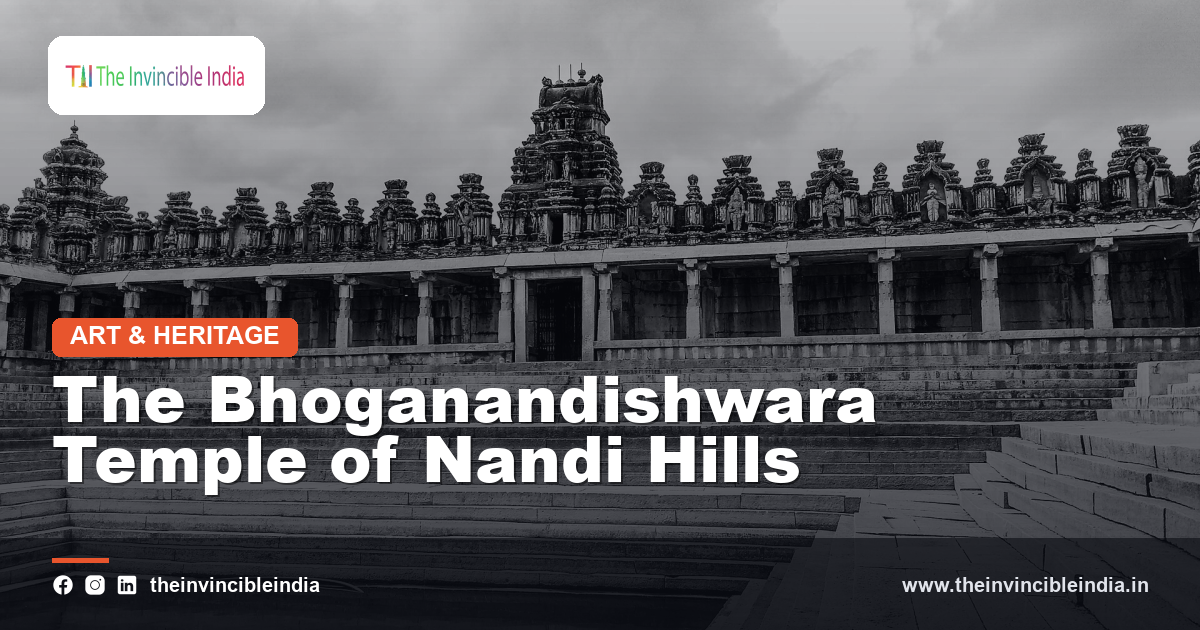
The Bhoganandishwara temple, also written Bhoga Nandeeshwara or Bhoga Nandishwara and often called the Nandi temple, is an ancient Shiva temple standing at the foot of Nandi Hills, near the village of Nandi in the Chikkaballapur district of Karnataka. The temple is a complex of shrines, halls, gateways and a sacred tank, built over many centuries and enriched by successive dynasties of South India. It is a quiet and much-visited monument that sits below the more famous hill station above it, and it rewards visitors with fine carved pillars and a deep sense of continuity. The temple stands within the long story of Dravidian temple architecture, which here shows the work of several ruling houses in a single place. This article explains where it is, who shaped it and what it shows.
Quick answer: The Bhoganandishwara temple is an ancient Shiva temple at the foot of Nandi Hills in Chikkaballapur district, Karnataka, India. It was begun in the early medieval period under the Nolamba dynasty and was enlarged by later rulers, including the Cholas, Hoysalas and the Vijayanagara kings, which gives it several layers of Dravidian art. The temple is known for its carved pillars, its twin shrines and its sacred tank.
Key Takeaways
- The Bhoganandishwara temple is a Shiva temple at the foot of Nandi Hills in Chikkaballapur district, Karnataka.
- Its earliest parts are generally attributed to the Nolamba dynasty of the early medieval period.
- Later rulers, including the Cholas, the Hoysalas and the Vijayanagara kings, added to the temple over the centuries.
- The temple is built in the Dravidian style, with gateways, pillared halls and shrines enclosed within a walled court.
- A ceremonial hall, called a kalyana mantapa, is among its most admired features for its carved pillars.
- The temple is a complex of shrines, including those of Shiva as Bhoganandishwara and as Arunachaleshwara, together with a sacred tank.
The sections below describe the setting, dynasties, architecture and traditions of the Bhoganandishwara temple.
Quick Facts
| Detail | Information |
|---|---|
| Location | Foot of Nandi Hills, Chikkaballapur district, Karnataka |
| Type | Ancient Hindu temple complex of Shiva |
| Main deity | Shiva, worshipped as Bhoganandishwara |
| Early patrons | Nolamba dynasty |
| Later patrons | Cholas, Hoysalas and Vijayanagara rulers |
| Architectural style | Dravidian, with layered additions |
| Notable features | Kalyana mantapa, carved pillars, sacred tank |
| Nearby landmark | Nandi Hills hill station above the village |
What Is the Bhoganandishwara Temple?
The Bhoganandishwara temple is an ancient temple complex dedicated to Shiva that stands at the base of Nandi Hills in southern Karnataka. It is made up of several linked parts: sanctums, pillared halls, gateways and an enclosed court with a sacred tank nearby. The temple is not the work of one age but of many, so that visitors move through centuries as they walk from one hall to the next. It is still a place of worship, and its daily rites and annual festivals continue in the old manner. The monument is valued by historians for its inscriptions and by lovers of art for its detailed stone carving. The Bhoganandishwara temple is therefore both a living shrine and an archive of South Indian temple history.
Where Is the Bhoganandishwara Temple Located?
The Bhoganandishwara temple is located in the village of Nandi, at the foot of Nandi Hills, in the Chikkaballapur district of Karnataka. The place lies to the north of Bengaluru, at a distance that makes it an easy journey from the city by road. Nandi Hills rises above the village as a rocky granite hill, well known for its cool climate, morning mist and views over the plains. The temple stands below, in a more secluded setting among the houses of the village and the fields beyond. Because many visitors go directly to the hilltop, the temple is sometimes overlooked, which keeps its courts quiet. The position beneath the hill ties the monument to a landscape that has been regarded as sacred for a very long time.
Why Is the Temple Called Bhoganandishwara?
The name Bhoganandishwara joins the ideas of enjoyment, joy and lordship, and it refers to Shiva as the lord of the delight of the world. The word bhoga means enjoyment or the fruit of worldly life, ananda means bliss and ishwara means lord, so the name describes Shiva in a gracious and benevolent aspect. Local tradition explains the name in relation to the bull Nandi, the devoted vehicle of Shiva, and the hill itself is linked in tradition with Nandi. Such explanations belong to devotional belief, but they show why the name is loved. The temple name thus describes a Shiva who gives both worldly well-being and spiritual joy. The title Bhoganandishwara therefore expresses the generous character of the deity worshipped here.
Who Built the Bhoganandishwara Temple?
The earliest parts of the temple are generally attributed to the Nolamba dynasty, a ruling family of the region in the early medieval period. The Nolambas held parts of the southern Karnataka and neighbouring country and are known for temple building in a local style. Inscriptions at the site and in the region record gifts and grants made by various rulers, and these help scholars follow the temple’s growth. The names of other dynasties, including the Cholas, the Hoysalas and the Vijayanagara kings, also appear in the story of the monument. Exact dates for individual parts are debated, so it is wiser to speak in general terms of centuries of addition. The temple is therefore the product of many royal patrons rather than of a single builder.
What Role Did the Nolamba Dynasty Play?
The Nolamba dynasty played the opening role in the temple’s history and left the oldest stone work at the site. The Nolambas ruled in the region sometimes called Nolambavadi, which lay in what is now southern Karnataka and parts of neighbouring states, and they were connected with the larger political world of the Gangas, the Rashtrakutas and the Cholas. Their temples often show a restrained and sturdy style, with simple plans and finely cut stone. The earliest shrines at Nandi belong to this tradition and set the pattern that later builders respected and extended. Although the dynasty is less famous than some of its successors, its contribution to temple building was real. The Nolambas are therefore remembered as the founders of the architectural heritage at Nandi.
How Did the Cholas, Hoysalas and Vijayanagara Kings Add to the Temple?
The later dynasties added halls, shrines and gateways that gave the temple its present rich and layered form. The Cholas, a great power of the Tamil country, extended their influence into the region and are associated with early additions. The Hoysalas, famed for their detailed carving in other parts of Karnataka, are linked with the sculptural refinement seen in some pillars and ornament. The Vijayanagara kings, the great patrons of the later medieval Deccan, are associated with the grand ceremonial hall and enlargements that suited a growing pilgrim tradition. Each addition respected the original shrine while expressing the taste of its own time. The result is a temple in which several dynasties can be read in stone, each adding its own chapter to a shared building.
What Is the Architecture of the Temple?
The architecture of the Bhoganandishwara temple follows the Dravidian tradition of South India, in which shrines are set within an enclosed court and approached through gateways. The sanctums are crowned by towers of stepped form, and the halls are supported by rows of carved stone pillars. The walls are built of granite, a durable stone that is easy to find in the region and that carries sharp detail. The plan includes an outer court, an inner hall and the sanctum, a sequence that moves the worshipper from the open world towards the sacred centre. The unity of the whole is helped by the steady use of stone and by the repeated forms of pillar and bracket. The architecture shows how a temple can grow over centuries while remaining coherent.
What Is the Kalyana Mantapa?
The kalyana mantapa is a ceremonial pillared hall in the temple, used traditionally for festive rites such as the symbolic wedding of the deity. Its pillars are carved with figures, floral patterns and mythological scenes, and they show the skill of the stone workers who made them. Halls of this kind are a hallmark of the Vijayanagara period in Karnataka and the neighbouring southern regions, where they were built as grand spaces for public ritual. The hall at Nandi is admired for the harmony of its proportions and the delicacy of its decoration. It stands open to the air, so light plays across the carved stone through the day. The kalyana mantapa is one of the most visited and photographed parts of the temple.
What Is the Significance of the Twin Shrines?
The temple is notable for containing more than one major shrine within its complex, and these shrines are dedicated to Shiva in different forms. Worshippers know one as the shrine of Bhoganandishwara and another as that of Arunachaleshwara, with a shrine of the goddess associated with Shiva as well. The arrangement reflects the way South Indian temples often grew by adding new shrines beside older ones, each tied to a particular aspect of the god. Pilgrims move among the shrines in an established order, offering prayers at each. The result is a temple that feels like a small religious town rather than a single building. The twin shrines therefore show how devotion enriched the temple with several centres of worship.
What Is the Role of the Sacred Tank?
The sacred tank is a stepped pond of stone, often called a pushkarini or kalyani, that forms part of the temple’s ritual landscape. Water is central to temple life in South India, and such tanks serve for bathing, for rites of purification and for festivals in which the deity is carried to the water. The tank at Nandi is built of well-cut stone with steps on its sides, and its geometry is pleasing and practical. It also helped to collect and store water in a region that depends on seasonal rain. The pond and the temple together form one sacred unit. The sacred tank is a reminder that Indian temples were designed as complete environments of architecture, water and ritual.
What Do the Carvings and Sculptures Show?
The carvings at the Bhoganandishwara temple cover pillars, brackets, doorways and walls with figures and ornament. They include images of gods and goddesses, mythological episodes, floral scrolls, animals and dancing figures, and they show the range of themes available to South Indian sculptors. Different layers of the temple show different styles, so that a careful visitor can compare early restraint with later richness. Some figures are small and delicate, while others are bold and large, and all are cut from the hard granite with considerable skill. Inscriptions in old scripts also appear on the walls and are valuable records of gifts and patrons. The carvings make the temple a gallery of sculpture as well as a place of worship.
How Is Nandi the Bull Linked with the Place?
The bull Nandi is the sacred mount and chief devotee of Shiva, and he gives the hill and the village their name. Tradition holds that the hill resembles a reclining bull, and many local legends connect the place with Nandi’s devotion and with penance performed here. Images of the bull appear in and around the temple, which fits the standard Shiva temple plan in which Nandi faces the sanctum. The link between the god, the bull and the hill makes the whole area feel like one sacred landscape. These traditions are devotional rather than documented, but they are part of how the temple is understood by those who worship. Nandi the bull is thus woven into the identity of the site.
What Festivals and Worship Are Observed Here?
Worship at the temple follows the daily rites common to Shiva temples, with morning and evening offerings, lamps and chanting. The great festival of Mahashivratri, the night of Shiva, draws devotees who stay in prayer and observe vigil through the night. Other seasonal festivals, including processions in which the deity is carried in a decorated chariot or palanquin, bring the local community together. Such events keep the temple at the centre of village life and sustain the crafts, music and food customs that surround it. Visitors who come during a festival see the temple as it has been used for generations. The festivals confirm that the Bhoganandishwara temple is a living institution as well as an ancient monument.
How Does the Temple Relate to Nandi Hills?
The temple lies at the foot of Nandi Hills, and the hill above shapes the experience of the whole area. Nandi Hills is a granite hill known for its cool air, early morning mist and sweeping views of the plains, and it also carries the Yoga Nandeeshwara temple on its upper slopes. In the later period the hill became a retreat for rulers and then for the people of Bengaluru. The temple at its base, however, is far older than the modern popularity of the hilltop. Many visitors now combine a morning on the hill with a visit to the temple below. The relationship of hill and temple shows how a natural height can anchor a religious and cultural landscape.
How Do Visitors Experience the Temple Today?
Visitors to the temple find a calm and spacious complex of stone courts that is open for worship and for visits. The best approach is to walk slowly through the gateways, halls and shrines, paying attention to the changes of style from one part to the next. Modest dress and quiet conduct are expected, as the temple is an active place of prayer, and footwear is removed before entering the inner areas. The cooler months are comfortable for a visit, and early morning offers the best light for seeing the carvings. Local guides and caretakers can explain the sections and their stories. A visit usually leaves the impression of an old and generous place that has welcomed many centuries of worshippers.
The Bhoganandishwara Temple Today
The Bhoganandishwara temple today is a protected monument and a working shrine, valued as one of the finest old temples in the Bengaluru region. It continues to attract worshippers, art lovers and students of South Indian history, who find in its halls a clear record of changing dynasties and styles. Conservation efforts aim to keep the stone work sound and to protect the inscriptions, while the temple community maintains its rites. The popularity of Nandi Hills has brought new visitors, and with them a need for careful management of the site. The temple remains a calm counterpoint to the busy hilltop above. The Bhoganandishwara temple endures as a layered monument in which faith, patronage and craftsmanship are all still visible.
Sources & Further Reading
- Archaeological Survey of India (asi.nic.in).
- Ministry of Culture, Government of India (indiaculture.gov.in).
Frequently Asked Questions
Where is the Bhoganandishwara temple located?
The Bhoganandishwara temple is located at the foot of Nandi Hills, in the village of Nandi in Chikkaballapur district of Karnataka. It lies to the north of Bengaluru and is reached by road.
Who built the Bhoganandishwara temple?
The earliest parts of the Bhoganandishwara temple are generally attributed to the Nolamba dynasty. Later additions are linked with the Cholas, the Hoysalas and the Vijayanagara kings, though exact dating of each part is debated.
Which deity is worshipped at the Bhoganandishwara temple?
The temple is dedicated to Shiva, who is worshipped here as Bhoganandishwara. The complex also contains a shrine of Shiva as Arunachaleshwara and a shrine of the goddess.
What is the kalyana mantapa at Nandi temple?
The kalyana mantapa is a ceremonial pillared hall in the Bhoganandishwara temple, used for festive rites such as the symbolic wedding of the deity. It is admired for its carved pillars and is typical of Vijayanagara-period temple halls.
What architectural style is the Bhoganandishwara temple?
The Bhoganandishwara temple is built in the Dravidian style of South India, with gateways, pillared halls and shrines inside an enclosed court. Its stone work shows the influence of several dynasties over many centuries.
Is the Bhoganandishwara temple the same as the temple on top of Nandi Hills?
No, the Bhoganandishwara temple stands at the foot of the hill, while the Yoga Nandeeshwara temple is on the upper slopes of Nandi Hills. The two are separate temples and are often visited together.


