

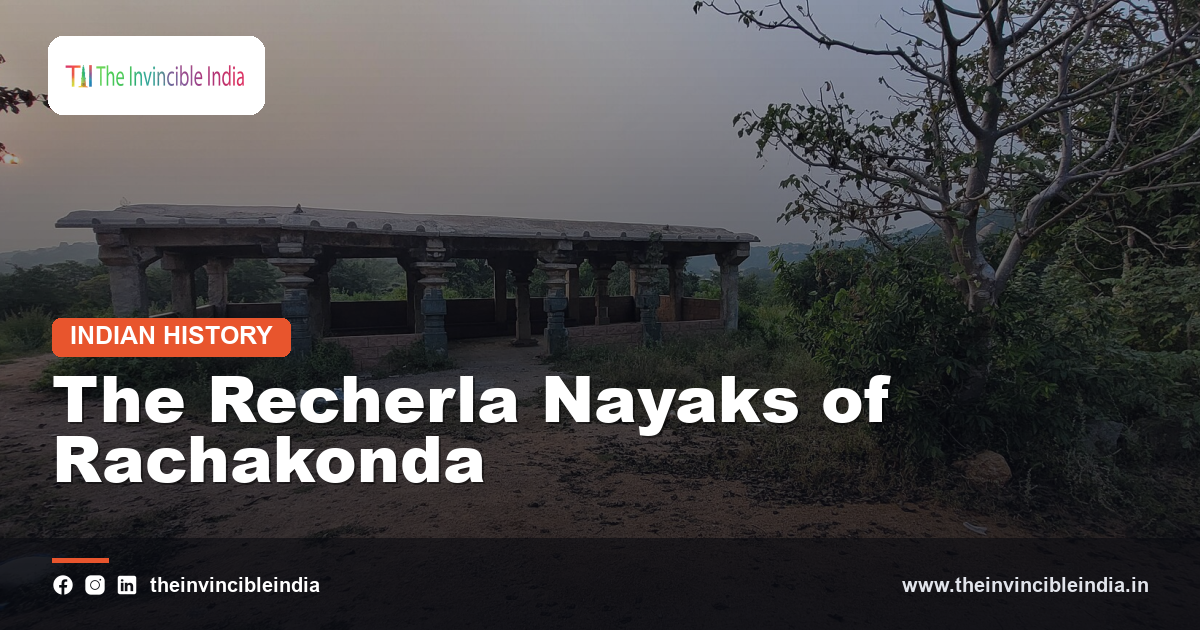
The Recherla Nayaks, also called the Recherla chiefs, the Velama Nayaks of Rachakonda or the rulers of Rachakonda and Devarakonda, were a Telugu chiefly family who governed large parts of Telangana from the fourteenth to the fifteenth century. They rose after the Kakatiya kingdom fell and the Musunuri confederacy weakened, and they built a state around the hill forts of Rachakonda and Devarakonda in the Nalgonda region. Their rivalry with the Bahmani Sultanate and the Vijayanagara Empire, described in our Vijayanagara guide, shaped the politics of the Deccan. Dates and some details are debated, so this guide keeps to broad terms.
Quick answer: The Recherla Nayaks were a Telugu chiefly dynasty that ruled much of Telangana from the hill forts of Rachakonda and Devarakonda in the fourteenth and fifteenth centuries. They rose after the fall of the Kakatiyas, fought the Bahmani Sultanate and the Reddis, and are remembered for the scholar-king Singabhupala, who wrote in Sanskrit. Their state declined under Bahmani and later Deccan sultanate pressure.
Key Takeaways
- The Recherla Nayaks were a Telugu chiefly dynasty that governed much of Telangana in the fourteenth and fifteenth centuries.
- Their seats were the hill forts of Rachakonda and Devarakonda in the Nalgonda region of Telangana.
- They rose as successors to the Musunuri Nayaks after the Kakatiya kingdom collapsed.
- Singabhupala, one of their best-known rulers, is remembered as a scholar who wrote Sanskrit works on drama and poetics.
- They fought repeated wars with the Bahmani Sultanate, the Reddis of Kondavidu and the Vijayanagara Empire.
- Their exact chronology and the order of some rulers are debated among historians.
Read on for the history, culture, and legacy in detail.
Quick Facts
| Detail | Information |
|---|---|
| Dynasty | Recherla Nayaks (rulers of Rachakonda) |
| Region | Telangana, centred on the Nalgonda area |
| Main Strongholds | Rachakonda and Devarakonda hill forts |
| Era | Fourteenth and fifteenth centuries, with dates debated |
| Best-Known Ruler | Singabhupala, the scholar-king |
| Major Rivals | Bahmani Sultanate, Reddis, Vijayanagara |
Who Were the Recherla Nayaks?
The Recherla Nayaks were a Telugu chiefly family that rose to prominence in Telangana during the fourteenth century and ruled for roughly a century and a half. They are usually described as belonging to the Padmanayaka community, a warrior group of the Telugu country, and their name comes from the village of Recherla, from which the family is said to have taken its name. Their forebears had served the Kakatiya kings as local commanders, and they built on that background when the Kakatiya order collapsed. Rather than a vast empire, they created a regional state held together by hill forts, family ties and military service. Historians differ on some aspects of their origins, and this guide leaves those debates aside. The Recherla Nayaks are thus remembered as the leading Telugu rulers of Telangana in their age.
Where Were Rachakonda and Devarakonda?
Rachakonda and Devarakonda are two hill-fort sites in the Nalgonda region of Telangana, which served as the main strongholds of the Recherla Nayaks. Rachakonda lies in the hills near Hyderabad, and its fortified plateau commanded the surrounding countryside. Devarakonda, in the Nalgonda district, stood in a rugged range of hills with natural defences that made it a formidable stronghold. The forts included several lines of walls, gateways, tanks and temples, and they were connected with the surrounding villages through an administrative network. Both are protected heritage sites today. The geography of these forts explains how a regional family could hold out against larger powers for generations.
How Did the Recherlas Rise After the Kakatiyas?
The Recherla Nayaks rose after the Kakatiyas because the fall of Warangal left many chiefs competing for leadership in the Telugu country. At first, the Musunuri confederacy under Kapaya Nayaka restored Telugu authority at Warangal, but its leadership was fragile. Recherla chiefs, who had their own local power base, challenged the Musunuris and gradually extended their control over Telangana. Traditional accounts describe conflicts between Kapaya Nayaka and Recherla leaders, which ended in the weakening of the Musunuri state. Details are known mainly from inscriptions and later literary works, and some dates are debated. This rise illustrates how local chiefly families took over from fallen dynasties.
Who Were the Early Recherla Rulers?
The early Recherla rulers include chiefs such as Anapota Nayaka and Singama Nayaka, who established the family’s regional authority. Inscriptions describe them as warriors and administrators who built forts, dug tanks and granted lands to temples and Brahmins. The family expanded its power over time, extending its influence across Telangana and into neighbouring regions. The order and exact reigns of some early rulers are uncertain, because the records give titles and names but few dates. Scholars compare inscriptions and literary sources to reconstruct the sequence. The early Recherlas therefore laid the base on which the later rulers built a durable state.
What Did Singama Nayaka Achieve?
Singama Nayaka is traditionally credited with major military success and with consolidating the power of the Recherla family in Telangana. Tradition links him with the downfall of Kapaya Nayaka and the extension of Recherla control over the Warangal region. He is remembered as a vigorous commander who dealt with neighbouring powers, including the Bahmani Sultanate and the Reddi kings. His reign shows how the Recherla state moved from a local chiefdom to a significant regional power. Because some accounts are drawn from praise-poems and inscriptions, historians read them with caution. His career remains central to the story of the dynasty’s rise.
Who Was Singabhupala, the Scholar-King?
Singabhupala, also known as Sarvajna Singabhupala, is the best-known Recherla ruler and is remembered as a king who was also a distinguished scholar. He is credited with authoring Sanskrit works, most notably the Rasarnavasudhakara, a text on dramaturgy and poetics. The title Sarvajna, meaning all-knowing, expresses the reputation he held among learned men. He ruled from Rachakonda and gathered poets and scholars at his court, in the tradition of learned kings of the Deccan. Scholars still study his writings for their analysis of rasa and theatre. Singabhupala thus represents the cultural side of the Recherla state.
What Is the Rasarnavasudhakara?
The Rasarnavasudhakara is a Sanskrit treatise on dramaturgy and poetics attributed to Singabhupala, and it discusses the theory of rasa, or aesthetic sentiment. The text follows the tradition of earlier works on dramatic theory, such as the Natyashastra, and adds commentary and examples. It covers topics such as heroes and heroines, stage conventions and the aesthetic moods that drama should evoke. Because it comes from a regional court, it shows how Sanskrit learning continued in the Telugu country after the fall of the Kakatiyas. Scholars see it as an important late contribution to the Indian theatrical tradition. The work remains a key reason why the Recherla court is remembered in literary history.
How Did the Recherlas Support Telugu and Sanskrit Literature?
The Recherla Nayaks supported both Telugu and Sanskrit literature, and their court was a meeting place for poets and scholars. Besides Singabhupala’s own works, other writers are connected with the court in tradition, and the dynasty is remembered for encouraging learned discussion. Telugu poets of the age, among them the famous author of the Telugu Bhagavatam, Bammera Potana, are linked in tradition with the Recherla country, though accounts of his patron vary and are debated. The Recherla rulers also supported temple festivals and Brahmin scholars through land grants. This patronage helped preserve the literary culture of Telangana during an age of political change. The Recherla court therefore holds a place in the cultural history of the Deccan.
How Were the Hill Forts Built and Used?
The Recherla hill forts were built to take advantage of natural rock formations, with walls, bastions and gateways added to guard the approaches. Rachakonda and Devarakonda feature massive stone ramparts that follow the contours of the hills, with water tanks cut into the rock to supply the garrison. Inside the forts were temples, residences, granaries and assembly places. The forts served as military bases, administrative centres and refuges in times of danger. Their design reflects the long Deccan tradition of hill-fort building, found also at Warangal, Golconda and elsewhere. The forts remain the most visible legacy of the Recherla period.
What Wars Did the Recherlas Fight?
The Recherlas fought a series of wars with the Bahmani Sultanate to the north-west, the Reddi kingdom of Kondavidu to the east and the Vijayanagara Empire to the south. These conflicts were driven by competition for fertile land, forts and trade routes, and alliances shifted frequently. Sometimes the Recherla chiefs cooperated with Vijayanagara against the Bahmanis, and at other times they faced Vijayanagara pressure themselves. The record includes sieges, raids and treaties, though accounts differ on outcomes. The wars show how exposed a middle-sized state was in the competitive politics of the Deccan. The Recherla story is therefore a story of constant negotiation and conflict.
How Did the Recherlas Deal with Vijayanagara?
The Recherlas dealt with Vijayanagara through a mix of rivalry and cooperation, since both were Telugu-speaking powers with interests in the same regions. Vijayanagara kings sometimes intervened in Andhra and Telangana, and Recherla chiefs sometimes allied with them. At other times the Vijayanagara forces pressed against Recherla territory, especially in the coastal and southern areas. The relationship reflected the larger competition among the Deccan states. Historians rely on inscriptions and chronicles to piece together the sequence of events, and many details are debated. The relationship with Vijayanagara shows the Recherla state as an active player in the wider politics of the south.
What Was the Relationship with the Bahmani Sultanate?
The relationship with the Bahmani Sultanate was one of the most important in Recherla history, marked by cooperation against common foes and by long conflict. The Bahmani rulers, based in Gulbarga and later Bidar, sought to expand into Telangana and often clashed with the Recherla chiefs. At times the Recherlas allied with the Bahmanis against the Musunuris or against Vijayanagara, and the alliances changed as interests shifted. In the fifteenth century, Bahmani pressure grew, and the Recherla state lost ground. The details of many battles are known only in outline. This relationship was decisive in shaping the Recherla decline.
How Did the Recherla State Decline?
The Recherla state declined in the fifteenth century as the Bahmani Sultanate and other regional powers gained strength. Repeated wars drained resources, and internal rivalries among chiefs reduced unity. Eventually the Rachakonda and Devarakonda areas came under the control of the Bahmanis, and later the Qutb Shahi dynasty of Golconda took over much of Telangana. Some Recherla families continued as local chiefs under new rulers, and the memory of the dynasty continued. The exact sequence of events is debated. The decline shows the difficulty that regional dynasties faced against larger organised states.
What Do the Inscriptions and Chronicles Reveal?
The history of the Recherla Nayaks is known mainly from inscriptions, Telugu and Sanskrit literary works and later chronicles, each offering a different view. Inscriptions record grants, victories and the names of chiefs, while literary works such as the Rasarnavasudhakara reveal the cultural life of the court. Persian chronicles of the Bahmani period offer an outside perspective on conflicts. Historians compare these sources to build a coherent picture, but gaps remain. Some details in later chronicles may reflect tradition or praise rather than strict fact. The sources together create a layered account of the dynasty.
What Is the Heritage of the Recherlas?
The heritage of the Recherla Nayaks includes forts, temples, tanks and a body of literary work that continues to be studied. The hill forts of Rachakonda and Devarakonda are the most striking physical remains, and local communities keep memories of the Nayaks alive. The Sanskrit works of Singabhupala remain important in the study of Indian aesthetics, and the court’s patronage of Telugu literature enriched the language’s early development. The dynasty also contributed to the political culture of Telangana, in which hill forts and local chiefs played a major role. Together these remains make the Recherla period a visible part of Telangana’s past.
The Recherla Nayaks Today
The Recherla Nayaks are remembered today as a major Telugu dynasty of Telangana, noted for their forts, their scholar-king and their cultural patronage. Their memory is preserved in local histories, heritage trails and scholarly studies, and the forts of Rachakonda and Devarakonda are visited by trekkers and history lovers. Researchers continue to examine inscriptions and manuscripts to clarify the dynasty’s chronology. For readers, the Recherla story offers a view of medieval India shaped by regional powers rather than empires. The Recherla legacy remains an important thread in the cultural memory of the Telugu country.
Sources & Further Reading
- Archaeological Survey of India (asi.nic.in).
- Ministry of Culture, Government of India (indiaculture.gov.in).
Frequently Asked Questions
Who were the Recherla Nayaks?
The Recherla Nayaks were a Telugu chiefly dynasty who ruled much of Telangana from the hill forts of Rachakonda and Devarakonda in the fourteenth and fifteenth centuries. They rose after the fall of the Kakatiyas.
Where is Rachakonda fort?
Rachakonda fort is a hill fort in the Nalgonda region of Telangana, not far from Hyderabad. It was one of the main strongholds of the Recherla Nayaks.
Who was Singabhupala?
Singabhupala, also called Sarvajna Singabhupala, was a Recherla ruler and scholar who wrote Sanskrit works on drama and poetics. He is best known as the author of the Rasarnavasudhakara.
What is the Rasarnavasudhakara?
The Rasarnavasudhakara is a Sanskrit treatise on dramaturgy and poetics attributed to Singabhupala. It discusses rasa, the aesthetic sentiments evoked by drama and poetry.
How did the Recherla Nayaks rise to power?
The Recherla Nayaks rose to power after the Kakatiya collapse, when they challenged the Musunuri Nayaks and extended their control over Telangana. Some details of the rise are debated.
How did the Recherla state end?
The Recherla state declined in the fifteenth century under pressure from the Bahmani Sultanate and other Deccan powers. Later the Qutb Shahis of Golconda took over much of Telangana.


