

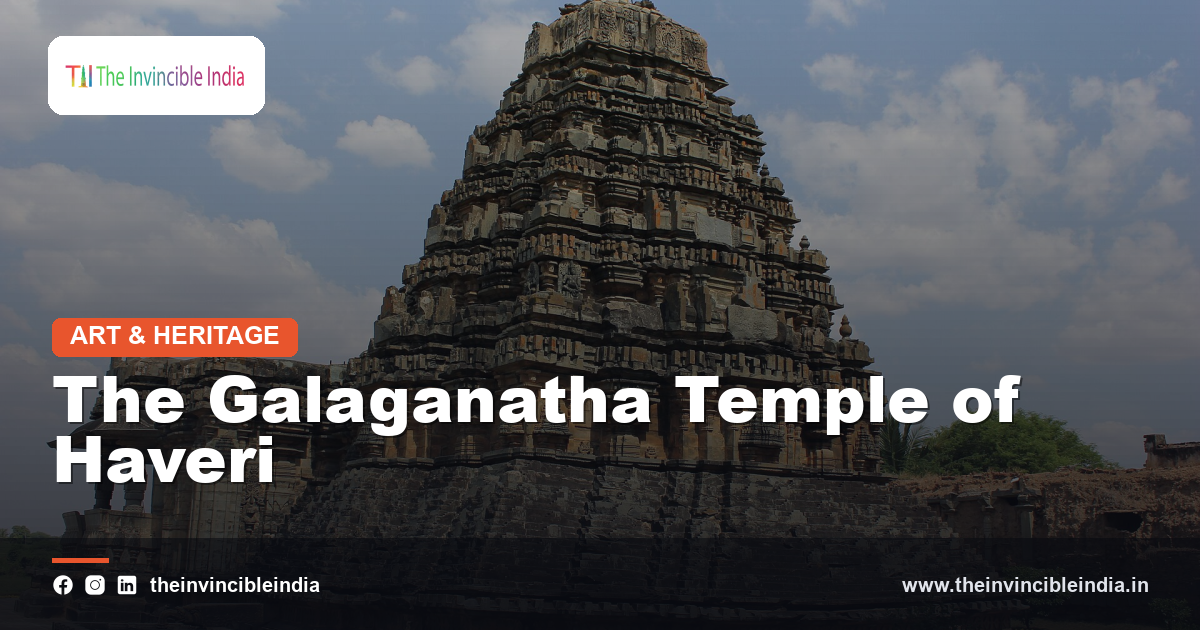
The Galaganatha temple, also spelled Galagnath or Galageshwara temple in some accounts, is an ancient Shiva shrine in Haveri district of Karnataka, standing in a quiet village setting beside the Tungabhadra river. It belongs to the tradition of Chalukya temple building in the Deccan, in which carefully dressed stone, rhythmic pillars and a curved tower combine into a compact and dignified sanctuary. Its builders drew on the same visual language described in the guide to Dravidian temple architecture while also borrowing northern forms, and the result is a monument that rewards slow looking. This guide explains its location, history, design, sculpture and present-day significance.
Quick answer: The Galaganatha temple (also called Galagnath temple) is a Shiva temple of the Chalukya tradition in the Galaganatha area of Haveri district, Karnataka, India, on the bank of the Tungabhadra river. It is generally attributed to the Western Chalukya period, roughly the eleventh to twelfth century, and is known for its curved stone tower, carved pillars and calm riverside setting. It is distinct from the Galaganatha temple at Pattadakal.
Key Takeaways
- The Galaganatha temple is a Shiva shrine in Haveri district, Karnataka, set beside the Tungabhadra river.
- It is generally assigned to the Western Chalukya (Kalyani Chalukya) period, although exact dating is debated.
- The temple follows a plan of sanctum, vestibule and hall, topped by a curvilinear tower in the northern manner.
- Its pillars and doorway show the crisp carving typical of Chalukya stone workshops of the Deccan.
- It shares its name with a better known temple at Pattadakal, but the two are separate monuments.
- The shrine remains a place of worship, particularly on Shivaratri and other Shaiva observances.
The sections below explain where the temple stands, how it was built and what a visitor can still see today.
Quick Facts
| Detail | Information |
|---|---|
| Location | Galaganatha, Haveri district, Karnataka |
| Also known as | Galagnath temple, Galageshwara temple |
| Deity | Shiva, worshipped as a linga in the sanctum |
| Approximate era | Generally the Western Chalukya period, about the eleventh to twelfth century |
| Type | Stone Hindu temple of the Chalukya tradition |
| Setting | Bank of the Tungabhadra river in north-central Karnataka |
What Is the Galaganatha Temple?
The Galaganatha temple is a Shiva temple of the Chalukya architectural tradition in Haveri district of Karnataka. It is a stone sanctuary arranged around a sanctum that houses the linga, the aniconic form in which Shiva is worshipped, and it is approached through a pillared hall. The temple is valued less for its size than for the harmony of its proportions and the quality of its stonework. Like many Chalukya shrines, it joins a clear ground plan to a tower that rises in carefully measured tiers. Its quiet village surroundings help it feel closer to the way such temples were once experienced, as centres of local devotion rather than as distant monuments. The Galaganatha temple is therefore best understood as a living Shaiva shrine that also preserves an important chapter of Deccan temple architecture.
Where Is the Galaganatha Temple Located?
The Galaganatha temple is located in the Galaganatha area of Haveri district in northern Karnataka, close to the bank of the Tungabhadra river. Haveri lies in the plains between the Western Ghats and the drier interior plateau, a region that has been settled for many centuries and is dotted with old temples, tanks and fortified towns. The district town of Haveri can be reached by road and rail, and the temple lies a short journey away through farmland and small villages. The surrounding landscape of cotton fields, river terraces and low hills gives the monument a simple rural setting. This position beside a major river is not accidental, since temples were commonly raised near flowing water for ritual bathing and daily worship. The location of the Galaganatha temple thus ties the shrine closely to both the geography and the religious life of the region.
Which Dynasty Built the Galaganatha Temple?
The Galaganatha temple is generally attributed to the Western Chalukyas, also called the Kalyani Chalukyas, who ruled much of the Deccan and the Karnataka region in the later part of the first millennium and the early centuries of the second. This dynasty was a major patron of temple building and encouraged a distinctive local style, with fine stone carving and richly turned pillars. Its rulers and their feudatories raised many Shiva and Vishnu temples across what is now northern Karnataka, including in the Haveri and Gadag areas. Attribution of any single temple rests mainly on its style and, where available, on inscriptions, and scholars sometimes disagree on details. For the Galaganatha temple, the Chalukya connection is widely accepted on stylistic grounds. The shrine therefore stands as a regional example of the architectural confidence and religious patronage of the Chalukya age.
How Old Is the Galaganatha Temple?
The Galaganatha temple is generally dated to the Western Chalukya period, which places it roughly in the eleventh to twelfth century, though no single exact year can be given with confidence. Dating of such temples depends on stylistic comparison, because features like the shape of the tower, the turning of the pillars and the treatment of the doorway changed gradually over time. Inscriptions found at or near a site can narrow the range, but not every temple carries one, and some records refer to later repairs rather than original construction. Scholars therefore speak of an approximate era rather than a precise date. This careful language is common in Indian art history and does not weaken the monument’s value. The age of the Galaganatha temple, placed within the Chalukya centuries, makes it a useful document of mature Deccan stone architecture.
What Was the Historical Setting of Haveri?
The Haveri region was an active part of the Chalukya world, lying along routes that connected the coast, the Tungabhadra valley and the interior plateau. Towns in this belt were centres of agriculture, trade and learning, and local chiefs and merchants supported temples as acts of piety and as marks of prestige. The surrounding area also contains other medieval temples and ruins, which show that Galaganatha was part of a wider landscape of sacred sites rather than an isolated monument. Later centuries brought new rulers and changing fortunes, but the temples of the older age continued to serve their communities. Understanding this setting helps explain why a modest village could hold a carefully built stone shrine. The history of Haveri therefore gives the Galaganatha temple its context as one of many acts of devotion that shaped the cultural life of the region.
What Is the Layout of the Galaganatha Temple?
The layout of the Galaganatha temple follows the classic pattern of Chalukya shrines, with a sanctum, a connecting vestibule and a pillared hall. The sanctum, called the garbhagriha, is a small, dim chamber meant for the principal image, while the vestibule forms a transition between the intimate inner space and the larger hall. The hall, or mandapa, provides room for worshippers, musicians and ritual gatherings, and its pillars carry the weight of the roof. This sequence moves a visitor from the open air through gradually darker and more sacred spaces, a design intended to focus the mind. The plan is compact, which makes the whole building easy to read from outside. The layout of the Galaganatha temple thus shows how Chalukya architects balanced practical needs with a carefully ordered spiritual journey.
What Does the Tower of the Galaganatha Temple Look Like?
The tower of the Galaganatha temple is a curvilinear spire in the northern manner, known in Sanskrit architectural terms as a shikhara, rising above the sanctum. Its surface is divided into rhythmic vertical bands and carved miniature elements that lead the eye upward to a crowning stone. This form is related to the spires of temples in northern and central India, and its presence in Karnataka reflects the open exchange of ideas between regions. Chalukya builders in the Deccan often experimented with both northern and southern tower types, producing a blend sometimes described as a local style. The tower marks the sacred centre of the temple from a distance and gives the building its vertical emphasis. The shikhara of the Galaganatha temple is therefore both a structural crown and a visible sign of the shrine’s place in a wider Indian architectural conversation.
What Are the Pillars and Doorway Like?
The pillars and doorway are among the most admired features of the Galaganatha temple, showing the crisp finish for which Chalukya stone workshops became known. Pillars in this tradition are often turned to a smooth, rounded profile, as if shaped on a lathe, and carved with horizontal bands that catch the light. The doorway leading to the sanctum is framed by layered mouldings and may carry decorative motifs and small figures that guard the threshold. Such detail was not merely ornamental but marked the entrance as a boundary between the everyday world and the sacred interior. The quality of the finish depends on the fine-grained stone used, which allowed sharp edges and delicate patterns. The pillars and doorway of the Galaganatha temple therefore express the skill of Chalukya craftsmen and the care taken to dignify every threshold.
Which Deities and Sculptures Are Found There?
The principal deity of the Galaganatha temple is Shiva, worshipped in the form of a linga placed at the centre of the sanctum. Around the temple, carved figures and decorative panels typically represent related deities, guardians, celestial beings and floral or geometric ornament, in keeping with Shaiva temple custom. A seated or recumbent bull, Nandi, traditionally faces a Shiva shrine as the divine mount and devoted attendant, and temples of this kind usually include or once included such an image. The sculpture is generally modest in scale, favouring clean lines and balanced composition over crowded scenes. Worn surfaces and later repairs mean that some details are less clear than they once were. The sculpture of the Galaganatha temple thus serves devotion first, while also preserving examples of Chalukya figure carving for study.
Why Does the Tungabhadra Setting Matter?
The Tungabhadra setting matters because rivers have always been central to Hindu temple life, and this shrine stands close to one of southern India’s great waterways. The river provides water for ritual bathing, offerings and festivals, and its banks have long attracted pilgrims, ascetics and settlements. The Tungabhadra is formed by two rivers that rise in the Western Ghats and flow eastward across Karnataka, and it nourishes farmland, towns and monuments along its course. Many celebrated sites of the Deccan, including the temples of the Vijayanagara capital further upstream, lie in the same river system. A temple on its bank therefore belongs to a long sacred geography. The riverside position of the Galaganatha temple gives it both a scenic charm and a deep link with the devotional landscape of Karnataka.
Is It the Same as the Galaganatha Temple at Pattadakal?
The Galaganatha temple of Haveri is not the same as the Galaganatha temple at Pattadakal, even though the two share a name. Pattadakal, in Bagalkot district, is a World Heritage site famous for a group of early Chalukya temples, and one of its monuments is also called the Galaganatha temple. The similarity of names is a coincidence of regional naming, in which Galaganatha is associated with Shiva in several places. The two buildings differ in location, period and setting, so readers should be careful when consulting sources. Distinguishing them also avoids confusion about dates and architectural features. The Galaganatha temple of Haveri should therefore be studied on its own terms, as a separate shrine within the broad family of Chalukya temples in Karnataka.
How Does It Relate to Other Chalukya Temples in Karnataka?
The Galaganatha temple relates to other Chalukya temples in Karnataka as a smaller regional example of a widely shared architectural language. Better known monuments in the Gadag, Haveri and Dharwad areas show similar features, including finely turned pillars, layered doorways and towers adapted from northern forms. Chalukya builders worked in several phases, and the later phase associated with the Kalyani rulers produced many compact, highly finished temples. Comparing the Galaganatha temple with these relatives reveals how local workshops shared techniques while adding individual touches. Such comparison is also a reminder that heritage in Karnataka is not confined to a few famous sites. The Galaganatha temple therefore contributes to a rich network of related monuments that together document the achievements of Chalukya temple builders.
What Materials and Techniques Were Used?
The Galaganatha temple was built of carefully dressed stone, assembled without mortar in the traditional manner of Indian temple construction. Blocks were cut to fit closely and held in place by their own weight and by interlocking joints, a technique that has allowed many such buildings to survive for centuries. Chalukya builders often favoured fine-grained stones that could be carved with sharp detail, and masons worked with chisels and hammers, finishing surfaces by hand. Pillars were frequently turned on large lathes before being set upright, which explains their smooth, rounded profile. The process demanded skilled planning, since each part had to be shaped to match the whole. The materials and techniques of the Galaganatha temple show how patient craftsmanship and local resources combined to produce a durable and elegant structure.
How Is the Temple Used in Worship and Festivals?
The temple is used for worship, and Shiva devotees visit it for daily prayers, offerings and special occasions. Shivaratri, the night dedicated to Shiva, is the most important observance at Shaiva temples across India, and it is marked by vigil, abhisheka or ritual bathing of the linga, and devotional singing. Local festivals and the rhythms of the farming year also shape worship, bringing villagers together around the shrine. A temple that remains in active use is cared for in ways that a ruined monument cannot be, and the continuing rituals keep its meaning alive. The mix of ancient stone and living devotion is one of the most valuable aspects of such sites. Worship at the Galaganatha temple therefore continues a tradition that stretches back through many centuries of Shaiva practice in Karnataka.
How Is the Temple Protected and Preserved?
The temple is preserved through a combination of heritage protection and local care, as with many historic monuments in Karnataka. Government archaeological departments are responsible for documenting and protecting notable temples, while local communities and temple trusts maintain daily worship and basic upkeep. Challenges include weathering of stone, vegetation growth, structural settlement and the wear caused by visitors. Careful conservation aims to stabilise the structure and clean surfaces without altering the original design. Public awareness also plays a role, since respectful visitors help protect carvings and surroundings. Because details of formal protected status can change, readers are advised to check current information from official heritage bodies. The preservation of the Galaganatha temple depends on cooperation between officials, worshippers and visitors who value its place in the architectural record of the Deccan.
How Can Visitors Plan a Trip to the Galaganatha Temple?
Visitors can plan a trip to the Galaganatha temple most easily by basing themselves in Haveri and travelling by road to the village. The cooler months from about October to February are generally the most comfortable, while the summer is hot and the monsoon can make rural roads muddy. Simple, modest clothing is appropriate, and footwear is removed before entering the temple. Visitors should respect worship in progress, avoid touching carvings and carry water, since facilities in small villages may be limited. Hiring a local guide or asking residents for directions is often the best way to find the shrine. It is also wise to check current timings in advance, as small temples may open only at set hours. A well prepared visit allows the Galaganatha temple to be enjoyed calmly and respectfully.
The Galaganatha Temple Today
The Galaganatha temple today remains a working Shiva shrine and a modest but valuable monument of Chalukya art. Its curved tower, turned pillars and riverside setting continue to draw devotees, students of architecture and travellers interested in the lesser known heritage of Karnataka. While it lacks the fame of nearby World Heritage sites, it offers something different, a chance to see a medieval temple in an everyday village context. Such places remind us that India’s architectural heritage is spread far beyond its celebrated landmarks. Careful study, respectful visiting and continued conservation will help ensure that the temple endures. For those exploring the region, it makes a rewarding stop alongside other Chalukya sites. The Galaganatha temple thus stands as a quiet witness to the faith, skill and patronage of the Chalukya age.
Sources & Further Reading
- Archaeological Survey of India (asi.nic.in).
- Ministry of Culture, Government of India (indiaculture.gov.in).
Frequently Asked Questions
Where is the Galaganatha temple located?
The Galaganatha temple is located in the Galaganatha area of Haveri district in Karnataka, beside the Tungabhadra river. The district town of Haveri is the usual base for reaching it by road.
Who built the Galaganatha temple?
The Galaganatha temple is generally attributed to the Western Chalukyas, also called the Kalyani Chalukyas. Attribution rests mainly on architectural style, and scholars note that exact details of patronage are not fully documented.
Is the Galaganatha temple the same as the one at Pattadakal?
No, the Galaganatha temple of Haveri is a separate monument from the Galaganatha temple at Pattadakal in Bagalkot district. The two share a name but differ in location, period and setting.
Which deity is worshipped at the Galaganatha temple?
Shiva is the deity worshipped at the Galaganatha temple, in the form of a linga in the sanctum. Shaiva festivals such as Shivaratri are the most important occasions of worship.
What is the best time to visit the Galaganatha temple?
The best time to visit is the cooler season from about October to February. These months are more comfortable for travel and sightseeing than the hot summer or the rainy monsoon.
What architectural style is the Galaganatha temple?
The Galaganatha temple follows the Chalukya style of the Deccan, with a sanctum, vestibule and hall, finely turned pillars and a curved tower. The tower shows influence from northern Indian temple forms.


