

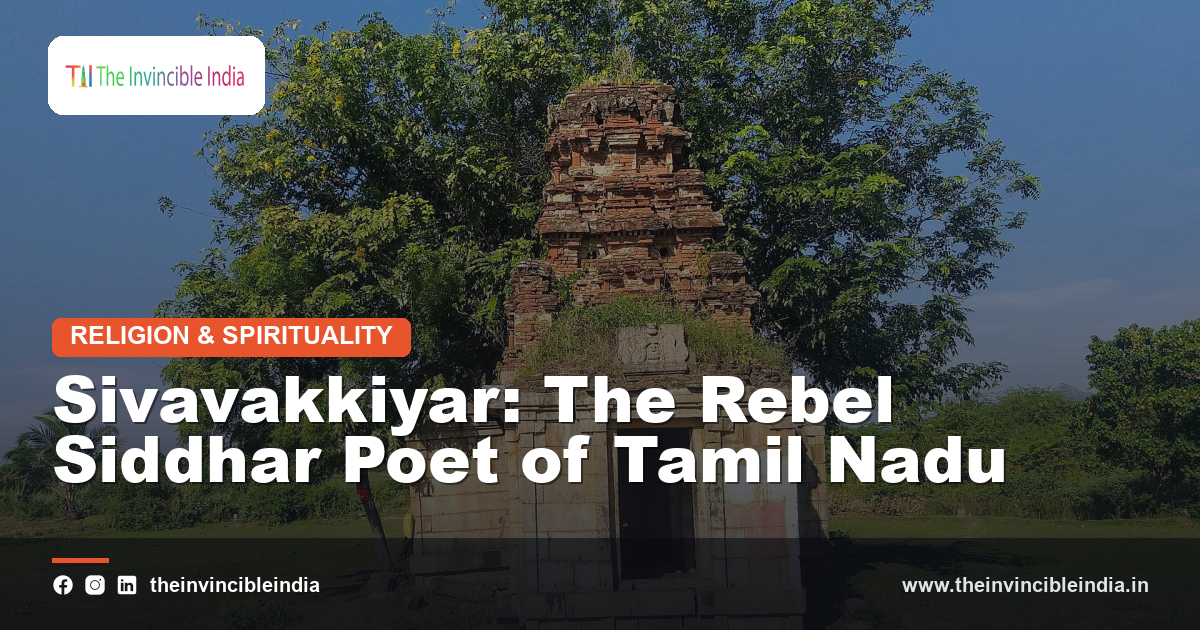
Sivavakkiyar, also spelled Sivavakkiar or Shivavakkiyar and known to devotees as Sivavakkiya Siddhar, is a Tamil poet-saint of the Siddhar tradition, remembered for plain, fearless verses on yoga, devotion to Shiva and the oneness of the divine. His poems, gathered under the name Sivavakkiyam, question empty ritual and rigid social barriers in everyday Tamil, which is why he is often called the rebel among the Siddhars. The details of his life are uncertain and wrapped in tradition, but his voice belongs to the wider current of Shaivism in South India.
Quick answer: Sivavakkiyar is a Tamil Siddhar poet-saint, associated with the Shaiva tradition of Tamil Nadu, whose plain-spoken verses, collected as the Sivavakkiyam, teach yoga, the oneness of God and inner devotion over empty ritual. His period is uncertain, and many details of his life are tradition. He is valued for the directness of his Tamil poetry and for his reform-minded spirit.
Key Takeaways
- Sivavakkiyar is a Tamil Siddhar poet-saint whose verses are collected under the name Sivavakkiyam.
- The Siddhars are Tamil mystics who combined yoga, medicine, devotion and spiritual inquiry.
- His poems use plain, colloquial Tamil and speak about the inner presence of God, breath, mind and self-knowledge.
- He is called a rebel poet because his verses question empty ritual and birth-based social divisions.
- His exact era and biography are uncertain, and stories about his life are best treated as tradition.
The sections below explain the life, works, teachings and continuing legacy in more detail.
Quick Facts
| Detail | Information |
|---|---|
| Also spelled | Sivavakkiar, Shivavakkiyar, Sivavakkiya Siddhar |
| Tradition | Tamil Siddhar tradition, Shaiva-oriented |
| Region | Tamil Nadu |
| Language | Tamil |
| Main work | Sivavakkiyam, a collection of verses attributed to him |
| Themes | Yoga, oneness of God, inner devotion, reform |
| Era | Uncertain, placed in the medieval period by many writers |
Who Was Sivavakkiyar?
Sivavakkiyar was a Tamil poet-saint of the Siddhar tradition whose verses speak of yoga, devotion to Shiva and the unity of God in direct, everyday language. He is regarded as one of the most outspoken voices among the Tamil Siddhars, and his poems are still quoted by readers who admire their courage and clarity.
Historians cannot fix his life with certainty. The name may refer to a single poet or to a tradition of verses gathered under one name, and the poems are known mostly through manuscripts, oral recitation and later editions. For that reason careful writers describe his teachings and his place in Tamil spiritual literature rather than asserting dates or personal facts. What survives with certainty is the poetry and its lasting appeal.
What Does the Name Sivavakkiyar Mean?
The name Sivavakkiyar is commonly understood to mean one whose words are the word of Shiva, from Siva for the deity and vakkiyam for utterance or saying. It suggests that the poet spoke as a vessel of divine truth rather than as a scholar composing for praise.
The name appears in several spellings, including Sivavakkiar, Shivavakkiyar and Sivavakkiya Siddhar, because Tamil names are transcribed into English in different ways. The collection of his verses is called the Sivavakkiyam. Some readers also note that in a number of verses the poet uses a style of direct address that fits the meaning of the name. Knowing these forms helps a reader recognise the same poet across books, temple booklets and websites.
When and Where Did Sivavakkiyar Live?
Sivavakkiyar is associated with Tamil Nadu, and his period is uncertain, with many writers placing him in the medieval centuries of Tamil history. Scholars do not agree on a date, and it is wiser to say that his era is debated than to name a year.
Tradition connects him with the Kaveri delta and in particular with the town of Kumbakonam, which has long been a centre of temples, learning and devotion. This setting fits the many Shaiva and Vaishnava shrines of the region and the busy religious life of its towns. Whatever the exact date, his poems reflect a Tamil society in which temple ritual, caste custom and personal mysticism lived side by side and sometimes in tension.
Who Are the Siddhars of Tamil Nadu?
The Siddhars are a line of Tamil mystics and poets who are remembered for yoga, alchemy-related lore, the Siddha system of medicine and bold spiritual verse. The word siddhar is linked with siddhi, meaning attainment, and refers to one who has realised the truth through discipline and direct experience.
Traditional lists name eighteen principal Siddhars, among them Thirumular, Agastya, Bogar and Pambatti Siddhar, although the lists differ between sources. Many Siddhar poems are written in simple Tamil, use riddles and plain imagery, and challenge ritual formalism. Sivavakkiyar is often counted within this broad tradition because of his style and themes. The Siddhars together form a distinctive stream of Tamil spirituality that sits beside, and sometimes against, temple-centred worship.
What Is the Sivavakkiyam?
The Sivavakkiyam is the collection of Tamil verses attributed to Sivavakkiyar, and it is the main source for his thought. The poems are short and forceful, and they speak of God, the body, breath, the mind and the path to liberation in the voice of a plain-speaking teacher.
Like many works of its kind, the collection has been copied, printed and edited over a long period, and verses have sometimes been added or arranged differently in different editions. Readers should therefore treat any single edition with a sense of the textual history behind it. Even so, the collection gives a consistent picture of a poet who prizes inner experience over outward display and who addresses ordinary people rather than only scholars.
Why Is Sivavakkiyar Called a Rebel Poet?
Sivavakkiyar is called a rebel poet because his verses openly question empty ritual, pride of birth and outward religious show. He did not write in a learned or polished court style but in a sharp, conversational Tamil that could be understood in markets and villages.
The word rebel does not mean that he rejected faith. His poems are full of devotion to Shiva and of respect for the divine. What he challenged was the idea that holiness can be measured by observance alone or by the family into which a person is born. In this he stands with other reforming voices of Indian devotion, such as those found in the wider Bhakti movement, even though he belongs to a different Tamil tradition.
What Did Sivavakkiyar Say About Caste and Social Divisions?
Verses attributed to Sivavakkiyar reject the idea that spiritual worth depends on birth, and they stress that all people share the same body, the same breath and the same divine presence. This theme is one of the main reasons he is remembered as a reformer.
The poems use plain comparisons to make the point that the inner reality does not change from one person to another. A respectful reading sees these verses as part of a long Indian tradition of mystics who taught that devotion and self-knowledge matter more than status. It is also fair to say that the poet speaks as a spiritual teacher and not as a political organiser. His message is moral and mystical, addressed to the conscience of the listener.
How Does Sivavakkiyar Treat Ritual and Idol Worship?
Sivavakkiyar treats outward ritual as secondary to inner realisation, and some of his verses are strongly critical of worship that is carried out without understanding. A famous verse attributed to him asks, in paraphrase, how a stone that is planted and decorated with flowers could speak, as a way of pointing to the living divine within.
Readers should understand this as a call to inwardness and not as a general attack on temples. Tamil Nadu has a profound temple tradition, and many Siddhars lived in a world shaped by it. The Siddhar approach is to ask worshippers to look for God in the heart and in conduct as well as in the shrine. His voice therefore complements temple devotion by reminding worshippers of its inner purpose.
What Is the Role of Yoga in His Verses?
Yoga is central to the Sivavakkiyam, and the poems repeatedly point to control of breath and mind as the practical way to realise God within. The verses use the language of breath, the subtle channels of the body and inner stillness to describe the path.
The poet does not give a manual of technique in the modern sense. Instead the verses use compact images to suggest that the divine can be known when the mind is calm and attention is turned inward. This links him with the Siddhar emphasis on direct experience and with the wider yoga traditions of India. Readers who wish to practise anything described in such poems are generally advised to seek qualified, traditional guidance rather than rely on a verse alone.
How Is Sivavakkiyar Connected With Shaivism?
Sivavakkiyar is connected with Shaivism through his name, his praise of Shiva and his emphasis on the inner Self, though he does not follow the formal path of temple priests or scholastic schools. His Shiva is both the supreme reality and the presence within every being.
Tamil Nadu has a rich Shaiva heritage, which includes the devotional hymns of the Nayanars, the Tirumurai collection and the philosophy of Shaiva Siddhanta. The Siddhar poets share the same ground of devotion to Shiva, but they speak in a freer and more experiential voice. For the wider background, readers can turn to the guide on Shaivism, which explains the beliefs and traditions that form the setting of his poetry.
What Is the Language and Style of His Poetry?
The poetry of Sivavakkiyar is written in simple, colloquial Tamil with short lines, strong images and a tone that often sounds like direct speech. It avoids ornate vocabulary and prefers a blunt, memorable turn of phrase.
This plainness is deliberate. The poet wants listeners to think and to question, and short verses with clear images are easy to remember and recite. Many lines work by contrast, setting an outward habit against an inward truth. The style also helps explain why the verses have been quoted far beyond religious circles, in literature, public speech and discussions of Tamil social thought. Its directness and humour are a large part of its lasting charm.
What Legends Are Told About Sivavakkiyar?
Tradition tells many stories about Sivavakkiyar, including accounts of a humble birth, a life of wandering and miraculous powers, but these are legendary and cannot be confirmed as history. They differ between tellers and are best understood as part of sacred biography.
Such stories often serve to illustrate the character of the saint, for example his freedom from convention, his indifference to status and his closeness to God. Respectful writers mention them as tradition and take care not to present them as verified events. The real evidence of the poet is the body of verse, which speaks for itself without any need for miracle stories. Legends and poems together show how devotees have remembered him over the centuries.
Where Is Sivavakkiyar Remembered Today?
Sivavakkiyar is remembered in Tamil Nadu above all through his poems, and tradition links his memory with Kumbakonam, where a shrine in his name is honoured by devotees. Local custom there holds that he lived and was laid to rest in the region.
Exact claims about burial places differ between traditions, so it is best to describe them as local belief. Kumbakonam itself is a famous temple town of the Kaveri delta, and visitors who come for its great Shaiva and Vaishnava temples may also learn of the Siddhar tradition. Pilgrims and readers interested in the wider Indian practice of travel to sacred places can find background in the guide to pilgrimage in India.
How Does Sivavakkiyar Compare With Other Siddhar Poets?
Sivavakkiyar is often compared with other Siddhars such as Thirumular, the author of the Tirumantiram, and Pambatti Siddhar, a poet known for playful, riddling verse. Each shares the Siddhar emphasis on inner experience, but each has a distinct voice.
Thirumular is known for a long, systematic poem on yoga and Shaiva thought, while Pambatti Siddhar is remembered for verses that mix humour with mysticism. Sivavakkiyar stands out for the sharpness of his criticism and the bluntness of his language. Placing these poets side by side shows that the Siddhar tradition was not a single school but a family of voices. Together they preserve a lively Tamil mystical literature outside the formal temple and scholarly framework.
What Do His Teachings Offer to Readers Today?
The teachings of Sivavakkiyar offer a reminder that sincerity, self-knowledge and compassion matter more than display, and that the divine is to be sought within as well as in outward worship. These ideas speak to readers of many backgrounds.
The poems encourage honesty, humility and thoughtful questioning, and they invite the reader to look at habits of mind with a clear eye. At the same time, a respectful approach recognises that the poet spoke within a living religious tradition and that his words should be read with care and context. Students of Tamil literature, of yoga traditions and of Indian reform thought each find something of value in the Sivavakkiyam, which keeps it present in modern discussion.
How Should Readers Approach His Verses Respectfully?
Readers can approach Sivavakkiyar respectfully by reading the verses in context, noting that dates and biography are uncertain, and avoiding the use of his sharp lines as weapons against any community. The poems are spiritual teaching and should be read in that spirit.
A reliable approach is to consult recognised Tamil editions and translations, to remember that texts have changed hands over many years, and to treat legends as tradition. It is also fair to notice that devotees of many paths hold the poet in affection. A careful reading honours both the independence of his voice and the faith he expressed. This balanced approach keeps the focus on the poetry and its message of inner truth.
Sivavakkiyar Today
Sivavakkiyar today remains one of the best-known Siddhar voices of Tamil Nadu, valued for plain-spoken poetry on yoga, the oneness of God and inner devotion. His verses are read, quoted and discussed by devotees, students of Tamil literature and those interested in reform traditions.
Though the facts of his life remain uncertain, the Sivavakkiyam has kept his voice alive for generations. It reminds readers that Indian spirituality includes quiet temple worship, learned philosophy and also fearless poets who spoke to ordinary people in everyday language. His rebel spirit is not one of rejection but of sincerity, asking every listener to look beyond outward form. In that sense his legacy continues as a living part of Tamil religious and literary culture.
Sources & Further Reading
- Ministry of Culture, Government of India (indiaculture.gov.in).
- Tamil Nadu Department of Archaeology and Hindu Religious and Charitable Endowments general references.
Frequently Asked Questions
Who was Sivavakkiyar?
Sivavakkiyar was a Tamil Siddhar poet-saint known for plain verses on yoga, devotion to Shiva and the oneness of God. His era is uncertain, and many details of his life come from tradition.
What is the Sivavakkiyam?
The Sivavakkiyam is the collection of Tamil verses attributed to Sivavakkiyar. It covers yoga, inner devotion and the critique of empty ritual, and it exists in several editions.
Why is Sivavakkiyar called a rebel poet?
He is called a rebel poet because his verses question empty ritual and birth-based social divisions. His criticism is moral and spiritual, and it rests on deep devotion to the divine.
What are the Siddhars?
The Siddhars are Tamil mystics and poets remembered for yoga, the Siddha system of medicine and bold spiritual verse. Traditional lists name eighteen principal Siddhars, though the lists vary.
Where is Sivavakkiyar remembered?
Tradition links Sivavakkiyar with Kumbakonam in Tamil Nadu, where a shrine in his name is honoured. Claims about his life and burial are local belief and differ between sources.
Was Sivavakkiyar against temple worship?
No, he is better understood as calling for inner devotion alongside outward practice. His critical verses target empty ritual and pride, and they sit within a Tamil world full of temples and Shaiva faith.


