

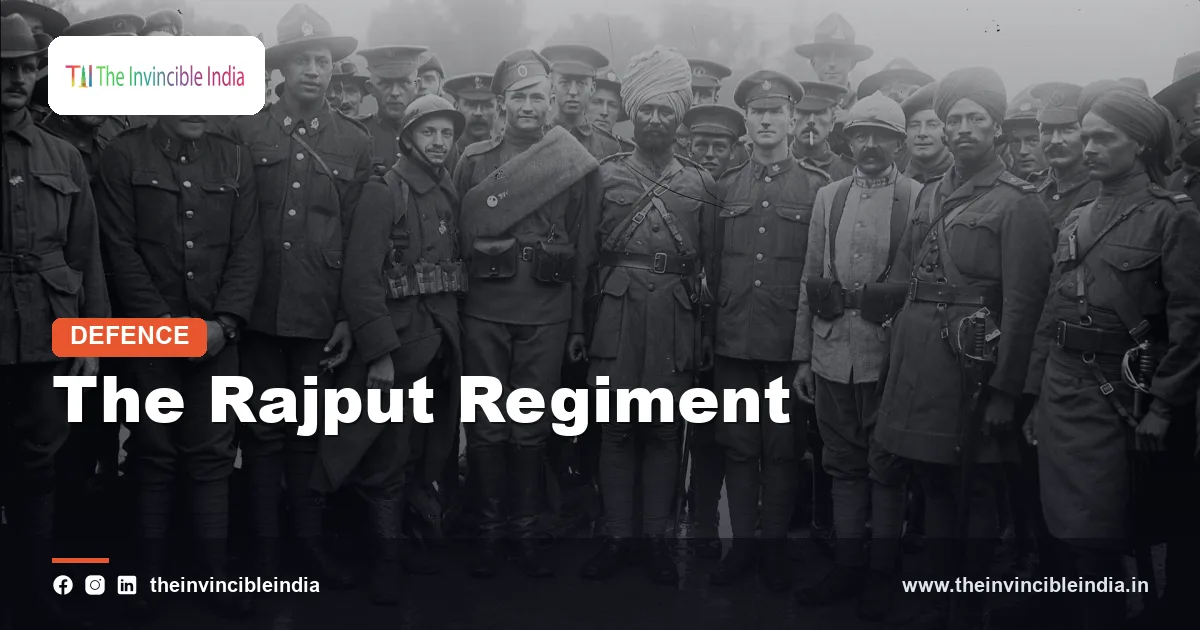
The Rajput Regiment is one of the oldest infantry regiments of the Indian Army, tracing its lineage to Bengal Army battalions raised in the late 18th century and headquartered today at its regimental centre in Fatehgarh, Uttar Pradesh. The regiment draws a large share of its soldiers from Rajput communities, alongside Gujjars and others, and its war cry is “Bol Bajrang Bali Ki Jai”.
Across more than two centuries, battalions in this lineage have fought in the World Wars and in every major post-independence conflict. The regiment also holds a Param Vir Chakra, India’s highest wartime gallantry award, won by Naik Jadunath Singh in 1948.
| Attribute | Details |
|---|---|
| Full name | The Rajput Regiment, Indian Army |
| Type | Infantry regiment of the line |
| Lineage | Bengal Native Infantry battalions raised from about 1778 (earliest components; dates vary by source) |
| Present form | Reorganised as the Rajput Regiment after independence from the 7th Rajput Regiment of 1922 |
| Regimental centre | Fatehgarh, Farrukhabad district, Uttar Pradesh |
| War cry | “Bol Bajrang Bali Ki Jai” |
| Motto | “Sarvatra Vijay” (Victory Everywhere) |
| Param Vir Chakra | Naik Jadunath Singh, 1 Rajput, 1948 (posthumous) |
| Not to be confused with | Rajputana Rifles, a separate regiment with its own centre in Delhi |
Key Takeaways
- The Rajput Regiment is among the oldest infantry regiments of the Indian Army, with component battalions descending from Bengal Native Infantry units raised in the late 18th century.
- The Rajput Regiment’s regimental centre is at Fatehgarh in Uttar Pradesh, where recruits are trained and regimental traditions are kept.
- The war cry of the Rajput Regiment is “Bol Bajrang Bali Ki Jai”, and its motto is “Sarvatra Vijay”.
- The Param Vir Chakra associated with the Rajput Regiment is that of Naik Jadunath Singh, 1st Battalion, who was killed in action in the Naushera sector of Jammu and Kashmir in February 1948.
- The Rajput Regiment is distinct from the Rajputana Rifles, a different regiment whose Param Vir Chakra winner is Company Havildar Major Piru Singh.
- The Rajput Regiment recruits largely from Rajput communities and associated groups such as Gujjars, following the class-composition model that the Indian Army inherited from the colonial period.
What is the Rajput Regiment?
The Rajput Regiment is a regular infantry regiment of the Indian Army that forms part of the Army’s order of battle as a group of numbered battalions with a common regimental centre, traditions and identity. Like every infantry regiment, it does not operate as a single formation. Its battalions serve within brigades and divisions, often beside battalions from other regiments.
The regiment is among the senior units of the line. Its present name came after independence in 1947, when the former 7th Rajput Regiment of the British Indian Army was renamed. Its regimental colours, museum and records reflect the history of the older battalions that were absorbed into it.
What is the history and lineage of the Rajput Regiment?
The lineage of the Rajput Regiment begins with battalions of the Bengal Native Infantry raised by the East India Company in the late 18th century, with the earliest components usually dated to about 1778. These battalions recruited heavily from the Gangetic plain, including the regions around Awadh and Bihar, which supplied large numbers of high-caste Hindu soldiers.
Their numbering changed repeatedly through the 19th century as the Company’s army was reorganised, and many of the battalions saw action in the Anglo-Mysore, Maratha and Afghan wars. The great reorganisation of 1922 grouped the old battalions into numbered multi-battalion regiments, and one of these was the 7th Rajput Regiment.
Sources differ on the exact raising dates of individual battalions, and the numbering of the older units is complicated, so this article uses the broad statement that the lineage is of late 18th century origin.
How did the regiment change in 1947?
The 7th Rajput Regiment was renamed the Rajput Regiment after Partition and independence in 1947. Battalions manned by Muslim soldiers were part of the older Army structure, and the division of the Army between India and Pakistan led to those men and units being allotted according to the choices and the reorganisation of the time. The Indian Rajput Regiment continued with its Hindu Rajput and allied composition.
Where is the Rajput Regiment’s regimental centre?
The regimental centre of the Rajput Regiment is at Fatehgarh in the Farrukhabad district of Uttar Pradesh, on the banks of the Ganga. Fatehgarh was a military station of the East India Company, and the cantonment has been linked with Bengal Army regiments for a long time.
The centre trains new recruits in drill, weapons, fieldcraft and physical fitness, and it holds the regiment’s records and museum. It also coordinates the regiment’s welfare work for veterans and war widows, and it is where regimental days and reunions are held.
Who joins the Rajput Regiment?
The Rajput Regiment recruits predominantly from Rajput communities, with Gujjars and some other groups enrolled in the regiment’s battalions. This is an example of the “class composition” system, in which the colonial Army organised units around communities believed to be “martial”. After independence, the Indian Army kept the system in many older regiments while adding all-India-all-class units.
Historically, before 1947, the predecessor battalions also included Muslim Rajputs, which is the origin of the claim that Muslims served in the regiment. Some popular accounts also list other communities, such as Bengalis, in the regiment, but standard references do not support this, so it is not stated as fact here. Readers should rely on the Army’s current recruitment notifications for the exact classes enrolled today, since policies have been adjusted over the decades and publicly available summaries are often out of date.
Today’s recruitment follows Army-wide rules on age, education, physical standards and medical fitness. Candidates are selected through rallies and written tests. The Agnipath scheme introduced in 2022 changed the enrolment framework for new soldiers across the Army, and how it interacts with regiment-wise recruitment is a subject of continuing public discussion.
What are the Rajput Regiment’s war cry and motto?
The war cry of the Rajput Regiment is “Bol Bajrang Bali Ki Jai”, a call invoking the Hindu deity Hanuman, and its motto is “Sarvatra Vijay”, Sanskrit for “Victory Everywhere”. The war cry is shouted by troops on ceremonial parades and when going into an assault, and it distinguishes the regiment from others, such as the Rajputana Rifles, which uses a different call.
The regiment’s identity also rests on its dress, colours and band traditions. Regimental celebrations and the Fatehgarh museum keep older practices alive for serving soldiers and families.
The choice of Hanuman for the war cry follows a widespread Indian military habit of invoking a figure associated with strength and devotion. The Army treats such invocations as part of unit identity and not as religious instruction, and regiments with mixed faiths use cries that members of every religion can shout together. Regimental mottos in Sanskrit, such as “Sarvatra Vijay”, serve a similar role by offering a short, memorable statement of purpose that appears on badges, colours and publications.
What wars and operations has the Rajput Regiment fought in?
Battalions of the Rajput lineage fought in the two World Wars and in the Jammu and Kashmir operations of 1947-48, the 1965 and 1971 wars with Pakistan, and later counter-insurgency and high-altitude operations. The list below is a broad outline rather than an official battle honour record, because the individual honours are numerous and sources vary in how they are credited to different battalions.
| Period | Broad service by Rajput-lineage battalions |
|---|---|
| Late 18th and 19th centuries | Campaigns of the East India Company’s Bengal Army |
| World War I | Service in several overseas theatres with the Indian Army |
| World War II | Operations in the Middle East, North Africa and Burma |
| 1947-48 | Defence of Jammu and Kashmir, including the Naushera sector |
| 1965 and 1971 | Operations on the western and eastern fronts |
| Late 20th century onwards | Counter-insurgency in Jammu and Kashmir and the Northeast, and mountain deployments |
The regiment holds battle and theatre honours from these campaigns, but readers who need exact lists should consult the official regimental history.
Who won the Param Vir Chakra in the Rajput Regiment?
The Param Vir Chakra associated with the Rajput Regiment was won by Naik Jadunath Singh of the 1st Battalion, who was awarded the honour posthumously for his actions in February 1948 in the Naushera sector of Jammu and Kashmir. Jadunath Singh commanded a section holding a forward post near Taindhar, and he is recorded as having held off repeated Pakistani attacks before he was killed.
Why Major Hoshiar Singh is not a Rajput Regiment awardee
The popular belief that the Param Vir Chakra recipient Major Hoshiar Singh belonged to the Rajput Regiment is incorrect. Major Hoshiar Singh Dahiya, who won the award in the 1971 war near Basantar in the Shakargarh sector, served in the 3rd Battalion of the Grenadiers. Likewise, Company Havildar Major Piru Singh, who won the award in 1948 at Tithwal, belonged to the Rajputana Rifles, a different regiment. These mix-ups are common because of the similar names.
How is the Rajput Regiment different from the Rajputana Rifles?
The Rajput Regiment and the Rajputana Rifles are two separate infantry regiments, even though both recruit heavily from Rajput communities and both have deep colonial-era roots. They differ in their regimental centres, their war cries and their lineage.
| Feature | Rajput Regiment | Rajputana Rifles |
|---|---|---|
| Regimental centre | Fatehgarh, Uttar Pradesh | Delhi Cantonment |
| War cry | Bol Bajrang Bali Ki Jai | Raja Ramchandra Ki Jai |
| Param Vir Chakra | Naik Jadunath Singh | Company Havildar Major Piru Singh |
| Parent lineage | Bengal Native Infantry and the 7th Rajput Regiment | Older Bombay Army battalions and later Rajputana units |
The Rajputana Rifles is commonly described as the senior-most rifle regiment of the Indian Army, whereas the Rajput Regiment is a regiment of the line. Ordinary news reports and school books often confuse the two.
How does the Rajput Regiment train and serve today?
The Rajput Regiment’s battalions train and serve like any other Indian infantry battalions, with a professional cycle that emphasises tactical drills, weapon skills, live firing and acclimatisation to terrain, and with regular rotations between peace stations, field areas and high-altitude postings. A typical battalion has around eight hundred to a thousand soldiers organised into rifle companies, a support company and a headquarters element.
Battalions may be employed on the Line of Control, in counter-terrorism grids, in the Northeast or in other areas, depending on operational needs. They also take part in disaster relief, such as flood rescue, when the Army is called out by civil authorities. Mechanised and specialised roles are filled by other arms.
What is a regimental centre’s role in daily life?
A regimental centre such as Fatehgarh acts as the home base for every serving soldier of the Rajput Regiment, even when his battalion is stationed thousands of kilometres away. Records of service, pension documentation, welfare funds and veteran liaison are handled through the centre, and the Colonel of the Regiment, a senior officer appointed as the ceremonial head, takes an interest in regimental traditions.
The centre also organises the annual regimental day, hosts the regimental band and maintains the memorials to soldiers who died in service. For families in the recruiting areas, it is the most visible link between the village and the Army.
Why does the Rajput Regiment matter?
The Rajput Regiment matters because it preserves one of the longest unbroken institutional traditions in the Indian Army, from the East India Company’s Bengal Army to the present. It shows how the Army uses community identity, ritual and history to build cohesion, and it stands as a record of the contributions of soldiers from the Gangetic plains.
It also illustrates the wider debate about class-based regiments, which some commentators see as a source of strong esprit de corps and others as a legacy that sits uneasily with modern, merit-based ideas. The Army has kept both models, and this article takes no position beyond describing them.
Bottom Line
The Rajput Regiment is a historic infantry regiment with late-18th-century roots, a centre at Fatehgarh, the war cry “Bol Bajrang Bali Ki Jai” and the Param Vir Chakra of Naik Jadunath Singh. It should not be confused with the Rajputana Rifles, and its Param Vir Chakra is not that of Major Hoshiar Singh. Exact raising dates and honours differ between sources and should be checked in official histories.
Frequently Asked Questions
Where is the Rajput Regiment’s centre?
The Rajput Regiment’s regimental centre is at Fatehgarh in the Farrukhabad district of Uttar Pradesh. The centre trains recruits and houses the regiment’s museum and records. Fatehgarh has been a military station since East India Company days.
What is the war cry of the Rajput Regiment?
The war cry of the Rajput Regiment is “Bol Bajrang Bali Ki Jai”. It invokes Hanuman and is used on parades and in battle. The Rajputana Rifles uses a different war cry.
Who won the Param Vir Chakra in the Rajput Regiment?
Naik Jadunath Singh of the 1st Battalion won the Param Vir Chakra, awarded posthumously, for actions in the Naushera sector of Jammu and Kashmir in February 1948. Major Hoshiar Singh belonged to the Grenadiers, not the Rajput Regiment. Piru Singh belonged to the Rajputana Rifles.
How old is the Rajput Regiment?
The Rajput Regiment traces its lineage to Bengal Native Infantry battalions raised in the late 18th century, with the earliest components usually dated to about 1778. The regiment took its present name after independence in 1947. Dates for individual battalions vary between sources.
Is the Rajput Regiment the same as the Rajputana Rifles?
No, the Rajput Regiment and the Rajputana Rifles are separate regiments. They have different centres, war cries and lineages, though both recruit heavily from Rajput communities. The Rajputana Rifles is based in Delhi, while the Rajput Regiment is based in Fatehgarh.
Who is recruited into the Rajput Regiment?
The Rajput Regiment recruits mainly from Rajput communities, with Gujjars and some other groups also enrolled. This follows the class-composition model inherited from the colonial Army. Candidates must meet the Army’s common standards of age, education and fitness.
{“@context”:”https://schema.org”,”@graph”:[{“@type”:”FAQPage”,”mainEntity”:[{“@type”:”Question”,”name”:”Where is the Rajput Regiment’s centre?”,”acceptedAnswer”:{“@type”:”Answer”,”text”:”The Rajput Regiment’s regimental centre is at Fatehgarh in the Farrukhabad district of Uttar Pradesh. The centre trains recruits and houses the regiment’s museum and records. Fatehgarh has been a military station since East India Company days.”}},{“@type”:”Question”,”name”:”What is the war cry of the Rajput Regiment?”,”acceptedAnswer”:{“@type”:”Answer”,”text”:”The war cry of the Rajput Regiment is “Bol Bajrang Bali Ki Jai”. It invokes Hanuman and is used on parades and in battle. The Rajputana Rifles uses a different war cry.”}},{“@type”:”Question”,”name”:”Who won the Param Vir Chakra in the Rajput Regiment?”,”acceptedAnswer”:{“@type”:”Answer”,”text”:”Naik Jadunath Singh of the 1st Battalion won the Param Vir Chakra, awarded posthumously, for actions in the Naushera sector of Jammu and Kashmir in February 1948. Major Hoshiar Singh belonged to the Grenadiers, not the Rajput Regiment. Piru Singh belonged to the Rajputana Rifles.”}},{“@type”:”Question”,”name”:”How old is the Rajput Regiment?”,”acceptedAnswer”:{“@type”:”Answer”,”text”:”The Rajput Regiment traces its lineage to Bengal Native Infantry battalions raised in the late 18th century, with the earliest components usually dated to about 1778. The regiment took its present name after independence in 1947. Dates for individual battalions vary between sources.”}},{“@type”:”Question”,”name”:”Is the Rajput Regiment the same as the Rajputana Rifles?”,”acceptedAnswer”:{“@type”:”Answer”,”text”:”No, the Rajput Regiment and the Rajputana Rifles are separate regiments. They have different centres, war cries and lineages, though both recruit heavily from Rajput communities. The Rajputana Rifles is based in Delhi, while the Rajput Regiment is based in Fatehgarh.”}},{“@type”:”Question”,”name”:”Who is recruited into the Rajput Regiment?”,”acceptedAnswer”:{“@type”:”Answer”,”text”:”The Rajput Regiment recruits mainly from Rajput communities, with Gujjars and some other groups also enrolled. This follows the class-composition model inherited from the colonial Army. Candidates must meet the Army’s common standards of age, education and fitness.”}}]}]}


