

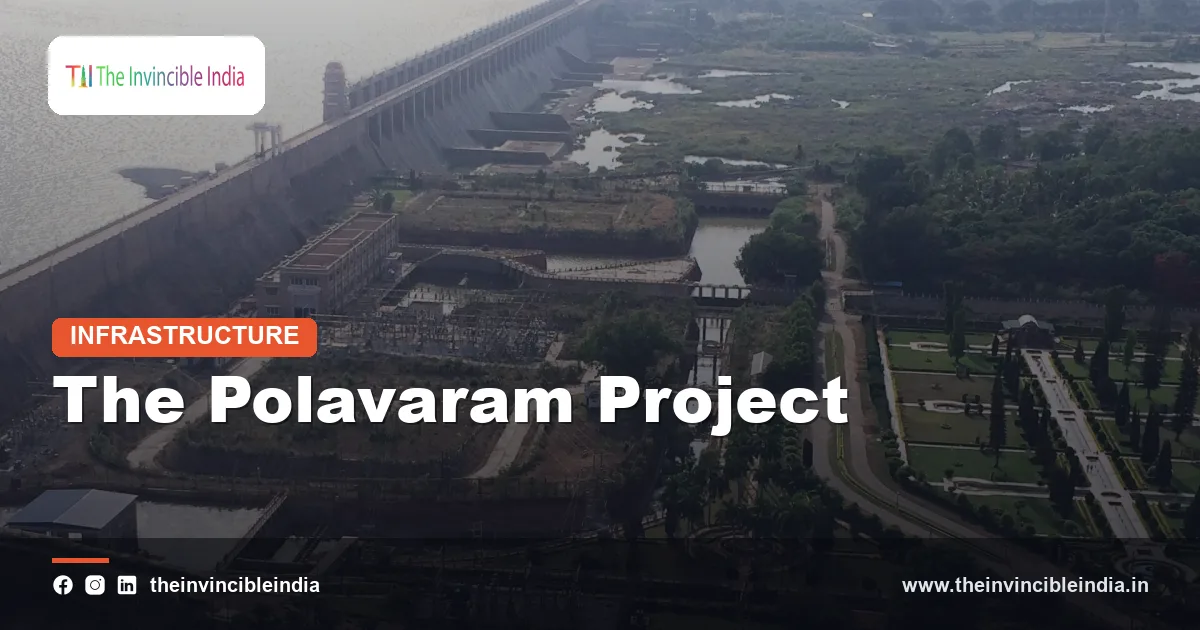
The Polavaram project is a multipurpose irrigation and hydroelectric dam being built across the Godavari river in Andhra Pradesh, near the village of Polavaram in the Eluru district (formerly part of West Godavari), and it has been declared a national project by the Government of India. Officially called the Indira Sagar Polavaram Project, it is designed to irrigate large areas of the coastal districts, supply drinking and industrial water, generate hydropower and enable a diversion of Godavari water to the Krishna basin.
The Polavaram project is one of the largest and most closely watched infrastructure works in southern India. It is also one of the most contested, because its reservoir will submerge land in several states, require the resettlement of a very large number of mostly tribal families, and has been affected by long delays and cost escalation. This explainer covers the structure, purpose, history and controversies in a balanced way.
Quick Facts
| Attribute | Details |
|---|---|
| Official name | Indira Sagar Polavaram Project (earlier known as Ramapada Sagar) |
| River | Godavari |
| Location | Near Polavaram village, Eluru district (earlier West Godavari), Andhra Pradesh |
| Type | Multipurpose project with earth-cum-rock-fill dam, spillway, canals and a hydropower station |
| Status | Declared a national project under the Andhra Pradesh Reorganisation Act, 2014 |
| Main purposes | Irrigation, drinking and industrial water, hydropower, and Godavari-Krishna water transfer |
| Oversight | Polavaram Project Authority, with the Ministry of Jal Shakti and the Government of Andhra Pradesh |
| States affected by submergence | Andhra Pradesh, Telangana, Odisha and Chhattisgarh (as per project documents and legal disputes) |
| Main controversy | Displacement of tribal communities, inter-state objections, delay and cost escalation |
Key Takeaways
- The Polavaram project is a multipurpose dam on the Godavari river in Andhra Pradesh, intended for irrigation, drinking water, hydropower and a link to the Krishna basin.
- The Polavaram project was declared a national project under the Andhra Pradesh Reorganisation Act, 2014, which made the Union Government responsible for completing it.
- The Polavaram dam is an earth-cum-rock-fill structure with a large gated concrete spillway, designed to pass very large Godavari floods.
- The Polavaram reservoir will submerge land and villages, and resettlement of a very large number of families, many of them tribal, is the project’s biggest social challenge.
- Telangana, Odisha and Chhattisgarh have raised objections about backwater and submergence effects, and some disputes have reached the Supreme Court.
- The Polavaram project has faced repeated delays and cost revisions, so any figures for cost, capacity or completion should be checked against the latest official sources.
What is the Polavaram project?
The Polavaram project is a large dam and canal system on the Godavari river that aims to store monsoon flows and use them for irrigation, water supply and electricity in Andhra Pradesh. It is formally named the Indira Sagar Polavaram Project, and it is often described simply as the lifeline project for the state.
The Godavari is the second-longest river in India after the Ganga and flows for much of its course across Maharashtra, Telangana and Andhra Pradesh before reaching the Bay of Bengal. A great deal of its water flows unused to the sea during the monsoon, and the Polavaram project is designed to capture a share of this flow.
The scheme has three broad parts: a dam and spillway across the river, two main canals (the Left Main Canal and the Right Main Canal) that carry water to farmland, and a power station at the dam. The Right Main Canal also connects with the Krishna river system, which is the basis of the planned Godavari-Krishna link.
Where is the Polavaram project located?
The Polavaram project is located on the Godavari river near Polavaram village in Andhra Pradesh, a short distance upstream of the point where the river begins to spread into its delta. After the 2022 reorganisation of districts, the area falls in Eluru district, while the reservoir also reaches into the Alluri Sitharama Raju district and neighbouring areas.
The location is chosen because the river here passes through a gap in the Eastern Ghats hills, which offers a natural site for a dam. Upstream of the gap the river flows through a hilly, forested tribal belt, and downstream it enters the fertile deltaic plains of East and West Godavari. The reservoir therefore backs up into a long, narrow valley that runs through hills and forests.
Because the backwater of the reservoir extends upstream, parts of the project’s impact fall beyond Andhra Pradesh. Areas in Telangana, Odisha and Chhattisgarh lie along the tributaries and the main river, and this is the source of the inter-state concern discussed later in this article.
How does the Polavaram dam work?
The Polavaram dam works by holding back the Godavari to create a large reservoir, then releasing water through a spillway during floods and through canals and turbines at other times. The main dam is an earth-cum-rock-fill embankment, which is a design that uses compacted earth and rock rather than concrete across most of its length.
The major components can be summarised in a simple list.
- Earth-cum-rock-fill dam (ECRF): the main embankment across the river, built in sections with a core that resists seepage and rockfill that gives stability.
- Spillway: a concrete gravity structure with many large radial gates that controls flood flows. The Godavari is a flood-prone river, so the spillway is designed for a very large design flood.
- Cofferdams: temporary barriers upstream and downstream that allow work on the main dam in the dry riverbed.
- Left Main Canal and Right Main Canal: the irrigation backbone that takes water from the reservoir to farmland on both sides of the Godavari.
- Power house: a hydropower station with a number of turbine units at the dam site.
Engineering the foundation of a dam on the Godavari is difficult because the river carries heavy sand and gravel and has an enormous flood range. Special measures such as a diaphragm wall in the riverbed were used to control seepage and strengthen the foundation, and they have been part of repair and strengthening work after floods affected construction.
What is the purpose of the Polavaram project?
The purpose of the Polavaram project is to provide irrigation, drinking water, industrial water and hydropower, and to enable a transfer of Godavari water to the Krishna basin. These objectives were set in the project reports and reaffirmed when the project was given national status.
Irrigation
The project is expected to irrigate a large area, running into several lakh hectares, mainly in the coastal districts through the Left and Right Main Canals. Part of the benefit is the stabilisation of irrigation in the Godavari delta, which already receives water from the Dowleswaram barrage.
Drinking and industrial water
The project includes allocations for the drinking water needs of many villages and towns, as well as industrial water for the coastal belt, including the port and industrial areas near Visakhapatnam through the canal system.
Hydropower
The power station is planned at a capacity of around a gigawatt, which would add significant hydroelectricity to the state grid. The exact installed capacity is best taken from the latest official project documents.
Godavari-Krishna link
The Right Main Canal carries Godavari water toward the Krishna river near Vijayawada, which is part of the larger plan to link the two rivers. This diversion would help the Krishna delta, which often receives less water than it needs, and is generally counted among the strategic benefits of the project.
What is the history of the Polavaram project?
The history of the Polavaram project goes back to the 1940s and 1950s, when engineers first identified the site on the Godavari for a dam, and it took many decades to move from concept to construction. The project passed through several designs, clearances, court cases and political changes before work began in earnest in the 2000s.
| Period | Development |
|---|---|
| 1940s and 1950s | Early surveys by the Madras Presidency and later by the Andhra state identify the Polavaram site |
| 1980s | Project taken up in the form of a planned multipurpose scheme; inter-state agreements discussed |
| 2004 | Work begins in earnest under the name Indira Sagar Polavaram Project after clearances and tendering |
| 2010s | Environmental and forest clearances, court cases and inter-state objections shape the project |
| 2014 | Andhra Pradesh Reorganisation Act declares Polavaram a national project |
| 2014 onward | Polavaram Project Authority takes charge; Centre funds the irrigation component; construction accelerates, with repeated deadline revisions |
The decision to grant national project status came after the state of Andhra Pradesh was divided in 2014 to create Telangana. Because the project lies in the residuary Andhra Pradesh and some of its effects fall in other states, the reorganisation law placed responsibility on the Union Government, and a statutory body, the Polavaram Project Authority, was created to oversee it.
What does national project status mean for Polavaram?
National project status means that the Union Government takes primary responsibility for completing the Polavaram project and for funding the irrigation component through central assistance. The status is meant to ensure that a project with inter-state implications and large costs does not stall because of the finances of a single state.
Under the Andhra Pradesh Reorganisation Act, 2014, the Centre committed to execute the project and to meet the cost of the irrigation component, subject to the terms later notified. In practice, the arrangement works through the state executing the construction and then claiming reimbursement of eligible expenditure from the Centre. This arrangement has itself been a source of discussion, including about what costs are eligible for reimbursement and how quickly funds are released.
The national status also brought the Polavaram Project Authority into the picture. The authority is meant to coordinate with the state governments concerned, supervise implementation and help resolve issues of land, resettlement and water-related effects.
Who is affected by displacement and resettlement?
The people most affected by displacement from the Polavaram project are the residents of villages in the submergence zone, a large proportion of whom belong to Scheduled Tribe communities such as the Koya and Konda Reddi peoples. The number of families who must move runs into the tens of thousands, and project documents have listed hundreds of habitations.
The affected area includes parts of the Godavari districts of Andhra Pradesh, and it extends to tribal areas in neighbouring regions. These areas are covered by special protections for tribal communities, including provisions relating to the Fifth Schedule of the Constitution and the Panchayats (Extension to Scheduled Areas) Act, 1996, as well as forest-rights law.
The main social issues raised over the years can be summarised as follows.
- Scale of displacement: a very large number of families lose homes, farmland and access to forests.
- Pace and quality of rehabilitation: colonies for resettled families have been built in stages, and civil-society groups have raised questions about their facilities and the timing of payments.
- Loss of culture and livelihood: tribal communities depend on forest produce, local markets and sacred sites that are difficult to replace.
- Legal protections: resettlement is governed by the Right to Fair Compensation and Transparency in Land Acquisition, Rehabilitation and Resettlement Act, 2013, together with the project’s own policy, and compliance has been examined by courts and commissions.
The government position is that rehabilitation packages are generous, and that houses, land compensation and livelihood support are being provided. Researchers and activists argue that the process has lagged behind construction. Both accounts have appeared in public records, and the long-term outcome for resettled families is still unfolding.
Why do other states object to the Polavaram project?
Telangana, Odisha and Chhattisgarh have objected to the Polavaram project mainly because the reservoir backwater could submerge or affect land and settlements in their territory, and because they feel that consultation and safeguards were inadequate. The Godavari and its tributaries, such as the Sabari and Sileru, flow through or along these states before reaching the Polavaram site.
Odisha has raised concerns about possible submergence in districts such as Malkangiri, and Chhattisgarh has made similar points regarding areas along the Sabari. Telangana has argued about the effect on the Bhadrachalam area, a major temple town on the Godavari, and about the project’s design and approvals. Some of these disputes have been taken to the Supreme Court and to tribunals, and the questions of backwater studies and protective embankments have been part of the proceedings.
The Godavari Water Disputes Tribunal award of 1980 is also relevant, because it recognised the Polavaram project and set out conditions about submergence and protective measures. The central government has taken the position that these conditions are being observed, while the objecting states have asked for independent verification of backwater impacts. The matter has therefore remained a mix of technical, legal and political questions.
What are the environmental concerns and flood risks?
The main environmental concerns about the Polavaram project are the loss of forest and wildlife habitat in the submergence area and the long-term effect on the river’s flow, sediment and delta. The reservoir will cover forest land in the Papikonda hills region, which includes the Papikonda National Park and surrounding forests rich in biodiversity.
The Godavari is also subject to very large floods, so dam safety and flood management are central issues. The design of the spillway, the height of the dam and the handling of cofferdams during construction have all been examined. Floods have damaged parts of the works during construction, and engineering teams have carried out repairs and strengthening. Experts have stressed the importance of independent safety review and robust operating rules for the reservoir.
Supporters of the project argue that the dam will help moderate floods in the lower Godavari, store water for dry periods and reduce the strain on the delta. Critics reply that large reservoirs can also cause backwater flooding upstream, and that sediment trapped behind the dam will reduce the nutrients reaching the delta. As with other major dams, the answer depends heavily on operation rules and monitoring.
Why has the Polavaram project been delayed and why have costs risen?
The Polavaram project has been delayed and has become much more expensive mainly because of land acquisition and resettlement difficulties, legal disputes, design and technical revisions, flood damage, and the sheer scale of the work. The original deadlines have been revised several times, and the estimated cost has risen multiple times over the original figure.
Several factors typically combine in a project of this size.
- Price escalation: material and labour costs rise over a long construction period.
- Rehabilitation costs: the cost of land acquisition and resettlement has grown as more families and villages were included and as compensation norms became stricter.
- Court cases and inter-state disputes: litigation and objections slowed clearances and work.
- Technical challenges: foundation work, cofferdam management and flood damage added work and cost.
- Funding timelines: the flow of funds between the state and the Centre affected the pace of work.
Cost and completion figures differ between sources and have been revised several times, so this article does not quote a single number. Readers who need current estimates should refer to the latest statements from the Ministry of Jal Shakti, the Polavaram Project Authority and the Andhra Pradesh Water Resources Department.
What is the Godavari-Krishna link and what comes next?
The Godavari-Krishna link is a plan to bring surplus Godavari water to the Krishna basin and, further, to the drier regions of southern Andhra Pradesh, using the Polavaram right canal as the first stage. It forms part of the wider idea of linking peninsular rivers that is also reflected in the National Perspective Plan for river interlinking.
The state already has a lift scheme at Pattiseema that pumps Godavari water into the Right Main Canal during the monsoon so that it reaches the Krishna system earlier than the dam alone would allow. Proposals have also been discussed to extend Godavari water further south toward the Rayalaseema region. These proposals raise their own questions of cost, energy use, water availability and the interests of the other riparian states.
Looking ahead, the main tasks are to complete the dam and canals, finish rehabilitation, settle remaining disputes, and put in place sound operating rules. How these are managed will determine whether the project delivers the benefits promised and how its social and environmental costs are judged.
Bottom Line
The Polavaram project is a large national project on the Godavari that promises irrigation, drinking water, hydropower and a link to the Krishna basin for Andhra Pradesh. It also brings heavy costs in the form of displacement of tribal communities, inter-state disputes, environmental effects and long delays. Its eventual verdict will depend on whether benefits reach farmers and cities and whether resettled families are treated fairly.
Frequently Asked Questions
What is the Polavaram project?
The Polavaram project is a multipurpose dam and canal system on the Godavari river in Andhra Pradesh, officially called the Indira Sagar Polavaram Project. It is meant to provide irrigation, drinking water, industrial water and hydropower, and to carry Godavari water toward the Krishna basin. It has been a national project since 2014.
Where is the Polavaram dam located?
The Polavaram dam is located on the Godavari river near Polavaram village in Eluru district of Andhra Pradesh. The site lies just upstream of the Godavari delta, where the river passes through a gap in the Eastern Ghats. Its reservoir extends upstream through hill and forest areas.
Why was Polavaram declared a national project?
Polavaram was declared a national project under the Andhra Pradesh Reorganisation Act, 2014, because of its large scale and its inter-state implications. National status makes the Union Government responsible for completing the project and funding the irrigation component through central assistance. The Polavaram Project Authority was created to oversee its execution.
Who is displaced by the Polavaram project?
The Polavaram project displaces a very large number of families living in the submergence zone, many of them from Scheduled Tribe communities such as the Koya and Konda Reddi. Resettlement and rehabilitation is governed by the 2013 land acquisition and rehabilitation law and the project’s own policy. The adequacy and pace of rehabilitation remain a matter of public debate.
Why do Telangana, Odisha and Chhattisgarh object to Polavaram?
Telangana, Odisha and Chhattisgarh object to Polavaram mainly because they fear backwater effects and submergence in their territory, and they have questioned the adequacy of studies and safeguards. Some of these objections have been taken to the Supreme Court. The central government maintains that the project follows the conditions of the Godavari tribunal award and applicable approvals.
Why is the Polavaram project so delayed?
The Polavaram project is delayed because of the scale of land acquisition and resettlement, legal and inter-state disputes, technical challenges with foundations and floods, and funding timelines. Deadlines have been revised several times, and costs have risen well above the original estimates. Current progress should be checked against official updates.
{“@context”:”https://schema.org”,”@graph”:[{“@type”:”FAQPage”,”mainEntity”:[{“@type”:”Question”,”name”:”What is the Polavaram project?”,”acceptedAnswer”:{“@type”:”Answer”,”text”:”The Polavaram project is a multipurpose dam and canal system on the Godavari river in Andhra Pradesh, officially called the Indira Sagar Polavaram Project. It is meant to provide irrigation, drinking water, industrial water and hydropower, and to carry Godavari water toward the Krishna basin. It has been a national project since 2014.”}},{“@type”:”Question”,”name”:”Where is the Polavaram dam located?”,”acceptedAnswer”:{“@type”:”Answer”,”text”:”The Polavaram dam is located on the Godavari river near Polavaram village in Eluru district of Andhra Pradesh. The site lies just upstream of the Godavari delta, where the river passes through a gap in the Eastern Ghats. Its reservoir extends upstream through hill and forest areas.”}},{“@type”:”Question”,”name”:”Why was Polavaram declared a national project?”,”acceptedAnswer”:{“@type”:”Answer”,”text”:”Polavaram was declared a national project under the Andhra Pradesh Reorganisation Act, 2014, because of its large scale and its inter-state implications. National status makes the Union Government responsible for completing the project and funding the irrigation component through central assistance. The Polavaram Project Authority was created to oversee its execution.”}},{“@type”:”Question”,”name”:”Who is displaced by the Polavaram project?”,”acceptedAnswer”:{“@type”:”Answer”,”text”:”The Polavaram project displaces a very large number of families living in the submergence zone, many of them from Scheduled Tribe communities such as the Koya and Konda Reddi. Resettlement and rehabilitation is governed by the 2013 land acquisition and rehabilitation law and the project’s own policy. The adequacy and pace of rehabilitation remain a matter of public debate.”}},{“@type”:”Question”,”name”:”Why do Telangana, Odisha and Chhattisgarh object to Polavaram?”,”acceptedAnswer”:{“@type”:”Answer”,”text”:”Telangana, Odisha and Chhattisgarh object to Polavaram mainly because they fear backwater effects and submergence in their territory, and they have questioned the adequacy of studies and safeguards. Some of these objections have been taken to the Supreme Court. The central government maintains that the project follows the conditions of the Godavari tribunal award and applicable approvals.”}},{“@type”:”Question”,”name”:”Why is the Polavaram project so delayed?”,”acceptedAnswer”:{“@type”:”Answer”,”text”:”The Polavaram project is delayed because of the scale of land acquisition and resettlement, legal and inter-state disputes, technical challenges with foundations and floods, and funding timelines. Deadlines have been revised several times, and costs have risen well above the original estimates. Current progress should be checked against official updates.”}}]}]}


