

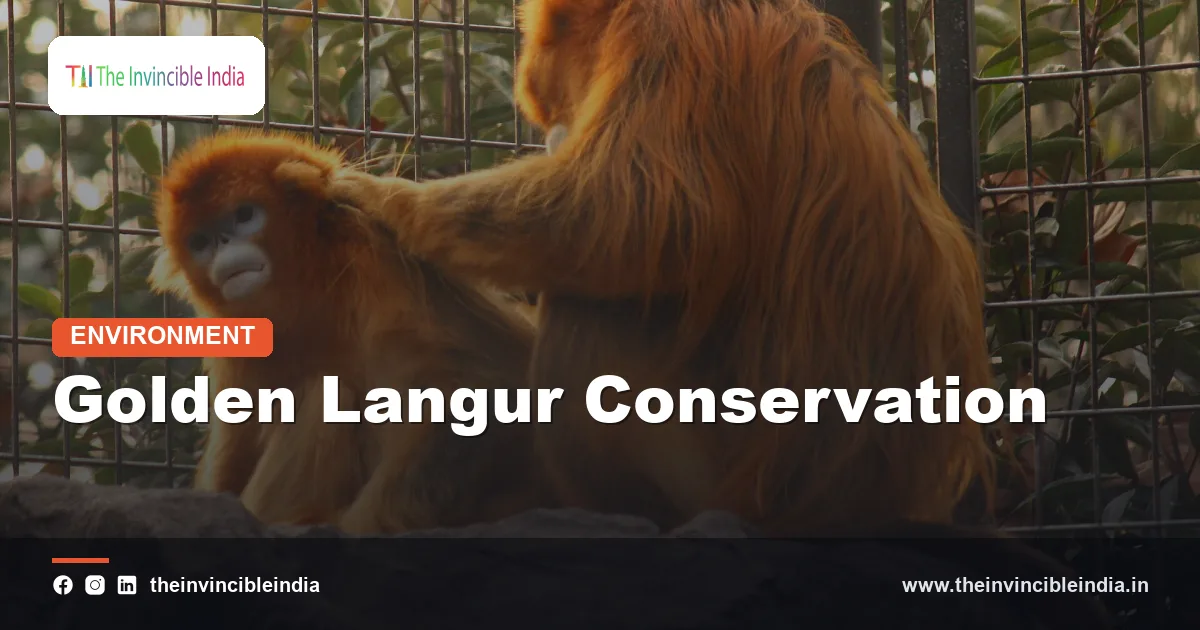
The golden langur (Trachypithecus geei), also called Gee’s golden langur, is an endangered, golden-furred leaf-eating monkey found only in a small area of western Assam in India and in the neighbouring foothills of Bhutan. Its entire world range is confined to a narrow belt of forest between the Manas and Sankosh rivers, which makes it one of the most range-restricted primates in Asia and a focus of conservation attention.
Golden langur conservation in India depends on protecting scattered forest patches, reconnecting them, and reducing deaths from roads, railway lines and power lines. This explainer describes the animal, its discovery, where it lives, the threats it faces and the protected areas and community efforts that work to keep it from disappearing.
Quick Facts
| Attribute | Details |
|---|---|
| Common name | Golden langur, also called Gee’s golden langur |
| Scientific name | Trachypithecus geei |
| Range | Western Assam (India) between the Manas and Sankosh rivers, and southern Bhutan |
| IUCN status | Endangered |
| Legal protection in India | Schedule I of the Wildlife (Protection) Act, 1972; listed in CITES Appendix I |
| Named after | Edward Pritchard Gee, naturalist and tea planter |
| Key protected areas | Kakoijana Reserve Forest and Chakrashila Wildlife Sanctuary, plus Manas National Park and fringe forests |
| Main threats | Habitat loss and fragmentation, road and rail accidents, electrocution, small and isolated populations |
Key Takeaways
- The golden langur (Trachypithecus geei) is found only in western Assam in India and in a small adjoining part of southern Bhutan.
- Gee’s golden langur is named after the naturalist Edward Pritchard Gee, who drew wide attention to the species in the early 1950s.
- The golden langur is classified as Endangered by the IUCN and is protected under Schedule I of India’s Wildlife (Protection) Act, 1972.
- Golden langur habitat is split into scattered forest fragments, so populations are small and isolated and face the risk of a narrow gene pool.
- Roads, railway tracks and overhead power lines are major causes of golden langur deaths in Assam, because the animals live in trees and must cross open ground.
- Kakoijana and Chakrashila are the main protected forests for the golden langur in India, and community participation by local people has been central to its protection.
What is the golden langur?
The golden langur is a medium-sized, long-tailed monkey of the family Cercopithecidae, known for its creamy to golden-red fur and a black face. It is a leaf-eating primate that spends almost its entire life in the tree canopy and is placed in the same genus as the capped langur, which is its closest relative.
Adults have a long tail that is often longer than the body and helps them balance as they leap between branches. The face is dark, which contrasts strongly with the golden coat. Males and females look similar, though the colour intensity differs somewhat between individuals and with age and season.
The golden langur lives in groups, typically made up of a few adult females with their young and one or a small number of adult males. Troops commonly number around eight to fifteen animals, though sizes vary. They are active during the day, moving through the canopy and resting in the shade during the heat of the afternoon.
Where is the golden langur found?
The golden langur is found in the semi-evergreen and moist deciduous forests of western Assam, in a region bounded by the Manas river on the east, the Sankosh river on the west, the Brahmaputra on the south and the foothills of Bhutan on the north. A related population lives across the border in Bhutan.
In India, the species occurs in districts of the Bodoland Territorial Region and adjoining areas, including Kokrajhar, Chirang, Bongaigaon and Dhubri. Its distribution is not continuous. Instead, it lives in patches of forest separated by farmland, villages, roads, railway lines and rivers.
The Manas river system is an important link in the story of this species. The Manas National Park and Tiger Reserve and its surrounding reserved forests form the eastern edge of the langur’s range, and the riverine forests in this landscape provide some of the best remaining habitat. Because the range is so small, any change in these forests can affect the entire species.
Who discovered the golden langur and why is it called Gee’s golden langur?
The golden langur is called Gee’s golden langur because of Edward Pritchard Gee, an English-born tea planter and naturalist working in Assam, who brought the animal to scientific and public attention in 1953 during an expedition in the region. Gee had heard of a golden monkey from local people and from early reports and set out to document it.
Gee published his observations, and the species was subsequently described scientifically in the mid-1950s. It was named in his honour. Gee also became widely known for his work on the Indian rhinoceros and for his role in the movement to protect wildlife in Assam and across India.
Although the species was new to science, it was not new to local people. Communities in the Bodo and other groups of western Assam had long known the animal, and some regard it with respect. This local awareness has proven valuable in conservation, because villagers have often protected langurs without formal enforcement.
Why is the golden langur endangered?
The golden langur is endangered because its total population is small, its range is tiny and shrinking, and its forest habitat has been broken into isolated fragments. The International Union for Conservation of Nature (IUCN) classifies the species as Endangered, which indicates a high risk of extinction in the wild.
The population is generally described as a few thousand animals in total across India and Bhutan, and numbers are often quoted only approximately, since surveys differ and populations in different patches fluctuate. What is clear is that the species occurs in a narrow area and that many of its groups are small and cut off from one another.
Specialists point to two kinds of risk. The first is the direct loss of animals and trees. The second is the genetic risk that arises when small, isolated groups can no longer exchange individuals, leading to inbreeding and reduced resilience to disease or environmental change. Both risks grow when habitat is fragmented.
What are the main threats to the golden langur?
The main threats to the golden langur are habitat loss and fragmentation, road and railway accidents, electrocution on power lines, and the vulnerability that comes with a small and divided gene pool. Each of these threats is closely linked to the way land is used in the densely populated Assam plains.
- Habitat loss and fragmentation: forests have been cleared for agriculture, settlement, tea gardens, timber and fuelwood, leaving patches isolated from each other.
- Road and rail mortality: highways and railway lines cut through langur habitat, and animals crossing on the ground are hit by vehicles and trains.
- Electrocution: langurs that use overhead power cables as bridges between trees can be electrocuted when they touch live lines.
- Small gene pool: isolated groups risk inbreeding, which lowers health and reproduction over generations.
- Dogs and human conflict: animals that descend to the ground can be attacked by free-ranging dogs, and the loss of fruit trees can push groups toward crop areas.
- Disease and disturbance: small groups are more exposed to disease outbreaks and to disturbance from human activity.
The same fragmentation that drives these threats also makes conservation harder, because even a well-protected patch cannot sustain the species over the long term if it stays cut off from others.
What is the diet and behaviour of the golden langur?
The golden langur is mainly a folivore, which means it feeds chiefly on leaves, supplemented by fruit, flowers, buds and seeds. It spends most of the day in the canopy and rarely comes to the ground except to cross gaps between trees.
Leaves are hard to digest, so langurs, like other colobine monkeys, have a specialised multi-chambered stomach in which bacteria help break down plant material. This gives them a slow and steady lifestyle with long rest periods. The seasonal availability of food shapes the way they use their range, and they move between feeding trees across the year.
Their fur has an interesting seasonal change. The coat is often creamy or pale in the warm season and turns to a deeper golden or chestnut shade in winter, though the extent differs between individuals. Young animals are born with a light, often whitish coat that darkens as they grow.
Which protected areas shelter the golden langur?
The main protected areas that shelter the golden langur in India are Chakrashila Wildlife Sanctuary, the Kakoijana Reserve Forest, and the Manas National Park and Tiger Reserve with its fringe forests, together with a number of other reserved forests in the region. In Bhutan, the species occurs in protected forests along the southern foothills, including the Royal Manas National Park.
| Area | Location | Role for the golden langur |
|---|---|---|
| Chakrashila Wildlife Sanctuary | Western Assam, in the Dhubri and Kokrajhar region | Sanctuary established mainly to protect the golden langur, and one of the species’ best-known strongholds |
| Kakoijana Reserve Forest | Bongaigaon district, Assam | Forest with a notable langur population, managed with strong local involvement |
| Manas National Park and surrounding forests | Eastern edge of the range, along the Manas river | Large protected landscape with riverine forests that anchor the eastern limit of the species’ range |
| Other reserved forests | Kokrajhar, Chirang and nearby districts | Smaller patches that hold groups and can serve as stepping stones |
| Royal Manas National Park and southern Bhutan forests | Southern Bhutan | Cross-border habitat that supports the Bhutanese population |
Chakrashila Wildlife Sanctuary was notified in the 1990s with the golden langur as its flagship species. Kakoijana was long a reserve forest and later received stronger protected status. The contiguity of these forests with Manas is why the Manas connection is so often stressed by conservationists.
How are people and communities helping conserve the golden langur?
People and communities help conserve the golden langur by protecting forest patches, reporting problems, taking part in monitoring and planting trees, and by treating the animal as part of their local heritage. In several places, village groups and local committees have taken responsibility for guarding langur habitat.
Non-governmental organisations such as Aaranyak and Ecosystems-India have worked with the Assam Forest Department, researchers and villagers on surveys, awareness and habitat measures. Community-based patrols, village forest committees and eco-development activities that provide alternatives to forest extraction have all been part of the effort.
These efforts matter because most golden langurs live outside strictly protected areas, in forests that are used by local people. Where communities see a benefit in protecting the langur, through pride, tourism or support for livelihoods, protection tends to be more durable.
What conservation measures are being taken?
The conservation measures for the golden langur include legal protection, habitat restoration and corridor creation, mitigation of roads and power-line hazards, scientific monitoring and, in some places, captive breeding. Legal protection comes from Schedule I of the Wildlife (Protection) Act, 1972, the highest level of protection under Indian law, and from its listing in CITES Appendix I, which bans international commercial trade.
Several practical measures target the specific threats.
- Canopy bridges: rope and other artificial bridges are installed over roads and railway lines to let langurs cross above the ground.
- Insulated power lines: covering overhead cables and trimming branches reduces the risk of electrocution.
- Habitat restoration and corridors: planting native trees in degraded patches and linking fragments helps groups move and exchange genes.
- Speed controls and signage: measures along roads and railway lines reduce accidents in sensitive stretches.
- Monitoring and research: regular population counts and genetic studies guide management decisions.
- Captive breeding and translocation: zoos and conservation programmes maintain insurance populations and examine the possibility of moving animals between groups.
Any such measures should be seen as part of a long-term programme. Their success depends on funding, coordination between the forest department, railway, road and electricity agencies, and sustained community support.
What does the future hold for the golden langur?
The future of the golden langur depends on whether its forest patches can be connected, protected and managed together across the Indian and Bhutanese parts of its range. The species has survived so far in a landscape of dense human settlement, which suggests that local goodwill and careful management can work.
The challenges remain large. Expanding roads and railways, growing demand for land and the pressures of climate change could squeeze remaining habitat further. At the same time, rising public awareness, growing scientific knowledge and closer cooperation between agencies and communities have improved the prospects compared with earlier decades.
For India, the golden langur is also a symbol. It represents the idea that a small, rare species in a crowded landscape can be protected when forests, local people and public institutions work together.
Bottom Line
The golden langur is a rare, golden-coated monkey found only in western Assam and southern Bhutan, and it is endangered because its forests are small, fragmented and crossed by roads, railways and power lines. Protected areas such as Chakrashila and Kakoijana, together with the Manas landscape and strong community involvement, give it a real chance. Reconnecting forest patches and reducing accidents are the most important tasks ahead.
Frequently Asked Questions
What is the golden langur?
The golden langur (Trachypithecus geei) is an endangered leaf-eating monkey with golden to cream fur and a black face. It is found only in western Assam in India and in southern Bhutan. It is also known as Gee’s golden langur.
Why is it called Gee’s golden langur?
It is called Gee’s golden langur after Edward Pritchard Gee, a naturalist and tea planter who documented the animal in Assam in the early 1950s and brought it to scientific attention. The species was formally described in the mid-1950s and named in his honour. Local communities had known the animal long before that.
Where does the golden langur live?
The golden langur lives in the forests of western Assam between the Manas and Sankosh rivers, and in the adjoining southern foothills of Bhutan. In India it is found in districts such as Kokrajhar, Chirang, Bongaigaon and Dhubri. Its habitat is divided into scattered forest patches.
Is the golden langur endangered?
Yes, the golden langur is classified as Endangered by the IUCN. It is protected under Schedule I of India’s Wildlife (Protection) Act, 1972, and is listed in CITES Appendix I. Its population is small and its range is very limited.
What are the biggest threats to the golden langur?
The biggest threats to the golden langur are habitat loss and fragmentation, deaths from road and railway accidents, electrocution on power lines, and the genetic risks of small isolated populations. Because the species lives in trees, crossing open ground exposes it to vehicles and dogs. Reconnecting forests and installing canopy bridges are among the main remedies.
Which sanctuaries protect the golden langur?
The golden langur is protected mainly in Chakrashila Wildlife Sanctuary and the Kakoijana Reserve Forest in Assam, and in the forests around Manas National Park. In Bhutan, it occurs in protected areas such as Royal Manas National Park. Many langurs also live in smaller reserved forests outside formal sanctuaries.
{“@context”:”https://schema.org”,”@graph”:[{“@type”:”FAQPage”,”mainEntity”:[{“@type”:”Question”,”name”:”What is the golden langur?”,”acceptedAnswer”:{“@type”:”Answer”,”text”:”The golden langur (Trachypithecus geei) is an endangered leaf-eating monkey with golden to cream fur and a black face. It is found only in western Assam in India and in southern Bhutan. It is also known as Gee’s golden langur.”}},{“@type”:”Question”,”name”:”Why is it called Gee’s golden langur?”,”acceptedAnswer”:{“@type”:”Answer”,”text”:”It is called Gee’s golden langur after Edward Pritchard Gee, a naturalist and tea planter who documented the animal in Assam in the early 1950s and brought it to scientific attention. The species was formally described in the mid-1950s and named in his honour. Local communities had known the animal long before that.”}},{“@type”:”Question”,”name”:”Where does the golden langur live?”,”acceptedAnswer”:{“@type”:”Answer”,”text”:”The golden langur lives in the forests of western Assam between the Manas and Sankosh rivers, and in the adjoining southern foothills of Bhutan. In India it is found in districts such as Kokrajhar, Chirang, Bongaigaon and Dhubri. Its habitat is divided into scattered forest patches.”}},{“@type”:”Question”,”name”:”Is the golden langur endangered?”,”acceptedAnswer”:{“@type”:”Answer”,”text”:”Yes, the golden langur is classified as Endangered by the IUCN. It is protected under Schedule I of India’s Wildlife (Protection) Act, 1972, and is listed in CITES Appendix I. Its population is small and its range is very limited.”}},{“@type”:”Question”,”name”:”What are the biggest threats to the golden langur?”,”acceptedAnswer”:{“@type”:”Answer”,”text”:”The biggest threats to the golden langur are habitat loss and fragmentation, deaths from road and railway accidents, electrocution on power lines, and the genetic risks of small isolated populations. Because the species lives in trees, crossing open ground exposes it to vehicles and dogs. Reconnecting forests and installing canopy bridges are among the main remedies.”}},{“@type”:”Question”,”name”:”Which sanctuaries protect the golden langur?”,”acceptedAnswer”:{“@type”:”Answer”,”text”:”The golden langur is protected mainly in Chakrashila Wildlife Sanctuary and the Kakoijana Reserve Forest in Assam, and in the forests around Manas National Park. In Bhutan, it occurs in protected areas such as Royal Manas National Park. Many langurs also live in smaller reserved forests outside formal sanctuaries.”}}]}]}


