

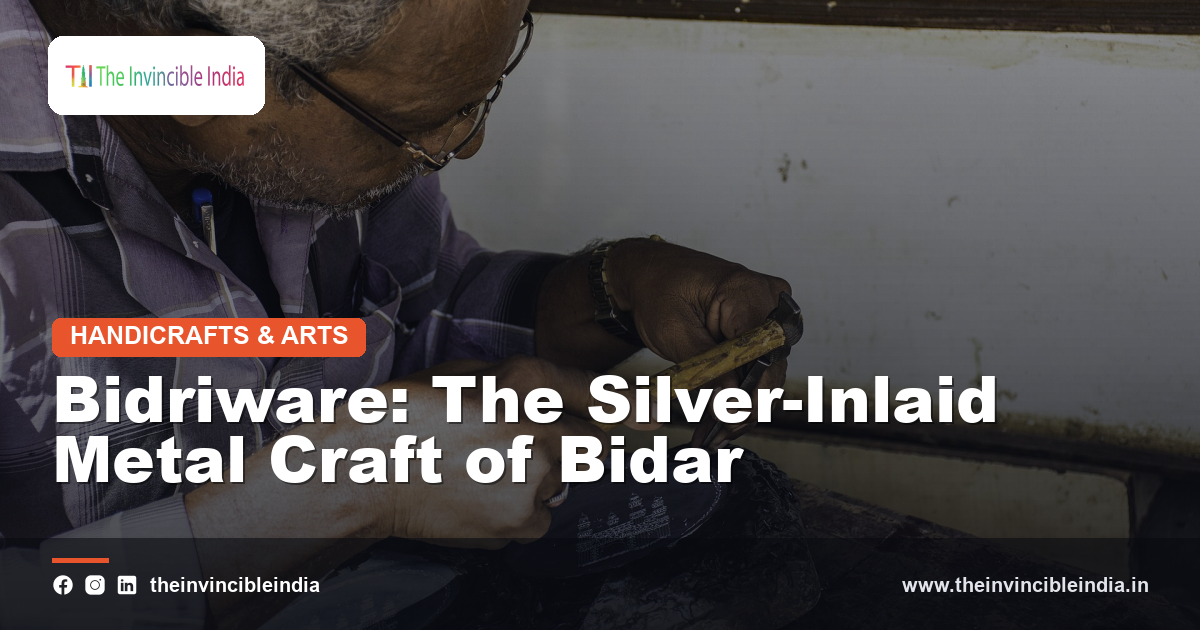
Bidriware, also spelled Bidri or Bidari, is a celebrated metal handicraft from the city of Bidar in the state of Karnataka, from which it takes its name. The craft is famous for its striking contrast of a deep matte-black metal ground inlaid with shimmering patterns of silver, and sometimes brass. The body is cast from an alloy that is mainly zinc with a small amount of copper, and the signature black colour is produced by a special chemical treatment unique to the craft. Bidriware is made into vases, boxes, bowls, hookah bases, jewellery and ornamental objects. Readers who appreciate the regional handicraft traditions gathered in the traditional handicrafts of Rajasthan will find in Bidriware a distinct and sophisticated metal art from the Deccan. This guide describes the place, the history, the materials, the technique, the motifs and the legacy of Bidriware.
Quick answer: Bidriware is a metal handicraft from Bidar in Karnataka, India, known for a deep black alloy ground inlaid with silver, and sometimes brass. The body is cast from an alloy that is mostly zinc with some copper, and its characteristic black colour comes from a special surface treatment. Bidriware is a Geographical Indication craft of India, made into decorative vessels, boxes, jewellery and ornaments.
Key Takeaways
- Bidriware is a metal craft from the city of Bidar in Karnataka, India, giving the craft its name.
- The body is cast from an alloy that is mostly zinc with a small proportion of copper.
- Silver, and sometimes brass, is inlaid into engraved patterns to create the shimmering design.
- The signature deep black colour is produced by a special surface treatment that darkens the alloy but not the silver.
- Typical motifs include flowers, creepers, geometric patterns and designs influenced by Persian and Mughal art.
- Bidriware has been recognised with a Geographical Indication tag as a handicraft of India.
The sections below explain where Bidar is, how the craft arose, how a piece is made, what it depicts and why it still matters.
Quick Facts
| Detail | Information |
|---|---|
| Craft type | Inlaid metal handicraft |
| Place of origin | Bidar, Karnataka |
| Also known as | Bidri, Bidari |
| Base metal | Zinc alloy with a small amount of copper |
| Inlay | Silver, sometimes brass |
| Known for | Deep black ground with shimmering silver patterns |
| Typical products | Vases, boxes, bowls, hookah bases, jewellery |
| GI status | Recognised with a Geographical Indication tag |
What Is Bidriware?
Bidriware is a traditional metal handicraft in which a dark alloy object is inlaid with silver to create bright patterns against a black ground. The body is cast from an alloy that is largely zinc with a little copper, shaped into vessels and ornaments, then engraved and inlaid. After inlay, the surface is treated so that the alloy turns a deep, matte black while the inlaid silver stays bright, producing the craft’s famous contrast. Bidriware is used for decorative and functional pieces such as vases, boxes, trays, bowls, hookah bases and jewellery. The craft is named after the city of Bidar, where it developed and is still practised. It is regarded as one of the most refined metal crafts of India. Its distinctive look makes it instantly recognisable.
Where Is Bidar and Why Is It Central to the Craft?
Bidar is a historic city in the north of Karnataka, in the Deccan plateau, and it is the home of Bidriware. The city was an important centre during the rule of Deccan sultanates, and that courtly past shaped its arts and architecture. Bidar is central to the craft because the special soil found in and around the old fort is traditionally used in the blackening process, giving the ware its unique finish. Generations of artisan families have worked in the city, keeping the skills alive. The name of the craft comes directly from the city. Because the blackening is linked to local conditions, Bidar holds a special place in the craft’s identity. The city and the ware are bound together.
How Did Bidriware Originate?
Bidriware is traditionally said to have originated in the Deccan during the rule of the Bahmani sultanate and its successor states, when Bidar was a flourishing capital. Many accounts link the craft to Persian metalworking traditions that reached the Deccan through artisans and courtly exchange, which were then blended with local skill. The precise date of origin is not firmly documented, so the early history is best told in general terms and partly as tradition. What is clear is that the craft matured under courtly patronage and became a prized art of the region. Over the centuries the techniques were refined and passed down through artisan families. Bidriware thus emerged from a meeting of Persian and Indian craftsmanship. Its origin story reflects the cosmopolitan culture of the medieval Deccan.
What Makes Bidriware Distinctive?
Bidriware is distinctive for the dramatic contrast between its deep black ground and its bright silver inlay, a look achieved through a process found nowhere else in quite the same way. The blackening treatment darkens only the zinc alloy and leaves the inlaid silver untouched, so the patterns gleam against velvety black. The matte, non-reflective quality of the black surface makes the silver appear even brighter. The craft also stands out for the skill of its inlay, in which fine wire and sheet are set flush into engraved channels. The forms, from vases to jewellery, carry elegant floral and geometric designs. This combination of colour, contrast and craftsmanship gives Bidriware its unmistakable identity. No other Indian metal craft looks quite like it.
What Metals and Materials Are Used?
Bidriware is made from an alloy that is mostly zinc with a small proportion of copper, cast into the shape of the object to be decorated. The inlay is usually pure or fine silver, worked as wire or thin sheet, and brass is sometimes used for variety. A key material is the special soil traditionally taken from the old Bidar fort area, which is used in the paste that blackens the surface. Other materials include copper sulphate or similar agents, resin or wax to hold the piece during work, and files and chisels for engraving. Because the exact recipes and sources are part of artisan knowledge, they vary between workshops. The combination of alloy, silver and local soil is essential to the craft. These materials together create the finished ware.
How Is a Piece of Bidriware Made Step by Step?
A piece of Bidriware is made through a long sequence of steps carried out by skilled artisans. First, the zinc-copper alloy is melted and cast in a mould to form the basic shape, which is then filed and smoothed. The surface is temporarily coated so that a design can be drawn and engraved into it. Fine silver wire or sheet is then hammered and set into the engraved grooves, a stage that demands great precision. After inlay, the surface is smoothed again so the silver lies flush with the metal. Finally, a paste made with the special soil and other agents is applied and heated, which turns the alloy black while leaving the silver bright. The piece is then cleaned and polished. Each stage requires patience and long training.
Why Does the Metal Turn Black but the Silver Stays Bright?
The metal turns black while the silver stays bright because the blackening treatment reacts chemically with the zinc alloy but not with the inlaid silver. When the paste containing the special Bidar soil and darkening agents is applied and warmed, it causes the zinc-rich surface to develop a deep, permanent matte-black colour. Silver does not react in the same way, so the inlaid patterns remain their natural bright tone. This selective reaction is the heart of the craft and the reason for its striking contrast. Artisans understand through long experience how to prepare and apply the paste for an even black. The result is a lasting finish that does not simply wash off. This chemistry is what makes Bidriware unique among metal crafts.
What Types of Inlay and Patterns Are There?
Bidriware uses several kinds of inlay and surface work to create its patterns. The main techniques involve setting silver wire into fine engraved lines and setting flat silver sheet into broader shapes, so that designs can range from delicate linear tracery to bolder filled motifs. Some pieces combine both wire and sheet for richness, and brass may be added for contrast. In certain work the background rather than the motif is covered in silver, reversing the usual effect. The inlay is always set flush with the surface, not raised above it, which distinguishes it from some other metal crafts. The variety of techniques lets artisans produce a wide range of effects. This flexibility is part of the craft’s artistic appeal.
What Motifs and Designs Appear on Bidriware?
Bidriware is decorated with elegant motifs drawn largely from Persian, Mughal and Indian decorative traditions. Floral and creeper patterns are especially common, including stylised poppy flowers, vines and leaves that wind gracefully across the surface. Geometric designs, star patterns and ornamental borders also appear, as do occasional depictions of landscapes or architectural elements. The motifs are arranged with balance and symmetry, suiting the courtly origins of the craft. Because the black ground is plain and matte, the silver patterns read clearly and gracefully. These designs connect Bidriware to the wider Indo-Persian art of the Deccan. The choice of motif reflects both tradition and the taste of the buyer. Floral elegance remains the signature of the craft.
What Objects Are Made in Bidriware?
Bidriware is made into a wide range of decorative and useful objects. Traditional products include hookah bases, vases, bowls, plates, boxes, trays, pandan and paan containers, and ewers, many of which recall the courtly life in which the craft flourished. Smaller items such as jewellery, buttons, cufflinks, pendants and small boxes are popular with modern buyers. Larger decorative pieces serve as showpieces and gifts. The craft adapts well to new forms, so contemporary artisans also make items suited to present-day homes. Whatever the object, the black-and-silver contrast remains the defining feature. This versatility has helped Bidriware find buyers across generations. The range of objects shows the craft’s lasting usefulness and appeal.
Who Are the Artisans of Bidriware?
The artisans of Bidriware are skilled metalworkers, many from families that have practised the craft in Bidar for generations. The work demands mastery of casting, engraving, inlay and the blackening process, so training is long and usually passed down within the community. Different artisans may specialise in particular stages, such as inlay or finishing, while working together on a piece. Craft cooperatives and government bodies have supported the artisans by providing training, materials and market access. Like many traditional crafts, Bidriware faces the challenge of keeping younger artisans in the trade. The knowledge held by these makers is the craft’s most precious resource. Their skill turns metal and soil into a prized art. The community of artisans sustains the tradition.
Does Bidriware Have a Geographical Indication Tag?
Bidriware has been recognised with a Geographical Indication tag, which ties the craft name to the city of Bidar and the surrounding area. A Geographical Indication protects a product whose qualities and reputation are linked to its place of origin, and it helps guard genuine Bidriware against imitation. For the artisans of Bidar, the tag affirms that authentic Bidriware comes from their region and is made by their traditional methods. Because sources can differ on the exact registration date, the precise details are best confirmed with the official Geographical Indications Registry. The recognition supports the craft’s reputation and the livelihoods of its makers. It also helps buyers identify real Bidriware. The GI status underlines the deep bond between the craft and its home city.
How Does Bidriware Compare with Other Indian Metal Crafts?
Bidriware differs from other Indian metal crafts in its black ground, its silver inlay set flush with the surface and its special blackening process. Tarkashi and koftgari work also use inlaid wire, but on steel or brass rather than on a blackened zinc alloy. Pembarthi and Moradabad brasswork feature engraved and repousse brass with a bright golden surface, quite unlike the matte black of Bidri. Thathera and bell-metal crafts focus on hammered utensils rather than decorative inlay. Comparing these traditions highlights how varied Indian metalwork is. Bidriware occupies a special place for its dramatic colour contrast. Its technique is among the most distinctive in the country. Each craft reflects the resources and culture of its region.
What Challenges Does Bidriware Face Today?
Bidriware faces several challenges, including the high cost and skill required for genuine work, competition from cheaper imitations and the difficulty of attracting young artisans. The craft is labour-intensive, and the price of silver and the long training needed make authentic pieces relatively costly. Machine-made or low-quality copies can mislead buyers and undercut real artisans. Access to the traditional soil and materials, and to steady markets, can also be a concern. Younger members of craft families sometimes choose other work, threatening the transfer of skills. Support from craft bodies, fair pricing and growing interest in authentic handicrafts offer encouragement. Protecting the GI and educating buyers help the craft survive. Its future depends on valuing genuine, handmade Bidriware.
How Can You Buy Authentic Bidriware?
Authentic Bidriware can be bought from recognised craft emporiums, artisan cooperatives in Bidar, government handicraft outlets and trusted stores that name Bidar as the source. A genuine piece has a deep, even matte-black ground with silver inlay set smoothly flush into the surface, and it usually feels solid and well finished. Imitations may have a painted or uneven black coating, raised or poorly fitted inlay, or a glossy rather than matte ground. Buyers can ask about the workshop and look for GI labelling where available. Buying directly from artisans or cooperatives helps income reach the makers. Keeping Bidriware clean and dry and avoiding harsh polishing preserves its finish. Careful buying rewards genuine craftsmanship. It also helps sustain the tradition.
Bidriware Today
Bidriware today remains one of India’s most admired metal crafts and a proud emblem of Bidar and the Deccan. Artisans continue to make traditional vessels alongside contemporary jewellery and decorative items for buyers across India and abroad. Geographical Indication recognition, craft promotion and interest from collectors have brought the craft renewed attention. At the same time, the craft faces real challenges of cost, imitation and the need to attract new artisans. Readers can support Bidriware by learning its technique, visiting craft outlets and choosing authentic handmade pieces. The art endures as a living link to the courtly culture in which it arose. Bidriware remains a shimmering testament to the skill of its makers. Its black-and-silver beauty continues to captivate new admirers.
Sources & Further Reading
- Development Commissioner (Handicrafts), Ministry of Textiles, Government of India (handicrafts.nic.in).
- Geographical Indications Registry, Government of India (ipindia.gov.in).
Frequently Asked Questions
What is Bidriware?
Bidriware is a traditional metal handicraft from Bidar in Karnataka, India, known for a deep black alloy ground inlaid with silver. The body is cast from an alloy that is mostly zinc with some copper, and the black colour comes from a special surface treatment. It is made into vases, boxes, jewellery and other decorative objects.
Where does Bidriware come from?
Bidriware comes from the city of Bidar in northern Karnataka, which gives the craft its name. Bidar was an important centre during the rule of the Deccan sultanates. The special soil from the old Bidar fort area is traditionally used in the blackening process.
Why is Bidriware black with silver patterns?
Bidriware is black with silver patterns because its surface treatment darkens the zinc alloy but not the inlaid silver. A paste made with special soil and darkening agents is applied and heated, turning the alloy a deep matte black while the silver stays bright. This selective reaction creates the craft’s famous contrast.
What is Bidriware made of?
Bidriware is made of an alloy that is mostly zinc with a small amount of copper, inlaid with silver and sometimes brass. The blackening paste uses a special soil traditionally taken from the Bidar fort area. These materials together produce the ware’s distinctive look.
Does Bidriware have a GI tag?
Yes, Bidriware has been recognised with a Geographical Indication tag that links the craft to Bidar and its region. The tag helps protect genuine Bidriware against imitation. The exact registration details are best confirmed with the official Geographical Indications Registry.
How can I identify authentic Bidriware?
Authentic Bidriware has a deep, even matte-black ground with silver inlay set smoothly flush into the surface, and it usually feels solid and well finished. Imitations may have a painted or glossy black coating and poorly fitted inlay. Buying from recognised cooperatives or emporiums in Bidar helps ensure authenticity.


