

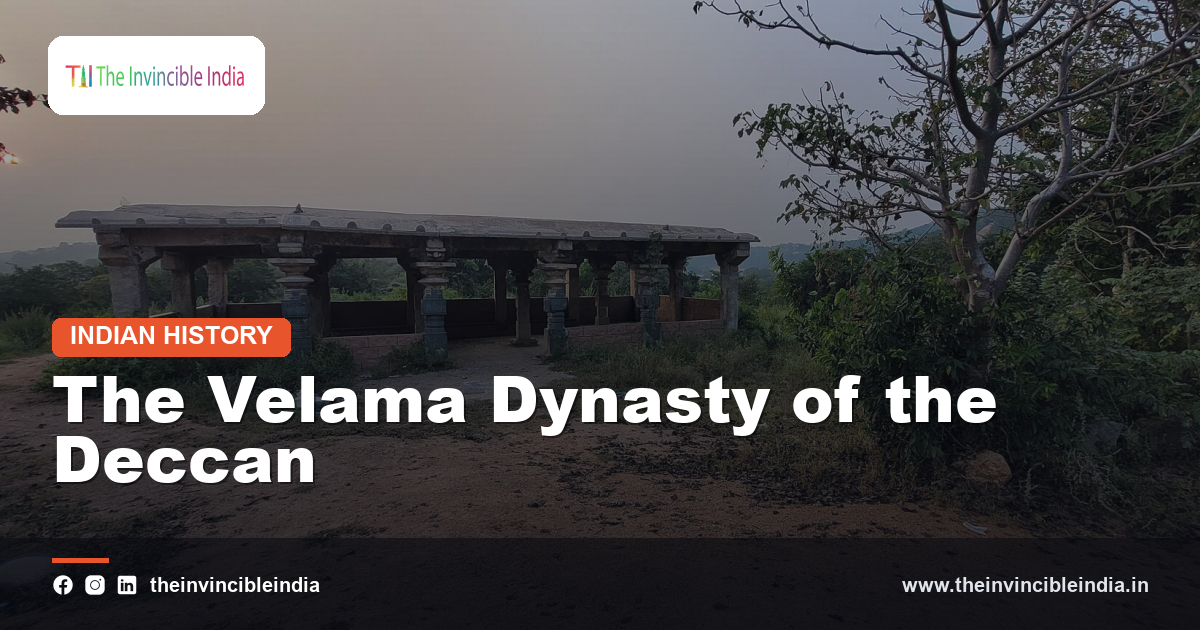
The Velama dynasty, also known as the Padmanayaka Velamas or the Recherla Velamas, refers to the warrior chiefs of the Telugu-speaking country who built the hill kingdoms of Rachakonda and Devarakonda in Telangana during the fourteenth and fifteenth centuries. Rising in the unsettled years after the fall of the Kakatiya kingdom, the Velama chiefs became one of the major regional powers of the Deccan, locked in long rivalry with the Reddi kings of coastal Andhra and with the Bahmani Sultanate. Their world was the same crowded Deccan arena that produced the Vijayanagara Empire. Because the surviving records are fragmentary, this guide keeps to broad terms where dates are uncertain.
Quick answer: The Velama dynasty was a line of Telugu warrior chiefs, often called the Padmanayaka or Recherla Velamas, who ruled much of Telangana from the hill forts of Rachakonda and Devarakonda in the fourteenth and fifteenth centuries. They rose after the collapse of the Kakatiyas and were known for their massive fortresses, their scholar-king Singabhupala, and their long rivalry with the Reddi kingdom and the Bahmani Sultanate. Their lands were later absorbed by the Bahmanis and the Qutb Shahis of Golconda.
Key Takeaways
- The Velamas, or Padmanayakas, were Telugu warrior chiefs who ruled Telangana from the forts of Rachakonda and Devarakonda.
- They rose in the fourteenth century after the fall of the Kakatiya kingdom of Warangal.
- The Recherla family is the best-known lineage among the Velama chiefs.
- They were long-standing rivals of the Reddi kingdom of coastal Andhra and of the Bahmani Sultanate.
- The scholar-king Sarvajna Singabhupala wrote the Sanskrit work Rasarnavasudhakara on poetics and drama.
- Their territory was eventually absorbed by the Bahmanis and later the Qutb Shahis of Golconda.
Read on for the history, culture, and legacy in detail.
Quick Facts
| Detail | Information |
|---|---|
| Dynasty | Velama dynasty (Padmanayaka / Recherla Velamas) |
| Region | Telangana, in the Deccan plateau |
| Main Capitals | Rachakonda and Devarakonda hill forts |
| Era | Fourteenth and fifteenth centuries, dates debated |
| Best-Known Ruler | Sarvajna Singabhupala, scholar-king |
| Chief Rivals | Reddi kingdom and Bahmani Sultanate |
| Community | Velama (Padmanayaka) warrior class |
| Successor Powers | Bahmani Sultanate and Qutb Shahis of Golconda |
Who Were the Velamas?
The Velamas were a Telugu warrior community whose chiefs rose to rule much of Telangana after the fall of the Kakatiyas. They are often called the Padmanayakas, a term describing a class of military leaders who had served the earlier kingdoms, and the ruling family is best known by its clan name, Recherla. Many Velama chiefs had held commands and forts under the Kakatiya kings of Warangal, so they already possessed soldiers, lands and local authority when central power collapsed. Using these resources, they carved out independent principalities in the hill country. Their identity blended the role of landed warrior with that of regional sovereign. The Velamas thus represent the way local military elites turned the crisis of the fourteenth century into an opportunity for kingship.
Where Did the Velama Dynasty Rule?
The Velama dynasty ruled over large parts of Telangana, the upland region of the Deccan that lies west of the coastal Andhra plains. Their heartland lay in the districts around present-day Nalgonda and the country south and east of Hyderabad, a landscape of rocky hills, rivers and fertile valleys. This terrain favoured the building of strong hill forts, which became the centres of Velama power. The region sat between the coastal Reddi kingdoms to the east and the Bahmani Sultanate to the north-west, making it a frontier zone. Control of its forts and trade routes was valuable to every neighbouring power. The geography of Telangana therefore shaped both the strength and the vulnerability of the Velama state.
How Did the Velamas Rise After the Kakatiyas?
The Velamas rose to power in the political vacuum created by the fall of the Kakatiya kingdom of Warangal in the early fourteenth century. When the Kakatiya ruler was defeated and the Delhi Sultanate briefly occupied the region, many Telugu chiefs, including Velama and other Nayaka leaders, organised local resistance and seized territory. Among them the Recherla Velama family established itself in the hill country, building the forts that would anchor its rule. The early generations consolidated control over villages, temples and garrisons. The exact sequence of events is reconstructed from inscriptions and later tradition, so historians describe it in general terms. The rise of the Velamas was thus part of the broader Telugu recovery that followed the Kakatiya collapse.
What Were Rachakonda and Devarakonda?
Rachakonda and Devarakonda were the two great hill forts that served as the capitals of the Velama dynasty, and the kingdom is often described through these twin centres. Rachakonda, in the Nalgonda region of Telangana, was a massive fortress built on rocky hills, and it became the principal seat of the senior Velama line. Devarakonda, also in the same region, was a second major stronghold held by a related branch of the family. Both forts combined natural rock defences with built ramparts, gateways, tanks and temples. From these heights the Velama chiefs controlled the surrounding country and resisted their rivals. The two forts remain the most striking physical reminders of Velama rule and are still visited for their dramatic setting.
Who Was Singama Nayaka, the Founder?
Singama Nayaka of the Recherla family is generally regarded as the founder of the Velama kingdom at Rachakonda, the chief who turned the family’s local authority into a ruling power. Tradition describes him as a warrior who established control over the hill country and laid the basis for the dynasty’s independence. His successors extended the kingdom and fortified its strongholds. Because the early records are limited, details of his reign are known in outline, and historians treat the traditional accounts with care. What is clear is that the dynasty traced its rise to this early leader and his immediate descendants. Singama Nayaka therefore occupies the place of founder in the dynasty’s memory, even where exact dates cannot be fixed.
Who Was Sarvajna Singabhupala?
Sarvajna Singabhupala was the most celebrated Velama ruler, a king remembered as much for learning as for war, who governed from Rachakonda. His title Sarvajna, meaning all-knowing, reflects his reputation as a patron of scholarship and as an author in his own right. He is credited with the Sanskrit treatise Rasarnavasudhakara, a work on dramaturgy and poetics that discusses rasa, the aesthetic sentiments evoked by literature and drama. He is also associated with other learned works and with a court that welcomed poets and scholars. Through his patronage, the Velama court became a centre of Sanskrit and Telugu culture. Singabhupala thus gives the dynasty its distinctive image as a house of scholar-kings in the medieval Deccan.
Why Did the Velamas Fight the Reddi Kingdom?
The Velamas fought the Reddi kingdom of coastal Andhra because the two powers competed for land, forts and prestige across the Telugu country. Both had risen after the Kakatiya fall, and their territories met along the uncertain frontier between upland Telangana and the coastal deltas. The rivalry involved repeated campaigns, sieges and shifting alliances, with each side sometimes seeking help from larger neighbours such as the Bahmanis or Vijayanagara. Chronicles and inscriptions record wars between Velama chiefs and Reddi kings, although the details of battles are often uncertain. The contest was one of the defining features of fourteenth and fifteenth century Andhra and Telangana. The Velama-Reddi rivalry therefore shaped the politics of the whole region.
How Did the Velamas Deal with the Bahmani Sultanate?
The Velamas dealt with the Bahmani Sultanate through a changing mixture of alliance and conflict, since the Bahmani kingdom was a powerful neighbour to the north-west. At times the Velama chiefs cooperated with the Bahmanis against the Reddis or against Vijayanagara, and at other times they resisted Bahmani expansion into Telangana. The Bahmani rulers, based first at Gulbarga and later at Bidar, sought control of the forts and revenues of the uplands. Diplomacy, tribute and marriage sometimes kept the peace, but warfare recurred. Over the long term, the growing strength of the Bahmanis pressed heavily on the Velama kingdoms. This relationship was decisive in the eventual decline of Velama independence.
How Were the Hill Forts Built and Defended?
The Velama hill forts were built to exploit natural rock formations, with stone walls, bastions, gateways and water tanks added to create nearly impregnable strongholds. At Rachakonda and Devarakonda, the fortifications follow the contours of the hills, climbing in tiers so that an attacker had to pass through successive defences. Inside the forts stood temples, residences, granaries and assembly halls, allowing a garrison to withstand a long siege. Rock-cut cisterns and tanks ensured a supply of water. This style of hill-fort building was a long Deccan tradition, seen also at Warangal, Golconda and later Maratha strongholds. The Velama forts remain impressive examples of the art, and their ruins show how defence shaped the region’s political life.
What Was the Velama Court and Administration Like?
The Velama court combined the roles of a military camp and a cultural centre, with the ruler governing through a body of ministers, commanders and local officers. The kingdom was organised around its forts, each of which controlled a surrounding territory of villages and temples. Revenue came mainly from agriculture, supplemented by levies on trade and craft, and land grants to Brahmins and temples were a regular feature of royal piety. Warrior chiefs and officials held lands in return for military service, a system common across the Deccan. The court also supported poets, scholars and religious teachers. This blend of fortress-based rule and cultural patronage defined the Velama political order throughout its existence.
How Did the Velamas Patronise Literature and Learning?
The Velamas patronised both Sanskrit and Telugu learning, and their court is remembered as a meeting place for poets and scholars. The outstanding example is the scholar-king Singabhupala, whose Sanskrit treatise on poetics placed the dynasty in the mainstream of Indian aesthetic thought. The court also encouraged Telugu literature during a formative period in the language’s growth, and several poets are linked in tradition with Velama patrons, though accounts vary. Royal grants supported temples, festivals and learned Brahmins, which sustained the intellectual life of the region. This patronage helped carry the literary culture of the Kakatiya age into later centuries. The Velama contribution to learning is one of the dynasty’s most enduring legacies.
What Religion and Temples Did the Velamas Support?
The Velama kings were patrons of Hindu temples and supported Shaiva and Vaishnava worship alike, in keeping with the mixed devotional life of the Telugu country. Their inscriptions record gifts of land and villages to temples, grants for worship and festivals, and the building or repair of shrines. Temples within and near the forts served both religious and community functions, drawing pilgrims, scholars and craftsmen. The kings presented themselves as protectors of dharma and as devotees of the gods, which strengthened their legitimacy. Local goddess and folk cults also flourished alongside the great temple traditions. Through this patronage the Velamas tied their rule to the sacred landscape of Telangana, a bond that reinforced their authority.
How Did the Velamas Relate to Vijayanagara?
The Velamas related to the Vijayanagara Empire through alternating cooperation and rivalry, since both were major powers in the Telugu-speaking Deccan. Vijayanagara kings sometimes intervened in Andhra and Telangana, and Velama chiefs at times allied with them against the Bahmanis or the Reddis. At other moments Vijayanagara forces pressed against Velama or Reddi territory in the contest for the Krishna and Tungabhadra country. The relationship reflected the larger three-cornered competition among Vijayanagara, the Bahmanis and the regional Telugu states. Historians reconstruct the sequence from inscriptions and chronicles, and many details remain debated. The Velama dealings with Vijayanagara show the dynasty as an active participant in the wider politics of the southern Deccan.
Why Did the Velama Kingdoms Decline?
The Velama kingdoms declined in the fifteenth century as the Bahmani Sultanate and other organised powers gradually overwhelmed them. Repeated wars with the Reddis, the Bahmanis and Vijayanagara drained the resources of the hill states, while rivalry between the Rachakonda and Devarakonda branches weakened their unity. In time the Bahmanis captured the key forts, and later the Qutb Shahi dynasty of Golconda extended its authority over Telangana. Some Velama families continued as local chiefs under the new rulers, preserving their status and memory. The exact sequence of conquests is known only in outline. The decline illustrates the difficulty that even strong regional dynasties faced against larger, better-organised states.
What Do the Sources Tell Us About the Velamas?
The history of the Velamas is reconstructed from inscriptions, Sanskrit and Telugu literary works, and later chronicles, each of which offers a partial view. Inscriptions record grants, victories and the names and titles of chiefs, while literary works such as Singabhupala’s treatise reveal the cultural life of the court. Persian chronicles of the Bahmani period add an outside perspective on the wars of Telangana. Historians compare these sources to build a coherent narrative, but gaps and disagreements remain, especially over dates and the order of rulers. Some details in later tradition may reflect praise or legend rather than strict fact. Read together, the sources create a layered and valuable picture of the dynasty.
The Velama Dynasty Today
The Velama dynasty is remembered today as one of the major Telugu powers of medieval Telangana, noted for its mighty forts, its scholar-king and its long struggle with the Reddis and Bahmanis. The ruins of Rachakonda and Devarakonda draw trekkers, photographers and students of history, and local communities keep alive the memory of the Padmanayaka chiefs. Scholars continue to study the inscriptions and manuscripts of the period to refine the dynasty’s chronology. For readers of Indian history, the Velama story offers a view of an age shaped by regional kingdoms rather than great empires. The Velama legacy remains a vivid thread in the cultural and political memory of the Telugu country.
Sources & Further Reading
- Archaeological Survey of India (asi.nic.in).
- Ministry of Culture, Government of India (indiaculture.gov.in).
- Department of Heritage Telangana, Government of Telangana (heritage.telangana.gov.in).
Frequently Asked Questions
Who were the Velamas?
The Velamas, also called the Padmanayakas, were Telugu warrior chiefs who ruled much of Telangana from the hill forts of Rachakonda and Devarakonda in the fourteenth and fifteenth centuries. They rose to power after the fall of the Kakatiya kingdom of Warangal.
Where did the Velama dynasty rule?
The Velama dynasty ruled over large parts of Telangana in the Deccan, with its heartland around present-day Nalgonda. Its two chief capitals were the hill forts of Rachakonda and Devarakonda.
Who was Sarvajna Singabhupala?
Sarvajna Singabhupala was the most famous Velama ruler, a scholar-king remembered for learning as well as warfare. He is credited with the Sanskrit treatise Rasarnavasudhakara on poetics and drama.
Who were the main rivals of the Velamas?
The main rivals of the Velamas were the Reddi kingdom of coastal Andhra and the Bahmani Sultanate of the Deccan. They also had a complex relationship of rivalry and alliance with the Vijayanagara Empire.
What happened to the Velama kingdoms?
The Velama kingdoms declined in the fifteenth century under pressure from the Bahmani Sultanate and other powers. Their forts were absorbed by the Bahmanis and later by the Qutb Shahis of Golconda, though some Velama families continued as local chiefs.
Why are Rachakonda and Devarakonda important?
Rachakonda and Devarakonda are important as the twin hill-fort capitals of the Velama dynasty. Their massive stone fortifications are the most striking surviving monuments of Velama rule in Telangana.


