

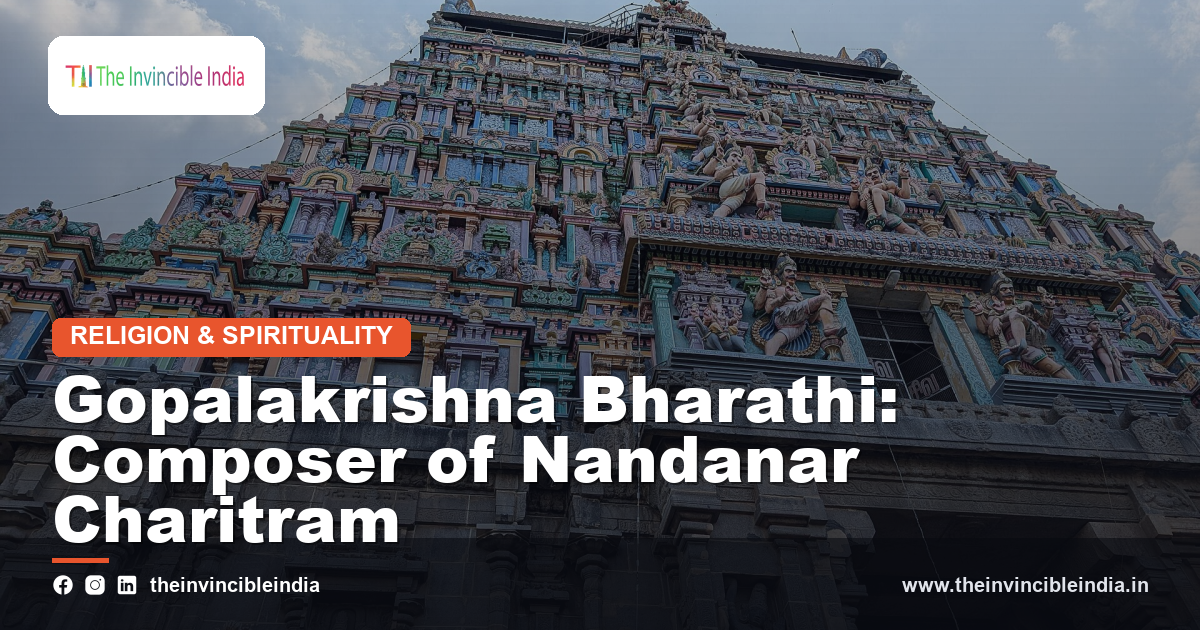
Gopalakrishna Bharathi was a nineteenth-century Tamil composer and devotee best known for the Nandanar Charitram, the musical story of the Nayanar saint Nandanar, and for songs in praise of Shiva, especially the Lord as Nataraja of Chidambaram. He is remembered as a master of Tamil devotional music whose compositions unite the beauty of melody with the depth of devotion and the telling of a sacred story. By tradition he is counted a contemporary of the great composer Tyagaraja, in an age rich in the music and devotion of the south. The Nandanar Charitram, his most celebrated work, tells of the devotee Nandanar, honoured among the Nayanars, the saints of Shiva, and his longing to behold the Lord. His life and work belong to the wider world of Shaivism, and though some details of his life come through tradition, his standing as a beloved Tamil composer-saint is firmly held.
Quick answer: Gopalakrishna Bharathi was a nineteenth-century Tamil composer and devotee best known for the Nandanar Charitram, the musical story of the Nayanar saint Nandanar, and for songs in praise of Shiva, especially the Lord as Nataraja of Chidambaram. By tradition a contemporary of Tyagaraja, he is remembered as a master of Tamil devotional music. His Nandanar Charitram tells of the devotee Nandanar and his longing to behold the Lord, and it remains a treasured work of the Tamil tradition.
Key Takeaways
- Gopalakrishna Bharathi was a nineteenth-century Tamil composer and devotee.
- He is best known for the Nandanar Charitram, the musical story of the Nayanar saint Nandanar.
- He composed many songs in praise of Shiva, especially the Lord as Nataraja of Chidambaram.
- By tradition he is counted a contemporary of the great composer Tyagaraja.
- The Nandanar Charitram tells of the devotee Nandanar and his longing to behold the Lord.
- He is remembered as a master of Tamil devotional music.
The sections below explain his life as told by tradition, his devotion to Shiva, the Nandanar Charitram, the saint Nandanar, his link with Chidambaram and his continuing place in Tamil music and devotion.
Quick Facts
| Detail | Information |
|---|---|
| Tradition | Tamil Shaiva devotion; Carnatic and Tamil music |
| Era | Nineteenth century, traditionally dated |
| Region | Tamil Nadu, the Kaveri delta and Chidambaram country |
| Language of works | Tamil |
| Principal work | Nandanar Charitram and songs on Shiva |
| Deity | Shiva, especially Nataraja of Chidambaram |
| Contemporary | Tyagaraja, by tradition |
| Principal shrine | Nataraja temple, Chidambaram |
Who Was Gopalakrishna Bharathi?
Gopalakrishna Bharathi was a nineteenth-century Tamil composer and devotee best known for the Nandanar Charitram, the musical story of the Nayanar saint Nandanar, and for songs in praise of Shiva. He is remembered as a master of Tamil devotional music whose compositions unite melody with devotion.
By tradition he is counted a contemporary of the great composer Tyagaraja, in an age rich in the music and devotion of the south. His devotion was directed above all to Shiva as Nataraja of Chidambaram, and his most celebrated work tells the sacred story of the devotee Nandanar and his longing to behold the Lord. Tradition pictures him as a saint-composer of deep devotion and gifted art. Although some details of his life come through devotional tradition rather than documented record, his standing as a beloved Tamil composer-saint, whose works are still sung, is firmly remembered.
What Is the Nandanar Charitram?
The Nandanar Charitram is the most celebrated work of Gopalakrishna Bharathi, a musical telling of the story of Nandanar, a devotee of Shiva honoured among the Nayanar saints, which unites song, story and devotion in the Tamil tradition. Its name means the story or life of Nandanar.
The work follows the devotee Nandanar in his longing to behold the Lord at the great temple, dwelling on his humble devotion, his trials and his final vision of the divine. Composed as a series of songs woven into a narrative, it is cherished both as devotional music and as a telling of a sacred story. The Nandanar Charitram has been sung, performed and loved in the Tamil country, carrying the devotion of the saint to many. Through this work Gopalakrishna Bharathi gave the Tamil tradition one of its most treasured musical stories, and it remains at the heart of his legacy.
Who Was Nandanar, the Subject of the Work?
Nandanar was a devotee of Shiva honoured among the Nayanars, the sixty-three saints of the Tamil Shaiva tradition, remembered for his humble and ardent devotion and his longing to behold the Lord at the great temple. His story is the subject of the Nandanar Charitram.
The Nayanars are the saints of the devotion to Shiva in the Tamil country, cherished for their love of the Lord and celebrated in the sacred songs of the tradition. Nandanar is remembered among them as a devotee of humble birth whose devotion was so pure that it overcame every obstacle, and whose story is treasured as an image of the power of true devotion. Gopalakrishna Bharathi took this beloved story as the subject of his great work. Understanding who Nandanar was helps a reader appreciate the devotion and the meaning that fill the Nandanar Charitram and that have made it so cherished.
Who Is Shiva as Nataraja of Chidambaram?
Shiva as Nataraja, the Lord of the Dance, worshipped at the great temple of Chidambaram in Tamil Nadu, is the form of the divine especially cherished in the devotion of Gopalakrishna Bharathi. The Nataraja and his shrine at Chidambaram lie at the heart of his songs.
Nataraja is the form of Shiva as the cosmic dancer, whose dance is understood to express the creation, preservation and dissolution of the universe and the grace that frees the soul. The temple of Chidambaram is revered as the foremost shrine of this form, one of the holiest places of the worship of Shiva in the Tamil country. Gopalakrishna Bharathi, as a devotee of the Nataraja, sang the praises of the Lord of the Dance and of his shrine. Understanding the place of Nataraja and Chidambaram helps a reader appreciate the devotion that fills the songs of the Tamil composer.
What Songs in Praise of Shiva Did He Compose?
Gopalakrishna Bharathi composed many songs in praise of Shiva, especially the Lord as Nataraja of Chidambaram, which are cherished in the Tamil devotional and musical tradition. These songs express his wholehearted devotion to the Lord of the Dance.
His songs dwell on the beauty, the grace and the mystery of Shiva, and on the devotion of the soul that longs to behold him. Composed in Tamil and set to melody, they unite the beauty of music with the depth of devotion, in keeping with the tradition of the Tamil composer-saints. These songs are sung in worship and in concert, keeping his devotion alive in the living music of the south. Because they belong to the living tradition and are performed within it, careful accounts describe them in general terms rather than claiming detailed knowledge of every song. Together they reflect his standing as a master of Tamil devotional music.
How Is He Linked to Tyagaraja?
Gopalakrishna Bharathi is counted by tradition as a contemporary of the great composer Tyagaraja, one of the most honoured figures of Carnatic music, in an age rich in the music and devotion of the south. This link places him within a flowering of devotional composition in the Tamil country.
Tyagaraja is remembered as a supreme composer of the Carnatic tradition, whose devotional songs are treasured across the south. The tradition that Gopalakrishna Bharathi was his contemporary reflects the richness of the age in which both lived, a time of great saint-composers. While Tyagaraja composed chiefly in Telugu and in devotion to Rama, Gopalakrishna Bharathi composed in Tamil and in devotion to Shiva, so that the two represent different streams of the devotional music of the period. Understanding this link helps a reader place Gopalakrishna Bharathi within the great age of devotional composition in southern India.
When and Where Did Gopalakrishna Bharathi Live?
Gopalakrishna Bharathi is traditionally dated to the nineteenth century, and because some of the sources are devotional it is wise to describe his era in general terms while holding to the broadly accepted period. He is associated with the Tamil country, especially the Kaveri delta and the region around Chidambaram.
His life unfolded in Tamil Nadu, in a land rich in the worship of Shiva and in the traditions of Tamil music, and his memory is bound to the shrines of the Lord, above all the Nataraja temple of Chidambaram. This region was a centre of the devotion and the music that his compositions express. Because parts of his biography are handed down through tradition, careful writers describe his region and general period with confidence while leaving finer details open, in keeping with the respectful caution that the devotional sources invite.
Why Is the Nandanar Charitram So Beloved?
The Nandanar Charitram is so beloved because it unites beautiful music with a moving sacred story of humble and ardent devotion, giving the Tamil tradition a work that touches both the heart and the ear. Its blend of song, story and devotion has made it one of the treasures of Tamil music.
The work tells of the devotee Nandanar, whose pure devotion overcame every obstacle and who longed to behold the Lord, and this story of devotion rewarded is cherished by the faithful. The songs that carry the story are loved for their melody and their feeling, and they have been sung and performed across the Tamil country. The Nandanar Charitram thus reaches listeners both as music and as a tale of devotion, and this union is the secret of its enduring appeal. For devotees and lovers of music alike, it is a beloved expression of the devotion to Shiva in the Tamil tradition.
How Does the Work Tell the Story of Devotion?
The Nandanar Charitram tells the story of devotion through a series of songs woven into a narrative, following the devotee Nandanar in his longing, his trials and his final vision of the Lord, so that the hearer is drawn into the movement of his devotion. The work makes the story of a saint live in music.
Through its songs the work expresses the humility, the longing and the trust of the devotee, and the grace of the Lord who answers true devotion. The telling moves from the devotee’s yearning to his final blessing, carrying the hearer through the stages of his spiritual journey. This weaving of story and song is a cherished form in the Tamil tradition, and Gopalakrishna Bharathi gave it one of its finest expressions. For devotees the work is not only music but a way of entering the story of a saint and of being moved to devotion by his example.
What Is the Place of the Nayanars in the Tradition?
The Nayanars are the sixty-three saints of the Tamil Shaiva tradition, devotees of Shiva honoured for their love of the Lord and celebrated in the sacred songs of the tradition, and Nandanar, the subject of Gopalakrishna Bharathi’s great work, is counted among them. Their devotion is a treasure of Tamil Shaivism.
The Nayanars came from every walk of life and are cherished for the depth and daring of their devotion to Shiva, which is held up as a model for the faithful. Their lives and devotion are celebrated in the Tamil Shaiva canon and in the worship of the tradition. By taking the story of the Nayanar Nandanar as the subject of his work, Gopalakrishna Bharathi drew on this rich tradition of devotion. Understanding the place of the Nayanars helps a reader appreciate the devotional background of the Nandanar Charitram and the saint whose story it tells.
How Have His Works Been Performed and Preserved?
The works of Gopalakrishna Bharathi, above all the Nandanar Charitram, have been performed and preserved as part of the living tradition of Tamil music and devotion, sung in concert, in dance-drama and in worship, and handed down through performance and collection. His compositions remain a cherished part of the music of the south.
The Nandanar Charitram in particular has been performed in music and in dramatic and dance forms, carrying its story and songs to many generations. His songs on Shiva are sung by musicians and loved by audiences and devotees. Their survival in living performance gives a clear witness to his gift, even where details of his life rest on tradition. Through this continuing life in music and performance, the devotion of Gopalakrishna Bharathi reaches new audiences, as part of the devotional and musical culture of the Tamil country.
How Is Gopalakrishna Bharathi Honoured in Tradition?
Gopalakrishna Bharathi is honoured in the Tamil devotional and musical tradition as a master composer and a devotee of Shiva, remembered above all for the Nandanar Charitram and for his songs on the Lord as Nataraja. His memory is cherished wherever his compositions are sung.
Devotees and musicians honour him for his gift of song, his devotion to Shiva and his telling of the sacred story of Nandanar. His works are performed in concert, in dance-drama and in worship, keeping his devotion and his art alive. His memory is bound to the shrines of Shiva, above all Chidambaram, and to the music of the Tamil country. The honour given to Gopalakrishna Bharathi reflects the love in which his compositions are held and keeps his memory present in the devotional and musical life of the south.
Why Does Gopalakrishna Bharathi Still Matter Today?
Gopalakrishna Bharathi still matters today because the Nandanar Charitram and his songs on Shiva remain a living and beloved part of Tamil music and devotion, performed in concert, dance-drama and worship. His compositions continue to carry the devotion to Shiva and the story of a saint to new generations.
For devotees and lovers of music he is a master composer whose work unites melody, story and devotion, and whose Nandanar Charitram is a treasure of the Tamil tradition. Scholars value his place in the devotional music of the south in the great age of the saint-composers. Careful readers honour the context of his tradition and treat the devotional accounts of his life in that spirit, while recognising the enduring beauty and devotion of the compositions that have made him one of the beloved composer-saints of the Tamil country.
Gopalakrishna Bharathi Today
Gopalakrishna Bharathi today is remembered as a master Tamil composer and devotee of Shiva, best known for the Nandanar Charitram and for his songs on the Lord as Nataraja of Chidambaram, and counted by tradition as a contemporary of Tyagaraja. His works remain a living presence in the music and devotion of the Tamil country.
Through his compositions he gave the Tamil tradition a beloved musical story of devotion and a treasury of songs on Shiva, uniting the beauty of music with the depth of faith. Some details of his life come through tradition, yet the living performance of the Nandanar Charitram and his songs gives a clear witness to his gift. His legacy endures as a reminder that devotion told in song can move the heart and carry the story of a saint to generation after generation.
Sources & Further Reading
- Ministry of Culture, Government of India (indiaculture.gov.in).
- Sangeet Natak Akademi general references on Tamil and Carnatic music (sangeetnatak.gov.in).
Frequently Asked Questions
Who was Gopalakrishna Bharathi?
Gopalakrishna Bharathi was a nineteenth-century Tamil composer and devotee best known for the Nandanar Charitram, the musical story of the Nayanar saint Nandanar, and for songs in praise of Shiva, especially the Lord as Nataraja of Chidambaram. By tradition he is counted a contemporary of Tyagaraja.
What is the Nandanar Charitram?
The Nandanar Charitram is the most celebrated work of Gopalakrishna Bharathi, a musical telling of the story of Nandanar, a devotee of Shiva honoured among the Nayanars. It unites song, story and devotion, following Nandanar in his longing to behold the Lord, and it remains a treasure of Tamil music.
Who was Nandanar?
Nandanar was a devotee of Shiva honoured among the Nayanars, the sixty-three saints of the Tamil Shaiva tradition, remembered for his humble and ardent devotion and his longing to behold the Lord at the great temple. His story is the subject of Gopalakrishna Bharathi’s Nandanar Charitram.
Which deity did Gopalakrishna Bharathi worship?
Gopalakrishna Bharathi was a devotee of Shiva, especially the Lord as Nataraja, the cosmic dancer worshipped at the great temple of Chidambaram in Tamil Nadu. Many of his songs praise the Nataraja and his shrine, which lie at the heart of his devotion.
Was Gopalakrishna Bharathi a contemporary of Tyagaraja?
By tradition Gopalakrishna Bharathi is counted a contemporary of the great composer Tyagaraja, in a rich age of devotional music in the south. While Tyagaraja composed chiefly in Telugu in devotion to Rama, Gopalakrishna Bharathi composed in Tamil in devotion to Shiva.
Why is Gopalakrishna Bharathi important?
Gopalakrishna Bharathi is important because his Nandanar Charitram and his songs on Shiva are treasured works of Tamil devotional music, performed in concert, dance-drama and worship. He is honoured as a master composer-saint who united melody, story and devotion in the tradition of the south.


